 AI Tools Review Editorial Team
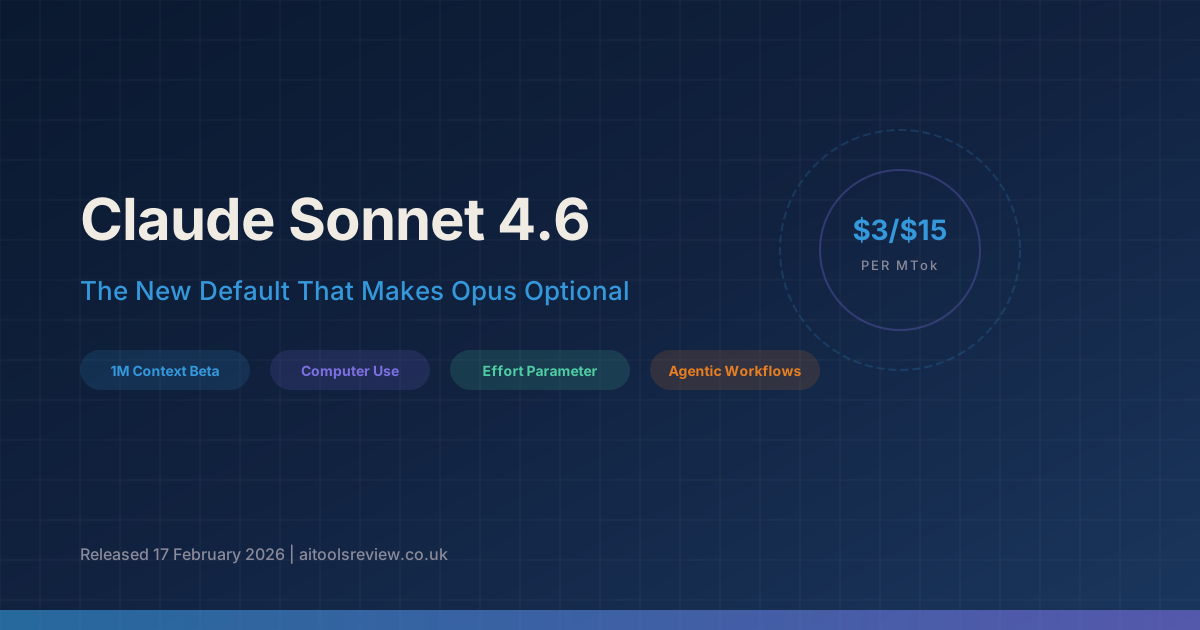
Anthropic released Claude Sonnet 4.6 on 17 February 2026, and within hours it became the default model on claude.ai. According to Anthropic's own system card, it is the company's most capable Sonnet model yet, with upgrades spanning coding, computer use, long-context reasoning, agent planning, knowledge work and design.
The pitch is straightforward: performance that used to require paying the Opus premium is now available at the balanced Sonnet price point. Anthropic reports that developers preferred Sonnet 4.6 over Sonnet 4.5 roughly 70% of the time in head-to-head testing, and even preferred it over the larger Opus 4.5 (released November 2025) about 59% of the time, citing better instruction-following and fewer hallucinated "success" claims on coding tasks.
All About AI covers Sonnet 4.6 in this video.
Sonnet's Place in the Claude Lineage
Sonnet has always been the balanced middle tier of the Claude family: faster and cheaper than Opus, more capable than the entry-level Haiku models, and historically the model most developers reached for by default once Claude 3.5 Sonnet established that a mid-tier model could still lead on coding benchmarks. Each subsequent Sonnet release narrowed the gap to that generation's Opus a little further, and Sonnet 4.6 continues that trend rather than breaking from it.
What is different this time, according to Anthropic, is how small the remaining gap has become: on several of the benchmarks below, Sonnet 4.6 lands within a couple of percentage points of Opus 4.6 despite costing roughly 1.7x less per million tokens. That combination — an Opus-adjacent ceiling at a Sonnet floor price — is the core reason Anthropic made it the default model for Free and Pro users rather than treating it as a budget alternative.
The 1M Token Context Window Comes to Sonnet
Like Opus 4.6, Sonnet 4.6 gets a 1M-token context window, currently shipped in beta. This lets users feed the model entire document libraries or multi-file codebases in a single request, and it is paired with a new context compaction feature (also in beta) that automatically summarises older parts of a long conversation to extend the effectively usable context further still.
Memory retrieval performance
On MRCR v2 (8 needles at 1M tokens), Sonnet 4.6 scores 65% Mean Match Ratio, a roughly 3.5x improvement over Sonnet 4.5's 18.5%. It still sits behind Opus 4.6's 76% on the same test, but it makes long-context reasoning genuinely usable at the Sonnet price point rather than a niche, Opus-only capability.
Adaptive Thinking & Effort Levels
Sonnet 4.6 inherits the adaptive thinking system Anthropic introduced with Opus 4.6, replacing the older manual budget_tokens approach. Instead of a developer guessing how many reasoning tokens a task needs up front, the model dynamically decides how much internal deliberation to spend based on the complexity of the request in front of it.
Developers retain control through configurable effort levels, ranging from Low (fast, cheap, minimal deliberation, suited to routine classification or short-form generation) through to Max (extended reasoning for multi-step agentic plans, complex debugging, or long-document synthesis). In practice this means the same API call pattern used for Opus 4.6 largely carries over to Sonnet 4.6, which simplifies building applications that route between the two models based on task difficulty rather than rewriting prompts for each.
Why this matters for cost control
Because thinking depth is adaptive rather than fixed, simple requests are not taxed with unnecessary reasoning tokens, and hard requests are not artificially capped. For high-volume production workloads, this generally lowers effective cost per resolved task compared with a fixed thinking budget tuned for the worst case.
Computer Use: Best-in-Class Automation
Anthropic's own benchmarking positions Sonnet 4.6 as its strongest computer-use model to date. It scores 72.5% on OSWorld-Verified, up sharply from Sonnet 4.5's 61.4% and now within a hair of Opus 4.6's 72.7% on the same benchmark — a striking result given Sonnet's much lower price. In practice this shows up as more reliable navigation of complex spreadsheets, multi-step web forms, and workflows that span several browser tabs.
Prompt Injection Resistance
This matters most for security. Anthropic's system card reports that, in adversarial computer-use testing without extra safeguards, prompt-injection attacks succeeded in just 1.29% of scenarios (0.29% of individual attempts) against Sonnet 4.6, down from 49.36% of scenarios against Sonnet 4.5 — roughly a 38x reduction. With Anthropic's safeguards enabled, the attack success rate falls further, to 0.51% of scenarios and 0.08% of attempts. That is a material improvement for anyone deploying browsing or desktop-automation agents against untrusted web content.
Agentic Coding Performance
Coding is where Sonnet 4.6's gains are most visible day to day. On SWE-bench Verified — real, human-curated GitHub issues, graded by whether the proposed fix passes the repository's own tests — Sonnet 4.6 scores 79.6%, up from Sonnet 4.5's 77.2% and closing in on Opus 4.6's 80.8%. On Terminal-Bench 2.0, which evaluates multi-step, tool-using agentic tasks in a real terminal environment, it scores 59.1%, a large jump from Sonnet 4.5's 51.0%.
Anthropic also reports improvements that don't show up neatly in a single benchmark number: better code consolidation across multi-file changes, fewer false "task complete" claims when a fix hasn't actually resolved the underlying issue, and steadier behaviour across long agentic sessions in Claude Code. For a closer look at how the model handles long-form technical and creative writing specifically, see our companion piece on Sonnet 4.6's writing benchmarks.
Benchmarks: Closing the Gap With Opus
The table below collects the headline benchmark figures Anthropic and independent trackers have published for Sonnet 4.6 against its immediate predecessor and Opus 4.6. Treat any single benchmark as one data point rather than the whole picture — real workloads rarely map cleanly onto a single leaderboard.
| Benchmark | Sonnet 4.5 | Sonnet 4.6 | Opus 4.6 |
|---|---|---|---|
| SWE-bench Verified (coding) | 77.2% | 79.6% | 80.8% |
| Terminal-Bench 2.0 (agentic tasks) | 51.0% | 59.1% | - |
| OSWorld-Verified (computer use) | 61.4% | 72.5% | 72.7% |
| MRCR v2, 8 needles at 1M (long context) | 18.5% | 65% | 76% |
Sources: Anthropic's Claude Sonnet 4.6 system card (17 February 2026) and Claude Opus 4.6 system card, cross-checked against independent trackers including Artificial Analysis. Anthropic's public materials compare Sonnet 4.6 primarily against its own model lineage rather than publishing head-to-head scores against contemporaneous competitor models such as OpenAI's GPT-5.3 Codex; see our GPT-5.3 Codex vs Claude Opus 4.6 comparison for that side of the picture.
Real-World Deployments vs Benchmarks
Public leaderboards are useful but narrow, so it's worth looking at what Anthropic's launch partners reported from actual production use. Enterprise document-search platform Box reported that Sonnet 4.6 outperformed Sonnet 4.5 on heavy reasoning question-answering by roughly 15 percentage points on its own internal benchmark. Insurance-focused deployment partner Pace reported a 94% score on its own insurance-specific evaluation set. Anthropic also cited strong results on Vending-Bench Arena, a simulated long-horizon agentic economics benchmark, where Sonnet 4.6 finished well ahead of competing models on strategic resource-allocation decisions.
These are partner-reported, task-specific figures rather than independently reproduced academic benchmarks, so treat them as directional evidence of real-world gains alongside the standardised benchmarks above, not as a substitute for testing Sonnet 4.6 against your own workload.
System Card: Safety & Alignment
Sonnet 4.6 is deployed with ASL-3 safeguards under Anthropic's Responsible Scaling Policy, the same standard applied to Anthropic's other current frontier models. Anthropic's system card describes the model as having "a broadly warm, honest, prosocial, and at times funny character, very strong safety behaviours, and no signs of major concerns around high-stakes forms of misalignment."
Harmlessness on adversarial requests
- • Overall harmless-response rate: 99.38% (Sonnet 4.5: 97.89%)
- • Higher-difficulty adversarial cases: 99.40% (Sonnet 4.5: 98.40%)
- • Malicious agentic-coding requests: 100.0% refusal on the relevant evaluation set
Over-refusal on benign requests
- • Straightforward benign prompts: 0.41% refused (Sonnet 4.5: 0.08%)
- • Harder, ambiguous benign prompts: 0.18% refused (Sonnet 4.5: 8.50%) — roughly a 47-fold reduction in false refusals on tricky-but-legitimate requests
In the interest of not overstating what's public: Anthropic's announcement materials we reviewed did not publish detailed cyber, biological, or autonomous-replication evaluation figures specific to Sonnet 4.6 in the way earlier Claude system cards sometimes do for frontier models. If you need that level of detail for a compliance or procurement review, consult Anthropic's full published system card directly rather than relying on this summary.
Pricing & Availability
Sonnet 4.6 pricing is unchanged from Sonnet 4.5: $3 / £2.40 per million input tokens and $15 / £12 per million output tokens. That is roughly 1.7x cheaper than Opus 4.6's standard $5/$25 per million tokens, without Opus's separate Fast Mode premium tier.
The model is available on claude.ai, in Claude Cowork, in Claude Code, via the Claude API under the model ID claude-sonnet-4-6, and through the major third-party cloud platforms that host Claude models. It is now the default model for Free and Pro plan users on claude.ai.
When to Use Sonnet 4.6 vs Opus 4.6
Use Sonnet 4.6 for:
- • The bulk of daily coding tasks
- • High-volume data processing
- • Web & desktop automation agents
- • Routine knowledge work
Reserve Opus 4.6 for:
- • Complex, zero-error architecture work
- • Extended, longer-horizon agentic sessions
- • Deep disciplinary research
- • High-stakes infrastructure logic
Pricing advantage: Sonnet 4.6 is roughly 1.7x cheaper per million tokens than Opus 4.6, with faster typical response times, making it the sensible default for the vast majority of production workloads.
How It Compares to Opus 4.6 and the Rest of the Field
Against its own stablemate, Sonnet 4.6 has narrowed the practical gap to Opus 4.6 substantially compared with the Sonnet 4.5 generation: within a couple of points on SWE-bench Verified (79.6% vs 80.8%) and OSWorld-Verified (72.5% vs 72.7%), while remaining further behind on the most extreme long-context test, MRCR v2 (65% vs 76%). For most teams, that means Sonnet 4.6 now covers workloads that previously justified paying the Opus premium.
Against the wider market, Sonnet 4.6 launched into a field that included OpenAI's GPT-5.3 Codex and Google's Gemini lineup as the era's other frontier options. Anthropic's own published materials focus their comparisons on the Claude lineage rather than head-to-head scores against those competitors, so we won't repeat unverified claims here; our dedicated GPT-5.3 Codex vs Opus 4.6 comparison covers that matchup at the Opus tier in more depth, and the general pattern — Anthropic leading on agentic reliability and safety behaviour, with OpenAI and Google trading blows on raw benchmark scores and price — held for the Sonnet tier too, based on independent trackers.
Limitations & Honest Caveats
- The 1M-token context window and context compaction are both still labelled beta by Anthropic; expect rough edges in edge cases rather than a fully mature feature.
- Over-refusal on ambiguous benign requests, while dramatically improved, is not zero (0.41% on straightforward prompts) — some legitimate requests will still occasionally be declined.
- Anthropic's own public materials do not include the level of published cyber/bio/autonomy evaluation detail that appears in some other frontier system cards, so treat that gap honestly rather than assuming coverage that isn't published.
- For the very hardest, longest-horizon reasoning and architecture work, Opus 4.6 still measurably outperforms Sonnet 4.6 — the gap has narrowed, not closed.
Bottom Line
Claude Sonnet 4.6 is the clearest evidence yet that Anthropic's mid-tier model is no longer a compromise pick. Real, sourced benchmark gains in coding, computer use and long-context handling — alongside a genuinely stronger safety profile against prompt injection and over-refusal — make it the sensible default for most day-to-day work, at unchanged pricing. Opus 4.6 remains worth the premium for the hardest problems, and its successor is already covered in our Claude Opus 4.7 review; if you're tracking where the Sonnet line goes next, our Claude Sonnet 5 review picks up the story.
Last updated 12 September 2026 with sourced benchmark and system-card figures from Anthropic's official Claude Sonnet 4.6 announcement and system card.
Get the free guide: Claude vs ChatGPT, Gemini & Grok
A 20-page playbook covering everything you need to choose and use the big four AI models in 2026, full cost and feature comparisons, what each is best (and worst) at, and how-tos for images, vectors, building a website, Claude Code and more.