
 AI Tools Review Editorial Team
What is DeepSeek V3?
DeepSeek V3 is an open-source large language model with 671 billion total parameters using a Mixture-of-Experts architecture. Only 37 billion parameters activate per inference, making it remarkably efficient. Trained for approximately $5.5 million, a fraction of comparable models, it delivers frontier-level performance in reasoning, coding, and mathematics while being freely available for commercial use.
The open-source AI community has long been chasing the "frontier" performance levels of OpenAI and Anthropic. With DeepSeek V3, that gap has narrowed significantly, if not vanished entirely in certain benchmarks.
Technical Prowess
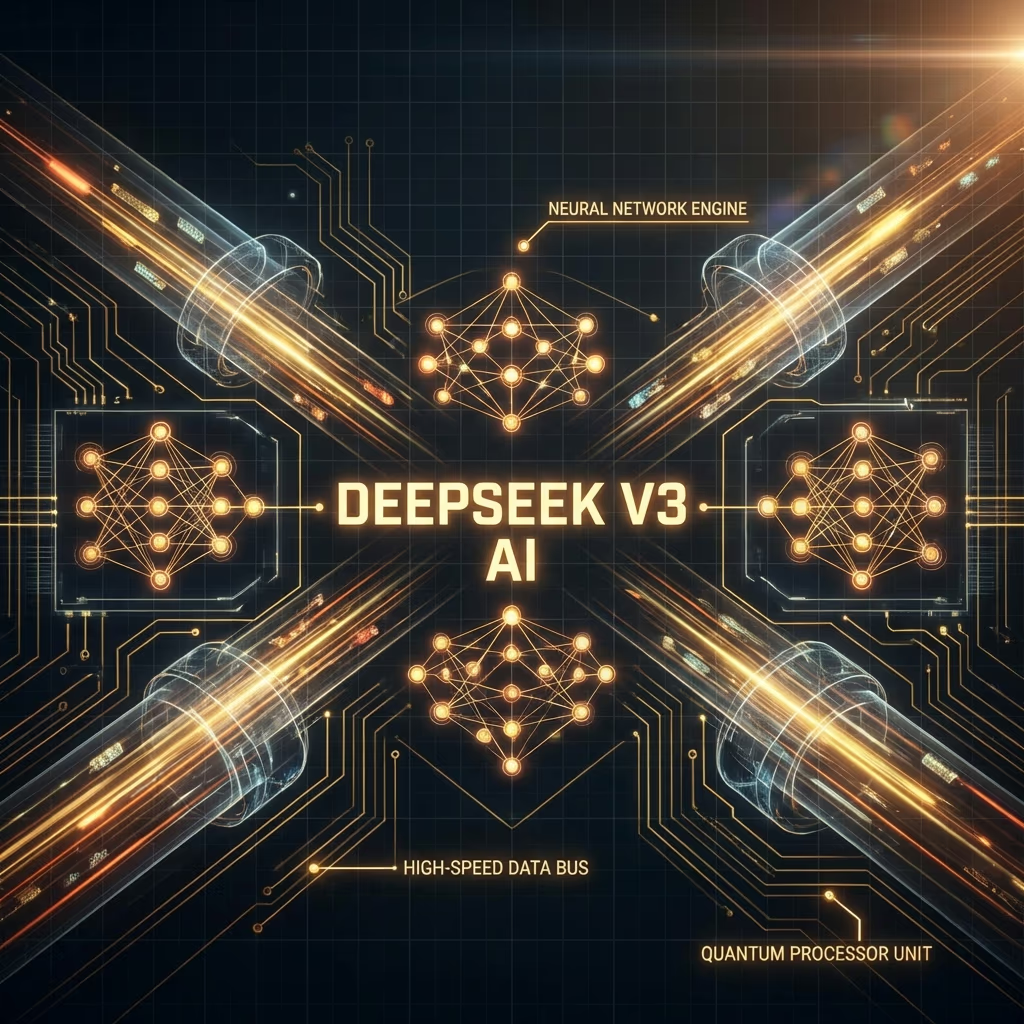
DeepSeek V3 utilises a sophisticated Mixture-of-Experts (MoE) architecture with over 671 billion parameters, of which only 37 billion are active during any single inference. This makes the model incredibly efficient, offering GPT-4 level intelligence with a much smaller memory footprint and lower computational cost.
What sets V3 apart from previous open-source models is the combination of scale, efficiency, and training innovation. It's not just a bigger model, it's a smarter one, trained with techniques that extract more capability per dollar of compute than any predecessor.
The MoE Architecture Deep Dive
The Mixture-of-Experts design is the key to V3's efficiency. Here's how it works at a high level:
- Expert Networks: The model contains hundreds of specialised sub-networks ("experts"), each trained to handle different types of information and reasoning patterns.
- Router Network: For each input token, a lightweight router network decides which experts are most relevant and activates only those experts (typically 8 out of 256).
- Sparse Activation: Because only a fraction of experts activate per token, the computational cost per inference is dramatically lower than a dense model of equivalent total parameter count.
- Load Balancing: DeepSeek V3 uses an auxiliary-loss-free load balancing strategy to ensure experts are utilised evenly, preventing some experts from being overloaded while others sit idle.
This architecture means V3 effectively has the "knowledge" of a 671B parameter model but the inference cost of a ~37B parameter model. The trade-off is complexity: MoE models are harder to train, harder to fine-tune, and require more memory to load (even if the active parameters are small).
Training Efficiency & Cost
Perhaps V3's most remarkable achievement is its training cost. DeepSeek reported spending approximately $5.5 million on the training run, a figure that sent shockwaves through the industry. For context, GPT-4's training was estimated to cost over $100 million, and Claude 3 Opus likely cost a similar order of magnitude.
Several innovations enabled this cost efficiency:
- FP8 Mixed-Precision Training: V3 was one of the first production models trained using FP8 (8-bit floating point) for portions of the computation, reducing memory bandwidth requirements and enabling higher GPU utilisation.
- Multi-Token Prediction (MTP): Instead of predicting one token at a time during training, V3 predicts multiple future tokens simultaneously. This provides richer training signal per forward pass, improving sample efficiency.
- Efficient Data Pipeline: DeepSeek invested heavily in data quality and deduplication, ensuring the model trained on cleaner data and required fewer total tokens to reach its performance level.
- Hardware Optimisation: Training on NVIDIA H800 GPUs (the export-restricted variant available in China), DeepSeek squeezed maximum performance through custom CUDA kernels and pipeline parallelism strategies.
Benchmark Performance
| Benchmark | DeepSeek V3 | GPT-4o | Claude 3.5 Sonnet |
|---|---|---|---|
| MMLU | 88.5% | 88.7% | 88.3% |
| MATH (500) | 90.2% | 76.6% | 78.3% |
| HumanEval | 82.6% | 90.2% | 92.0% |
| GPQA (Diamond) | 59.1% | 53.6% | 65.0% |
Note: Benchmark figures are from DeepSeek's published results and independent evaluations. Performance can vary depending on specific task formatting and evaluation methodology.
The Open-Source Advantage
Unlike its closed-source rivals, DeepSeek V3's weights and architecture details are publicly accessible. For UK researchers and security-conscious firms, this transparency is invaluable. It allows for deep auditing and custom fine-tuning that is simply not possible with proprietary "black box" models.
The practical benefits of open weights include:
- Security Auditing: Organisations can inspect the model for biases, vulnerabilities, or undesirable behaviours before deployment.
- Custom Fine-Tuning: Companies can train the model on their own data to specialise it for specific domains without sharing that data with any third party.
- On-Premises Deployment: The model can run entirely within an organisation's infrastructure, ensuring no data ever leaves their network.
- Cost Control: After the initial hardware investment, there are no per-token API costs, critical for high-volume applications.
- Research Reproducibility: Academics can study, modify, and build upon the model, accelerating the pace of AI research.
Coding & Mathematical Performance
In our research, DeepSeek V3 consistently rivalled, and occasionally beat, Claude 3.5 Sonnet in Python coding tasks and competitive mathematics. Its ability to handle complex "chain of thought" reasoning makes it an ideal backend for automated engineering and scientific research tools.
The model shows particular strength in:
- Algorithm Implementation: Clean, efficient implementations of standard algorithms and data structures.
- Debugging: Identifying and explaining bugs in provided code, with accurate root cause analysis.
- Mathematical Proofs: Step-by-step mathematical reasoning with proper notation and logical flow.
- Data Analysis: Writing pandas/numpy code for data manipulation and statistical analysis.
Running DeepSeek V3 Locally
One of the most asked questions about V3 is whether it can run on consumer hardware. The answer depends heavily on your willingness to trade quality for accessibility:
| Configuration | Hardware Required | Quality Impact |
|---|---|---|
| Full (FP16) | 8x NVIDIA H100 (640GB VRAM) | Maximum quality, production-grade |
| 8-bit Quantised | 4x A100 80GB (320GB VRAM) | Minimal quality loss, suitable for most applications |
| 4-bit Quantised | 2x A100 80GB or Mac Studio M2 Ultra (192GB) | Noticeable quality reduction on complex reasoning tasks |
| 2-bit Quantised | Mac Studio M2 Ultra (128GB) or single A100 | Significant quality loss, experimental only |
Apple's unified memory architecture has made Macs surprisingly capable for running large models. A Mac Studio with 192GB of unified memory can run the 4-bit quantised version at usable speeds, making it a viable option for developers who want local AI without a data centre.
Impact on AI Pricing
V3's combination of low training cost and competitive performance has put significant downward pressure on API pricing across the industry. When a model that cost $5.5 million to train performs comparably to one that cost $100+ million, it forces a reckoning about how AI is priced.
The ripple effects have been immediate. API prices across the industry have fallen significantly since V3's release, and OpenAI, Anthropic, and Google have all adjusted their pricing structures in response. For UK businesses budgeting for AI integration, this is unambiguously good news, the same capabilities cost a fraction of what they did a year ago.
DeepSeek: Company Background
DeepSeek is a research lab backed by High-Flyer, a Chinese quantitative trading firm. This unusual parentage gives DeepSeek a distinctive character, it operates more like a research lab than a product company, prioritising publications and open-source releases over commercial API revenue.
The firm's origins in quantitative finance are evident in V3's mathematical capabilities. The same rigour that drives algorithmic trading, where a fraction of a percentage point matters, informs their approach to model training efficiency and benchmark optimisation.
The Verdict
DeepSeek V3 is a game-changer. It democratises access to world-class reasoning capabilities and proves that open-source models can indeed stand shoulder-to-shoulder with the tech giants. For anyone building AI-powered applications today, DeepSeek V3 should be at the top of your consideration list.
The model's significance extends beyond its own capabilities. It has demonstrated that frontier AI performance is achievable at dramatically lower cost than previously assumed, that open-source models can compete with proprietary ones, and that the MoE architecture is the future of efficient inference. These lessons will shape the AI industry for years to come.
Review Methodology
Note: This review is based on extensive research of publicly available information, user reports, official documentation, and expert analyses. We have compiled insights from multiple sources to provide a comprehensive look at DeepSeek V3. Benchmark figures are sourced from DeepSeek's published paper, LMSYS Chatbot Arena, and independent evaluation runs.