 AI Tools Review Editorial Team
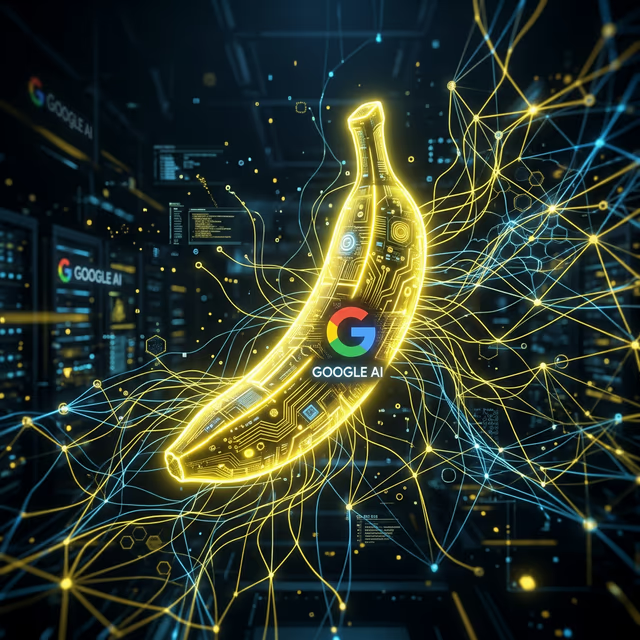
Rumours had been circulating for weeks about a secret Google project, but nobody quite predicted the release of a model codenamed "Nano Banana 2." Delivering an astonishing leap in multimodality and reasoning efficiency, the model has left the AI community stunned and sent competitors scrambling.
WorldofAI covers Nano Banana 2 in this video.
The Mystery of Nano Banana 2
Google has a history of cryptic internal codenames, but Nano Banana 2 leaked unexpectedly into the public domain through an API endpoint briefly exposed on Google AI Studio. What researchers found was a model that didn't just iterate on Gemini's capabilities, but seemingly rewrote the rules of how tokens are generated.
As detailed in Matthew Berman's breakdown above, Nano Banana 2 introduces entirely new paradigms for how AI models process information. By shifting away from standard autoregressive point-by-point token generation, it enables something fundamentally more organic and hyper-fast.
Breaking the Latency Wall
The most striking feature of Nano Banana 2 is its raw speed. Traditional LLMs hit a "latency wall", a physical limitation on how quickly tokens can be served based on memory bandwidth and compute orchestration. Nano Banana 2 bypasses this through a novel "speculative block-processing" architecture.
This means the model can generate logical blocks of thought concurrently rather than sequentially. For developers building real-time applications, this drops time-to-first-token (TTFT) to near-zero and pushes total generation speeds into the thousands of tokens per second.
Implications for AI Agents
The true power of Nano Banana 2 isn't in generating text faster; it's in enabling real-time autonomous agents. When an AI can reason, plan, and execute within milliseconds, the barrier to seamless human-computer interaction vanishes. The implications for robotic control interfaces, real-time speech translation, and instantaneous multi-agent collaboration are staggering.
From Leak to Launch: The Official Story
The mystery did not stay a mystery for long. On 26 February 2026, Google officially launched Nano Banana 2, and the confirmed product turned out to be an image generation model: the commercial name for Gemini 3.1 Flash Image. The playful codename that had fuelled weeks of speculation was retained for the public release, continuing the branding Google established with the original Nano Banana in 2025.
That launch clarified where the model sits in Google's strategy. Rather than a secret general-purpose reasoning engine, Nano Banana 2 is Google's answer to a very practical problem: how to make high-quality image generation fast enough, and cheap enough, to become the default experience across its consumer products. The speed obsession that dominated early speculation was real; it was simply aimed at pixels rather than prose.
The episode is a useful case study in how Google now ships models. Cryptic codenames surface through developer tooling, the community reverse-engineers what it can, and by the time the official blog post arrives the launch feels less like an announcement and more like a confirmation. We saw a similar pattern across Google's wider 2026 AI wave.
Capabilities and Image Quality
According to launch coverage, Nano Banana 2 produces more realistic images than its predecessor, with more vibrant lighting, richer textures and sharper detail. It maintains character consistency for up to five characters within a scene and can preserve the fidelity of up to fourteen distinct objects in a single workflow, a capability aimed squarely at storyboarding, product photography and marketing use cases.
Output resolution spans from 512px up to 4K across a range of aspect ratios. The headline trade-off against the higher-end Nano Banana Pro is speed: Google positions Nano Banana 2 as retaining much of the Pro model's high-fidelity character whilst generating images noticeably faster, which is precisely why it can serve as a default model at consumer scale.
For a broader look at how models like this fit into modern creative workflows, see our guide to AI image generation tools.
Where You Can Use Nano Banana 2
Distribution is arguably the real story. Nano Banana 2 became the default image model across all Gemini app modes (Fast, Thinking and Pro), the default for Google's Flow video editing tool, and the default in Google Search via Lens and AI Mode across 141 countries. Few model launches in recent memory have gone from announcement to default-for-billions quite this quickly.
Developers can access it through the Gemini API, the Gemini CLI, Vertex AI and Google AI Studio, as well as through Google's Antigravity development environment. Google AI Pro and Ultra subscribers can still manually select Nano Banana Pro for specialised, high-fidelity tasks, but the everyday path now runs through Nano Banana 2.
The Nano Banana Family Explained
The naming can be genuinely confusing, so here is the lineage. The original Nano Banana was the commercial name for Gemini 2.5 Flash Image, the 2025 model that made the codename famous. Nano Banana Pro, launched on 20 November 2025, is Gemini 3 Pro Image, the high-fidelity flagship. Nano Banana 2 is Gemini 3.1 Flash Image, which Google describes as the "generalist workhorse" of the family.
In other words, the family follows the same tiering logic as Google's text models: a Pro tier for maximum quality, a Flash tier for the mainstream, and, as of mid-2026, a Lite tier for raw throughput. Readers tracking the underlying Gemini platform can find our full analysis in the Gemini 3.1 Pro deep dive.
Nano Banana 2 Lite and the Race to Zero Latency
The latency theme returned emphatically on 30 June 2026, when Google announced Nano Banana 2 Lite (model name gemini-3.1-flash-lite-image). Google says the Lite model can deliver text-to-image outputs in around four seconds and prices it at roughly $0.034 per 1K-resolution image, optimising explicitly for high throughput, speed and scale.
Despite the speed focus, Google claims the Lite model retains strong prompt adherence, character consistency and legible text rendering. It launched across Google AI Studio, the Gemini API and the Gemini Enterprise Agent Platform, with a rollout to Google Search's AI Mode, the Gemini app, NotebookLM and Google Photos.
The same announcement introduced Gemini Omni Flash, a public-preview multimodal model for video generation and conversational editing, priced at $0.10 per second of video output and initially capped at ten-second clips. Taken together, the message is clear: Google believes the next competitive frontier in generative media is not peak quality but cost-per-output and time-to-result.
Practical Guidance for Developers and Creators
If you are choosing between the tiers, the practical rule of thumb is straightforward. Use Nano Banana Pro when a single hero image justifies extra wait time and cost, such as final marketing assets or print work. Use Nano Banana 2 for everyday generation where quality still matters, including client concepts, social content and iterative design. Reserve Nano Banana 2 Lite for high-volume pipelines: thumbnail farms, A/B creative testing, programmatic personalisation and any workflow where you generate hundreds of candidates and keep a handful.
For developers, the latency difference changes application architecture, not just user experience. A four-second generation loop makes interactive, conversational image editing viable inside a chat interface, whereas a twenty-plus-second loop pushes you towards queued, asynchronous jobs. Budget-wise, per-image pricing in the low pennies means the constraint shifts from cost to curation: the hard problem becomes selecting and quality-controlling outputs, not affording them.
Our original speculation about agentic implications also holds up in a modified form. Fast, cheap image generation is exactly what autonomous agents need to produce visual artefacts mid-task, whether that is a UI mock-up, a diagram or a product variant, without stalling the surrounding workflow. The latency wall did fall in 2026; it just fell for images first.
Last updated: 15 July 2026. Launch details, capabilities and availability were verified against TechCrunch's launch report and Google's Nano Banana 2 Lite and Gemini Omni Flash announcement. The opening sections preserve this article's original March 2026 coverage of the pre-launch leak and speculation.