 AI Tools Review Editorial Team
Quick Answer:
The Agentic Future of Work marks a comprehensive shift from reactive AI chatbots to proactive, autonomous digital colleagues. Modern AI agents (like Claude Opus 4.6 and OpenClaw) can now manage entire workflows, conduct research, write code, interact with web tools independently, and self-correct when encountering errors. This offers unimaginable productivity gains for businesses that integrate them as core operational assets.
Beyond the Chatbox: The Evolution of Interaction
The initial wave of AI adoption, heavily popularised by ChatGPT in 2022, was defined universally by the 'chat' interface. We talked to AI, and it talked back. It was a spectacular leap forward in human-computer interaction, but it inherently possessed a fatal flaw for mass enterprise automation: it required constant human prompting.
The limitation of chat interfaces is their intrinsically reactive nature. They wait on standby for explicit instruction to act. The 'agentic' future we are witnessing unfold in early 2026 is fundamentally different. AI agents are proactive; they are designed not just to answer questions, but to execute long-running tasks, browse the web, operate desktop software, and manage entire workflows whilst the human user focuses on higher-level strategic decisions.
What Is Agentic AI?
Agentic AI refers to artificial intelligence systems capable of understanding a high-level goal, breaking it down into actionable sub-tasks, executing those actions via external tools (APIs, browsers, databases), and dynamically self-correcting if they encounter an obstacle.
Think of generative AI (like ChatGPT or Midjourney) as an incredibly smart intern sitting at a desk giving you advice. If you ask them to write an email, they dictate it to you. Agentic AI is an intern who not only writes the email, but logs into your CRM, tracks down the correct client contact, drafts the follow-up, clicks send, updates the Salesforce record, and messages you on Slack when the job is done.
"By the end of 2026, 'agentic capacity', a company's ability to deploy and manage autonomous digital workers, will be the primary differentiator between industry leaders and legacy dinosaurs."
Key Features of the Agentic Workplace
The transition from generative to agentic requires a robust technological scaffolding. The tools driving this shift in 2026 exhibit the following core characteristics:
- Tool Use (Function Calling): Agents can natively interface with third-party software. They are given API keys or DOM access to execute real actions, rather than just returning formatted text.
- Long-Term Memory and Context: Utilising massive context windows (like Claude's 1M-2M token context or advanced Vector databases), agents remember projects across weeks, retaining crucial nuances of workplace culture and historic decision-making.
- Self-Correction Loops: When an agentic script fails, perhaps because an API endpoint changed, the agent can read the error log autonomously, debug the script, rewrite its own code, and re-attempt the task entirely without human intervention.
- Multi-Agent Orchaestration: Complex tasks are delegated to 'swarms' of smaller, highly specialised agents. A "Researcher Agent" gathers data, hands it to an "Analysis Agent," who passes it to a "Writer Agent," which is then peer-reviewed by an "Editor Agent."
Signature Feature: Autonomous Multi-Step Execution
The crowning achievement of 2026's AI models is Autonomous Multi-Step Execution. This is the ability to take an incredibly vague prompt and translate it into a cascading chain of specific actions.
Example: "Audit our Marketing Spend"
Generative AI Response (2023):
"Here is a 5-step guide on how you can audit your marketing spend. Step 1: Open Google Ads..."
Agentic AI Execution (2026):
[Action Log]
1. Authorized connection to Google Ads and Meta Ads APIs.
2. Downloaded Q1 2026 spend reports.
3. Queried Stripe API for Q1 top-line revenue.
4. Calculated CAC across all channels.
5. Generated a cross-platform data visualization in Plotly.
6. Drafted a slide deck in Google Slides highlighting Meta's underperformance.
7. Pinged CMO on MS Teams asking for review.
Technical Dossier: The Neuro-Symbolic Workforce
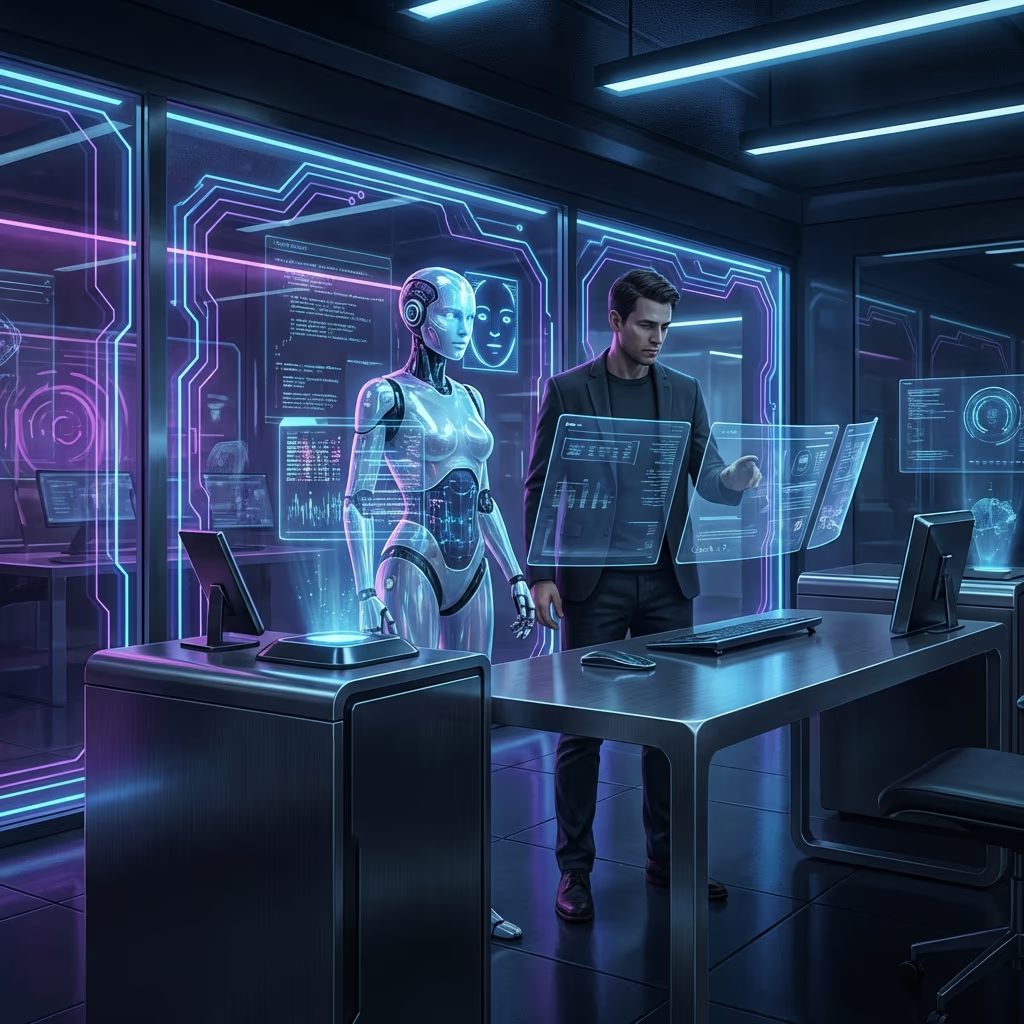
2026 marks the triumph of Neuro-Symbolic Architecture. While 2023 agents were "black boxes," modern agentic workflows (like the ones depicted above) combine the creative reasoning of Neural Nets with the rigid logic of Symbolic AI.
- Verifiable Action Payloads: Before an agent executes a 'Buy' command, the neural engine generates the intent, which is then validated by a symbolic logic-checker to ensure it doesn't violate pre-defined company budget constraints.
- Stateful Handoffs: Agents now use "Workspace Sharding," allowing multiple models (Claude, Gemini, GPT) to work on the same virtual terminal simultaneously, passing memory buffers back and forth with zero context loss.
- Predictive Proactivity: Modern agents don't just wait for prompts; they monitor your calendar and "preload" research for your next meeting, often having a technical briefing ready before you even log on.
How to Build an Agentic Workforce
Integrating autonomous agents into the UK workplace isn't a simple software installation; it requires a radical unbundling of traditional management structures.
- Identify 'Vague' Bottlenecks: Don't try to automate strict programmatic tasks (traditional software does that better). Automate fuzzy processes. Things like "Reading 50 candidate CVs to find the 3 best cultural fits" are prime targets for agentic workflows.
- Implement 'Human-in-the-Loop' Guards: Never give an agent unverified write access to critical financial infrastructure or production databases. Agents should generate the action plan and build the payload, but a human manager MUST click the final "Approve & Execute" button.
- Shift Management Styles: Managers must transition from "managing task implementation" to "managing task definition." Your job becomes writing incredibly robust, edge-case-proof system prompts and reviewing the mathematical output of the agents.
Architectural Comparisons: Generative vs Agentic
To fully understand the gap, we must compare the architectures directly.
| Feature | Generative AI (Chat) | Agentic AI (Autonomous) |
|---|---|---|
| Primary Interface | Text box prompt/response | Code, APIs, DOM manipulation, CLI |
| Execution Duration | Seconds (immediate generation) | Minutes to Hours (background processing) |
| Failure Handling | User must read error and re-prompt | Self-corrects iteratively based on error logs |
| Human Role | Micro-manager (Step-by-step guidance) | Director (Goal setting and final review) |
Real-World Use Cases in the UK
The adoption curves in London's financial and tech sectors are astronomical.
Legal Tech & Due Diligence
UK law firms are utilising agentic pipelines to conduct M&A due diligence. An agent is fed a repository of 10,000 PDF contracts. It reads them all, searches for irregular indemnity clauses, cross-references those clauses with standard UK legal precedent from the internet, and flags a spreadsheet of exactly 14 highly specific risks for senior partners to review.
Software Engineering (DevOps)
Instead of humans managing server architecture, dev-ops agents monitor AWS instances. If a memory leak causes an outage at 3 AM, the agent autonomously clones the repository, finds the buggy commit, writes a patch, runs the test suite, and pushes the hotfix directly to production whilst the senior engineer sleeps.
The Cost of Digital Labour (Pricing)
We are currently witnessing the commoditisation of cognitive labour. Pricing for agents is usually structured via API token consumption or "seat" licencing.
- Open Source Frameworks (Free): Frameworks like AutoGPT, BabyAGI, and AgentZero are free to download and run locally, though you must pay for underlying API keys (OpenAI / Anthropic), which can rack up massive bills (often exceeding £200/month if the agent enters an infinite loop).
- Enterprise Agent Platforms (£20-£80/month): Managed platforms offer safety rails, secure API vaults, and pre-built workflows for a flat monthly subscription per 'human seat' who manages the agents.
- Compute-based Pricing (Pennies per task): When deployed via Claude Opus 4.6 API specifically, a complex task (like auditing a codebase) might require 200,000 tokens of context, costing roughly £3 per execution. This is drastically cheaper than hiring a junior developer to spend a day on the same task.
Limitations and Ethical Considerations
The agentic shift is fraught with legitimate dangers that enterprises must navigate carefully in 2026.
- Infinite Loops & Token Burn: An agent failing to self-correct a bug might try to solve it 500 times in a row, consuming thousands of pounds in API costs in under an hour. Strong financial guardrails are mandatory.
- Hallucinated Confidence: When an agent operates autonomously, it might hallucinate a critical piece of logic (e.g. deleting the wrong row in a production database) and confidently execute it. Without human-in-the-loop sign-offs, the damage is instantaneous.
- Job Displacement: The harsh reality of 2026 is that entry-level analytical and administrative jobs are vanishing. Instead of hiring three junior analysts to do research, a company hires one senior manager to pilot a fleet of 10 agents. The societal implications of this "junior-level wipeout" are currently dominating UK political discourse.
The Verdict on 2026's Strategic Outlook
The agentic future of work is not arriving; it is already here. The fundamental structure of corporate productivity is being radically reorganised around the capabilities of autonomous digital counterparts.
For businesses, ignoring the shift from generative chat tools to agentic workflows is the equivalent of ignoring cloud computing a decade ago. It is a fatal operational error. Managing a fleet of digital agents is now the most critical core competency for modern managers. The goal is no longer just to 'use' AI, but to actively 'collaborate' with it as a fundamental member of your workforce.
Review Methodology
This review is based on extensive research of publicly available information, enterprise adoption reports across the UK tech sector, official API documentation from Anthropic and Google, and expert macroeconomic analyses gathered throughout early 2026.