 AI Tools Review Editorial Team
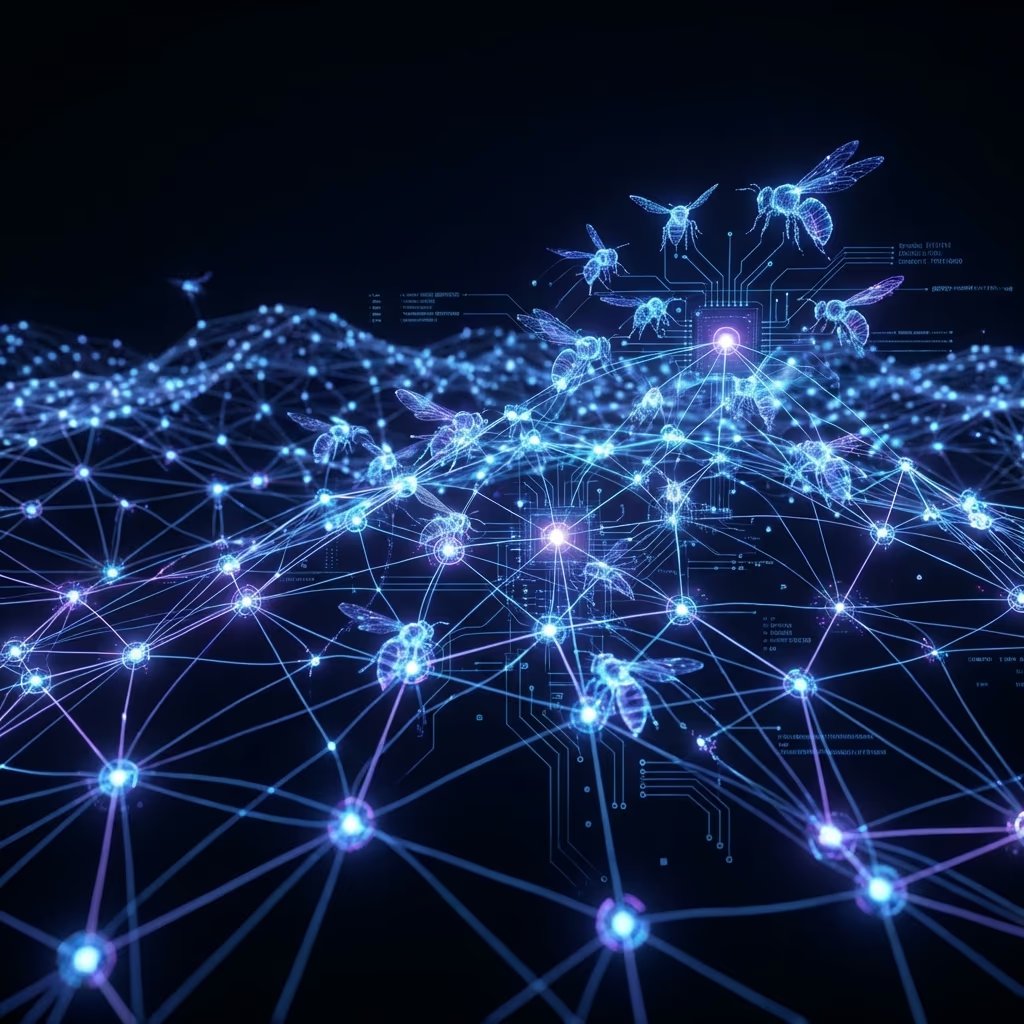
The era of the “lone genius” AI model is fading. While models like GPT-4o and Claude 3.5 Sonnet are incredibly capable individuals, the next frontier in Artificial Intelligence isn’t about building a smarter brain, it’s about building a better team. Enter Agent Swarms.
Imagine a software development team. You have a Product Manager defining the scope, a Senior Architect designing the system, a Backend Engineer writing the API, and a QA Engineer breaking it to find bugs. In the traditional LLM workflow, you ask one AI to be all of these things at once. It's essentially asking one person to run an entire company simultaneously. It *can* check its own work, but it suffers from context fatigue and cognitive overload.
Agent Swarms (or Multi-Agent Systems) flip this paradigm. Instead of one massive prompt, you instantiate distinct digital workers. You give one the “Researcher” hat, another the “Writer” hat, and a third the “Editor” hat. You hand them a goal, and they talk to *each other* to achieve it. They debate, they iterate, and they execute tasks in parallel. This is the closest we have come to mimicking human organizational intelligence in silicon.
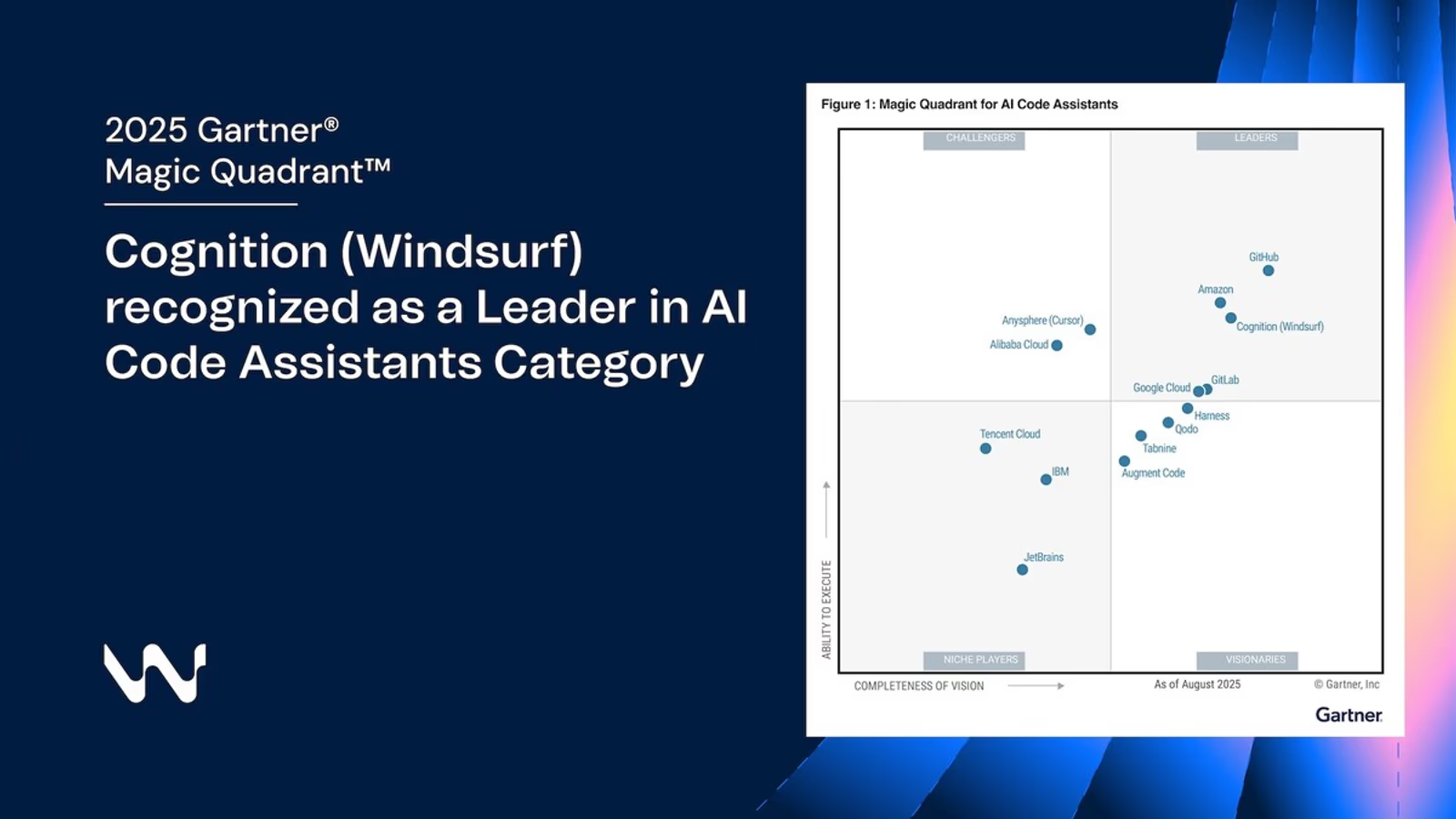
WorldofAI covers Agent Swarms in this video.
Biological Inspiration: From Ants to Algorithms
The term "swarm" isn't accidental. In nature, a single ant is relatively simple. It follows basic pheromone trails and has limited cognitive capacity. However, a colony of ants can build complex architectural structures, farm fungus, wage war, and adapt to catastrophic changes in their environment. This is Stigmergy, intelligence arising from indirect coordination between agents or actions.
AI Swarms apply this concept to Large Language Models. Each agent doesn't need to know the entire state of the world. It only needs to know its specific instruction, the tools available to it (like web search, code execution, or file system access), and the communication protocol to pass its output to the next agent.
“The whole is greater than the sum of its parts. In Agent Swarms, the collective intelligence emerges from the specialized interactions of smaller, focused models.”
The Architecture of a Swarm
How do you actually build one of these? While implementations vary between frameworks like CrewAI and AutoGen, the core architecture typically consists of four layers:
1. The Controller / Orchestrator
This is the "Boss" agent. It receives the initial user prompt and breaks it down into a Directed Acyclic Graph (DAG) of tasks. It decides which specialized agent is best suited for each step.
2. The Agents (Nodes)
These are instances of LLMs with specific system prompts.
- Role: “You are a Senior Python Engineer.”
- Goal: “Write cleaner, more efficient code.”
- Backstory: “You have 10 years of experience and hate for loops.”
3. The Tools
Agents need hands. Tools are Python functions that agents can call. Common tools include:
- search_internet(query)
- read_file(path)
- execute_python(code)
4. The Shared State (Memory)
For agents to collaborate, they need a shared whiteboard. This is usually a context window or a persistent database where results from Agent A are stored so Agent B can read them.
Swarm Communication Flow
graph TD
    User[User Prompt] --> Boss[Orchestrator Agent]
    Boss -->|Assigns Task| Researcher[Research Agent]
    Boss -->|Assigns Task| Writer[Writer Agent]
    Boss -->|Assigns Task| Reviewer[QA Agent]

    Researcher -->|Web Search Results| Writer
    Writer -->|Draft Content| Reviewer
    Reviewer --x|Feedback Loop| Writer
    Reviewer -->|Approved| Boss
    Boss -->|Final Output| User
Single Agent vs. Multi-Agent Systems (MAS)
| Feature | Single Agent (Standard LLM) | Agent Swarm (MAS) |
| Context Window | Shared and often crowded. | Separate context per agent. |
| Specialization | Generalist (Jack of all trades). | Specialists (Experts in one domain). |
| Error Recovery | Often hallucinates to fix errors. | Other agents can catch and correct errors. |
| Complexity | Low (Single API call). | High (Orchestration logic needed). |
Key Frameworks: CrewAI, AutoGen, and Swarm
The open-source community has exploded with frameworks to make building swarms easier. Here are the titans of the industry right now:
- CrewAI: Perhaps the most user-friendly. It focuses on "Crews" of agents with specific roles and backstories. It integrates beautifully with LangChain tools and feels very "human" in how you define tasks.
- Microsoft AutoGen: The heavyweight. AutoGen introduced the concept of "Conversable Agents", agents that are just essentially loops of chat. It supports extremely complex workflows where agents can write and execute code in docker containers to solve math problems or scrape data.
- OpenAI Swarm: A recent educational framework released by OpenAI. It is lightweight, stateless, and designed to demonstrate the "handoff" pattern, where one agent explicitly passes control to another based on the conversation turn. It's less of a production library and more of a reference implementation.
- LangGraph: From the LangChain team. It treats agent workflows as a graph (nodes and edges). This offers the most granular control over loops and conditionals (e.g. "If the Researcher fails 3 times, go to the Supervisor").
Real-World Use Cases
This isn't just theoretical. Companies are deploying swarms today for tasks that require high reliability:
Automated Software Engineering
Systems like Devin (and open-source alternatives like OpenDevin) are essentially swarms. One agent reads the GitHub issue, another navigates the codebase to find relevant files, a third writes the patch, and a fourth runs the test suite. If the test fails, the fourth agent tells the third agent what went wrong, and the loop continues.
Market Research & Content Generation
Imagine a "Newsroom Swarm".
1. Scanner Agent: Monitor RSS feeds and Twitter for breaking news.
2. Researcher Agent: When a topic is found, Google search for 10 sources and summarize facts.
3. Editor Agent: Decide if the story is on-brand.
4. Writer Agent: Draft the article.
5. SEO Agent: Optimize keywords and meta tags.
Challenges: Loops, Latency, and Cost
It's not all sunshine. Swarms are expensive. A single task might trigger 50+ LLM calls as agents argue or iterate.
- Infinite Loops: Agents can get stuck thanking each other or politely deferring tasks forever. "No, you go first." "No, I insist."
- Latency: While single inference is fast, a chain of 10 dependencies can take minutes. This makes swarms ill-suited for real-time chatbots but perfect for background jobs.
- Cost Control: Without strict "max_turn" limits, an autonomous agent could burn through $100 of API credits trying to fix a single bug.
The Future of Work: Managing Synthetic Employees
As we move into 2026, the role of a human "prompt engineer" is evolving into an "Agent Manager." We will no longer write prompts; we will write job descriptions for synthetic employees. We will conduct performance reviews on our AI agents. We will debug their interpersonal communication rather than their code.
Swarms represent the scalability of intelligence. If you need more code written, you don't just upgrade to a smarter model; you spin up 1,000 more instances of your Junior Coder agent.
Conclusion
Agent Swarms are the practical application of AGI concepts. They allow us to overcome the limitations of single-model reasoning by breaking problems down. Whether you are using CrewAI to automate your newsletter or building a custom AutoGen swarm to trade stocks, the future is multi-agent. The hive mind is here, and it is open for business.
Review Methodology
This deep dive is based on technical documentation from OpenAI, Microsoft Research, and current open-source repositories for CrewAI and LangGraph, alongside practical testing of multi-agent workflows.