 AI Tools Review Editorial Team
The world has moved past the initial shock of AI image generation. The question is no longer "Can AI make art?" but "How does AI fit into the artistic process?" In 2026, tools like Midjourney v7 and Flux have become standard instruments for designers, much like the camera or Photoshop before them.
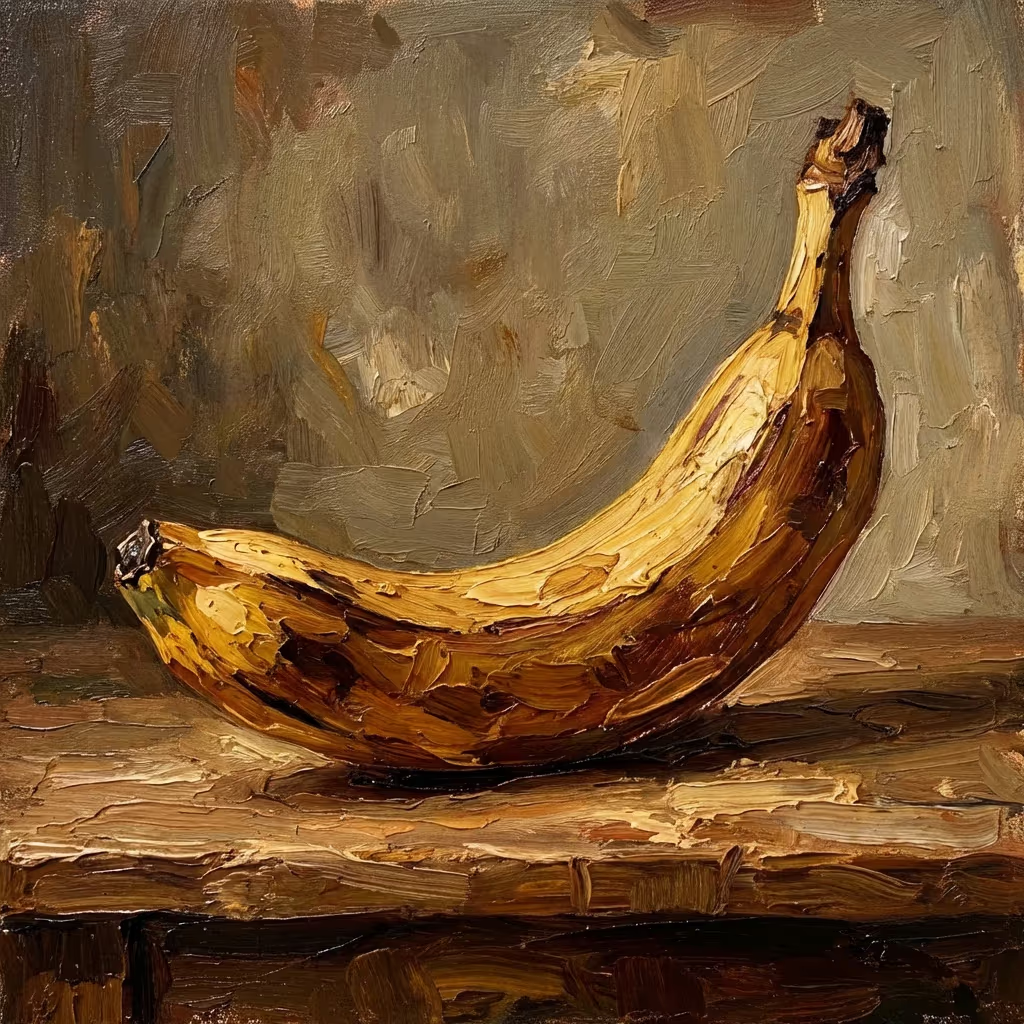
Midjourney v7: Painterly & Aesthetic
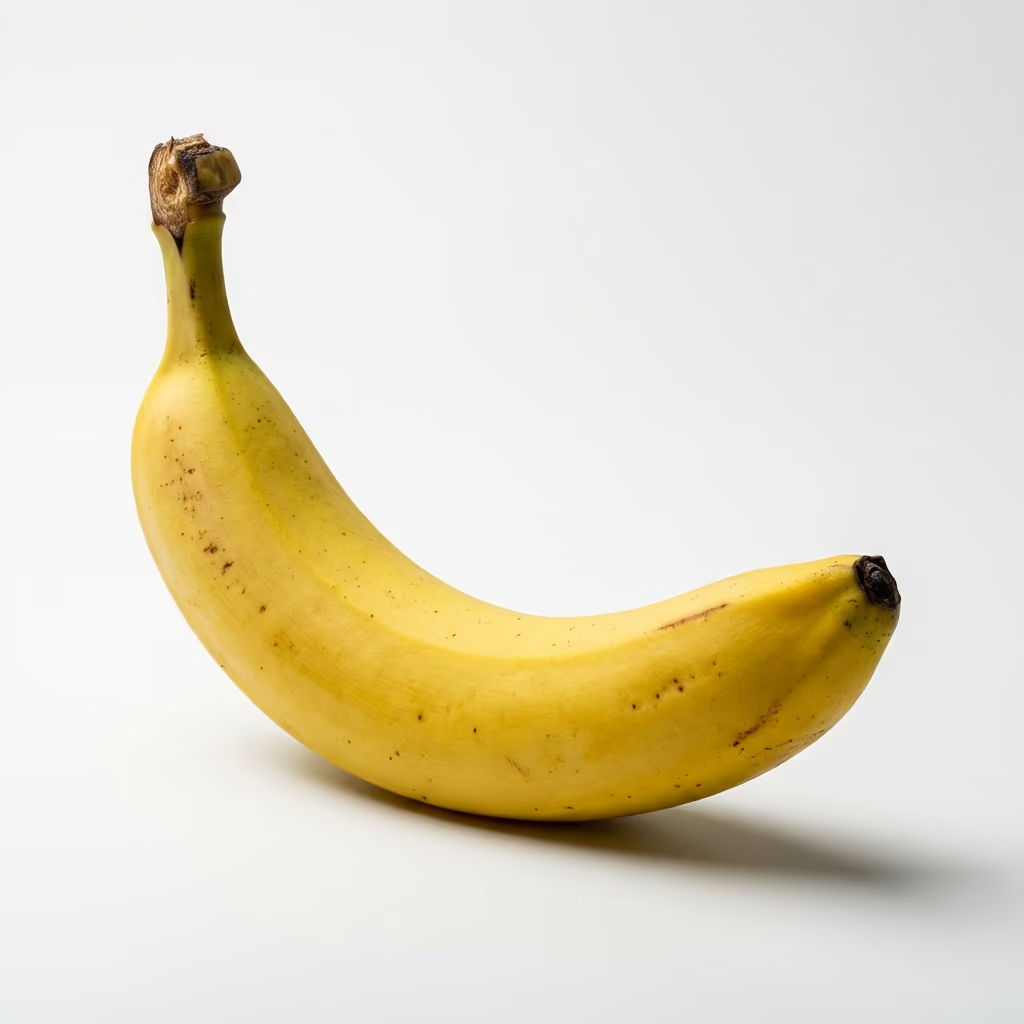
Flux: Technical & Realistic
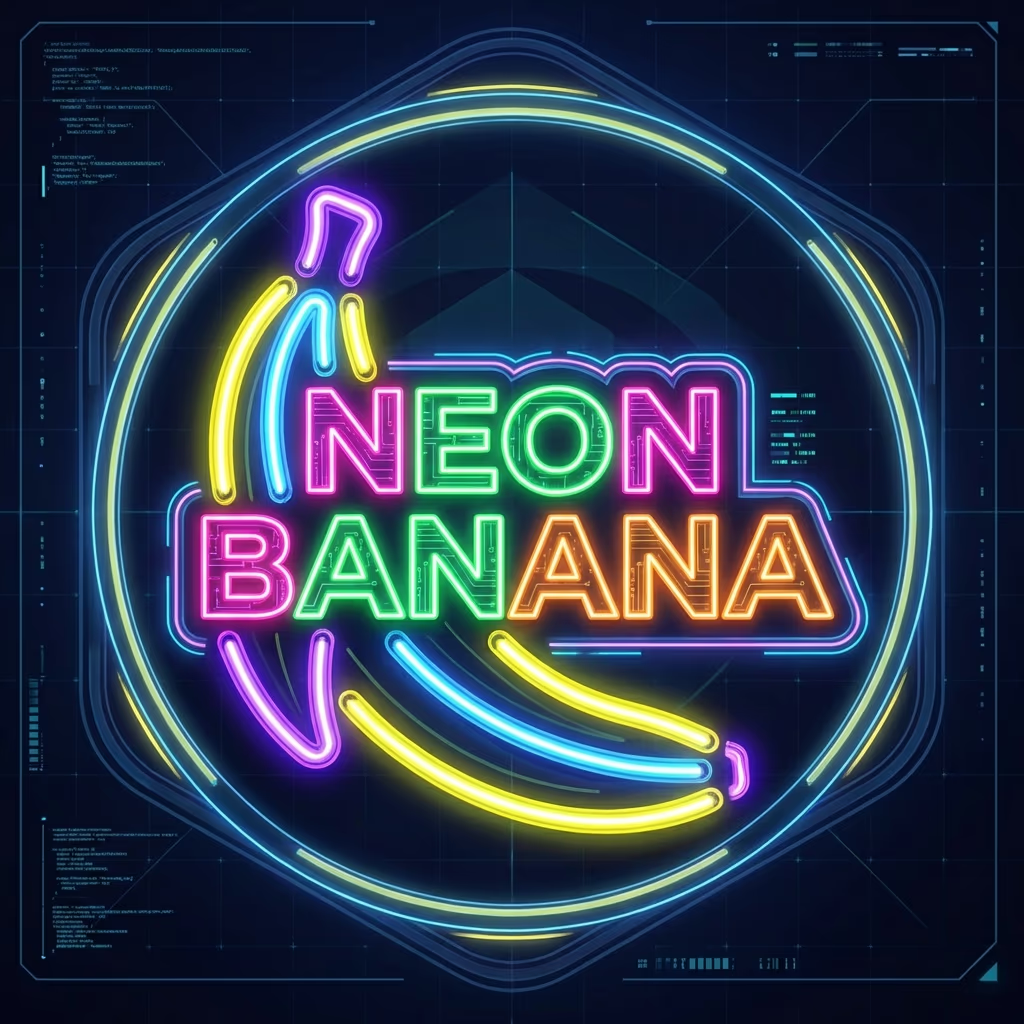
Ideogram: Precision Typography
The New Standard: Midjourney v7 vs Flux
Midjourney v7 continues to reign supreme for "aesthetic" quality. It has an opinion. It understands lighting and texture in a way that feels almost painterly. It is the choice for mood boards, concept art, and editorial illustration.
Flux, however, has won the hearts of technical designers. As an open-weights model, it offers control. You can run it locally. You can fine-tune it on your specific product line. It follows complex prompts about text placement and spatial relationships far better than its artistic rival.
Ideogram: The Typography Breakthrough Nobody Saw Coming
In August 2023, a startup called Ideogram launched with a singular focus: fixing the embarrassing problem that every major image generator had been ignoring. DALL-E would give you gibberish letters. Midjourney would mangle words into abstract shapes. Stable Diffusion couldn't spell "COFFEE" on a coffee shop sign to save its life.
Ideogram's founders (ex-Google Brain researchers) built their entire model around text rendering. When version 1.0 dropped, designers immediately started testing it with the prompts that had been failing everywhere else. "Vintage movie poster with the title 'MIDNIGHT DREAMS'" actually produced those exact words, in the right font, properly kerned, integrated into the composition.
By summer 2024, Ideogram 2.0 had become the default choice for anything involving text. Logo designers were using it to generate 50 variations of a concept in an afternoon. Print-on-demand sellers were churning out t-shirt designs with complex typography that would have taken hours to lay out manually. The "Magic Prompt" feature would take your rough idea and restructure it to maximise text clarity whilst maintaining visual appeal.
What made Ideogram genuinely important wasn't just that it could spell (though that alone was revolutionary). It understood the relationship between text and image in ways other models didn't. Ask for "a book cover where the title is made of vines" and it would generate letters actually constructed from vegetation, not just vines near text. Request "graffiti-style text that interacts with the background" and the letters would weave through architectural elements, cast shadows correctly, follow perspective lines.
The impact on commercial design was immediate. Small businesses that couldn't afford a professional designer suddenly had access to serviceable logo concepts. Marketing teams could prototype poster designs in real time during brainstorming sessions. The barrier between "I have an idea for how this should look" and "here's a mockup I can show the client" collapsed to about 30 seconds.
By late 2025, Ideogram had added "Style Reference" and could match not just the visual aesthetic of an uploaded image but its typographic treatment too. Upload a 1970s rock poster and ask for a new design "in this style," and it would nail the condensed gothic lettering, the chromatic aberration effects, the specific way text curved around illustrations in that era.
The criticism, predictably, was that this was automating away entry-level design work. Junior designers whose jobs involved creating logo variations or mocking up poster layouts found themselves competing with a tool that could generate 100 options in the time it took them to make five. The counterargument from design agencies was that Ideogram handled the grunt work, freeing humans to focus on strategy, client relations, and the conceptual thinking that actually differentiated good design from generic output.
What's fascinating is how Ideogram's success forced other platforms to catch up. By 2026, Midjourney v7 had dramatically improved text rendering (though still not at Ideogram's level). Adobe Firefly's typography capabilities had improved substantially. DALL-E 3 could now manage simple text reliably. The competitive pressure from a startup that did one thing exceptionally well pushed the entire industry forward.
The Ethics of Automation
The tension remains. Is this automation or tool use? The "Copyright Shield" policies offered by Adobe (Firefly) and Getty Images suggest a corporate sanitisation of the technology. These tools train on licensed data, offering a "guilt-free" generation experience for commercial agencies.
However, independent artists argue that the "style" is still being mimicked. The compromise appearing in 2026 is the "Hybrid Workflow". Artists use AI to generate textures, backgrounds, or rough sketches, but the final composition and "soul" of the piece remain human-directed. A new role has emerged: the "AI Art Director," someone who curates, guides, and edits the machine's output rather than holding the brush themselves.
Music is living through the same reckoning a few steps behind images. Suno's v6 launch retired every earlier model built on contested training data and replaced it with one trained solely on music licensed from Warner Music, BMG and independent distributor Believe, revenue-sharing with those partners from day one. It is the same "guilt-free generation" trade seen in Adobe Firefly and Getty's licensed-data image models, applied to a different medium, and it is still only a partial answer: Universal Music Group and Sony Music remain in litigation against Suno, unresolved as of this writing.
Beyond the Binary: Rethinking AI's Role in Creative Practice
The Cognitive Externalisation Thesis
Something profound happened when humans first began writing: memory was externalised. No longer did the epic poet need to hold The Iliad in their mind. It could live on papyrus, on vellum, eventually on digital storage. Humanity became symbiotic with storage systems, fundamentally changing what it meant to "know" something.
AI image generation represents a parallel shift: the externalisation of visual imagination. For millennia, the only way to manifest a mental image was through years of acquired motor skill. Learning to control a brush, understanding perspective, mastering colour theory. Now, the imaginative act itself can be externalised, delegating execution whilst retaining curatorial authority.
This is not the death of artistry but its transformation. Just as literacy didn't eliminate the need for good thinking (it actually elevated the importance of what you chose to remember and communicate), AI doesn't eliminate artistic vision. It makes the quality of that vision more important than ever, because execution is no longer the barrier.
Latent Space as Medium
Here's a radical reframe: the actual artistic medium isn't pixels or paint. It's the latent space itself.
Traditional painters work in oil or watercolour. Photographers work in light and time. Digital artists work in pixels and layers. But what does an AI artist work in? They navigate latent space, that high-dimensional mathematical realm where concepts exist as vectors, where "cat" and "dog" are coordinates, where style and content can be mathematically separated and recombined.
This is genuinely new. It's a medium that has never existed before. Learning to "paint" in latent space (understanding how semantic concepts map to these abstract dimensions, knowing which prompts will navigate you towards unexpected aesthetic territories) is a skill. It's not the same skill as traditional drawing, but it is legitimate craft.
Some practitioners are developing an almost intuitive sense of latent space topology. They know that "cinematic" will pull them towards one region, "ethereal" towards another, and that certain combinations create constructive interference. Moments where the model is forced into genuinely novel territory because you've asked for something that straddles multiple training clusters.
The Inversion of Skill: From Execution to Curation
For centuries, artistic value was tied to technical execution. The ability to render accurate anatomy, to mix colours perfectly, to control a brush stroke. These were the markers of mastery. AI inverts this entirely.
Now, the bottleneck is taste. Anyone can generate a technically perfect image. The question becomes: do you know what's worth generating? Can you recognise the one compelling image amongst the 10,000 variations? Do you understand composition well enough to know when the AI has given you something special, even if it's not what you asked for?
This echoes the transition from painting to photography. Early critics dismissed photography because it required "no skill." Anyone could press a button. But great photographers like Ansel Adams or Henri Cartier-Bresson proved that the skill had shifted from hand-eye coordination to vision: the ability to see the extraordinary in the ordinary, to frame the decisive moment, to recognise when light and shadow conspired to create something unrepeatable.
The same is happening now. The "AI Art Director" is developing a new kind of expertise: the ability to guide a non-human intelligence towards aesthetic territories neither human nor machine would discover alone.
Adversarial Creativity: The Human Backlash
Perhaps the most fascinating development is what might be called adversarial creativity. Artists deliberately working against AI capabilities as a form of resistance and distinction.
Some painters are embracing the deliberately "wrong": intentional anatomical distortions that AI would never make, colour palettes that violate learned aesthetic rules, compositions that leverage human perceptual quirks that AI doesn't understand. The art becomes valuable precisely because an AI couldn't have made it.
A renaissance is occurring in hand-crafted typography, deliberately imperfect letterforms that celebrate the tremor of the human hand. "Anti-prompt" movements are appearing: artists creating work that is specifically designed to be un-promptable, to exist in conceptual spaces that can't be described in text.
There's a parallel here to the Arts and Crafts movement's response to industrialisation. William Morris didn't reject machines because they couldn't make furniture. He rejected them because hand-crafted work carried a human signature, an irregularity that was valuable precisely because it was inefficient.
The Feedback Loop Problem: Aesthetic Monoculture
An uncomfortable truth exists: the industry is entering an era of aesthetic homogenisation driven by training loops.
When AI systems train on internet imagery, they learn the aesthetic preferences embedded in that data: what gets upvoted, shared, or saved. When humans then use these systems to generate new images, they tend to select outputs that match existing aesthetic preferences. These generated images then enter the training data for the next generation of models.
The result is a tightening spiral. Each iteration reinforces certain aesthetic modes whilst others fade. We're seeing the emergence of a "house style" across AI systems: that specific kind of dramatic lighting, those particular colour grading choices, that emphasis on hyper-detail that humans find impressive.
Professional artists are already noting how their clients increasingly request "that AI look." Not because it's optimal for the project, but because it's what people have become visually acclimatised to. Aesthetic standards are being trained to prefer the choices of the tools.
Some researchers call this "cultural domestication": the way human aesthetic preferences and AI capabilities co-evolve, each shaping the other. The question is: who is directing this evolution, or is it a process of being passively shaped?
Temporal Compression and the Democratization Paradox
AI achieves something unprecedented: temporal compression of skill acquisition. What once took a decade to learn (perspective, anatomy, colour theory, compositional balance) can now be accessed instantly through the right prompt.
This is genuinely democratising. A teenager in rural Indonesia with an internet connection and a free Stable Diffusion interface has access to visual capabilities that, 20 years ago, required art school and years of practice. An explosion of visual storytelling is emerging from communities that were previously locked out by the economics of skill acquisition.
But there's a paradox: when everyone has access to the same capabilities, differentiation becomes harder. If a million people can generate a photorealistic dragon in cinematic lighting, what makes your dragon special? The democratisation of capability necessitates a re-concentration of value in other domains: concept, curation, narrative, the ability to direct the tool towards genuinely novel expressions.
This pattern mirrors what happened with literacy. When reading and writing were rare skills, simply being literate was valuable. Once everyone could read, the value shifted to what was read and how it was thought about. The skill became metacognitive rather than technical.
The Question of Authorship: Collaborative Cognition
Who is the author of an AI-generated image? The obvious answer ("the person who wrote the prompt") is too simple.
Consider the chain of causation: the artists whose work trained the model, the engineers who designed the architecture, the person who wrote the prompt, the random seed that influenced the generation, the person who selected this output from amongst many attempts, the person who edited it afterward. Where does authorship begin and end?
The shift is towards a model of collaborative cognition: the recognition that creative acts are always distributed across human and non-human actors, and that AI simply makes this distribution more obvious.
This isn't as radical as it sounds. Traditional painters collaborated with their tools: the specific properties of oil paint, the texture of canvas, the quality of light in their studio. All of these non-human factors shaped the work. Photographers collaborate with their cameras, with light, with the decisiveness of the moment. Digital artists collaborate with their software's limitations and affordances.
AI is just a more obvious collaborator, one that brings its own "opinions" (in the form of training biases and architectural constraints) to the creative process. The art emerges from the dialogue between human intent and AI capability, neither fully controlling the outcome.
The New Primitivism: Analogue as Protest
A fascinating counter-trend is emerging: neo-primitivism, artists deliberately returning to purely analogue methods as both aesthetic choice and political statement.
Galleries are showcasing works explicitly labelled "Human Made" or "No AI." Not as criticism, but as categorical distinction, similar to how "organic" or "handmade" became valuable differentiators in food and craft. There's a growing collector market for paintings that proudly display their imperfections: visible brushstrokes, slightly irregular perspectives, the subtle asymmetries that mark human execution.
Some artists are even embracing pre-digital techniques: egg tempera, fresco, woodblock printing. Methods so laborious and material-specific that they're practically AI-proof. The value isn't just in the final image but in the trace of process, the evidence of human labour and decision-making that the object carries.
This isn't Luddism. Many of these artists use AI in their planning stages: generating compositional studies, testing colour palettes, exploring variations. But they reserve final execution for human hands, creating a kind of hybrid practise that uses AI as a thinking tool but not a making tool.
Style as Data: The Commodification Crisis
AI has done something unprecedented: it has turned artistic style into a fungible commodity.
Historically, developing a distinctive style was the result of years of practise, accidental discoveries, and the unique intersection of your influences, abilities, and obsessions. Your style was essentially non-transferable. Others could imitate it, but never perfectly, and the attempt itself required significant skill and study.
Now, your style can be captured through LoRA fine-tuning or style transfer. It becomes data, copyable and replicable with perfect fidelity. This fundamentally changes the economics of style.
Some artists are embracing this: licensing their style as an AI model, essentially franchising their aesthetic whilst focusing on concept development. Others are pursuing "uncapturable" styles: visual approaches that rely on real-world materials, chance operations, or conceptual frameworks that can't be reduced to pixel patterns.
"Adversarial styles" are also emerging: artists deliberately training their practise to occupy aesthetic spaces that confuse current AI systems. This is essentially an arms race, with work evolving to maintain distinctiveness as AI capabilities advance.
The Question of Originality in an Age of Infinite Variation
AI challenges our concept of originality in uncomfortable ways. When a system can generate infinite variations on any theme, what does it mean for an image to be "original"?
The traditional answer (originality as novelty, as the production of something never seen before) becomes incoherent. AI can generate billions of never-before-seen images. But we instinctively know that clicking "regenerate" 100 times doesn't make you creative.
Perhaps originality needs to be redefined: not as novelty of output, but as novelty of vision. The ability to see connections no one else saw, to pose questions no one else asked, to direct the tool towards territories that weren't in its training data as discrete concepts but emerge from their novel combination.
This shifts the locus of creativity from making to seeing, from execution to conceptualisation. The artist becomes less the producer of the object and more the first witness of a possibility space that already existed but hadn't been explored.
Co-evolutionary Aesthetics: Shared Training
Here's perhaps the most important insight: humans and AI are mutually training each other's aesthetic sensibilities.
Every time you select one AI-generated image over another, you're training the system (directly, if feedback is incorporated, or indirectly, by contributing to the statistical distribution of "good" outputs). But simultaneously, you're training yourself. You're developing preferences shaped by what the system can produce, learning to see value in certain aesthetic configurations because they're reliably generatable.
This creates a feedback loop that's neither purely human-directed nor AI-determined but genuinely collaborative. Our aesthetic standards are co-evolving with our tools' capabilities. We're not just using AI to make art. We're using art-making to negotiate a shared aesthetic language with non-human intelligence.
This might be the most profound aspect of AI art: it's a medium through which to discover what collaboration with artificial intelligence actually feels like. Every prompt is a negotiation, every generated image is a response, every selection is a judgment that shapes future interactions.
The Practitioner's Toolkit: Working With (and Against) AI
The Hybrid Workflow in Practise
The most sophisticated AI art practises in 2026 aren't purely AI-generated or purely hand-crafted. They're deliberately hybrid, using each medium for what it does best.
AI for exploration: Generate hundreds of compositional variations, test different lighting scenarios, explore colour palettes you wouldn't have thought to try manually.
Human for refinement: Take the AI output and push it further, adding the details that matter, correcting the anatomical oddities, introducing intentional imperfections that make the image feel lived-in rather than generated.
AI for iteration: Feed the hand-modified version back into the system, use it as a starting point for further variation, let the AI surprise you with interpretations of your refinements.
Human for curation: Select the keepers, understand why this version works and that one doesn't, develop the taste that makes the difference between good and great.
This workflow acknowledges that AI and human artists have complementary strengths. AI excels at systematic exploration of possibility spaces, at technical execution, at producing variations without fatigue. Humans excel at recognising what matters, at understanding cultural context, at making the intuitive leaps that connect technical execution to emotional resonance.
Developing Your Latent Space Intuition
For those working seriously with AI image generation, developing what we might call latent space literacy becomes crucial.
Start by exploring how concepts combine. Notice that "cyberpunk" + "watercolour" produces different results than "cyberpunk" + "oil painting", not just in medium but in the conceptual territory the model explores. Some prompt combinations create constructive interference, pushing the model into territories that are genuinely novel.
Pay attention to negation. What happens when you explicitly exclude common elements? "Fantasy landscape, no castles, no dragons, no mystical lighting" forces the model to explore less-travelled regions of fantasy aesthetics.
Experiment with conceptual contradictions: "aggressive softness", "harsh gentleness", "chaotic order". These paradoxical prompts can push models into interesting failure modes that reveal aesthetic possibilities.
Learn the model's biases. Every system has been trained on particular datasets and has inherited their aesthetic assumptions. Understanding these biases (what the model naturally gravitates towards) helps you work with or against them intentionally.
The Art of the Meta-Prompt
Advanced practitioners are developing "meta-prompts": prompts that don't just describe an image but encode a theory about what makes images interesting.
Instead of "a red car on a highway", try "a composition that creates tension between human-scale objects and vast spaces, using warm colours against cool backgrounds, with implied motion contradicted by perfect stillness".
You're not describing a specific image. You're describing aesthetic principles. You're collaborating with the AI on a conceptual level, treating it as a thinking partner rather than a rendering engine.
Building Your Adversarial Practise
For those interested in creating work that maintains human distinctiveness, consider developing an adversarial practise:
- Study AI limitations: What do current systems struggle with? Complex hand gestures? Unusual perspective distortions? Abstract conceptual combinations? These are your opportunities.
- Embrace the analogue: Incorporate real-world materials or processes that can't be digitally replicated. Scan actual textures, work with physical media, introduce chance operations that the AI can't predict.
- Pursue the unpromptable: Create work that resists description. Images whose power comes from subtle relationships that text can't capture.
- Celebrate imperfection: Make the human hand visible. Don't just accept imperfections. Feature them.
- Work conceptually: Focus on ideas that require cultural context, personal history, or lived experience to understand. Domains where AI's statistical learning hits limits.
Looking Forward: The Next Mutations
Agentic Systems and Creative Autonomy
The next frontier isn't just better image generation. It's AI systems with genuine creative autonomy. Systems are appearing that don't just execute prompts but propose ideas, critique outputs, and iterate without human intervention.
This raises fascinating questions: if an AI system generates 10,000 images overnight, selects the 10 best according to learned aesthetic criteria, and presents only those to you, who is the curator? At what point does the system transition from tool to collaborator to independent agent?
The Multimodal Future
Current systems work in single modalities: text to image, image to image. But we're moving towards genuinely multimodal systems that understand the relationships between text, image, sound, motion, and even suggested interactions.
Imagine describing not just what an image looks like, but how it should feel to encounter it, what music should accompany it, how it should transform over time. The image becomes part of a larger experiential design that AI helps orchestrate.
The Personalisation Endgame
As systems become more sophisticated, we'll see AI models that learn individual aesthetic preferences, that understand your visual language and can anticipate what you're trying to express before you finish explaining it.
This could be liberating: a creative partner that truly understands your vision. Or it could be limiting, a system that reinforces your existing preferences rather than challenging you to grow. The artists who thrive will be those who can toggle between personalised models that amplify their voice and generic models that introduce productive friction.
The Question We Haven't Asked
Perhaps the most important question isn't "Is AI art?" but rather: "What does the existence of AI art reveal about what creativity was thought to be?"
We built these systems to mimic human creativity, and in doing so, we had to formalise our assumptions about what creativity is: pattern recognition, combination, variation, surprise within constraint. The fact that AI can produce these elements suggests either that we understood something important about creativity, or that we radically underestimated what human artistry actually involves.
Maybe both are true. Maybe AI art is showing us that some aspects of what we called "artistic skill" were actually just pattern matching and recombination. Impressive but ultimately mechanical. And maybe by making those aspects trivial, AI is forcing us to focus on the parts of human creativity that aren't mechanical: the ability to care about things, to imbue work with personal history, to create from the lived specificity of embodied experience.
Conclusion: The Conversation Continues
There is a negotiation occurring. Not just about copyright or compensation or credit, but about something more fundamental: what is to be preserved about human creative practice, and what the machines are allowed to do.
The answer won't be universal. Some practitioners will embrace AI as liberator, as amplifier, as thinking partner. Others will turn away, seeking spaces where human touch remains primary, where the trace of struggle and decision is part of the artifact's meaning.
Both paths are valid. Both are already producing compelling work. The real error would be refusing to engage with the question: treating AI as either saviour or threat, rather than as the complex, ambiguous, genuinely novel creative tool that it is.
The most exciting work is happening at the edges: where practitioners are pushing AI into territories it wasn't designed for, where they're using it against itself, where they're discovering that the most interesting outputs come not from perfect prompts but from productive misunderstandings between human intent and machine interpretation.
This is where art has always happened: in the friction between vision and medium, between what you wanted to make and what the materials allowed, between control and chance. AI hasn't eliminated that friction. It's just made it more obvious, more negotiable, more a matter of deliberate choice.
The question isn't whether AI will replace human artists. It's what new forms of artistry will emerge from this strange new collaboration: this dance between human vision and machine capability, neither fully in control, both necessary, the result belonging to neither but emerging from their interaction.
And perhaps that's the most human thing about AI art: it reminds us that we've never created alone, that art has always been collaborative, that creativity emerges from conversation. With our materials, our tools, our traditions, and now, with our thinking machines.
The conversation is just beginning.
Get the free guide: Claude vs ChatGPT, Gemini & Grok
A 20-page playbook covering everything you need to choose and use the big four AI models in 2026, full cost and feature comparisons, what each is best (and worst) at, and how-tos for images, vectors, building a website, Claude Code and more.