 AI Tools Review Editorial Team
The market for AI text generators has matured. It is no longer just about who can write the fastest blog post. It is about workflow, integration, and specialised capabilities. Based on extensive research and user feedback, here are the top tools of 2026 that deliver ROI.
How we compared these tools
Raw output quality has largely stopped being the differentiator. The frontier models are close enough that, for a single paragraph of marketing copy, most readers could not reliably tell them apart in a blind test. What separates these tools in practice is everything around the generation step. We weighted five things:
- Drafting experience. Can you edit alongside the output, or are you copying text out of a chat window into a document? This is the single biggest determinant of whether a tool survives past week three.
- Brand and style adherence. Whether the tool can hold a defined voice across a long piece, and whether it can learn that voice from your existing material rather than a paragraph of instructions.
- Workflow integration. Does it reach your CMS, your CRM, your document store? A generator that cannot publish is a generator you will stop opening.
- Verifiability. For anything factual, whether the tool cites sources you can actually check, or produces confident prose you have to verify by hand.
- Data handling. Whether your inputs train somebody's model, and what certifications back that claim up. For regulated industries this moves from a footnote to the deciding factor.
One structural note before the list. Several entries here are not really competitors: a general-purpose assistant, a marketing platform and a word processor solve different problems, and the sensible answer for most teams is two or three tools rather than one. We return to that at the end.
1. Claude 3.5 Sonnet (Anthropic)
Best for: Nuanced writing and coding.
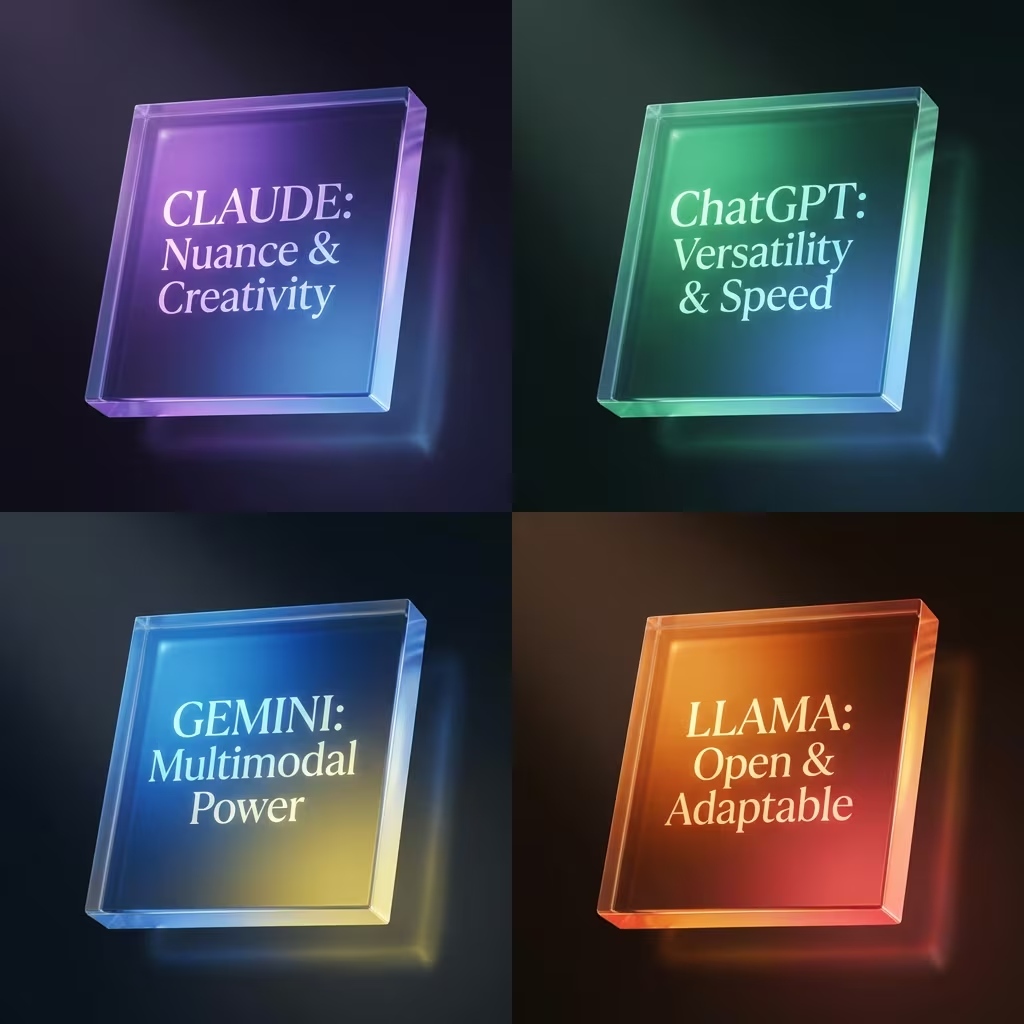
Claude remains the writer's favourite. Its "Sonnet" model strikes the perfect balance between speed and intelligence. Unlike other models that tend to sound robotic or overly enthusiastic, Claude's prose is natural, understated, and follows style guides exceptionally well. Its "Artifacts" feature allowing side-by-side editing makes it the best drafting partner.
2. ChatGPT (OpenAI)
Best for: Versatility and multimodal tasks.
The original is still a powerhouse. With the integration of DALL-E 3 and advanced data analysis, ChatGPT is the best generalist. If you need to write a report, generate the charts for it, and create a cover image in one session, this is your tool.
3. Jasper
Best for: Enterprise Marketing Teams.
Jasper has pivoted successfully from a generic writer to an enterprise marketing platform. Its strength lies in "Brand Voice" detection. You can upload your company's whitepapers, and Jasper will learn your specific tone. It also integrates directly with CMS platforms, making it a workflow tool rather than just a generator.
4. Copy.ai
Best for: GTM (Go-To-Market) automation.
Copy.ai has distinguished itself by focusing on sales and marketing workflows. Its "Workflows" feature allows you to chain tasks: "Scrape this LinkedIn profile → write a personalised outreach email based on their bio → save to CRM."
5. Writer
Best for: Corporate Compliance.
Writer builds its own LLMs (Palmyra) focused on factual accuracy. It is the tool for companies terrified of hallucinations. It doesn't use your data to train its models, which makes it the safe choice for finance and healthcare.
6. Perplexity
Best for: Research-backed content.
Whilst technically a search engine, Perplexity is an incredible writing tool for fact-heavy content. It cites every sentence. If you are writing a whitepaper that needs robust sourcing, start here.
7. Gemini (Google)
Best for: Google Workspace users.
Gemini's power is its context window (up to 2 million tokens) and its integration with Docs and Drive. You can ask it to "read these 50 PDFs in my Drive and summarise them," and it works seamlessly.
8. Notion AI
Best for: Project management and messy notes.
Notion AI isn't trying to write your novel; it is trying to fix your notes. Its concise summaries and ability to extract action items from messy meeting transcripts make it invaluable for internal documentation.
9. Lex
Best for: Creative Writers.
Lex is a word processor first, AI second. It feels like Google Docs but with a smart editor shoulder-partner. It tracks your writing style and offers suggestions only when you get stuck, rather than taking over.
10. Anyword
Best for: Performance Ad Copy.
Anyword gives you a "Performance Score" before you even publish. It predicts how well your copy will convert based on massive datasets of ad performance. For PPC managers, it acts as a pre-flight check.
Pricing: what you actually pay in 2026
The pricing landscape splits cleanly into three tiers, and understanding which tier a tool sits in tells you more than any feature list.
General-purpose assistants cluster around £20 a month. ChatGPT Plus is £20 in the UK. Claude Pro is $20 plus VAT, which lands somewhere between £19.50 and £21 depending on the exchange rate. Google AI Pro is $19.99. The four leading individual subscriptions sit within roughly a pound of each other, which means price is effectively not a variable at this tier — choose on capability and integration instead. Our breakdown of Claude pricing across Pro, Max and Team covers how the higher tiers compare.
Power tiers are an order of magnitude higher. ChatGPT Pro is $200 a month. Claude offers Max at $100 (five times standard usage) and $200 (twenty times). Google AI Ultra is $249.99. These are worth it only if you are genuinely hitting limits daily; for most writers they are not.
Specialist marketing platforms charge per seat and charge properly. Jasper's Pro plan is $69 per seat per month, falling to $59 billed annually, and that buys exactly one seat — team access requires the custom-priced Business plan. Copy.ai's self-serve Chat plan is $29 monthly or $24 billed annually, but its actual go-to-market product starts at $1,000 a month for the Growth tier and rises to $3,000 for Scale. That is a different category of purchase, evaluated against headcount rather than against a ChatGPT subscription.
The practical implication is that a marketing team paying £55 ($69) per seat for Jasper needs to be using the brand voice and CMS integration heavily to justify roughly three times the cost of a general assistant. If your team is mostly using it as a nicer chat box, you are overpaying.
Choosing by use case
| If your job is... | Start with | Because |
|---|---|---|
| Long-form editorial and thought leadership | Claude | Understated prose and reliable style-guide adherence, with Artifacts for side-by-side editing |
| Mixed work: writing, analysis, images | ChatGPT | The strongest generalist; one session covers report, charts and cover image |
| Enterprise marketing at scale | Jasper | Brand Voice learned from your own documents, plus direct CMS integration |
| Sales outreach and GTM automation | Copy.ai | Workflows chain scraping, personalisation and CRM writeback |
| Finance, healthcare or public sector | Writer | Own Palmyra models, zero data retention by default, and the certifications to prove it |
| Whitepapers and fact-heavy research | Perplexity | Sentence-level citations you can actually follow |
| Google Workspace-first organisations | Gemini | Reads Drive and Docs natively; huge context window for bulk document work |
| Internal documentation and meeting notes | Notion AI | Summarises and extracts actions where the notes already live |
| Books, essays, creative drafting | Lex | A word processor first; suggests only when you stall rather than taking over |
| Paid ads and landing page copy | Anyword | Predictive Performance Score acts as a pre-flight check before spend |
Data, privacy and UK compliance
For any organisation handling personal or regulated data, this section matters more than everything above it combined. The question is not whether a tool is good but whether you are permitted to use it.
Writer is the clearest example of a vendor built for this constraint. It states that customer data never trains its models, operates zero data retention by default so prompts, completions and documents are stored only as long as needed, and backs the claim with SOC 2 Type II, ISO 27001, ISO 42001, HIPAA, GDPR and PCI-DSS certification. It offers SSO and SCIM, granular role-based access control, audit logs, customer-managed encryption keys, and alignment to the NIST AI Risk Management Framework and the EU AI Act. Self-hosting and full data residency are available, and configurable guardrails can detect and redact personally identifiable information before output leaves the platform.
That is the bar. When assessing any other tool, work through the same checklist rather than accepting a marketing line: does customer data train the model, what is the retention period, where does the data physically sit, what certifications exist, and is there an audit trail. Consumer subscription tiers frequently have materially different terms from the business and enterprise plans of the same product, so confirm which one your organisation is actually on.
One further UK-specific point. If your output touches advertising, financial promotions or health claims, the regulatory obligation sits with you regardless of what generated the text. An AI tool cannot transfer liability, and "the model wrote it" is not a defence anyone has successfully run.
Where these tools still fall down
Confident wrongness remains the core problem. Every tool on this list will, given a sufficiently obscure question, produce fluent and entirely fabricated detail — a statistic, a date, a quotation, a citation to a paper that does not exist. Fluency is not a signal of accuracy, and the better the prose, the harder the error is to spot. This is precisely why Perplexity earns its place: sentence-level citations turn verification from a research task into a click.
Brand voice is shallower than the demos suggest. Tools that learn a voice from uploaded documents do a genuinely good job of tone, vocabulary and sentence rhythm. What they cannot infer is judgement: which claims your organisation is comfortable making, which comparisons your legal team will not sign off, which topics are off-limits this quarter. Those still require a human who knows the business.
Long-form structure degrades. Most of these tools produce excellent paragraphs and mediocre architecture. Ask for two thousand words and you will typically get well-written sections that repeat each other, with no genuine argumentative progression. The reliable workaround is unglamorous: outline yourself, generate section by section, and edit the joins.
Everything defaults to the same register. Without firm instruction, output converges on a recognisable middle-market business voice. If your differentiation is your writing, the tool will actively erode it unless you push back hard on every draft.
Build a stack, not a shortlist
The framing of "which AI writing tool is best" is the wrong question, and it is the reason so many teams churn through subscriptions. These products occupy different positions in a pipeline, and the sensible configuration for most content teams uses three of them.
A workable default: Perplexity for research and sourcing, because it produces citations you can check; Claude or ChatGPT for drafting, because that is where prose quality and editing experience live; and either Notion AI or your CMS-integrated platform for the internal documentation and publishing layer. Marketing teams add Jasper or Copy.ai on top when brand consistency across many people, or CRM automation, becomes the binding constraint. Regulated organisations replace the drafting layer with Writer and accept the trade-off in raw capability.
Total cost for that stack sits comfortably under £50 a month per person at the individual tier, which is less than most teams spend on tools they use half as often.
The verdict
Claude remains our pick for writers on the strength of its prose and its drafting experience, with ChatGPT the better choice if your work spans beyond text. Perplexity is close to mandatory for anything factual. Writer is the answer when compliance dictates the decision, and Jasper earns its premium only if brand voice and CMS workflow are doing real work for you.
The broader picture is that model quality has stopped being the interesting variable. Where the tools genuinely differ now is in workflow, verifiability and data handling — which is a much more boring set of criteria than the benchmark charts, and a far more reliable guide to which subscription you will still be paying for in a year. For a wider view of how the underlying assistants compare, see our head-to-head of Claude, ChatGPT, Gemini and Grok.
Sources
- Jasper pricing — Pro and Business plan rates
- Copy.ai pricing — Chat, Growth, Expansion and Scale tiers
- Writer — Palmyra enterprise LLMs — data handling and certifications
Sterling figures are approximate conversions of published US dollar list prices and will move with the exchange rate. Check the vendor's own pricing page before purchasing.