 AI Tools Review Editorial Team
The hype cycle is done. 2026 is when AI stops being a chat toy and starts doing actual work. We're talking desktop access, autonomous browsers, and agents that run workflows without you babysitting every step. The shift isn't coming - it's here.
The hype cycle has finally transitioned into the utility cycle. While 2024 was defined by "wow moments" in chat windows, 2026 is defined by quiet, background productivity. We have moved from AI as a consultant to AI as a collaborator. This shift hasn't been a single event, but a steady progression of trust, permissions, and architectural breakthroughs that have fundamentally altered our relationship with silicon.
2025: The Bridge Year
Before we dive into the 2026 landscape, we must understand the "Bridge Year" of 2025. This was the year the infrastructure for agency was actually built.
Q1-Q2: Model Contraction
The industry stopped obsessing over parameter counts and started obsessing over efficiency. We saw "O1-style" reasoning models compressed into mobile-native architectures.
Q3: Permissioning Breakthroughs
The "Secure Sandbox" became standard across Windows 12 and macOS Sequoia+. This allowed users to grant AI agents scoped access to local files without risking total system compromise.
Q4: Native OS Integration
Apple and Microsoft released their first true "Agentic Co-processors," dedicated hardware specifically for managing local agent loops and real-time screen awareness.
1. AI Gets the Keys to Your Desktop

The Death of the Chat Box
In 2026, the chat box is seen as a "legacy" interface. For years, we've been trapped in a reactive loop: copy text, paste into a prompt, wait for a response, then manually copy that response back into a document. This "human-in-the-middle" friction cost enterprises billions in lost productivity. That era ended in late 2025.
Today, AI operates with Desktop Agency. This means models aren't just reading your text; they are observing your screen and interacting with your file system in real-time. Anthropic's Claude Cowork represents the pinnacle of this shift. It doesn't ask you for a CSV; it asks for permission to scan your project folder, identify the missing data points, and generate the spreadsheet itself.
The Great Shift: AI in 2024 vs 2026
| Feature | The Hype Era (2024) | The Utility Era (2026) |
|---|---|---|
| Primary Interface | Chat Box (Isolated) | OS-Wide Agency (Integrated) |
| Workflow Role | Reactive Consultant | Proactive Collaborator |
| File Awareness | Manual Uploads only | Scoped System Access |
| Evaluation Metric | LPM (Likes Per Minute) | ROI & Task Completion Rate |
05. The Rise of "Ambient Agency"
We predict the decline of "Destination AI" (visiting a website) and the rise of Ambient Agency. Agents like Clawdbot will live in your messaging apps (WhatsApp, Slack) and act as a persistent layer of intelligence.
🚀 Expert Perspective:
"The transition from 2024 to 2026 was the move from 'AI that talks' to 'AI that does.' We stopped measuring AI by its vocabulary and started measuring it by its admin privileges. If your AI can't move a file or trigger an API, it's already a museum piece."
2. Agentic Browsers Become Your Web Autopilot

Moving Beyond Search
For decades, the browser was a window through which we looked at data. In 2026, the browser is an engine that performs tasks. We have moved from Information Retrieval to Intent Execution.
Modern agentic browsers (like those built on the BrowserBase architecture) no longer require traditional APIs. They use "Visual DOM Interpretation" to see the web as a human does. This means a 2026 agent can log into your legacy banking portal, find a specific invoice, download it, and upload it to your accounting software, all without the need for a pre-built integration.
Why this matters for your business:
The "walled gardens" of the web are being torn down by agents. If a human can do it in a browser, an agent can now do it faster, more accurately, and at a fraction of the cost. This is the end of manual data entry and the beginning of Universal Web Automation.
3. AI Agents Shift to Corporate Teammates
The Rise of the "Synthetic Employee"
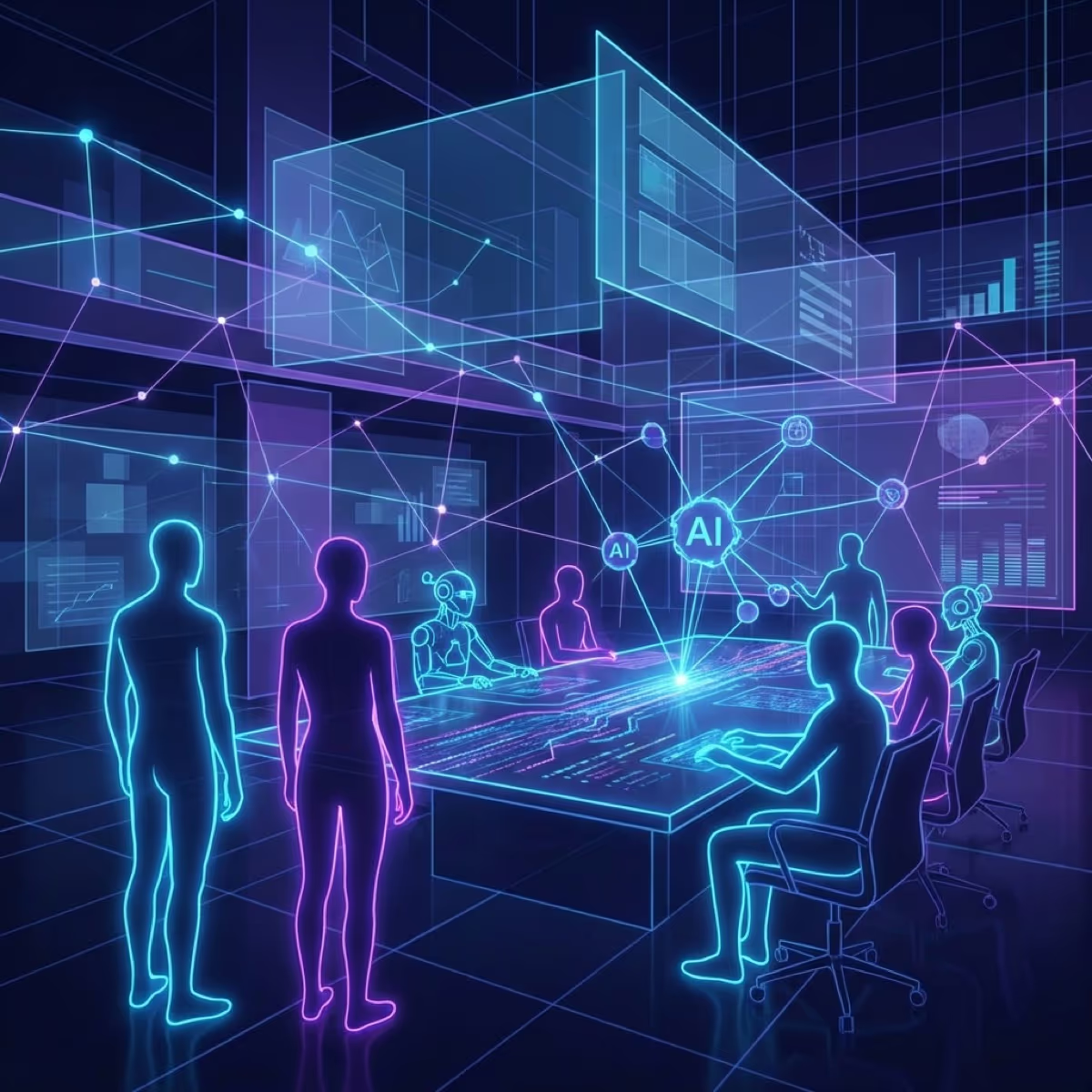
The concept of an "AI agent" has evolved from a simple script to a full-fledged corporate teammate. Major players like Salesforce (Agentforce) and Microsoft (Dynamics 365) are now shipping agents that don't just answer questions, they own outcomes. These agents sit in your communication channels like Slack or Teams, monitoring progress and proactively intervening when they detect a bottleneck.
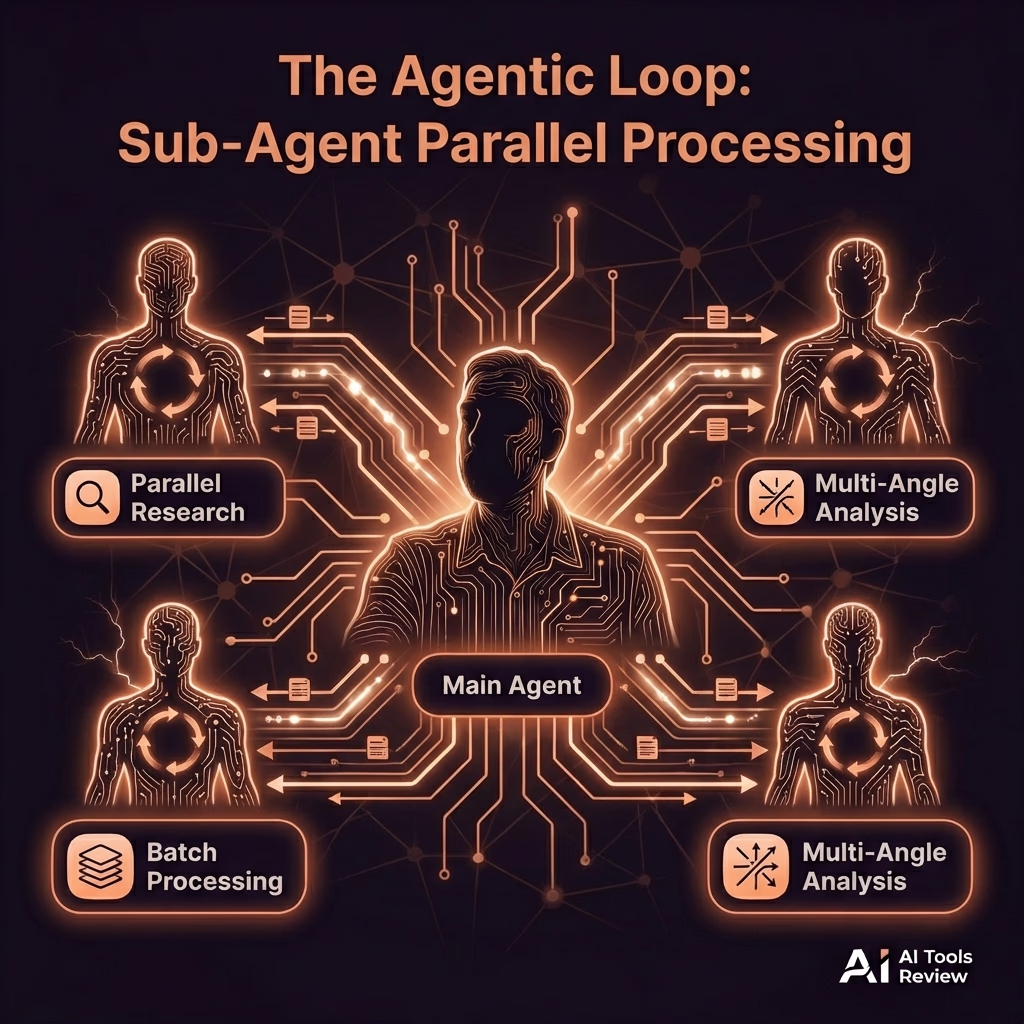
In 2026, we are seeing the emergence of Agentic Swarms. Instead of one large model doing everything, businesses deploy a series of specialised agents that communicate with each other. One agent might handle the research, another the drafting, and a third the compliance check. This "multi-agent orchestration" allows for a level of scale and precision that was previously impossible with human-only teams.
The New SOP (Standard Operating Procedure)
Corporate workflows are being rewritten to be "Agent-First." A typical project launch in 2026 involves:
- ● Autonomous Scoping: An agent scans previous project data to predict timelines and resource requirements.
- ● Recursive Drafting: Agents generate the first 80% of all documentation, including legal and technical specs.
- ● Human Approval Loops: The "Human in the Loop" has shifted to the "Human at the Helm," providing strategic oversight rather than manual labour.
4. Small Models Break the “Good, Cheap, Fast” Triangle

The End of the Generalist Monopoly
For years, the industry was obsessed with "Bigger is Better." In 2026, the mantra has shifted to "Better is Better." We have realised that you don't need a trillion-parameter model to categorise customer support tickets or summarise a legal brief.
Small, specialised models (often referred to as SLMs or Small Language Models) are now outperforming their larger cousins on specific benchmarks. These models are faster to run, cheaper to host, and, most importantly, can be hosted locally or in private clouds, ensuring total data sovereignty.
Vertical Specialisation
We are seeing "Law-GPT," "Med-Claude," and "Code-Llama" variants that are fine-tuned on industry-specific datasets, providing accuracy that generalist models simply cannot match.
Economic Reality
Operating a specialised small model costs approximately 1/15th of the price of a large generalist model, allowing for massive scaling of AI applications without breaking the budget.
This shift has democratised high-end AI. Small businesses can now afford to run their own private, fine-tuned models that rivals the capabilities of Fortune 500 systems from just two years ago. See our Claude Pricing Guide for more on how the cost of intelligence has plummeted.
5. Enterprise AI Enters Its Accountability Era
From Experimentation to ROI
The era of "AI for the sake of AI" is over. In 2026, boards and CEOs are demanding hard numbers. The pilot projects of 2024 and 2025 have either scaled to provide measurable value or they have been cut. This focus on Productivity Accountability has led to the rise of new metrics like "Time-to-Value per Agent Slot."
Enterprises are no longer just buying seats; they are buying outcomes. We are seeing a shift towards performance-based pricing from AI providers. If an agent fails to complete a task, the enterprise isn't billed for the compute. This has forced AI companies to focus on reliability and "hallucination-free" architectures.
The 2026 Clean-Up
We are currently in a period of consolidation. "Wrapper apps" that provided no real value beyond a pretty UI for a LLM are disappearing. The market is rewarding deep integration, custom data pipelines, and systems that can prove they are saving a company thousands of man-hours per month.
6. AI-Powered Coding Reaches a Tipping Point

The Architect Era
Programming has undergone its most radical transformation since the invention of the high-level language. In 2026, the primary role of a software engineer has shifted from "writing code" to "Architecting Intent." With tools like Cursor, GitHub Copilot (Agentic Edition), and specialised coding swarms, the boilerplate is gone.
Teams are reporting productivity gains of 40-70% for routine feature development. However, this has created a new challenge: The Verification Bottleneck. Because AI can generate thousands of lines of code in seconds, the human engineer's job is now to provide the architectural guardrails and perform deep-vein security audits. We are building systems that are more complex than any human could write alone, requiring a new set of "Agent-Aware" development tools.
The "Natural Language" Product Owner
"For the first time, a non-technical Product Owner can describe a feature in plain English and see a production-ready component deployed to staging in minutes. The barrier between business intent and software execution has effectively vanished."
7. The Security Reckoning Arrives

Defending Against the Swarm
As AI agents become more capable, so do the threats. We have entered the era of Autonomous Cyber-Warfare. Traditional firewalls and permission sets are no longer enough to stop an agent that can reason through an exploit in real-time.
Security in 2026 is based on "Recursive Defense", AI models built specifically to monitor, catch, and neutralise other AI agents. This is a perpetual loop: the red-team agent finds a flaw, the blue-team agent patches it, and both models grow stronger. For businesses, this means that security is no longer a monthly audit; it is a 24/7 AI-driven immunity system.
Critical Security Note:
The biggest risk in 2026 isn't data theft; it's Intent Hijacking. This occurs when a malicious agent tricks your local AI into performing an action (like authorising a payment) by spoofing a trusted context. Implementing "Human Confirmation Triggers" for high-stakes actions is now mandatory for any enterprise-grade AI deployment.
2027 and Beyond: The Physical-Digital Merger
While 2026 is about the mastery of digital agency, 2027 will be the year AI steps fully into the physical world. We are already seeing the prototypes:
Personal Reality Agents
AI combined with advanced AR (Augmented Reality) will allow for real-time translation of the physical environment. Imagine your glasses highlighting exactly which component in a complex server rack is failing, while a voice agent guides you through the repair.
Universal Translation of Intent
We will move beyond translating words to translating intent between species and hardware. Early work in bio-acoustic AI is already suggesting that in 2027, "talking to your environment" will be a literal reality, not a metaphor.
The Verdict
The Final Takeaway for 2026
The "toy phase" of AI is officially dead. In 2026, the competitive advantage doesn't come from using AI, it comes from the Speed of Delegation.
The winners this year are the organisations that have successfully transitioned from "managing humans" to "orchestrating agents." If you are still manually performing any task that involves moving data between two pieces of software, you are operating with an industrial-era handicap.
"In 2026, permission is the new power. Give your agents the keys, or watch your competition drive past you."
Predictions based on current industry trajectories from Anthropic, OpenAI, and Microsoft enterprise roadmaps.