
 AI Tools Review Editorial Team
Quick Answer:
Claude Cowork is Anthropic's new desktop agent (launched 12 Jan 2026) that allows Claude to perform multi-step tasks natively on your computer. It can organise files, process documents, and run parallel "sub-agents" to accelerate complex workflows. It's currently available for Pro (£16/mo) and Max (£80-160/mo) subscribers on macOS.
On 12 January 2026, Anthropic released Claude Cowork, a new feature that shifts the focus of AI assistants from conversation to action. Rather than just answering questions, Cowork allows Claude to access local files and perform tangible work.
The concept is straightforward: give Claude access to a folder, describe the task, and let it execute. It can organise downloads, process receipts into spreadsheets, or compile notes into reports, all without requiring terminal commands or coding knowledge.
This release represents a significant shift in AI productivity tools, moving towards recursive development and autonomous agents. This guide covers what Cowork is, its capabilities, security implications, and its role in the future of AI-augmented work.
Claude Cowork Launch Date
Claude Cowork officially launched on 12 January 2026.
Release Timeline:
- 12 Jan 2026: Initial Research Preview (Max subscribers)
- 16 Jan 2026: Expanded to Pro subscribers (Beta)
- 18 Jan 2026: UK & EU Availability confirmed
- Mid-2026 (Est): Windows & Enterprise General Availability
The Genesis: When Developers Stopped Coding with Claude Code
To understand Cowork, you need to understand its predecessor. Claude Code launched in late 2024 as a terminal-based tool for software engineers, designed to automate repetitive programming tasks. It was a hit with developers, quickly becoming one of Anthropic's most successful products. But something unexpected happened: users started using it for everything except coding.
Boris Cherny, the head of Claude Code at Anthropic, documented the phenomenon on X with evident bemusement: "Since we launched Claude Code, we saw people using it for all sorts of non-coding work: doing vacation research, building slide decks, cleaning up your email, cancelling subscriptions, recovering wedding photos from a hard drive, monitoring plant growth, controlling your oven."
That last one bears repeating: controlling an oven. Users had discovered that Claude Code wasn't really a coding tool at all, it was a general-purpose agent that happened to live in a terminal.
Most product teams, faced with such off-label usage, would panic. They'd write blog posts clarifying intended use cases and steer users back to the core value proposition. Anthropic did something different. They recognised that their users understood Claude Code's real value better than they did. The power was never about coding specifically, it was about agency and automation. The ability to execute real tasks on your computer without manual intervention.
"These use cases are diverse and surprising," Cherny noted. "The reason is that the underlying Claude Agent is the best agent, and Opus 4.5 is the best model."
The insight led directly to Cowork: strip away the intimidating terminal interface, repackage the same underlying Agent SDK, and offer it to everyone, not just developers willing to navigate command lines. If you're interested in how AI is transforming content creation more broadly, the guide to the best text generation tools provides a comprehensive comparison.
Built by AI in Ten Days: The Recursive Loop
Perhaps the most extraordinary detail surrounding Cowork's launch is how it was built. During a livestream hosted by Dan Shipper, Anthropic engineer Felix Rieseberg confirmed that the team built Cowork in approximately a week and a half. More striking still: according to Boris Cherny, all of Cowork's code was written by Claude Code itself.
The implications landed like a thunderclap in the AI community. Alex Volkov, who covers AI developments, expressed the collective shock: "Holy shit Anthropic built 'Cowork' in the last... week and a half?!"
Simon Smith, EVP of Generative AI at Klick Health, stated the obvious conclusion: "Claude Code wrote all of Claude Cowork. Can it be agreed that the industry is in at least somewhat of a recursive improvement loop here?"
Felix Rieseberg elaborated on the development philosophy: "We built Cowork the same way we want people to use Claude: describing what we needed, letting Claude handle implementation, and steering as we went. We spent more time making product and architecture decisions than writing individual lines of code."
This represents one of the most visible examples yet of AI systems being used to accelerate their own development, a self-reinforcing cycle that could widen the gap between AI labs that successfully deploy their own agents internally and those that do not. If Cowork can build its own successor in ten days, the pace of iteration becomes almost impossible for competitors to match through traditional development methods.
The "vibe coding" approach, where developers use prompts to create software rather than writing code themselves, isn't theoretical anymore. It's shipping to production.
How Cowork Actually Works
Cowork operates on a permission model where users designate a specific local folder for Claude to access. Within this sandbox, the AI agent can read, modify, and create files.
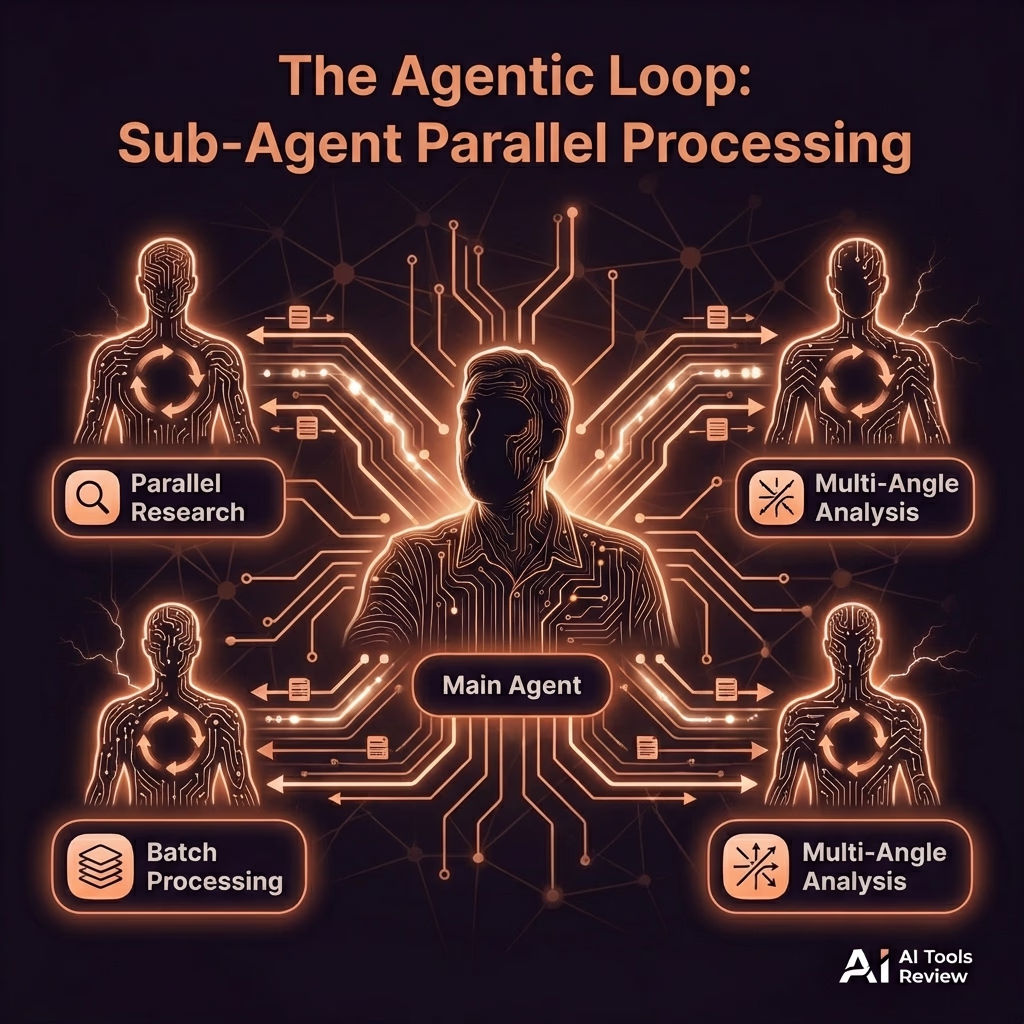
When a user assigns a task, the AI formulates a plan, executes steps in parallel, checks its work, and requests clarification if needed. This "agentic loop" allows for processed workflows, where users can queue multiple tasks for simultaneous execution. Anthropic describes this as "leaving messages for a coworker" rather than chatting with a bot.
The Technical Foundation
Under the hood, Cowork runs in a virtual machine using Apple's VZVirtualMachine (part of the Apple Virtualization Framework). Simon Willison, the UK-based programmer and AI commentator, had Claude Code reverse-engineer the Claude app and discovered that it downloads and boots a custom Linux root filesystem.
This sandboxing approach is crucial for security. The path structure Willison observed, /sessions/zealous-bold-ramanujan/mnt/blog-drafts, suggests Anthropic is mounting user-specified folders into a containerised environment, isolating the AI's activities from the rest of the operating system.
"As far as I can tell, Claude Cowork is regular Claude Code wrapped in a less intimidating default interface and with a filesystem sandbox configured for you without you needing to know what a 'filesystem sandbox' is," Willison concluded. "I think that's a really smart product."
Sub-Agents and Parallel Processing
Cowork's most sophisticated capability is its ability to spawn sub-agents, independent instances of Claude that work in parallel, each with fresh context. Unlike a single chat thread where everything accumulates together, each sub-agent starts clean.
This architecture enables several powerful workflows:
- Parallel research: Evaluate four vendors simultaneously, with separate sub-agents researching pricing, support reputation, and integration options for each
- Multi-angle analysis: Analyse a decision from financial, customer experience, and operational risk perspectives concurrently
- Batch processing: Process ten meeting transcripts at the same time, extracting key decisions, action items, and blockers from each
The practical impact is dramatic. Tasks that would take fifty minutes sequentially, processing ten files at five minutes each, can complete in five minutes with parallel execution.
Boris Cherny uses sub-agents extensively in his own workflow. His code review command spawns several sub-agents simultaneously: one checks style guidelines, another combs through project history, another flags obvious bugs. Then five more sub-agents specifically challenge the original findings. "In the end, the result is awesome," he says. "It finds all the real issues without the false ones."
What Cowork Can Actually Do
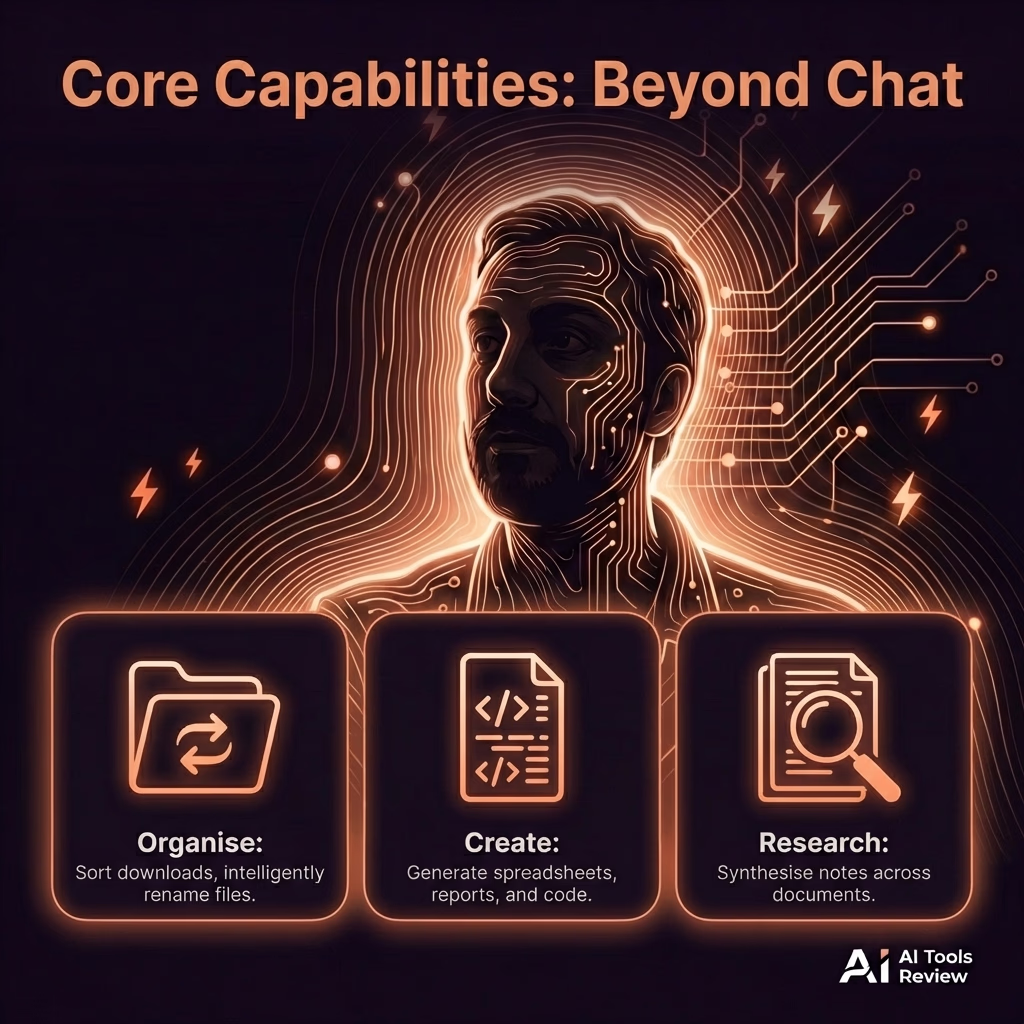
Anthropic highlights several practical use cases:
File Organisation and Management
The most immediately tangible application. Point Claude at your chaotic Downloads folder and ask it to organise by type and date. It can sort hundreds of files into categorised folders, intelligently rename them with consistent patterns, and identify duplicates or screenshots that can be deleted.
One user described a task that took three hours manually, organising financial reports, completing in twenty minutes with Cowork.
Document Processing
Drop a pile of receipt screenshots into a folder and ask Claude to create a formatted expense report. The AI can extract data from images, structure it appropriately, and generate Excel files with working formulas, conditional formatting, and multiple tabs, not just CSVs that need manual fixing.
Research and Synthesis
Perhaps Cowork's most impressive application for knowledge workers. Provide scattered notes across multiple documents and request a cohesive first draft. Or ask it to go through an entire notes vault, find orphaned files, surface connections you've missed, and suggest a better folder structure.
The tool can combine information from web searches, connected applications (via MCP connectors), and local files to produce deliverables that would otherwise require hours of manual collation. This capability positions it as a powerful companion to other AI tools, for visual content, consider exploring the guide to AI image generation.
Long-Running Tasks
Work that would get disrupted in regular chat, hitting context limits, losing the thread partway through, runs to completion in Cowork. Review all documents in a contracts folder and create a summary of key terms, renewal dates, and obligations for each. Analyse customer feedback across multiple platforms and synthesise the top complaints.
Extended Workflows with Browser Integration
When combined with the Claude in Chrome extension, Cowork can perform browser-based tasks: reading web pages, filling forms, extracting data from sites without APIs, and navigating across tabs. The integration enables complex workflows that span local files and web content.
Early User Experiences: Promise and Friction
Initial reactions to Cowork have been largely positive, with caveats. Simon Willison, whose technical assessments carry significant weight in the developer community, called it "a general agent that looks well positioned to bring the wildly powerful capabilities of Claude Code to a wider audience. I would be very surprised if Gemini and OpenAI don't follow suit with their own offerings in this category."
Dan Shipper, co-founder and CEO of Every, reported a handful of small complaints, "which are really just feature requests." The limitation to a single folder at a time and some UI confusion stood out, but the underlying capability impressed.
Claire Vo, founder of ChatPRD, offered a more nuanced assessment: "I tried a few tasks on Cowork, and I'd say the outputs were okay." She noted that Cowork exposes too much of its internal process for non-technical users whilst simultaneously limiting flexibility for more advanced ones. Despite these issues, she acknowledged that Cowork produced better results than standard chat.
Willison encountered a display bug, unable to close the right sidebar, resulting in cramped artifact display, but expected Anthropic to fix it quickly. The consensus seems to be that Cowork is genuinely useful but clearly early-stage.
As Cherny himself acknowledged: "The product is early and raw, similar to what Claude Code felt like when it first launched."
The Security Question: Real Risks, Honest Warnings
To their credit, Anthropic has been unusually transparent about Cowork's risks. The company devoted considerable space in its announcement to warning users about potential dangers, an approach that stands out in an industry often criticised for downplaying AI limitations.
Prompt Injection: The Unsolved Problem
The most significant security concern centres on prompt injection attacks, attempts by malicious actors to alter Claude's plans through content it might encounter. A malicious PDF could theoretically instruct the AI to delete files, exfiltrate data, or modify documents without user knowledge.
Anthropic's warning is direct: "We've built sophisticated defenses against prompt injections, but agent safety, that is, the task of securing Claude's real-world actions, is still an active area of development in the industry."
The Open Web Application Security Project (OWASP) ranks prompt injection as the number one security threat to large language model applications. Security firm Lakera frames the challenge more fundamentally, calling indirect prompt injection "a structural weakness in how AI systems process context," not merely a bug to be patched.
"The problem with prompt injection remains that until there's a high profile incident it's really hard to get people to take it seriously," Willison observed. "I myself have all sorts of Claude Code usage that could cause havoc if a malicious injection got in."
Destructive Actions
Anthropic explicitly acknowledges that Claude can take destructive actions, including deleting local files, if instructions are unclear or if the AI misinterprets a request. The sandbox provides isolation, but files within an approved folder remain vulnerable to mistakes or manipulation.
The Guidance Paradox
Security experts have noted a troubling mismatch. Anthropic's guidance advises users to "watch for suspicious actions that may indicate prompt injection", but the tool's target audience (non-developers) is least equipped to recognise such indicators. The people most likely to use Cowork are those least likely to spot when something has gone wrong.
The company recommends avoiding granting access to local files with sensitive information like financial documents, and limiting Claude in Chrome access to trusted sites. These are reasonable precautions, but they also highlight the tension between Cowork's promise of delegation and the vigilance required to use it safely.
The Competitive Landscape: Positioning Against Giants
With Cowork, Anthropic enters direct competition with Microsoft Copilot and Google Workspace AI for the enterprise productivity market. The positioning is strategic: rather than building a consumer assistant from scratch, Anthropic is extending proven Claude Code capabilities to a broader audience.
Claude Cowork vs Microsoft Copilot vs Google Workspace AI
| Feature | Claude Cowork | Microsoft Copilot | Google Workspace AI |
|---|---|---|---|
| Pricing | £80-160/month (Claude Max) | £25/user/month | £25/user/month |
| Platform Support | macOS only (Windows coming) | Windows, macOS, Web, Mobile | Web, Mobile, Cross-platform |
| Context Window | 200,000 tokens | 64,000 tokens | 2,000,000 tokens |
| File System Access | ✓ Direct folder access | ✗ No direct access | ✓ Google Drive integration |
| Parallel Processing | ✓ Sub-agents | ✗ Limited | ✗ Limited |
| Coding Capability | 72.5% SWE-bench (Opus 4) | ~15% AI-generated code | Moderate |
| Enterprise Features | Research preview only | ✓ Full enterprise suite | ✓ Full enterprise suite |
| Best For | Complex knowledge work, coding | Office productivity, collaboration | Document analysis, research |
Versus Microsoft Copilot
Microsoft 365 Copilot charges £25 per user per month and claims 116% ROI over three years with nine hours saved monthly per user. It integrates deeply with Office apps, handles email and calendar, and ships with enterprise admin controls.
Cowork's advantage is AI quality, Anthropic's frontier Claude models power it with arguably stronger reasoning than Microsoft's models. Copilot still leads on enterprise admin tooling and years of Office-suite integration depth, but the maturity gap with Cowork has narrowed since Cowork reached general availability on both macOS and Windows and began rolling out to web and mobile.
Versus Google Workspace AI
Google offered early adoption discounts through early 2026 to accelerate Gemini integration across Workspace apps. Like Microsoft, Google has deep ecosystem integration and production-grade enterprise features.
The Startup Threat
Perhaps more immediately consequential is Cowork's impact on AI startups. Its ability to handle file organisation, document generation, and data extraction overlaps with dozens of companies that have raised funding to solve these specific problems.
For startups building on top of foundation models from major AI companies, this represents an existential concern: the foundational labs bundling agent capabilities directly into their core products. Some argue that deep domain expertise or superior user experience for specific workflows may remain defensible, but the ground is shifting rapidly.
Pricing and Availability: Premium Positioning
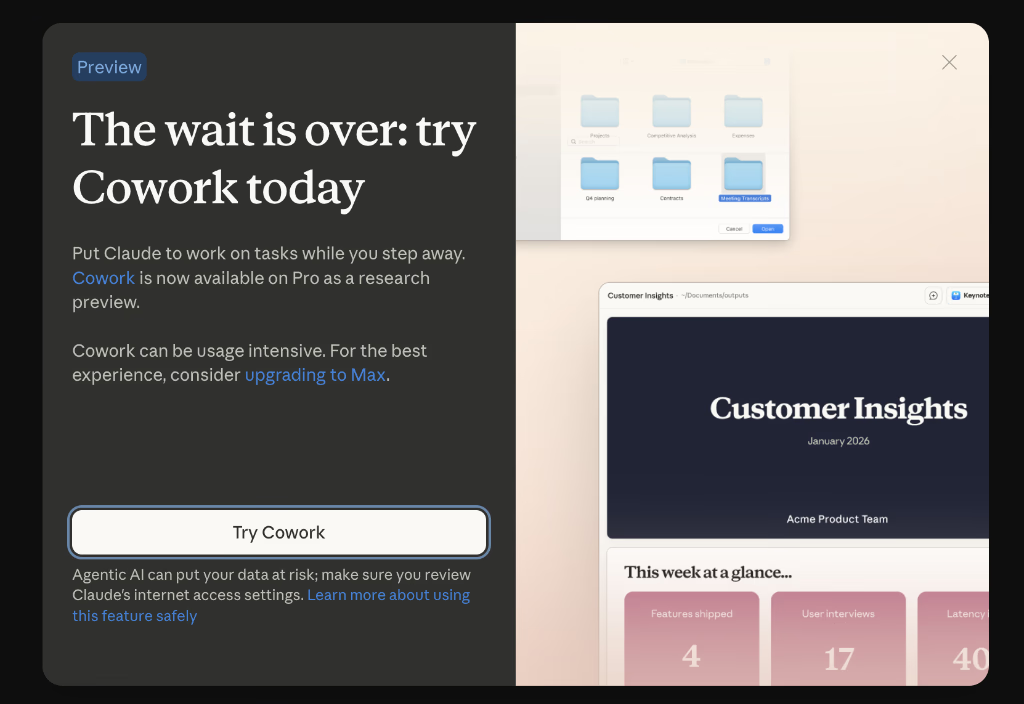
Cowork is available to Claude Pro subscribers (£16/month) with limited usage, and to Claude Max subscribers (£80-160/month) with full access, on macOS and Windows desktop, and, as of August 2026, rolling out to web and mobile as well.
This premium positioning is deliberate. Cowork consumes significantly more resources than standard chat; complex, multi-step tasks are compute-intensive and require more tokens to execute. The pricing reflects both the computational cost and the sophistication of the capability.

Critics have noted the steep barrier to entry. At £160 per month, Cowork costs considerably more than Microsoft Copilot's £25 per user, and alternatives like Elephas offer similar Mac-focused AI productivity features at a fraction of the price with offline capabilities.
📊 Looking for detailed pricing information?
See the complete Claude Cowork Pricing Guide for plan comparisons, competitor analysis, and FAQs about costs.
Anthropic has followed through on its expansion plans. Cowork reached Windows and cross-device availability months ago, and as of August 2026 the company is extending it further, to web and mobile.
Windows Release Date
Is Claude Cowork available on Windows? Yes.
Windows entered public beta on 10 February 2026 with full feature parity with macOS, and on 9 April 2026 Anthropic dropped the beta label entirely: Cowork reached general availability on both macOS and Windows simultaneously, included automatically on every paid Claude plan rather than gated behind a separate waitlist.
Anthropic has since kept expanding platform reach: as of August 2026, Cowork is rolling out to web and mobile as well, starting with Max subscribers and extending to other plans in the following weeks.
UK Availability
Claude Cowork is fully available in the United Kingdom for Pro and Max subscribers.
| Plan | GBP Price (VAT Excl.) | Status |
|---|---|---|
| Claude Pro | £16/mo | General Availability, limited usage |
| Claude Max | £80-160/mo | General Availability, full access |
Current Limitations: What Cowork Still Can't Do
Cowork has been generally available since April 2026 and is now expanding to web and mobile, but real constraints remain:
- Web/mobile rollout is gradual: as of August 2026, cross-device access is rolling out starting with Max subscribers, so not every plan has it yet
- No chat sharing: sessions remain on your machine or account rather than being shareable links
- No Projects support: cannot use Cowork within Claude Projects
- No memory across sessions: Claude doesn't retain information from previous Cowork sessions
- No artifact sharing: cannot share sessions with others
- Single folder at a time: cannot work across multiple directories simultaneously
These limitations reflect a still-maturing product rather than fundamental constraints. Anthropic has already resolved the platform-availability gap that dominated Cowork's first few months (macOS-only, desktop-only), and continues to iterate based on user feedback.
The Rise of the Super Individual
Claude Cowork represents more than a productivity tool, it's an embodiment of what some analysts call the "Super Individual" phenomenon. This concept describes how AI tools are enabling individual workers to accomplish what previously required entire teams.
AI as Force Multiplier
Consider the implications: a solo consultant can now process hundreds of documents, synthesise research across dozens of sources, and produce deliverables that would have required a team of junior analysts. A freelance developer can maintain multiple codebases with AI assistance that rivals having dedicated support staff. A content creator can research, write, edit, and format at a pace that would have been impossible just two years ago.
This force multiplication effect doesn't just make individuals more productive, it fundamentally changes the economics of knowledge work. The gap between what a single skilled person can accomplish with AI tools versus without them is widening rapidly. For video content creators, this transformation is already visible, see the analysis of AI-powered professional video creation.
Strategic Wisdom in Cowork's Architecture
Cowork's design reflects strategic wisdom that separates successful AI products from failed experiments. Rather than attempting to replace human judgment entirely, it positions itself as an execution layer, handling the mechanical work while humans retain strategic oversight.
The folder-based permission model is particularly clever. By requiring users to explicitly grant access to specific directories, Anthropic creates a natural boundary that:
- Limits blast radius if something goes wrong
- Forces users to think about what they're delegating
- Provides clear audit trails for enterprise deployment
- Reduces the surface area for security vulnerabilities
The Foundation First Principle
What makes Cowork notable is Anthropic's "Foundation First" approach. Rather than rushing to build flashy consumer features, they invested years in developing robust underlying capabilities, the Agent SDK, the sandbox architecture, the sub-agent system, before packaging them for mainstream users.
This patience is increasingly rare in the AI industry, where the pressure to ship quickly often trumps the need to build reliably. The graveyard of "pure AI" products that launched without solid foundations offers cautionary lessons that Anthropic appears to have learned.
File-System Access as Strategic High Ground
By claiming direct access to local file systems, Cowork occupies strategic high ground in the AI productivity landscape. While competitors like ChatGPT and Google Gemini operate primarily through cloud interfaces, Cowork can interact with files where they actually live, on users' machines.
This positioning has profound implications for enterprise adoption. Organisations increasingly want AI tools that can work with their existing file structures without requiring everything to be uploaded to cloud services. Cowork's local-first approach addresses privacy concerns that cloud-only solutions struggle to overcome.
The Bigger Picture: From Chatbot to Colleague
Cowork represents a broader philosophical shift in how AI assistants are conceptualised. For years, the industry focused on models that could answer questions. Cowork is part of a new generation focused on AI that can act on answers.
"The chatbot has learned to use a file manager," VentureBeat noted. "What it learns to use next is anyone's guess."
This transition from reactive assistants to proactive agents has profound implications:
Workflow Integration Over Model Intelligence
The bottleneck for AI adoption is shifting. Model intelligence is no longer the limiting factor, workflow integration and user trust are. Anthropic's goal, as they put it, is to make working with Claude feel less like operating a tool and more like delegating to a colleague.
The Speed of Iteration
If a major feature can be built in ten days by the company's own AI, the pace of capability development becomes almost impossible for competitors to match through traditional means. This compounds over time: each improvement enables faster development of the next improvement.
The Trust Question
Whether mainstream users are ready to hand over folder access to an AI that might misinterpret instructions remains an open question. The history of technology adoption suggests that convenience eventually outweighs caution, but the transition period carries genuine risks.
The Nature of Work Itself
Perhaps most significantly, Cowork hints at a future where AI handles much of the digital busywork that consumes modern workdays. File organisation, report compilation, data extraction, research synthesis, these tasks occupy enormous amounts of knowledge worker time. If AI can reliably handle them, it frees humans for higher-order work.
Or, less optimistically, it raises questions about the value of certain kinds of work altogether. The video content space is already grappling with these questions, OpenAI's Sora 2 raises similar concerns about AI's impact on creative workflows.
Our Take: The Editorial View
Greg's Thoughts
Claude Cowork is the most polished execution of the "agentic desktop" concept I've seen yet. While tools like Moltbot (Clawdbot) feel like power-user scripts, Cowork feels like a native OS feature. The ability to spawn sub-agents is a game-changer for batch processing files, it turns a serial task into a parallel one, which is where the real time savings live.
The catch? The price. At £80-160/month, this isn't for everyone. It's effectively a "tax" on high-value knowledge work. But if you're managing complex data or thousands of files, it pays for itself in a single afternoon.
My verdict: Anthropic has successfully bridged the gap between 'AI as a conversation' and 'AI as an employee'. Just watch those folder permissions closely.
Verdict: Revolutionary Capability, Research-Stage Reality
Cowork is simultaneously one of the most exciting and one of the most premature AI products released in recent memory.
What's genuinely impressive:
- The sub-agent architecture enables sophisticated parallel processing impossible in traditional chat interfaces
- The sandbox isolation provides meaningful security boundaries
- The speed of development, built in ten days by AI, demonstrates a new paradigm for product iteration
- The use cases are genuinely practical and address real pain points in knowledge work
Alternatives to Claude Cowork?
If you are looking for an open-source alternative that runs locally and connects to WhatsApp/Telegram, check the guide on Clawdbot. While Cowork is a polished enterprise product, Clawdbot offers a "DIY" approach for richer automation.
What gives pause:
- Security concerns around prompt injection remain fundamentally unsolved
- The £80-160 monthly price point ($100-200) excludes most potential users
- macOS-only availability limits the addressable market significantly
- The product is early and rough around the edges
Who should use it now:
- Claude Max subscribers on macOS who have high tolerance for early-stage products
- Knowledge workers with significant file organisation or document processing needs
- Users comfortable with the security trade-offs and willing to follow best practices
Who should wait:
- Anyone on Windows
- Users requiring enterprise security features and compliance certifications
- Those with limited budgets for productivity tools
- Anyone uncomfortable granting file access to AI systems
Looking Forward
Cowork is a preview of where AI productivity tools are heading, not just answering questions but completing tasks, not just suggesting edits but making them, not just participating in workflows but orchestrating them.
The risks are real and acknowledged. The limitations are significant. The price is steep. But the capability underneath is genuinely transformative.
If Anthropic can refine the safeguards, expand platform support, and develop the enterprise features necessary for serious organisational adoption, Cowork may prove to be an important step toward AI that truly earns its place at work. The technology is ready; the trust still needs to be built.
For now, Cowork represents what's possible when AI moves from conversation to action. Whether you're ready to delegate to it is a question only you can answer.
Claude Cowork reached general availability on macOS and Windows on 9 April 2026 and is included on every paid Claude plan, Pro (£16/month) and Max (£80-160/month). As of August 2026 it is also rolling out to web and mobile, starting with Max subscribers. Sign in at claude.ai to check availability on your plan.
Get the free guide: Claude vs ChatGPT, Gemini & Grok
A 20-page playbook covering everything you need to choose and use the big four AI models in 2026, full cost and feature comparisons, what each is best (and worst) at, and how-tos for images, vectors, building a website, Claude Code and more.