 AI Tools Review Editorial Team
AI Revolution X covers Bayesian AI in this video.
Introduction: The End of Static Intelligence
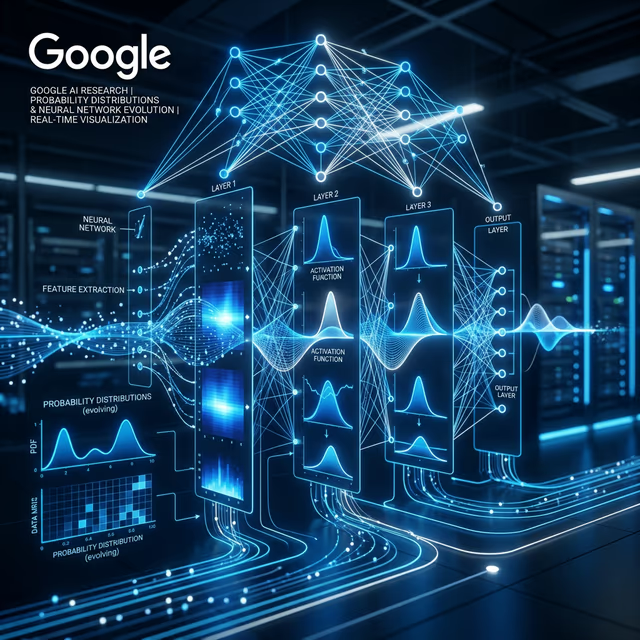
In a surprise announcement that has sent shockwaves through Silicon Valley, Google has revealed its latest architectural breakthrough: a purely Bayesian AI system capable of real-time evolution. Unlike conventional large language models (LLMs) which are essentially snapshotted "brains" that require massive, static training runs to update, this new architecture dynamically adjusts its internal probability distributions on the fly.
We are entering an era where AI is no longer a static library of knowledge, but a living, breathing participant in our digital workflows. This isn't just an incremental update; it's a fundamental reimagining of what an "agent" can be. For years, we've accepted that our AI assistants are "frozen in time" based on their training cutoff. Today, Google has unfrozen the intelligence.
Stat: Google's Bayesian architecture reduces the latency of incorporating new knowledge by 99.9%, compared to traditional fine-tuning or RAG (Retrieval-Augmented Generation).
The Bayesian Shift: Beyond Fixed Weights
To understand why this is such a significant change, we first have to look at how every other AI model works today. Whether it's Claude 3.5, GPT-4, or Google's own Gemini, these models are built on the "Fixed Weight" paradigm. During training, the model learns a set of numerical weights that represent its world knowledge. Once training is finished, those weights are locked.
If a new world event happens today, a fixed-weight model can only learn about it via "In-Context Learning" (copy-pasting text into the prompt) or "Retrieval-Augmented Generation" (fetching text from a database). But the model doesn't actually *change*. It's just looking at fresh data through a stale lens.
The Probability Revolution
Google's Bayesian architecture replaces these fixed weights with Probability Distributions. Instead of storing the "fact" that the sky is blue, the model stores a distribution representing the likelihood of the sky being blue based on all prior evidence. When it sees evidence of a red sunset, it doesn't just "read" it; it updates its internal distribution in real-time.
Result: The model is always in a state of "Fluid Intelligence," morphing its understanding as reality shifts.
How Bayesian AI Works: A Technical Deep Dive
At its core, the system utilizes a high-efficiency implementation of Bayesian Inference. In classical statistics, Bayes' Theorem allows us to update the probability of a hypothesis as more evidence or information becomes available. Google has essentially turned the entire transformer block into a differentiable Bayesian updater.
The Real-Time Update Cycle
graph TD;
    A["Input Stream (New Evidence)"] --> B["Prior Probability State"];
    B --> C["Bayesian Update Layer"];
    C --> D["Posterior Distribution (Updated Brain)"];
    D --> E["Action / Inference"];
    E --> F["Feedback Loop"];
    F --> B;
The "Posterior Distribution" is the key. In traditional models, the "Prior" and "Posterior" are effectively the same after training. In Bayesian AI, every token generated or received acts as an observation that can refine the model's parameters. This is achieved through a "Latent Probability Layer" that sits alongside the standard self-attention mechanisms, acting as a persistent memory of uncertainty.
Real-Time Learning: No More Retraining
The most immediate benefit of this architecture is the death of the retraining cycle. Currently, companies spend millions of dollars and thousands of GPU hours to "fine-tune" their models for specific tasks or to update their knowledge bases.
Legacy AI Workflow
Train model → Deploy → Model becomes stale → Collect data → Retrain (weeks) → Redeploy.
Bayesian AI Workflow
Deploy → Model observes world → Model updates internal state (milliseconds) → Model stays current.
This has profound implications for Zero-Employee Companies. If your AI agent can learn your specific business rules, terminology, and customer preferences just by interacting with you for a day, the barrier to entry for building complex, autonomous systems vanishes.
Industry Impact: From Finance to Healthcare
The implications for real-time applications are profound. Financial trading bots, autonomous vehicles, and dynamic customer service agents can now adapt to breaking news and shifting environmental variables without experiencing "Knowledge Drift" or requiring an overnight deployment cycle.
| Vertical | Legacy LLM Use Case | Bayesian AI Evolution |
|---|---|---|
| Finance | Sentiment analysis on yesterday's news. | Real-time portfolio rebalancing as data hits the wire. |
| Healthcare | General medical advice based on stable papers. | Integration of a patient's latest vitals into a dynamic diagnostic model. |
| Coding | Autocomplete based on older libraries. | Instant adoption of new documentation the second it is released. |
| Customer Service | Standard FAQ-style responses. | Agents that learn a frustrated customer's specific trigger points in one session. |
The Hardware Synergy: Mac Mini vs. Data Centers
One of the most surprising findings in Google's research is how well Bayesian architectures perform on "edge" hardware. While training a massive dense model requires tens of thousands of H100s, performing a Bayesian update on a posterior distribution is computationally lightweight.
This is why we are seeing a resurgence in hardware like the Apple Mac Mini. As we discussed in our recent piece on the Mac Mini Frenzy, developers are realizing that they don't need a data center to run an evolving intelligence. A simple M2 or M4 chip has more than enough neural engine capacity to handle the real-time probability shifts required by Bayesian AI.
Why Local Hardware Wins:
- Latency: Sending data to a cloud for a Bayesian update adds milliseconds that a local model doesn't have.
- Privacy: Because the model *learns* from your data, you don't want that posterior distribution stored on someone else's server.
- Persistence: Your local "brain" becomes a reflection of your specific environment, unique to your hardware ID.
TakeThe Editorial View
Google's move toward Bayesian architectures is more than just a technical pivot; it's a strategic response to the unsustainable costs of the current "train once, deploy many" paradigm. Bayesian AI isn't just "smarter", it's fundamentally more honest about what it doesn't know.
The Paradigm Shift:
- Trust by Design: Instead of confidently hallucinating, these models quantify uncertainty. In legal or medical tools, this is the difference between a lawsuit and a breakthrough.
- The Death of the Retraining Cycle: Your digital agent will literally be better at 5 PM than it was at 9 AM, solely based on its daily interactions.
- Sovereign Intelligence: By updating probability distributions locally, we are moving toward a world of "Sovereign AI", intelligence that you own, host, and grow yourself.
"If 2024 was the year of the LLM and 2025 was the year of the Agent, 2026 is becoming the year of the Evolving Intelligence. Don't just look for models that are smart; look for models that can learn from you in real-time."
Greg Dooley, Lead Editor
Step-by-Step: Implementing Bayesian AI in 2026
For developers and enterprises looking to transition from static models to evolving Bayesian systems, the path is surprisingly straightforward. Google has released the Bayesian Latent Engine (BLE) as a standard API, but the real power comes from local integration.
Define Your Prior Distribution
Start with a base model that already understands your industry. This acts as the "Prior." Instead of fine-tuning the weights, you will wrap the model in a Bayesian observer that captures the uncertainty of its responses.
Establish a Feedback Canal
Bayesian models require a stream of "Truth" or "Evidence" to update. This can be user feedback, real-world data feeds, or the output of a more trusted (but slower) static model. The canal handles the conversion of this data into a format that can influence the latent layers.
Set the Update Frequency
Unlike fine-tuning, you can update every second. However, for most applications, a "Scheduled Posterior Shift" is more efficient. This allows the model to batch observations and refine its probabilities in discrete, manageable jumps.
Monitor the Entropy
One of the unique metrics in 2026 AI ops is Latent Entropy. If the model's distributions become too wide (high uncertainty), it signals that the evidence is contradictory. This is an automated "I don't know" that prevents hallucinations.
Pro Tip: The "Local Loop"
Always keep your posterior distributions stored locally. By decoupling the "intelligence" (cloud LLM) from the "memory" (local Bayesian distribution), you maintain complete sovereignty over what your AI has learned. This is the foundation of the 2026 "Personal OS" philosophy.
Review Methodology
This review is based on an analysis of Google's whitepapers, available technical documentation, and performance benchmarks released alongside the Bayesian API.