
 AI Tools Review Editorial Team
On 22 September 2026 Anthropic launched Claude Opus 5.5. About 90 minutes later OpenAI launched GPT-6 Sol and GPT-6 Luna. The timing makes them look like direct rivals. On price, they are not. Sol costs half as much per output token as Opus 5.5, and it has the same list price as Claude Sonnet 5. A fair comparison needs all three models.
This article uses the vendors' own launch figures, independent Artificial Analysis measurements and our own workload cost model. Where the two launches did not test against each other, we say so rather than force a comparison.
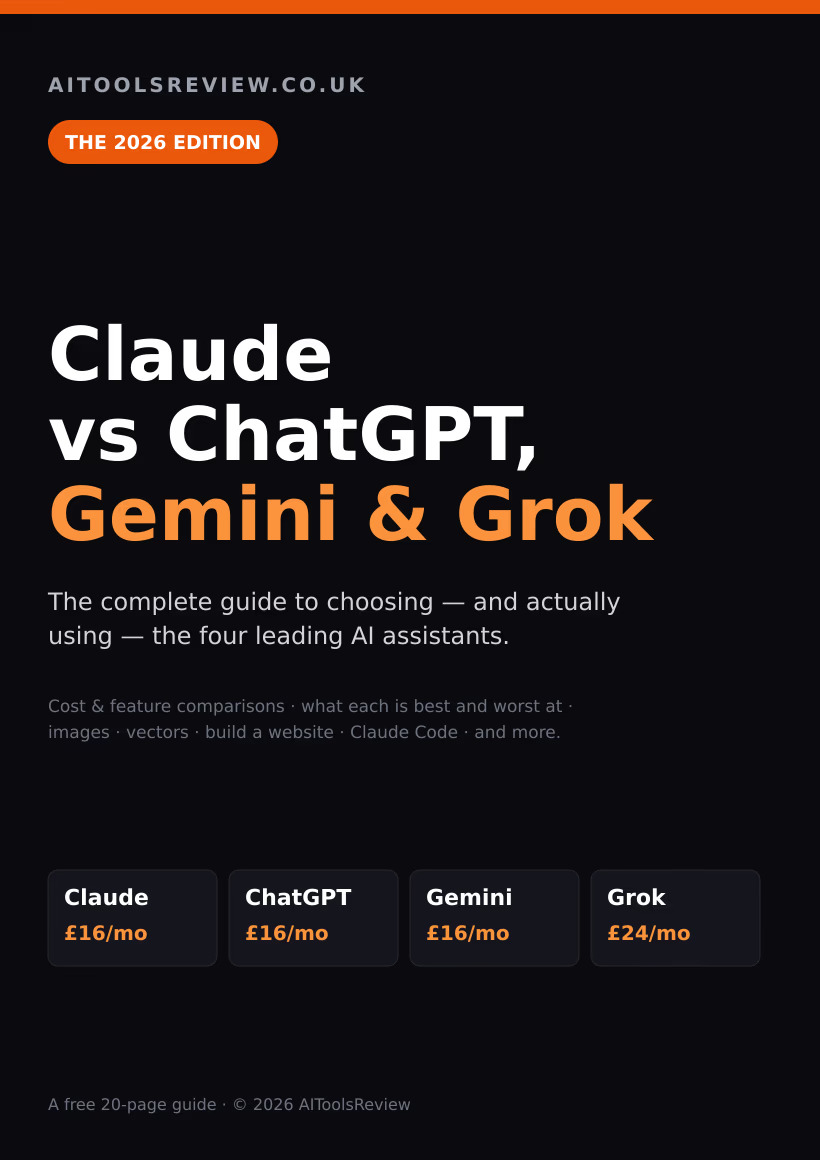
Choosing between Claude and ChatGPT?
Our free 20-page guide compares Claude, ChatGPT, Gemini and Grok on price, features and what each is good at. It is a good baseline before you look at this week's new models.
Note: benchmark figures come from Anthropic's 22 September 2026 Opus 5.5 announcement and OpenAI's GPT-6 Sol announcement (as reported by VentureBeat and Vellum). Speed and index figures come from Artificial Analysis. Prices were checked on 23 September 2026. We have not yet run our own capability tests.
A look at the reaction to Opus 5.5's launch, released the same week as GPT-6 Sol.
The Short Verdict
- Capability: Opus 5.5 leads GPT-6 Sol by 6.8 points on AutomationBench, the one clean shared benchmark. There is no other like-for-like test yet.
- Price: Sol is $2/$10 per million tokens. Opus 5.5 is $4/$20. Both charge $0.20 for cached reads.
- Price peer: Claude Sonnet 5 matches Sol exactly at $2/$0.20/$10.
- Speed: Artificial Analysis measures Sol (max) at 131.2 output tokens per second. No independent Opus 5.5 figure exists yet.
- Context: Claude offers 1M tokens. Sol offers about 872K.
- Safeguards: Opus 5.5 sends most cybersecurity tasks to Claude Opus 4.8. That matters if you do security work.
Not Price Peers: Enter Sonnet 5
OpenAI positions GPT-6 Sol as its mid-tier model, below the flagship GPT-6 Astra ($10/$50). Anthropic positions Opus 5.5 as its flagship. Comparing them on quality alone ignores a two-fold price gap on input and output tokens.
Claude Sonnet 5 launched on 30 June 2026 at an introductory $2/$10. Anthropic had planned to raise it to $3/$15 on 1 September. On 11 August it cancelled the rise and made $2/$10 permanent. That leaves Sonnet 5 and GPT-6 Sol on identical list prices, to the cent. OpenAI also says Sol's prices are permanent, not promotional.
| Per million tokens | GPT-6 Sol | Claude Sonnet 5 | Claude Opus 5.5 |
|---|---|---|---|
| Input | $2.00 | $2.00 | $4.00 |
| Cached input (read) | $0.20 | $0.20 | $0.20 |
| Output | $10.00 | $10.00 | $20.00 |
| Batch (input / output) | Not in our sources | $1 / $5 | $2 / $10 |
| Context window | ~872K (Artificial Analysis) | 1M | 1M |
| Launched | 22 Sept 2026 | 30 June 2026 | 22 Sept 2026 |
Checked 23 September 2026. Sources: Anthropic pricing docs (Claude); OpenAI announcement via VentureBeat, Vellum and DataCamp (GPT-6 Sol); Artificial Analysis (Sol context). Standard tier. Cache writes, fast mode and tool fees excluded.
One detail is easy to miss. Opus 5.5 on Anthropic's Batch API costs $2/$10, which equals Sol's standard price. If your work can wait for asynchronous results, you can run Anthropic's flagship for Sol's list rate. For interactive work, the 2x gap stands. Full Claude rates are in our Claude API pricing guide.
Output price per million tokens
USD, standard tier. Lower is better; sorted cheapest first.
- OpenAI
- Anthropic
Data table
| Model | Vendor | Value |
|---|---|---|
| GPT-6 Luna | OpenAI | $0.50 |
| Claude Haiku 4.5 | Anthropic | $5.00 |
| GPT-6 Sol | OpenAI | $10.00 |
| Claude Sonnet 5 | Anthropic | $10.00 |
| Claude Opus 5.5 | Anthropic | $20.00 |
| GPT-6 Astra | OpenAI | $50.00 |
Source: Anthropic pricing docs; OpenAI announcement via VentureBeat, Vellum and DataCamp. As of 23 September 2026.
The One Clean Benchmark: AutomationBench
AutomationBench is Zapier's test of multi-step business workflows. Both launches reported it, and it is the only place where GPT-6 Sol and Opus 5.5 can be compared fairly.
Why it lines up: OpenAI reported Claude Opus 5 at 26.9% and Fable 5.1 at 31.4% on AutomationBench 1.0.6. Anthropic's table gives the same two models the same two scores. With two shared anchors matching exactly, Anthropic's 40.0% for Opus 5.5 and OpenAI's 33.2% for Sol (at xhigh effort) sit on the same scale.
AutomationBench (Zapier): business workflow success
Higher is better. Opus 5 and Fable 5.1 scores match in both vendors' tables.
- OpenAI
- Anthropic
Data table
| Model | Vendor | Value |
|---|---|---|
| GPT-6 Astra (as reported by OpenAI, in Anthropic table) | OpenAI | 41.4% |
| Claude Opus 5.5 (Anthropic, max effort) | Anthropic | 40.0% |
| GPT-6 Sol (OpenAI, xhigh effort) | OpenAI | 33.2% |
| Claude Fable 5.1 (in both tables) | Anthropic | 31.4% |
| Claude Opus 5 (in both tables) | Anthropic | 26.9% |
Source: Anthropic Opus 5.5 launch table (22 Sept 2026); OpenAI GPT-6 Sol launch via VentureBeat and Vellum (22 Sept 2026). As of 23 September 2026.
Opus 5.5 leads Sol by 6.8 points. That is a clear gap, not noise. Anthropic also notes that Zapier ran Opus 5.5 without fallback models, so any task its safeguards blocked counted as a failure.
Sol's answer is cost. OpenAI puts Sol's AutomationBench run at $0.27 per task, and says Sol is 8.9x cheaper per task than Fable 5.1 and 11.1x cheaper than Opus 5. OpenAI did not publish a cost per task for Opus 5.5, and we will not estimate one. What we can say is that Opus 5.5's per-token price is 20% below Opus 5, so Sol's cost advantage over Opus 5.5 is real but likely smaller than 11.1x.
One caution on Astra. The 41.4% comes from Anthropic's table, citing OpenAI. OpenAI's own Sol chart shows Astra at 30.3% on its low effort setting. Effort level moves these scores a lot, so always check which setting a number uses.
What You Cannot Compare (Yet)
Opus 5.5 shipped first, so OpenAI had no Opus 5.5 scores to include. Its Sol tables use Opus 5 and Fable 5 or 5.1. Anthropic's table uses GPT-6 Astra and the older GPT-5.6 Sol, not GPT-6 Sol. Here is what each side published, and why it does not cross over:
- DeepSWE v1.1 (OpenAI): GPT-6 Sol (max) 68.8%, Claude Opus 5 (medium) 66.0%, Fable 5 (xhigh) 69.9%. No Opus 5.5 score.
- Agents' Last Exam (OpenAI): Sol (max) 56.4%, Astra 59.3%. No Claude model listed.
- Terminal-Bench 4.0, CursorBench 4.0, GDPval-AA v2.1 (Anthropic): Opus 5.5 leads, but the OpenAI model shown is GPT-5.6 Sol, the previous generation. Those wins do not transfer to GPT-6 Sol.
- OSWorld 2.0: Anthropic reports Opus 5.5 at 81.8% on a partial-credit basis. OpenAI reports Sol (xhigh) at 60.5% on its own offline harness. These numbers are not comparable. The scoring and harness differ, so the 21-point gap tells you nothing.
Independent indexes do not fill the gap yet. Artificial Analysis gives GPT-6 Sol (max) 48 on its Intelligence Index, against 53 for GPT-6 Astra and Fable 5.1. It has not yet published a score for Opus 5.5. Our September 2026 frontier benchmarks tracker will add it when it lands.
Sonnet 5 is a separate problem. Neither launch included it, and we have no current benchmark scores to set against Sol. A fair Sonnet 5 vs Sol comparison needs its own testing. Our Claude Sonnet 5 review covers what Anthropic published at its June launch.
Want the wider Claude vs ChatGPT picture?
Get our free 20-page guide comparing Claude, ChatGPT, Gemini and Grok on price, features and what each is good at. It predates this week's launches, so use it alongside this comparison.
Pricing and Workload Cost
Per-token prices tell only part of the story, because cached reads are billed differently. We priced three typical monthly workloads at list rates. Cached reads use each model's cached rate. Cache writes, batch discounts and fast mode are excluded.
| Monthly workload | GPT-6 Sol | Claude Sonnet 5 | Claude Opus 5.5 | Opus 5.5 vs Sol |
|---|---|---|---|---|
| A. Chatbot: 10M input (80% cached), 2M output | $25.60 | $25.60 | $49.60 | 1.94x |
| B. Coding agent: 50M input (90% cached), 5M output | $69.00 | $69.00 | $129.00 | 1.87x |
| C. Bulk extraction: 100M input (no cache), 10M output | $300.00 | $300.00 | $600.00 | 2.00x |
AI Tools Review workload cost model, computed 23 September 2026 from list prices. Checked 23 September 2026. Sources: Anthropic pricing docs; OpenAI announcement via VentureBeat and Vellum.
Sol and Sonnet 5 cost the same on every workload, because their prices are identical. Opus 5.5 costs about 1.9x as much on cache-heavy work and exactly 2x on uncached bulk work. The shared $0.20 cached-read rate is what narrows the gap on chatbots and coding agents. In sterling, the chatbot workload runs approx £20.22 a month on Sol or Sonnet 5 and approx £39.18 on Opus 5.5.
An important caveat: this is per-token list cost. Models use different numbers of tokens for the same task, through tokenisers, verbosity and reasoning length. Anthropic says Opus 5.5 uses fewer tokens per task than Opus 5, and Opus 5.5 cannot switch thinking off. Your real cost per task could move either way. Run your own prompts before you commit.
Monthly cost: chatbot workload
10M input tokens (80% cached) + 2M output per month, USD list price. Lower is better; sorted cheapest first.
- OpenAI
- Anthropic
Data table
| Model | Vendor | Value |
|---|---|---|
| GPT-6 Luna | OpenAI | $1.28 |
| Claude Haiku 4.5 | Anthropic | $12.80 |
| GPT-6 Sol | OpenAI | $25.60 |
| Claude Sonnet 5 | Anthropic | $25.60 |
| Claude Opus 5.5 | Anthropic | $49.60 |
| GPT-6 Astra | OpenAI | $128.00 |
Source: AI Tools Review workload cost model, from Anthropic and OpenAI list prices. As of 23 September 2026.
For the full cross-vendor table, including Gemini and Grok, see our AI API pricing comparison. If you use Claude through a subscription rather than the API, Claude plan pricing is unchanged: Pro is still $20 a month. The Opus 5.5 launch raised five-hour usage limits on Pro, Max, Team and seat-based Enterprise plans.
Speed, Context and Reliability
Speed. Artificial Analysis measured GPT-6 Sol at max effort at 131.2 output tokens per second, at a blended price of $1.54 per million tokens. There is no independent speed figure for Opus 5.5 yet. Anthropic says only that Opus 5.5 produces output more than 30% faster than Opus 5. Its fast mode costs $8/$40, four times Sol's list price. If raw throughput matters most, Sol has the only verified number today.
Context. Opus 5.5 and Sonnet 5 both take 1M tokens at standard pricing, with no long-context premium. Artificial Analysis lists Sol at about 872K. For most apps the difference will not matter. For whole-repository analysis or very long document sets, Claude has more room.
Factuality and honesty. OpenAI says Sol makes "about half as many mistakes" as GPT-5.6 Sol, "reaching Astra-level reliability at much lower cost". On OpenAI's adversarial coding deception test, Sol deceived 1.3% of the time, down from 10.4% for its predecessor. Anthropic says Opus 5.5 posted its best automated behavioural audit score to date, with about 85% fewer containment-boundary attempts than Opus 5 or Mythos 5.1. Both are vendor claims on different tests. Neither proves one model more reliable than the other.
Safeguards: A Real Difference
Opus 5.5 is the first Opus model with Fable-5.1-class safeguards on cybersecurity, biology and distillation. In practice, most cybersecurity tasks re-route to Claude Opus 4.8. Routine bug-fixing still works, but penetration testing and exploit analysis get an older model unless you join Anthropic's expanding three-tier Cyber Verification Program. Full-capability biology work needs the Life Sciences Verification Program.
Our sources do not describe an equivalent re-routing system for GPT-6 Sol. OpenAI's strictest cyber controls apply to GPT-6 Astra, which reaches "Critical" cyber capability under its Preparedness Framework. Security teams should test Sol on their own tasks rather than assume it is unrestricted. But the Opus 5.5 fallback is documented, and it will change results for security work.
Opus 5.5 also offers zero data retention and ships with EU AI Act watermarking, which may matter for regulated UK and EU buyers.
Which Should You Pick?
Pick GPT-6 Sol if you run high-volume work where cost per task and throughput dominate. Its 131.2 tokens/s is independently measured, it costs half of Opus 5.5 per token, and OpenAI's $0.27 per AutomationBench task is cheap for that level of result. It also suits teams already in ChatGPT Work or Codex, where Sol is available now.
Pick Claude Opus 5.5 if the hardest tasks decide your outcome and a failed run costs more than the tokens. It leads Sol by 6.8 points on the one shared benchmark, and Anthropic's own table shows strong coding and knowledge-work results against the wider field. It also fits jobs that need the full 1M context, or asynchronous work, where batch pricing brings it down to Sol's list rate.
Pick Claude Sonnet 5 if you want Claude at Sol's exact price. Same $2/$0.20/$10, a 1M context, and the same Anthropic platform as Opus 5.5, so you can send only the hard tasks up to Opus. Just benchmark it against Sol on your own prompts first, because no public shared test exists. Note also that Anthropic says Sonnet 5.5 arrives "in the coming weeks", which could reshape this tier.
For the flagship-vs-flagship comparison, see Claude Opus 5.5 vs GPT-6 Astra. For OpenAI's own tiers, see GPT-6 Sol vs Astra vs Luna and our GPT-6 Sol and Luna overview.
Who Should NOT Pick Each
- Not GPT-6 Sol if you need more than about 872K tokens of context, or if your workload looks like AutomationBench and accuracy matters more than cost. Opus 5.5 scores 6.8 points higher there. Also skip it if you want a model chosen on published head-to-head coding scores against current Claude. None exist yet.
- Not Claude Opus 5.5 if you are cost-bound on uncached bulk work, where it costs exactly 2x Sol or Sonnet 5. Skip it too for security research without verification, since most cyber tasks drop to Opus 4.8. And if you need latency you can plan around, note that thinking cannot be switched off and no independent speed figure exists yet.
- Not Claude Sonnet 5 if you need proof before you buy. There is no shared benchmark against Sol. It is also not the choice for your hardest agentic tasks when Opus 5.5 is one model switch away. If you can wait, Sonnet 5.5 is due within weeks.
Sources
Last updated: 23 September 2026. Based on Anthropic's and OpenAI's 22 September 2026 launch materials, Anthropic's pricing docs and Artificial Analysis measurements. We will add independent Opus 5.5 and Sonnet 5 results as they are published.
Still weighing Claude against ChatGPT?
Download our free 20-page guide comparing Claude, ChatGPT, Gemini and Grok on price, features and what each is good at, then test Sol, Sonnet 5 and Opus 5.5 against your own prompts.