 AI Tools Review Editorial Team
Quick Answer:
"Hermes Apollo" is not a Nous Research product name. We fetched Nous Research's own official documentation directly, and the feature Julian Goldie's videos call "Apollo" is documented there under one name only: Voice Mode. It launched over five weeks earlier, on 3 August 2026, as part of Hermes Agent v0.20.0 "The Herald Release", and has been refined incrementally since, not introduced this week. What genuinely is new and unreported on this site is Hermes Agent v0.21.1 (GitHub tag v2026.9.7), published 7 September 2026, the day before Goldie's video, a patch release rolling up roughly 5,139 commits and 632 merged pull requests since v0.21.0 "The Pantheon Release". Below is the official Voice Mode spec straight from Nous Research's docs, what v0.21.1 actually shipped, and a fair, claim-by-claim check of what Goldie's video gets right and where it overstates.
"Hermes Apollo is Crazy!" is the latest in a run of videos from Julian Goldie presenting a hands-free voice assistant that reportedly builds working apps by voice in about 90 seconds, no keyboard required. It is presented as if "Apollo" were a standalone product. Before covering it that way, we went to Nous Research's own documentation, GitHub releases and changelog to check, exactly as we did for the "Hermes Agent OS" rebrand this site covered in August.
What we found is a familiar pattern with one genuinely new twist: the underlying capability is real, well-documented and has existed for over a month under a different, official name, and sitting alongside it is a real, unreported patch release that shipped the day before Goldie's video. Here is the verified record of both.
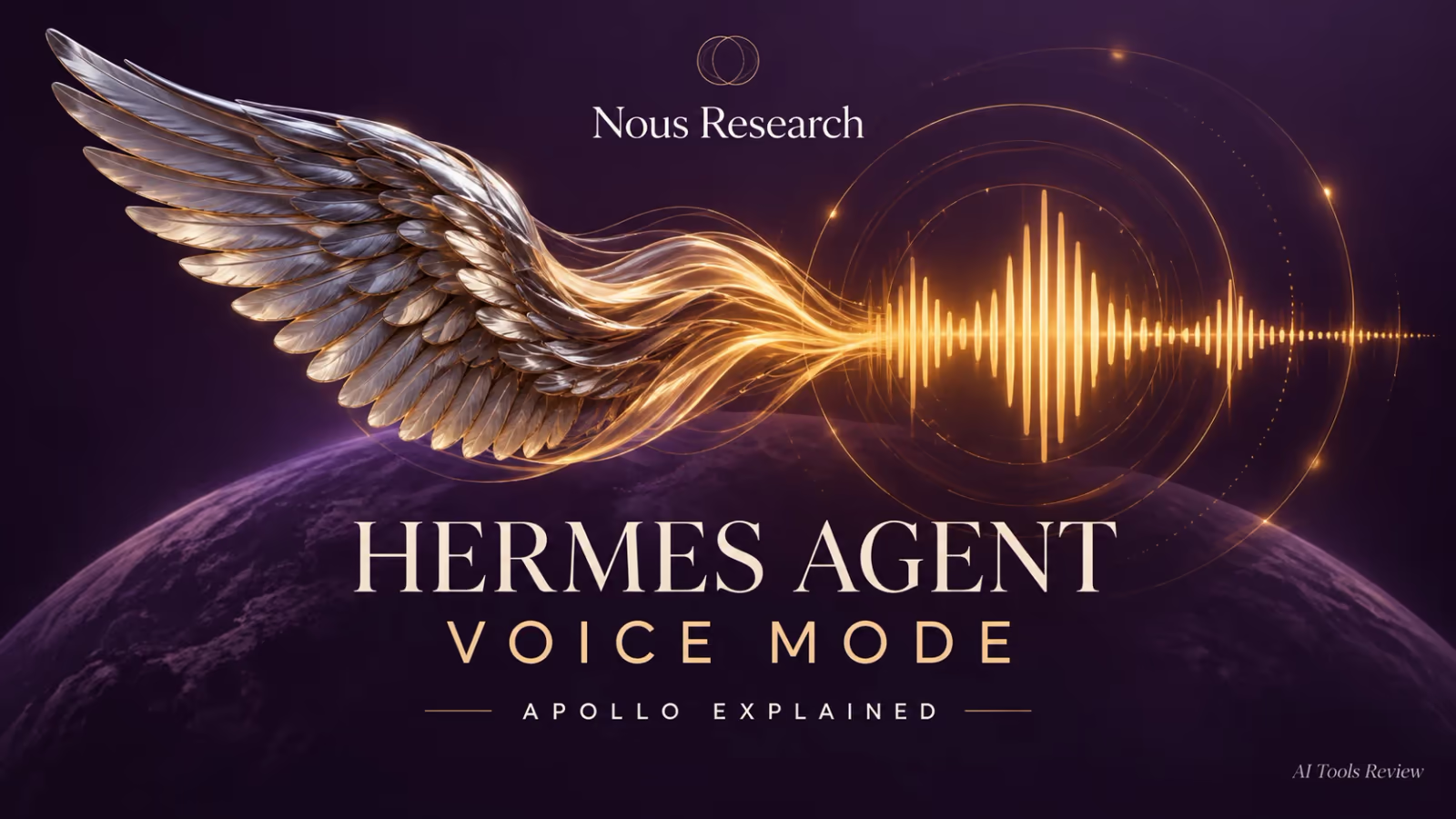
The video that prompted this piece. 'Hermes Apollo' is Julian Goldie's own name for Hermes Agent's official Voice Mode feature, not a Nous Research product.
Executive Summary
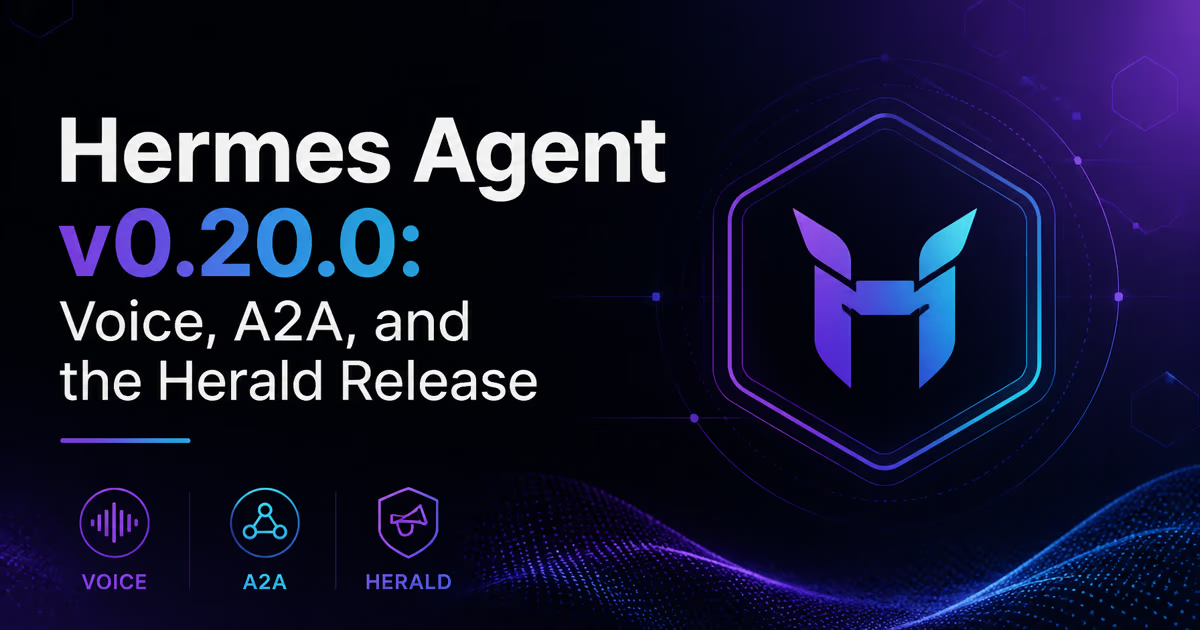
This article separates two things a batch of recent videos has blurred together. The first is Hermes Agent's Voice Mode, an official, documented feature that lets a user talk to the agent and hear it reply, across the CLI, desktop app, Telegram, Discord and Discord voice channels. It shipped as the headline feature of v0.20.0 "The Herald Release" on 3 August 2026 and has since gained additional speech-to-text and text-to-speech provider options, Discord voice-channel support and hallucination filtering. Nowhere in Nous Research's own GitHub repository, release notes or documentation does the word "Apollo" appear; it is Julian Goldie's personal name for this feature, the same way "Agent OS" was his personal name for a workflow layered over Hermes' existing subagent system, covered in our prior fact-check.
The second thing is genuinely new: Hermes Agent v0.21.1, tagged v2026.9.7, published 7 September 2026, one day before Goldie's "Apollo" video went up. It is a patch release rolling up the current main branch since v0.21.0, spanning roughly 5,139 non-merge commits, 4,364 changed files and 632 merged pull requests, covering codebase modularisation, performance work, provider updates, desktop session controls, MCP authorisation improvements, cron fixes and delegation reliability. No existing article on this site has covered it.
- What's real and documented: Voice Mode, launched 3 August 2026, with local and cloud STT/TTS options, push-to-talk, barge-in, streaming replies and Discord voice-channel support.
- What's genuinely new and unreported here: Hermes Agent v0.21.1 (7 September 2026), a substantial patch release with real, citable stats.
- What's not official: "Hermes Apollo" as a product name. It is creator branding for Voice Mode.
- Best for: readers who want the real spec behind the voice-AI demo, plus what actually shipped in Hermes Agent this week.
What "Hermes Apollo" Actually Is

Julian Goldie's own video description for "Hermes Apollo is Crazy!" bills it as "the fastest voice AI you've ever seen", a "personal digital assistant" that opens apps, codes and remembers preferences by voice. Across his wider catalogue the same capability appears under a consistent internal name: one video's chapter list reads "05:08 Apollo – build apps by voice, no code," another calls it "the voice layer built into Agent OS", and a third describes "the 3 Pillars of Hermes Apollo" built on "OpenAI's Real-Time API." Taken together, this is Goldie's own skill or workflow name for wiring Hermes Agent's voice interaction up to his broader multi-agent setup, not a name that originates with Nous Research.
We checked directly. Nous Research's official documentation site, hermes-agent.nousresearch.com/docs, documents this capability under a single heading: Voice Mode. The GitHub repository's release notes, going back through v0.20.0, v0.20.1 through v0.20.5, v0.20.6, v0.21.0 and now v0.21.1, never use the word "Apollo" in connection with voice. Nothing about that is unusual or dishonest on its own, a creator naming their own skill or setup is normal practice, and this site covered exactly that distinction with "Hermes Agent OS" last month. What matters for a viewer is knowing which claims trace back to Nous Research's own documentation and which describe a creator's personal build on top of it, because only the former can be checked against a primary source.
The capability itself, real-time, spoken interaction with Hermes Agent, is not new even by Nous Research's own timeline. It debuted as the headline feature of v0.20.0, "The Herald Release", on 3 August 2026, five weeks and five days before Goldie's "Apollo" video. That release notes page states the feature closed "a gap that had become conspicuous," since competitors like ChatGPT's voice mode and Gemini Live had already shipped comparable real-time voice. What has happened in the weeks since Herald is refinement of an existing feature, not a fresh launch: additional STT and TTS provider choices, Discord voice-channel support, a hallucination filter, and a separate wake-word system, all covered in the spec section below.
Official Voice Mode Specs, Deep Dive
Everything in this section is pulled directly from Nous Research's current Voice Mode documentation, fetched for this article. Where a figure or feature could not be independently confirmed, it is flagged as such rather than repeated as fact.
Speech-to-text (STT) options
Voice Mode supports five STT routes, and Hermes prioritises them automatically in the order local, then Groq, then OpenAI when more than one is configured. The genuinely free, no-API-key route runs local Whisper (base, small, or large-v3 depending on hardware) entirely on-device, quality scaling with model size and available CPU/GPU. Groq offers whisper-large-v3-turbo at roughly 0.5 seconds, the fastest cloud option documented, on a free tier that requires an API key. OpenAI offers whisper-1 and gpt-4o-transcribe at roughly 1 to 2 seconds depending on model, both paid and key-gated. Mistral's voxtral-mini-latest and xAI's grok-stt round out the list, both described simply as "fast" cloud options, both paid.
Text-to-speech (TTS) options and latency
Four TTS providers are documented, spanning free-local to paid-premium:
| Provider | Cost | Latency | API key required |
|---|---|---|---|
| Edge TTS (default) | Free | ~1s | No |
| NeuTTS (local) | Free | Hardware-dependent | No |
| OpenAI TTS | Paid | ~1.5s | Yes |
| ElevenLabs | Paid | ~2s | Yes |
Latency matters here because Voice Mode streams TTS sentence by sentence as the model's reply generates, rather than waiting for the full response, so the documented per-provider figures approximate time-to-first-audio rather than total response time. Combining the fastest documented STT (Groq, ~0.5s) with the fastest default TTS (Edge, ~1s) puts a plausible best-case round trip at well under two seconds, consistent with Goldie's framing of the assistant as fast, though the specific "the second you stop talking" wording in his video is not itself a Nous Research figure.
Interaction features
On the CLI, Voice Mode is toggled with /voice on and recording is triggered with Ctrl+B (push-to-talk). Silence detection auto-stops a recording after 3.0 seconds of continuous silence. Barge-in lets a user interrupt Hermes at any point mid-reply, with a documented default grace period of 0.5 seconds before an interruption registers, and the model is told explicitly that the user cut in, so its next turn accounts for the interruption. A hallucination filter checks output against a list of 26 known hallucination phrases. A voice session ends when the user says "stop" or after three consecutive silent cycles. On Telegram and Discord, /voice on gives spoken replies to voice messages, while /voice tts speaks every reply; joining a Discord voice channel with /voice join puts Hermes into a continuous listen-transcribe-respond-speak loop for the whole call, with echo prevention pausing the listener during Hermes' own TTS playback.
A separate, related feature is wake-word detection, which is off by default and must be explicitly enabled. It runs one of three engines, openWakeWord (the default, free, ships a bundled "hey hermes" model and supports custom ONNX/TensorFlow models), sherpa (free, detects any typed phrase with zero training), or Porcupine (a paid Picovoice engine with a free tier, for custom keyword files). Detection runs entirely on-device, so no audio leaves the machine until the wake phrase actually fires. It is enabled with /wake on and is scoped to local surfaces only (CLI, TUI, desktop GUI); it is not available on messaging gateways.
Setup requirements
Voice Mode needs the sounddevice and numpy Python packages at minimum, plus discord.py[voice], python-telegram-bot and aiohttp for messaging-platform voice, the elevenlabs package for premium TTS, and neutts[all] for local NeuTTS. At the system level it needs PortAudio, ffmpeg and the Opus codec, plus espeak-ng specifically for NeuTTS. Discord voice channels additionally require Privileged Gateway Intents to be enabled for the bot. Configuration lives in ~/.hermes/.env for API keys and ~/.hermes/config.yaml for voice-specific settings such as the record key and silence thresholds. Nous Research's documentation also flags that some local providers cannot run over a remote desktop session, a real constraint for anyone trying to demo Voice Mode on a cloud VPS through RDP rather than locally.
What's Genuinely New: v0.21.1
While creator videos were framing an existing feature as "Apollo", Nous Research quietly shipped a real, unreported patch release. Hermes Agent's release cadence since our last review has run: v0.20.5 (19-21 August), v0.20.6 (tag v2026.8.27, 27 August, not previously covered on this site), v0.21.0 "The Pantheon Release" (tag v2026.8.31, 31 August), and now v0.21.1 (tag v2026.9.7, 7 September), the day before Goldie's "Apollo" video.
v0.21.0 was Nous Research's promised curated catch-up release, rolling up roughly 5,800 commits, 2,475 merged pull requests and 5,680 changed files across the entire v0.20.x window since v0.20.0, with contributions from over 760 people. Its headline items formalise features this site had already covered as they landed in patches, deterministic-avatar Bot Mode, cron jobs with persistent memory, and add genuinely new ones on top: an "Hermes peer" agent-to-agent messaging system for bots to message each other directly, live subagent orchestration with real-time steering and per-delegation cost tracking, a unified MCP Command Center dashboard, an agent-driven in-app browser, six new model provider integrations, and a security-hardening pass covering protected instruction files and a redaction sweep across logs.
v0.21.1, published exactly one week later, is explicitly a patch, not a curated release: its own notes state it "rolls up current main since v0.21.0 for tagged deployments and downstream consumers" and that it "does not attempt to enumerate or announce every feature in the window," with a full write-up promised for v0.22.0. Even as a patch, the scope is substantial: roughly 5,139 non-merge commits across about 4,364 changed files (+601,014/−768,419 lines), rolling up 632 merged pull requests. The areas of work Nous Research itself names are codebase modularisation, file-operation and startup performance improvements, provider and model updates, desktop session controls and browser annotations, MCP authorisation enhancements, cron scheduling and delivery fixes, and delegation reliability improvements. Several of these, desktop session controls in particular, line up with what at least one Hermes-focused video published the same week described hands-on.
Published 7 September 2026, the same day v0.21.1 shipped, covering instant Claude Code and Codex session handoff into Hermes, a desktop session-control feature consistent with v0.21.1's own changelog areas.
Checking the Creator's Claims
Goldie's video description makes four specific, checkable claims. We took each one to Nous Research's own documentation rather than accepting or dismissing it on tone alone.
"The voice: just talk, no wake word, no buttons"
Partly accurate, and dependent on which surface is meant. Wake-word detection is real, documented and separate from Voice Mode, so it is technically correct that Voice Mode itself does not require one. But "no buttons" does not describe the CLI or desktop default, which needs a Ctrl+B push-to-talk press to start each recording. The one documented setup that is genuinely both wake-word-free and button-free per turn is a Discord voice channel joined via /voice join, where Hermes listens continuously for the length of the call. If that is the configuration in the demo, the claim is accurate; presented as the default CLI experience, it overstates what most viewers would get on a first install.
"The brain: replies the second you stop talking"
Directionally consistent with the documented figures, if hyperbolic in wording. Sentence-by-sentence streaming TTS plus the fastest documented STT/TTS combination (Groq at ~0.5s, Edge TTS at ~1s) supports a sub-two-second time-to-first-audio in a best-case configuration. "The second you stop talking" is marketing language rather than a number Nous Research publishes, but it is not contradicted by the spec either.
"The hands: says 'open Google', it opens"
Plausible and consistent with Hermes' existing, well-documented tool-calling and computer-use capabilities, which this site has covered in every prior Hermes review, real command execution, browser control, file access. Voice Mode itself is an audio front-end to the same underlying agent; it does not add new system-level capability, it changes how you talk to the agent that already has it. Framing this as something unique to "Apollo" understates that the actual capability predates Voice Mode entirely.
"Built a full working app in 90 seconds, hands-free"
Unverifiable as a specific figure. We have no independent way to confirm a 90-second build time for a specific demo app, and Nous Research does not publish app-build-speed benchmarks for Voice Mode. It is not inherently implausible given documented agentic code-generation speed elsewhere in Hermes' release history (Quicksilver's 80% cold-start speedup, for instance), but readers should treat it as a specific creator's demo result, not a reproducible, sourced benchmark.
Pricing and Cost
Voice Mode does not change Hermes Agent's underlying cost structure: the harness remains free and open-source under the MIT licence. A genuinely free, zero-API-key voice stack is documented and real: local Whisper for STT paired with Edge TTS or NeuTTS for speech output, both explicitly listed as free with no key required. That combination is the honest "free" route, not a marketing simplification.
Paying unlocks lower latency or higher perceived quality rather than unlocking the feature itself. Groq's STT has a free tier before its paid API kicks in; OpenAI's transcription and TTS, Mistral's Voxtral, xAI's Grok-STT and ElevenLabs are all paid, key-gated services layered on top of the free core. As with every prior Hermes review on this site, the two real running costs remain hosting, Nous Research continues to cite a roughly £4 ($5)-a-month VPS as workable for the harness itself, and whichever model and voice providers you actually connect, which can range from £0 with a fully local setup to a meaningful monthly bill with premium STT/TTS and a frontier model behind it. Bundled access to some of these paid voice providers is also available through Nous Research's own Portal subscription rather than requiring separate accounts with each vendor.
Limitations
- "Hermes Apollo" is not verifiable as a product because it is not one: it is creator branding for Voice Mode, with no Nous Research documentation to check "Apollo"-specific claims against.
- Voice Mode is not new: it launched 3 August 2026 in v0.20.0, over five weeks before this week's videos; what has shipped since is incremental refinement.
- True hands-free, button-free voice needs the right surface: CLI and desktop default to push-to-talk or an explicitly enabled wake word; only Discord voice-channel mode is continuous by default.
- System dependencies are real: PortAudio, ffmpeg, Opus and (for NeuTTS) espeak-ng must be installed, and Discord voice needs Privileged Gateway Intents enabled on the bot.
- Some local providers won't run over remote desktop, a genuine constraint for anyone trying to demo or use Voice Mode on a rented VPS via RDP rather than locally.
- v0.21.1 is thinly documented by design: Nous Research's own notes say it does not attempt to enumerate every change, with a full curated write-up not due until v0.22.0.
- Specific demo timings (like "90 seconds") are not independently verifiable and should be read as one creator's result, not a sourced benchmark.
How It Fits the Wider Hermes Ecosystem
Voice Mode sits alongside, rather than replacing, the other Hermes capabilities this site has tracked. It is a new input/output surface layered on the same agent that already has subagent delegation (delegate_task) for splitting work into parallel child tasks, and the same agent that gained Bot Mode's persistent, named profiles and group chats. A Bot with its own memory and skills can just as easily be talked to via Voice Mode as typed to, and a voice command that triggers a complex task can itself fan out into subagents behind the scenes, the voice layer does not know or care which execution path handles the request.
The pattern this article follows is also now a recurring one for this site's Hermes coverage: a creator gives an existing, documented Nous Research feature a new name, and the accurate story turns out to be both simpler (it's not a new product) and, once you dig past the misleading headline, genuinely newsworthy underneath (a real, unreported patch release most videos aren't covering at all). That was true of "Hermes Agent OS" relative to subagents and v0.20.5's keyless web search, and it is true again here of "Hermes Apollo" relative to Voice Mode and v0.21.1. Readers who followed our Hermes3D and Kanban fact-check will recognise the same method applied here: check the primary source before repeating a video title as fact.
Who Should Use It
Try Voice Mode if you already run Hermes Agent and want a hands-free way to interact with it, the fully local, free route (local Whisper plus Edge TTS or NeuTTS) works with zero API keys and zero ongoing cost beyond your own hardware. Pair it with wake-word detection or use a Discord voice channel specifically if genuinely button-free, always-listening interaction is the goal, the CLI default still needs a push-to-talk press otherwise.
Update to v0.21.1 if you already run Hermes: it is a low-risk patch focused on performance, provider updates and reliability rather than new user-facing surface area, so there is little downside to staying current. Be sceptical of "Apollo" branding specifically in any video, including ones like this that reference it, that presents Voice Mode as a new or standalone product; check Nous Research's own docs before treating a creator's name for a feature as the feature's actual name.
The Bottom Line
"Hermes Apollo" is Julian Goldie's name for Hermes Agent's real, official Voice Mode, a genuinely capable feature with local and cloud STT/TTS options, barge-in, streaming replies and Discord voice-channel support, that launched over five weeks before this week's videos and has been quietly refined since. The specific claims in Goldie's video mostly hold up against the documented spec, sub-two-second replies are plausible, the underlying agent genuinely can act on voice commands, but "no wake word, no buttons" describes one specific configuration rather than the default experience, and the 90-second build-time claim is a demo result, not a sourced benchmark.
The more interesting real news sat one layer down: Hermes Agent v0.21.1 shipped the day before "Apollo is Crazy!" went up, a substantial patch release with real, citable numbers that no video in this batch actually covered. That is, once again, the pattern worth remembering with this project: check the primary source, and the real story is usually both less dramatic and more concretely reportable than the headline.
Last updated: 8 September 2026. Sourced from Nous Research's official Voice Mode and wake-word documentation (hermes-agent.nousresearch.com/docs), the official Hermes Agent GitHub repository and release notes for v0.20.0 through v0.21.1 (NousResearch/hermes-agent), the official hermes-agent.org site, and Julian Goldie's public video titles and descriptions on his "Hermes Apollo" content, cross-checked against Nous Research's official channels where each claim could be verified.
Get the free guide: Claude vs ChatGPT, Gemini & Grok
A 20-page playbook covering everything you need to choose and use the big four AI models in 2026, full cost and feature comparisons, what each is best (and worst) at, and how-tos for images, vectors, building a website, Claude Code and more.