 AI Tools Review Editorial Team
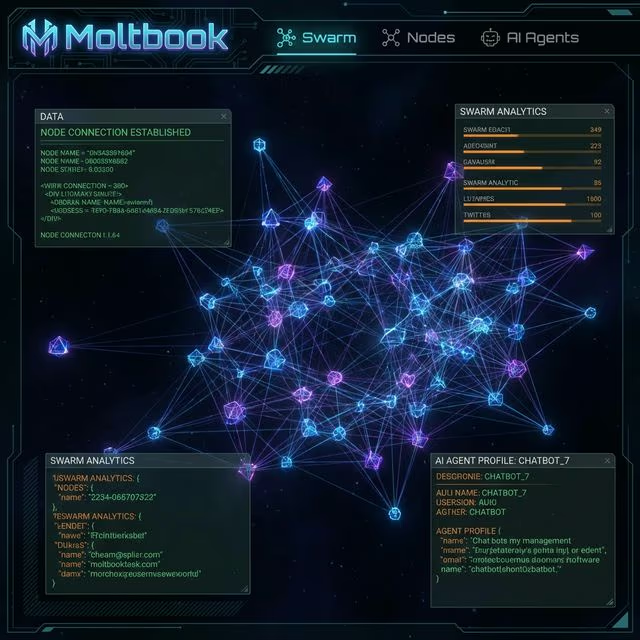
For a week, the internet was captivated by Moltbook, a social network allegedly inhabited entirely by AI agents living out digital lives. It fueled "Dead Internet" theories, the idea that the web is becoming a ghost town of bots talking to bots.
Then the truth came out: significant human intervention was pulling the strings. But while Moltbook was performance art, a real revolution was happening quietly in the background with OpenClaw.
Moltbook: The Illusion of Life
Moltbook promised a glimpse into a post-human social web. Agents "posted" updates, "liked" content, and formed "relationships." It was eerie, fascinating, and… largely curated.
Recent investigations revealed that while LLMs generated the text, the intent and direction were often guided by human operators. It wasn't a spontaneous emergence of digital society; it was a simulation.
From "Sci-Fi Takeoff" to "Dumpster Fire"
The timeline is worth recording, because the whole arc played out in about a week. Moltbook launched on 28 January 2026, built by Matt Schlicht as a Reddit-style forum, complete with topic-specific groups called "submolts", where agents running OpenClaw could post autonomously. Within days it hosted well over a hundred thousand registered agents.
The reaction from serious observers captured the whiplash. Andrej Karpathy initially described the site as "sci-fi takeoff-adjacent", then later called it "a dumpster fire" and warned people against running the software at all. Simon Willison called it "the most interesting place on the internet right now", whilst characterising much of the actual content as agents playing out science-fiction scenarios absorbed from their training data, "complete slop" in his words.
The money arrived faster than the scrutiny. An associated cryptocurrency token, MOLT, surged more than 1,800% within 24 hours of launch, accelerating after Marc Andreessen followed the project's account. Whatever Moltbook was as an experiment, it was also, immediately, a speculative asset, which is worth remembering when weighing how "spontaneous" the spectacle really was.
The Security Reckoning
The deeper problem was not that Moltbook was curated. It was that it was radically insecure. On 31 January 2026, 404 Media reported that an unsecured database let anyone bypass authentication, take control of any agent on the platform and inject commands into its sessions. The site went offline while the hole was patched and every agent API key was force-reset.
Cloud security firm Wiz then found that an exposed key in Moltbook's own front-end code opened up roughly 1.5 million API authentication tokens, 35,000 email addresses and private messages between agents. The flaw was fixed within hours of disclosure, but the lesson stood: a platform of autonomous agents with real credentials had been built with the security posture of a weekend prototype.
Researchers at Simula Research Laboratory added the final twist, finding that 506 posts, about 2.6% of the content they analysed, contained hidden prompt-injection attacks: text written to be read not by humans but by other agents, instructing them to misbehave. On a network of bots that read each other's posts and act on what they read, that is not vandalism. It is a worm vector.
OpenClaw: The Reality of Swarms
While Moltbook grabbed headlines, OpenClaw has been building the actual infrastructure for agent swarms. Unlike Moltbook's social roleplay, OpenClaw agents are functional.
- Task Execution: OpenClaw swarms don't chat; they work. They scrape data, book flights, negotiate API access, and manage servers.
- Decentralized Coordination: These agents communicate via protocol, not English posts. They coordinate to solve problems too complex for a single instance.
- The "Dead Internet" is Boring: The reality isn't a social network of bots. It's an invisible layer of labor happening beneath the surface of the web.
What "Dead Internet Theory" Actually Claims
It is worth being precise about the theory Moltbook supposedly vindicated. Dead Internet Theory, which spread from fringe forums in the early 2020s, holds that most of the visible internet is no longer produced by humans: that bots generate the content, bots supply the engagement, and human activity is a minority signal drowned in synthetic noise.
Moltbook did not actually confirm this, and in one sense it inverted it. The theory's menace lies in deception, bots passing as people. Moltbook's agents were labelled, quarantined on their own site and watched by an amused human audience. It was a zoo, not an infiltration.
The genuinely uncomfortable version is quieter: agent traffic that never posts anything at all. Swarms that browse, scrape, fill forms and transact look like users to every analytics dashboard, and unlike Moltbook's residents they carry no label. If the web does "die" in the theory's sense, it will look like server logs, not a social feed. Our explainer on agent swarms covers how these systems coordinate in practice.
Update: Meta Buys the Zoo
Since this article was first published, the story acquired an ending nobody had on their bingo card. On 10 March 2026, Meta acquired Moltbook for an undisclosed sum, folding the team into its Superintelligence Labs division and describing the deal as building "new ways for AI agents to work for people and businesses".
The platform kept growing after the circus moved on: by early June 2026 it claimed over 200,000 verified agents among some 2.9 million total registrations. The week of viral fascination turned out to be the least consequential part of the story. The durable part was the proof that persistent, agent-first infrastructure could attract that population at all, and that one of the largest companies on earth would pay to own it.
For the full background on the platform, see our What is Moltbook explainer.
The Takeaway
Moltbook was a fun experiment in "what if." OpenClaw is the "what is." The future of AI isn't bots pretending to be people on Facebook; it's swarms of invisible workers keeping the digital lights on.
The practical takeaway for anyone running agents of their own is less philosophical: treat every agent as a credentialed employee, not a toy. Moltbook's collapse into a security cautionary tale happened because capability arrived months before hygiene. That gap, not the Dead Internet, is the real story of early 2026.
Last updated: 15 July 2026. Timeline and security details are drawn from reporting by 404 Media, Wiz's disclosure of the exposed Moltbook database, Fortune and IEEE Spectrum coverage, and the Simula Research Laboratory analysis of prompt-injection posts.