 AI Tools Review Editorial Team
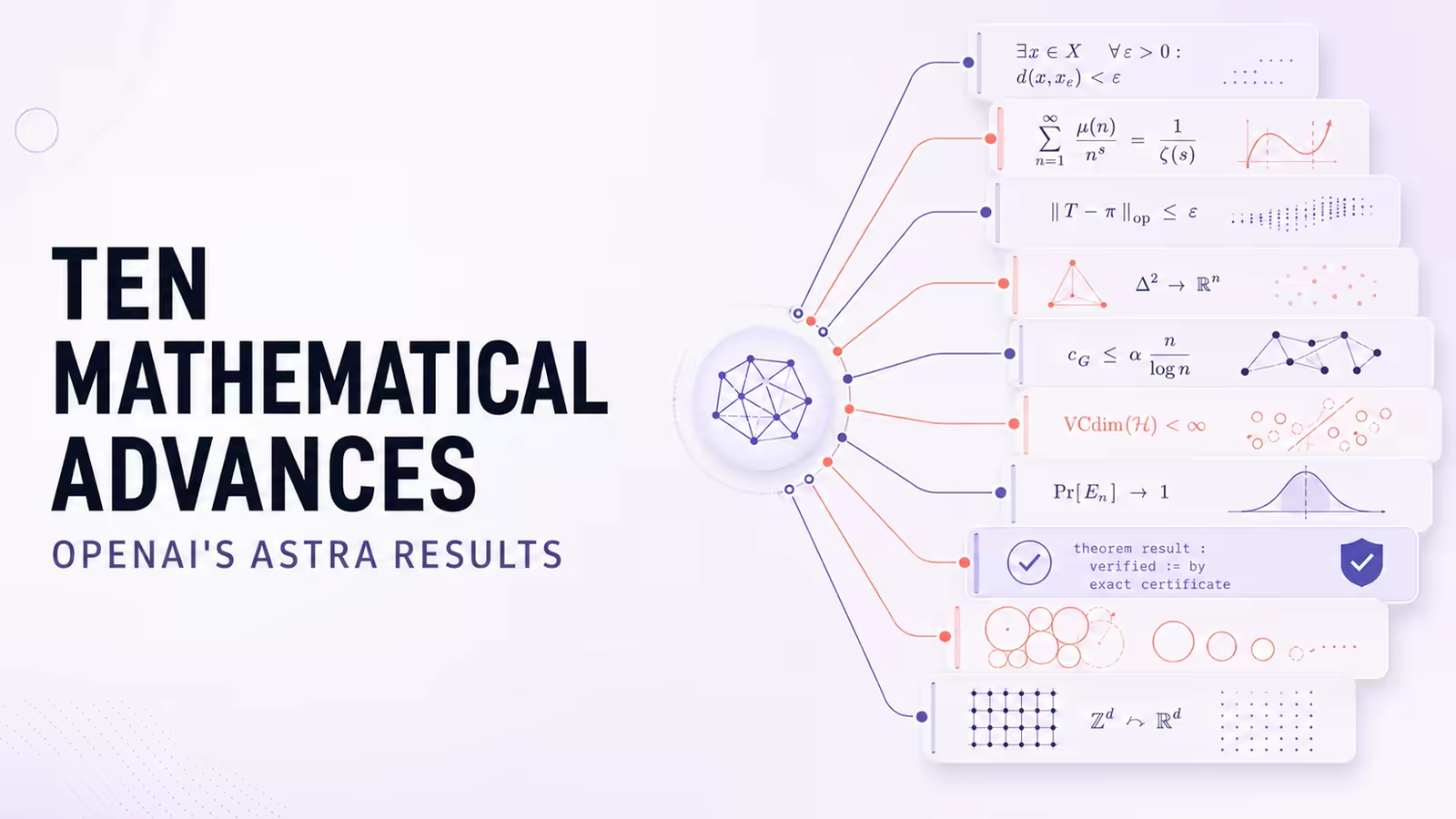
OpenAI says an internal AI model has produced ten new results in mathematics and theoretical computer science. If the claims withstand scrutiny, the work would be stronger evidence of AI-assisted research than another rise on a benchmark leaderboard.
The company has published a 249-page collection of arguments, 62 pages of narrated discovery notes and a repository of Lean certificates. That gives mathematicians unusually detailed material to inspect. It does not mean the ten results should immediately be treated as settled community consensus.
What OpenAI announced
On 1 August 2026, OpenAI released ten results covering problems in high-dimensional geometry, coding theory, group theory, operator algebras, circuit complexity, quantum complexity, lattice cryptography and extremal combinatorics.
OpenAI says each main problem had been open without progress on its central result for at least a decade, and usually longer. The arguments were generated by an internal version of Astra, which OpenAI calls its next major model. Astra is not a public product and no release date was announced.
The careful wording matters. OpenAI has released claimed advances with proofs, not simply announced that a model answered ten questions correctly. Acceptance now depends on specialists checking whether the formal and informal statements match, whether the assumptions are appropriate and how the results fit existing literature.
The ten claimed advances
| Area | OpenAI's published claim |
|---|---|
| Sphere packing | New high-dimensional density upper bounds reaching the Cohn–Elkies threshold |
| Binary and spherical codes | Exponential improvements to classical upper bounds across prescribed distances |
| Group theory | An explicit construction establishing the existence of non-sofic groups |
| Operator algebras | A disproof of Connes's rigidity conjecture |
| Arithmetic circuits | New lower bounds for computing the permanent, including an n⁴/log n formula bound |
| Quantum complexity | Exponential parallel repetition for general finite two-player entangled games |
| Lattice problems | Polynomial-factor hardness for approximating the closest vector problem |
| Convex geometry | A proof of the sharp bound in Ehrhart's volume conjecture in every dimension |
| Ramsey theory | A superexponential lower bound resolving Erdős problem 183 |
| Extremal graph theory | Counterexamples resolving the compactness and degeneracy conjectures |
Several claims are striking in their own right. The sphere-packing chapter describes the first improvement since 1978 to the general high-dimensional exponent. The non-sofic-group construction addresses a central existence question, while the closest-vector result concerns a lattice problem relevant to post-quantum cryptography.
Those descriptions come from OpenAI's publication. They should remain attributed until field experts have assessed the work independently.
How the results were produced
OpenAI says Astra generated the mathematical arguments. The total model usage required to find the ten solutions would have cost roughly $2,000 at GPT-5.6 Sol API rates.
Humans then worked with the same model to turn the arguments into manuscripts. Afterwards, each argument was formalised in Lean. OpenAI has also released a model-generated narration of how the ideas came together.
The $2,000 figure is interesting but narrow. It describes model-token cost at a comparison rate, not the full cost of model development, researcher time, failed experiments, formalisation, infrastructure or review.
What the Lean certificates show
Lean is a proof assistant. Once a theorem and its assumptions are expressed formally, Lean's kernel checks whether every step follows from the permitted rules and imported foundations. A valid certificate is much harder to wave away than a fluent explanation written in ordinary language.
Formal verification still has a boundary. Lean checks the statement it is given. Researchers must confirm that the formal statement captures the intended mathematical claim, that definitions and assumptions are appropriate, and that the result has not been made easier through a subtle mismatch.
OpenAI has made the certificates public in a GitHub repository, allowing specialists to reproduce the checks and inspect the formalisation rather than relying on a company summary.
What still needs independent scrutiny
The publication is first-party evidence. OpenAI generated the arguments, prepared the manuscripts and takes responsibility for correctness. That is transparent, but it is not the same as independent peer review or broad acceptance across eight specialist communities.
- Correctness: experts need to inspect the informal arguments and reproduce the formal checks.
- Statement alignment: the Lean theorem must match the research claim described in the paper.
- Novelty: specialists must compare each argument with recent and obscure literature.
- Significance: resolving a formal conjecture does not by itself establish how influential the method will be.
- Generalisation: ten selected successes do not reveal how many open problems Astra attempted or failed to solve.
The selection process is especially important. OpenAI has published ten successes, but has not supplied a denominator that would allow a success rate to be calculated. The results can be valuable without supporting a general claim that AI can now solve arbitrary unsolved problems.
Why the work matters
Most model evaluations ask whether an AI can reproduce answers that humans already know. Open research tests something harder: whether the system can find a useful argument that was not present as a completed solution in its training material.
The combination of discovery, manuscript preparation and formalisation is also important. Research progress is not only the moment of insight. It includes checking definitions, finding gaps, communicating the result and producing an artefact other researchers can verify.
If even part of this workflow becomes dependable, AI systems could help mathematicians explore more candidate ideas and spend more time on judgement, interpretation and the choice of worthwhile problems. That is a research-tool argument, not evidence that mathematicians have become unnecessary.
The authorship question
OpenAI says it would be misleading to claim human authorship for arguments generated entirely by an AI system. The paper is attributed to OpenAI, while the company describes the mathematical arguments as model-generated and the manuscript and formalisation stages as human-assisted work with the model.
That approach avoids pretending the model is a conventional human author, but it leaves open questions about credit for the researchers who selected problems, built evaluations, checked outputs and prepared the release. Mathematical communities will need norms that distinguish discovery, verification, exposition, tool building and institutional responsibility.
The bottom line
OpenAI's Astra release is unusually concrete. Ten manuscripts, discovery walkthroughs and public Lean certificates give experts enough material to challenge, reproduce and contextualise the claims.
The correct response is neither instant dismissal nor instant acceptance. These are substantial first-party research claims with formal evidence. Their lasting importance will depend on independent mathematical scrutiny over the coming weeks and months.
Sources: OpenAI's 1 August announcement, the ten-result manuscript, the reasoning walkthroughs and the public Lean certificate repository.
Published 2 August 2026. This article distinguishes OpenAI's claims from independent mathematical acceptance and will be updated if substantive expert reviews identify corrections or further context.