 AI Tools Review Editorial Team
Update, 28/08/2026:
A federal judge has set the designation aside as unlawful, finding that the Pentagon retaliated against Anthropic in violation of the First Amendment. Jump to the ruling for the detail. The original February analysis is preserved below.
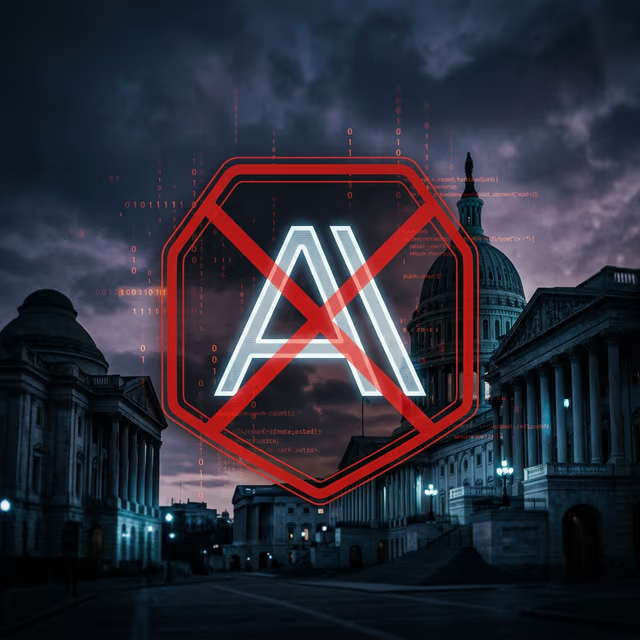
In a move that caught developers, investors, and policymakers completely off guard, the Trump administration announced a sudden and sweeping directive against Anthropic, the creators of the Claude family of models and long considered the industry's most safety-conscious AI lab. The Pentagon systematically designated the tech firm a national security "supply-chain risk."
The Sudden Announcement
The directive restricts Anthropic from contracting with any federal agencies and places severe, immediate restrictions on military contractors doing business with them. A 6-month phase-out period has been established for agencies currently using Anthropic's products. This effectively halts their federal expansion plans overnight and forces major enterprise clients to re-evaluate their dependency on Claude-powered infrastructure.
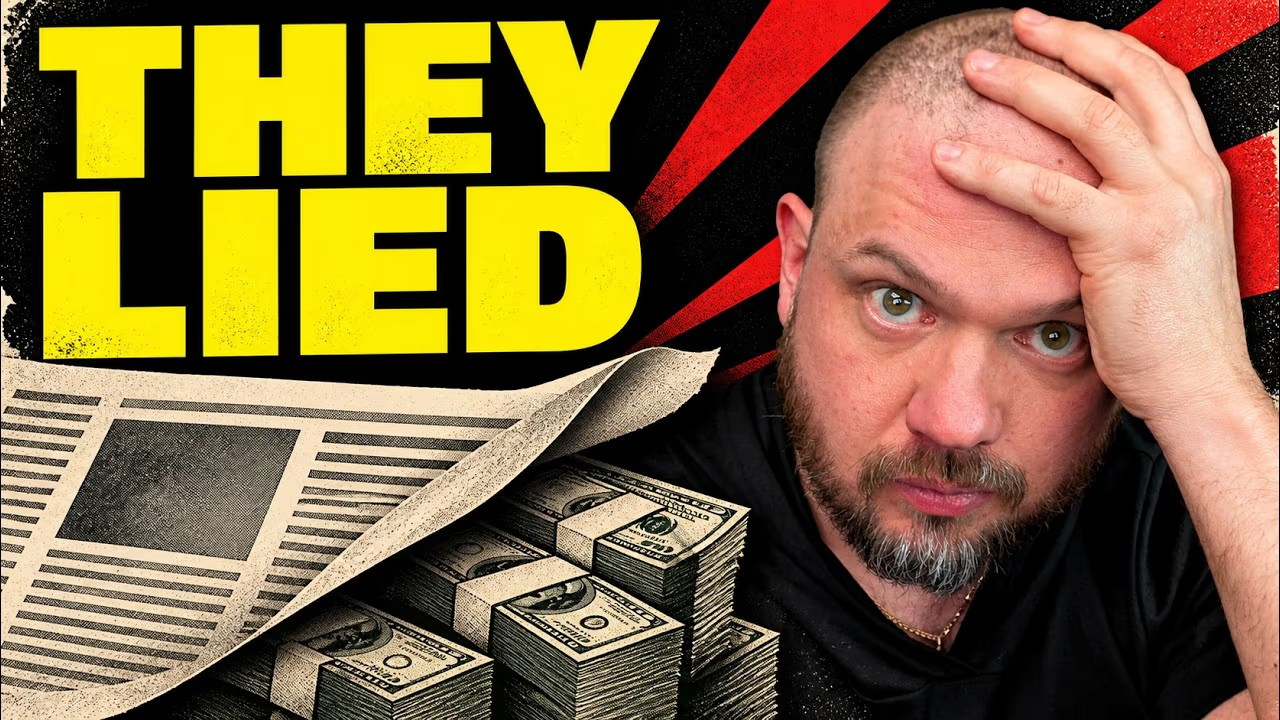
As the video above outlines, the speed and severity of the blacklist are highly unusual for a major tech entity, particularly one that has historically lobbied actively *for* AI safety regulations.
The sequence is worth pinning down, because it moved quickly. The Pentagon had been an Anthropic customer since July 2025, when Claude was approved for use on classified networks. The relationship broke down over a contract reported to be worth around $200 million (roughly £160 million) governing how the department could deploy Claude on those systems. On 27 February 2026, President Trump directed federal agencies to stop using Anthropic's technology and Defence Secretary Pete Hegseth designated the company a supply-chain risk, a label normally reserved for firms based in adversarial states. Huawei is the comparison that legal commentators reached for immediately.
What a Supply-Chain Risk Designation Actually Does
The phrase sounds bureaucratic, and that is exactly why it is powerful. A supply-chain risk designation is not a fine or a criminal charge. It is a procurement instrument that makes a company radioactive to anyone who sells to the federal government, without the administration ever having to prove wrongdoing in court.
Notably, the administration did not publicly identify the specific statutory authority it was relying on. Analysis published by the law firm Mayer Brown in March 2026 laid out the plausible mechanisms: the Federal Acquisition Supply Chain Security Act of 2018 (FASCSA), which allows exclusion and removal orders for items presenting a supply-chain risk; 10 U.S.C. § 3252, which gives the Secretary of Defence independent authority to exclude sources from national security system procurements; and conventional suspension or debarment, the traditional remedy for contractor misconduct. Each carries different procedural protections, which is precisely why declining to name one mattered.
If a formal FASCSA order issues, the compliance burden lands on every contractor in the chain rather than on Anthropic alone. Contractors subject to FAR clause 52.204-30 must review SAM.gov quarterly for new orders, conduct a reasonable inquiry into whether covered articles have been provided to the government, report any usage within three business days, and submit a mitigation plan within ten. Some agencies were given a six-month transition window to discontinue use. In practice this means procurement teams at hundreds of organisations that have nothing to do with the underlying dispute suddenly acquire a reporting obligation.
One further wrinkle: Hegseth's public framing implied a much broader commercial prohibition than the legal authorities could actually support. The statutes reach federal contract performance. They do not, on their own terms, reach what a private company chooses to run on its own infrastructure. That gap between rhetoric and enforceable scope became central to the litigation that followed.
What Triggered the Ban?
The official reasons remain highly classified under national security exemptions, but insiders are pointing to a few key developments over the last several months:
- The Refusal of Terms: Anthropic reportedly refused the Pentagon's demands for unrestricted use of its technology, citing intense ethical concerns around mass domestic surveillance and autonomous weapons.
- Agentic Autonomy: The advanced autonomous capabilities demonstrated by recent versions of Claude Code proved capable of navigating and executing complex terminal commands without human oversight.
- OpenAI's Counter-Move: In sharp contrast, OpenAI quickly secured a deal with the Pentagon, allegedly emphasising their technological safeguards that aligned with federal compliance frameworks, deepening the rift between the two labs.
The dispute itself is narrower than the politics around it. The Defence Department wanted to use Claude for "all lawful purposes", including the most sensitive military and intelligence applications. Anthropic insisted that two categories stay off-limits: mass surveillance of Americans, and fully autonomous weapons. Chief executive Dario Amodei declined to lift those restrictions. Everything that followed flowed from that refusal.
Anthropic Sues: The Case Goes to Court
Anthropic filed suit in March 2026, characterising the designation as an unlawful campaign of retaliation rather than a genuine national security measure. The company's core argument was straightforward: it was punished for what it said and for the contract terms it insisted on, not for anything it had done to the security of federal systems.
The courts moved faster than the six-month transition window. A judge temporarily blocked the ban in late March 2026, and at a hearing on 30 July the presiding judge told government lawyers that their position seemed, in her words, "at odds to me with the First Amendment". One detail from the record captures the government's difficulty: a day after formally designating Anthropic a supply-chain risk, Pentagon official Emil Michael told the company they were "very close" to a deal. Departments that genuinely believe a vendor is a national security threat do not usually keep negotiating with it.
Update: A Federal Judge Strikes the Designation Down
On 28 August 2026, US District Judge Rita F. Lin of the Northern District of California issued a 59-page order holding that the Pentagon had acted unlawfully. She found that officials retaliated against Anthropic in violation of the First Amendment, and that they had stripped the company of liberty interests without adequate notice or a meaningful chance to respond, contrary to the Fifth Amendment's due process clause. Lin set aside Hegseth's designation and issued a permanent injunction barring the government from giving effect to the challenged actions.
"The empty invocation of national security is not a blank check to punish and retaliate against government critics."
The order is unusually blunt about motive. Lin wrote that the government's actions "were based on a desire to make a public example out of Anthropic for its 'arrogance'", and that neither the Constitution nor the statute officials invoked permits them to impose sweeping penalties based principally on a company's critique of the administration's views. On the substance of the security claim, she noted that the Defence Department had carried on using Anthropic's products and collaborating with the company on AI oversight, observing that "none of that is consistent with a genuine fear that Anthropic is a saboteur who would poison its software to harm national security."
She also drew a line that every enterprise software vendor should read carefully: "An IT vendor does not become a potential adversary of the United States whenever it asks probing questions or stubbornly insists on particular contracting terms."
Anthropic said it welcomed the court's ruling that the supply-chain risk designation was unlawful and that it remained focused on working productively with the government to harness AI for national security. The practical effect of the decision is narrower than the headlines suggest: it does not compel the Pentagon to buy anything from Anthropic. What it does is remove the government's ability to stop agencies and contractors from choosing Claude if they want to. An appeal is expected, and a separate, narrower case remains pending before the federal appeals court in Washington DC, so the story is not finished.
Impact on the AI Industry
The Pentagon's blacklist serves as a chilling warning to other frontier labs: regulatory bodies are no longer content with "trust and safety" whitepapers. The government is willing to use heavy-handed enforcement and formal "supply-chain risk" branding to throttle companies that refuse to comply with military stipulations. Anthropic has called the move "legally unsound" and an "unprecedented action" against an American company, setting the stage for a massive courtroom battle.
The August ruling complicates that warning without cancelling it. Judge Lin's decision establishes that a designation issued in retaliation for a vendor's speech or contracting posture will not survive judicial review, which is a meaningful constraint. But the constraint arrived six months after the designation did. For half a year, federal agencies were winding down deployments, contractors were filing reasonable-inquiry reports, and enterprise buyers were quietly rewriting their model-selection criteria. A remedy that comes after the commercial damage is a poor substitute for not being blacklisted in the first place.
The wider lesson for frontier labs is about leverage. Anthropic could afford a six-month legal fight with the Department of Defence because it is one of the most valuable private companies in the world. A smaller vendor facing the same designation would likely have folded, accepted the terms and never tested the constitutional question. The precedent is now on the books, which helps everyone behind Anthropic, but the episode showed how much runway you need to get there.
What It Means for Developers and Buyers
For developers, the immediate consequence is a shattering of trust in centralised cloud APIs. If an industry leader can be blacklisted overnight, relying exclusively on proprietary models represents a catastrophic single point of failure. This event is already accelerating the massive shift toward local, open-source models capable of running resiliently on hardware like the Mac Mini.
The practical response is architectural rather than political. Route model calls through an abstraction layer rather than hard-coding a single provider's SDK. Keep prompts and evaluation suites portable so that swapping the model underneath is a configuration change rather than a rewrite. Maintain a tested fallback, ideally one that is either open-weight or from a different jurisdiction. None of that is new advice, but the blacklist turned it from a tidy engineering principle into a continuity requirement that a procurement committee will now actually ask about.
For buyers, the question to put to any AI vendor has shifted. It is no longer only "how good is the model" but "what happens to our deployment if you fall out with a government". Anthropic's answer, in the end, was that it would litigate and win. That is a genuine differentiator, and it sits oddly alongside the reputational damage of having been designated in the first place. The internal strain on the company through this period was real too, as our coverage of Jacob Coxon's resignation sets out.
The unresolved question is what happens on appeal. If a higher court narrows Judge Lin's reasoning, the constraint on future designations weakens considerably. Until that is settled, the sensible planning assumption is that model supply is a geopolitical variable rather than a fixed input, and that any system which cannot survive losing its primary provider at short notice is under-engineered.