 AI Tools Review Editorial Team
Quick Answer:
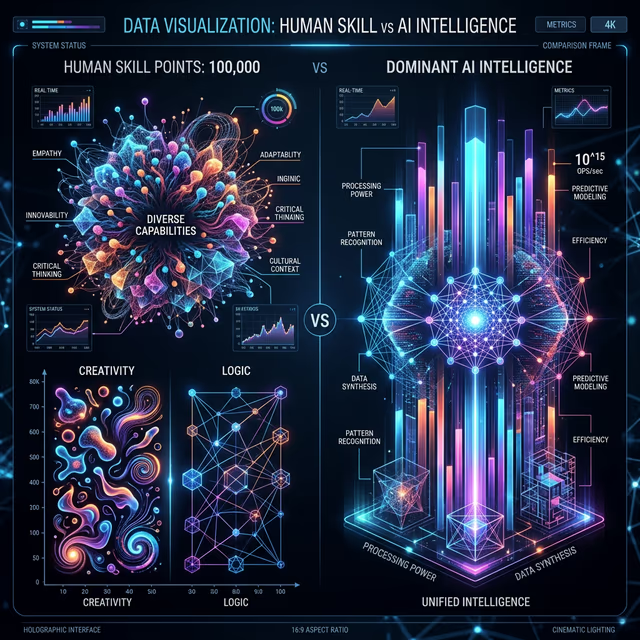
A landmark 2026 study pitting leading AI models against 100,000 humans proved that AI statistically outperforms the average human in divergent creativity tasks. While the top 10% of elite human creatives still maintain a distinct advantage, 'average' creative output is now a completely solved computational problem, leading to a massive economic "compression of the middle."
Introduction: The Creativity Illusion
For years, the comforting macroeconomic narrative was that Artificial Intelligence could handle strict logic, repetitive mathematics, and data processing, but creativity was the safely guarded, solely human frontier.
In early 2026, a massive new study testing the latest foundational models against exactly 100,000 human participants shattered that assumption permanently. The results aren't just surprising, they mark the definitive end of "average" as a viable career strategy in the knowledge economy.
The 100,000 Person Study Breakdown
In a landmark experiment published in Scientific Reports (Nature Portfolio), researchers from the University of Montreal, led by Professor Karim Jerbi and featuring insights from AI pioneer Yoshua Bengio, constructed the most comprehensive creativity benchmark ever deployed.
Unlike previous studies that relied on subjective human grading (which is highly susceptible to AI-bias), this study utilised strictly mathematical assessments of semantic distance to ensure an objective, unarguable comparison between silicon and carbon.
How Divergent Creativity is Measured
The primary tool utilised was the Divergent Association Task (DAT). The DAT asks subjects to generate 10 words that are as semantically unrelated to each other as possible.
- Poor Performance: Answering with "Cat, Dog, Fetch, Bone". These words are highly correlated in the English language vector space.
- High Performance: Answering with "Cat, Thermostat, Jurisprudence, Velvet". These words exist in completely separate semantic clusters, indicating high divergent thinking, the core engine of creativity.
The researchers then mathematically mapped the vector distances of the answers submitted by the 100,000 humans against the answers generated by Claude, GPT-4, and Gemini under identical constraints.
The Results: Average is Officially Solved
The data returned a reality check for the global workforce.
AI Beats the Median Human
The AI models consistently outperformed the *average* human participant in divergent thinking. The machine's semantic mapping allowed it to reliably generate word combinations that were mathematically further apart than the median 50th percentile of human participants.
The Elite Remain Untouched
However, humanity isn't obsolete. The top 10% of human creatives still outperformed the AI. The gap widens dramatically for the top 1%, proving that exceptional human eccentricity and lived experience cannot yet be replicated by statistical inference.
The Compression of the Middle
This creates a stark macroeconomic reality that economists are calling the "Compression of the Middle." If your creative output (whether that is writing code, drafting marketing copy, or designing a logo) is merely "good enough" or "average," you are now competing directly with an API that produces that exact level of quality for fractions of a penny in milliseconds.
| Career Level | Pre-2026 Status | Post-2026 AI Reality |
| Entry Level | Learning the ropes, low output value. | Empowered. AI acts as a 24/7 senior tutor accelerating their growth. |
| The "Average" Middle | The backbone of agencies; producing competent, standard work. | Danger Zone. Their core value proposition is free via Claude/ChatGPT. |
| The Elite Top 10% | Visionaries constrained by execution time. | Supercharged. They use AI as a force multiplier to execute their unique visions instantly. |
Welcome to the Era of Judgment
Shift from Generation to Judgment
Historically, a copywriter's job was to sit in a room for 4 hours and generate 10 potential ad slogans. Today, AI can give you 100 marketing slogans in 10 seconds. The bottleneck is no longer generating ideas; it is judging them.
AI cannot tell you which of those 100 slogans will make a 45-year-old mother in Ohio laugh, or which one will offend a specific sub-culture in London. That remains the exclusive domain of human empathy, cultural context, taste, and intuition.
What This Means for You: 3 Strategic Pivots
The findings of the Montreal benchmark shouldn't lead to existential dread, but rather to a ruthless strategic pivot in how you position your career.
1. Target the Top 10% (Or Pivot)
You can no longer aim for general competence. You must aim for excellence, developing a highly specific, unique perspective that statistical models cannot average out. If you cannot reach the top 10% of your specific sub-niche, pivot to a role focused on emotional intelligence.
2. Become an Editor, Not a Typist
Shift your identity from "Creator" to "Creative Director." Let AI write the crude first draft of the code, the article, or the design. Your entire value now lies in curation, refinement, and applying the final 10% of high-taste polish.
3. Double Down on Lived Experience
AI is trained on the past. It does not have a childhood, political opinions, or visceral reactions to modern events. Lean heavily into the human elements AI intrinsically lacks: raw emotional resonance, contrarian viewpoints, and cultural context.
Where AI Still Fails
It's vital to remember that the DAT measures divergent creativity (connecting unrelated dots). It does not measure convergent creativity (synthesising massive amounts of disparate information to formulate a unified, groundbreaking theory).
When researchers run models through long-form creative tasks, like writing an engaging 80,000-word novel with profound character arcs and subtle thematic foreshadowing, the AI's performance collapses compared to professional human authors. AI produces "predictably weird" content, but struggles to maintain emotional coherence over long contexts.
Final Verdict
The Bar Has Risen
The 100,000 human benchmark is the ultimate wake-up call for the white-collar workforce. The baseline for acceptable work has permanently shifted upward.
If your job description essentially boils down to "I take input A, apply standard industry logic, and produce output B," you are no longer competing with humans. But if your job is "I understand human nuance better than anyone else in the room," you have never been more valuable. The new era requires humans to be more human, not more machine-like.
This analysis references data published in Scientific Reports by the University of Montreal research team, alongside broader macroeconomic trends observed in early 2026.