 AI Tools Review Editorial Team
Quick answer:
Claude Enterprise inference hooks add a customer-controlled inspection point before a governed prompt reaches the model. Anthropic sends the conversation transcript in a signed HTTPS POST request to the organisation's DLP or security server. The server returns allow or deny, normally within a five-second timeout, and Claude waits for that verdict before generating. The beta launched on 5 August 2026 for Claude Enterprise. Despite broader wording in the launch post, Anthropic's current technical documentation says response-side enforcement is planned rather than available today. Inference hooks improve central policy enforcement, but they do not replace connector permissions, identity controls or careful handling of the copied transcript.
Enterprises already inspect email, file transfers and web traffic for sensitive data. Claude created a less tidy problem because information can enter through chat, coding sessions, Cowork tasks and connected tools. Until now, a company could apply client-side hooks in Claude Code, but there was no single native enforcement layer across the wider Claude Enterprise product.
Inference hooks are Anthropic's answer. The design is straightforward: let the customer's existing security system decide what Claude may process, and enforce that decision before inference continues.
Source note: feature behaviour and availability are based on Anthropic's 5 August launch post and current administration documentation. Where they differ, this article follows the more specific technical documentation and identifies the discrepancy. The feature is in beta. Anthropic has not published independent performance testing, separate pricing or a complete list of certified security-vendor integrations.
What inference hooks are
Inference hooks are a policy checkpoint for Claude Enterprise. They sit between Claude's user-facing products and a security server controlled by the customer. That server might be an existing data loss prevention platform, an AI security service or an internal policy engine.
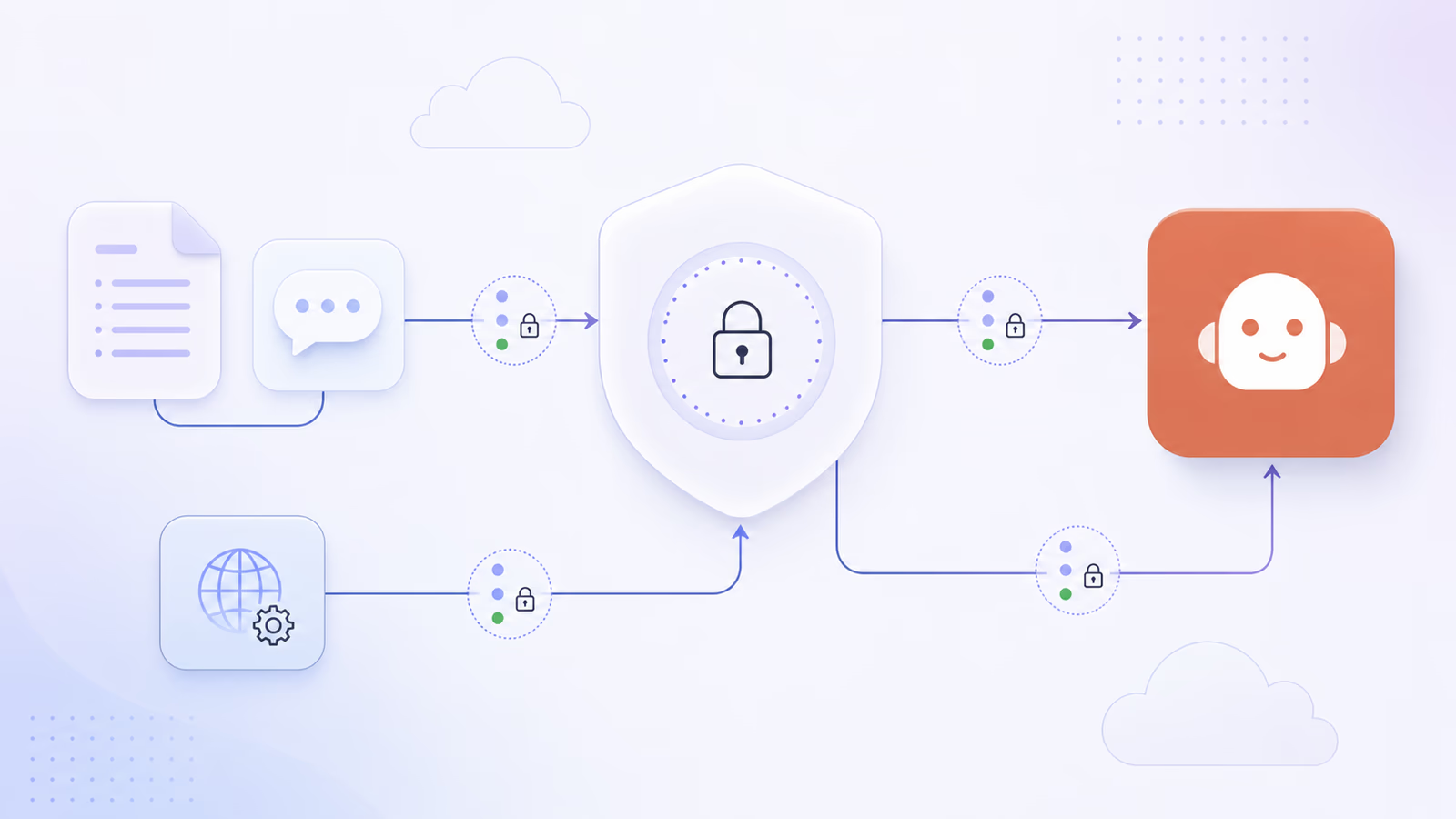
The important distinction is timing. This is not an audit report generated after a conversation. Anthropic says Claude sends content for inspection before the model begins generating, then waits for an allow or deny verdict. A denied request is blocked before it reaches the model.
The feature is intended to give compliance teams one organisation-level control rather than separate integrations for claude.ai, Claude Code and Claude Cowork. A transcript sent for inspection can include earlier tool calls and their results, which gives the policy server useful context around an agentic task.
How the inspection path works
- A user submits a request. This may come from Claude chat, Claude Code, Claude Cowork or another supported Enterprise surface.
- Claude forwards the conversation transcript. Anthropic sends a signed HTTPS POST request to the organisation's configured security server. The transcript can include text, tool calls, tool results and text extracted from attachments.
- The security server applies company policy. It can look for regulated records, source code, credentials, customer identifiers or any other pattern the organisation has defined.
- The server returns allow or deny. Claude proceeds only after it receives the verdict. The default verdict timeout is five seconds.
- The decision is logged. A denial produces a policy message for the user and is recorded in the organisation's Activity Feed.
Anthropic describes the underlying integration as an open, webhook-based protocol with a published schema. Its launch post names Netskope, Palo Alto Networks, Proofpoint and Zscaler as examples of services that may already receive security events. Companies can also build their own inspection server.
That wording needs care. Anthropic is explaining compatibility with existing security architecture, not promising that every named product has a finished, supported connector. Buyers should confirm the exact integration and support position with their chosen vendor.
What the beta covers
Anthropic's technical documentation says one hook covers conversations across claude.ai, Claude Cowork and Claude Code sessions on the web, desktop and command line. It does not cover voice mode, conversation-title generation or other ancillary requests. Platform organisations using the Claude API are out of scope, as are Amazon Bedrock and Google Cloud deployments.
There is an important conflict between Anthropic's two official explanations. The launch post says a tool response is checked before it is sent back to the model, including responses from MCP, skills and plugins. The current technical documentation says the only hook event is prompt, which fires once before a governed inference request, and that response-side enforcement is planned for a later event.
The practical reading is narrower: the policy server can inspect the transcript supplied with a governed prompt, including tool activity already recorded there, but administrators should not assume every new tool response is intercepted at the moment it arrives. They should keep using narrow connector scopes, least-privilege accounts and tool-level approval rules.
Rollout and failure controls
Anthropic has included controls designed for a gradual deployment. Shadow mode always allows the request while recording what the inspection server would have decided. This lets a security team test its rules against real usage before blocking anything.
Administrators can also use role-based exclusions and percentage-based rollouts. That makes it possible to start with a security or engineering group, compare false positives and then expand to the wider organisation.
Failure policy and timeout settings deserve particular attention. If the DLP service is slow or unavailable, the organisation must choose how Claude behaves. Failing closed protects data but can interrupt work. Failing open preserves availability but temporarily removes the inspection barrier. The correct choice depends on the sensitivity of the team, workflow and data involved.
Important limits and open questions
- Enterprise beta only: Anthropic has not announced the feature for consumer, Pro, Max or API-only customers.
- No separate price published: the launch post does not state whether inference hooks will remain included in Claude Enterprise or attract an additional charge after beta.
- The DLP server sees the transcript: organisations need to assess retention, logging, regional processing and access controls on that server, not only Claude itself.
- Images can pass unseen: the hook receives extracted attachment text and metadata, not raw file or image bytes. Image-only content, such as a screenshot of a document, is not inspected.
- No redaction: the server can allow or deny a request, but cannot rewrite or selectively redact it.
- Availability now depends on another service: a slow inspection server can add latency, while an outage can either stop Claude or remove enforcement depending on the chosen failure policy.
- Pattern matching has limits: secrets and regulated identifiers are easier to detect than commercially sensitive meaning expressed in ordinary language.
- Response enforcement is not yet documented as live: the launch post describes it, but the current technical guide says it is planned for a later event.
Who should consider it
The clearest fit is a regulated or security-conscious organisation that already operates a mature DLP programme and wants Claude to use the same policy engine. Financial services, healthcare, legal teams and software companies handling proprietary code are obvious candidates.
It is also relevant to companies expanding from chat into Claude connectors, skills and agentic workflows. The more systems Claude can reach, the more useful a central checkpoint becomes. Teams using only low-risk public information may find the operational overhead harder to justify.
Companies should treat inference hooks as one layer in a wider control model. Identity, connector scopes, human approvals, audit logs, endpoint security and staff guidance remain necessary.
Deployment checklist
- Map which Claude Enterprise surfaces and connected tools handle confidential data.
- Confirm whether the existing DLP platform can implement Anthropic's published protocol.
- Review where copied conversation transcripts will be processed, logged and retained.
- Define allow and deny rules with the data owners, security team and compliance function.
- Start in shadow mode and measure false positives before enabling enforcement.
- Choose explicit timeout and fail-open or fail-closed behaviour for each risk tier.
- Keep connector permissions narrow and test attempts to move data between tools.
- Document an exception and incident process before rolling out beyond the pilot group.
The bottom line
Inference hooks solve a real enterprise problem. Claude can now use one customer-controlled policy checkpoint across several products and connected tools, rather than leaving security teams to assemble separate controls around each interface.
The design is useful, but the beta should not be mistaken for complete data protection. Its value depends on the quality and resilience of the customer's inspection service, the rules it applies and the permissions around every connected tool.
Primary sources: Anthropic's 5 August announcement and the current inference hooks documentation.
Published: 5 August 2026. Availability and controls reflect Anthropic's beta announcement and may change before general release.
Get the free guide: Claude vs ChatGPT, Gemini & Grok
A 20-page playbook covering everything you need to choose and use the big four AI models in 2026, full cost and feature comparisons, what each is best (and worst) at, and how-tos for images, vectors, building a website, Claude Code and more.