 AI Tools Review Editorial Team
Quick Answer:
Cohere Rerank 5, released on 21/10/2026, is a pair of reranking models (Pro for quality, Fast for speed) that re-order search results before they reach a language model. Cohere reports a Pro score of 82.2 on BRIGHT and the top result on 39 of 46 composite datasets. A new Context Focus option returns only the relevant passages inside each document, which Cohere says cut tokens per agent task by up to 41% while raising accuracy. It costs $0.05 (Pro) or $0.02 (Fast) per million tokens. All benchmark figures are Cohere's own.
Most of the attention in AI goes to the big models. Yet in a retrieval-augmented generation (RAG) system, the model can only answer from what it is shown, and what it is shown is decided by a much smaller, less glamorous component: the reranker. Cohere's Rerank 5 is a bid to make that component both more accurate and cheaper to run.
This guide is based on Cohere's launch post and its published charts, which we have downloaded and credited below, together with creator coverage on YouTube. We have not run Rerank 5 ourselves, so every number is as reported by Cohere, and we flag where independent testing is still needed.
Julian Goldie covers the Rerank 5 launch, from the Pro and Fast tiers to Context Focus.
Executive Summary
What it is: Rerank 5 is the fifth generation of Cohere's reranker. It sits between a first-stage search and the language model, scoring each candidate document for relevance to the query so the best ones go first. It works with keyword, vector or hybrid search and needs no re-indexing.
- Two tiers: Pro (quality) and Fast (throughput and latency), both released on 21/10/2026.
- Quality: Cohere says Pro ranks first on 39 of 46 composite datasets and at least second on 43, and scores 82.2 on the reasoning-heavy BRIGHT benchmark.
- Context Focus: an optional feature that returns scored spans inside documents, so you can send a model less text.
- Efficiency claim: in Cohere's search-agent tests, the full stack used 35% fewer tokens than BM25 alone across 17 datasets, and 41% fewer on six deep-search benchmarks, with higher accuracy.
- Calibrated scores: scores are designed to be read as the probability a document is useful, with a default threshold near 0.5 (Pro) and 0.45 (Fast).
- Price: $0.05 per million tokens for Pro and $0.02 for Fast.
- Caveat: all numbers are vendor-reported; test on your own data.
Our view: the interesting part is not the leaderboard lead, which is a point or two on most tests, but Context Focus and calibration. Those two features change how you build a pipeline, not just how well a score reads on a chart.
What a Reranker Does and Why It Matters
If you have read our explainer on what RAG is, you know the basic loop: a user asks a question, a search system fetches documents, and a language model writes an answer grounded in them. The weak link is usually the search step. A fast first-stage search, whether keyword-based (BM25) or vector-based, returns a long list of plausible matches in milliseconds, but its ordering is crude. The most useful passage may sit at rank 30, and a model that only sees the top five will never read it.
A reranker is a second, slower and smarter pass. It reads the query and each candidate together and produces a relevance score, then the list is re-sorted. Because it only looks at a few dozen or hundred candidates rather than a whole corpus, it can afford to be far more careful. In practice, adding a reranker is one of the cheapest ways to improve a RAG system, because it requires no change to the index, the embedding model or the answering model.
That matters more as AI agents do their own searching. An agent that runs ten searches to answer one question pays for every irrelevant passage in tokens, latency and distraction. We covered the wider shift to agent-driven work in our guide to Cohere North 2, and a better retrieval layer is the sort of unglamorous upgrade such platforms depend on.
Pro and Fast: Two Tiers
Cohere has split Rerank 5 into two models rather than one. Pro is the quality model, intended for cases where getting the best passage to the top is worth extra compute. Fast trades a few points of accuracy for roughly three times the throughput, which suits high-volume search or interactive products where the reranker sits on the critical path.
The two share the same interface, so you can route different workloads to different tiers, for example using Fast for a live search box and Pro for an overnight analyst workflow, by changing one model ID. In the API those are rerank-v5.0-pro and rerank-v5.0-fast, called through https://api.cohere.com/v2/rerank.
Availability is broad: the Cohere API, Cohere's Model Vault, Microsoft Foundry and Amazon SageMaker (both tiers), and all North users. Organisations that need it inside their own VPC or on premises can ask Cohere sales about private deployment. Cohere also lists integrations with LangChain, Haystack, Elasticsearch and Weaviate, which means many existing pipelines can swap it in without bespoke code.
Benchmarks: What Cohere Reports
Cohere evaluates on four public suites, using a metric it calls RCP-nDCG@10, and compares against its own previous Rerank 4 Pro, Voyage AI's Rerank 3 and Rerank 3 Lite, and two open Qwen3 rerankers. Here is the headline chart, taken from the launch post.
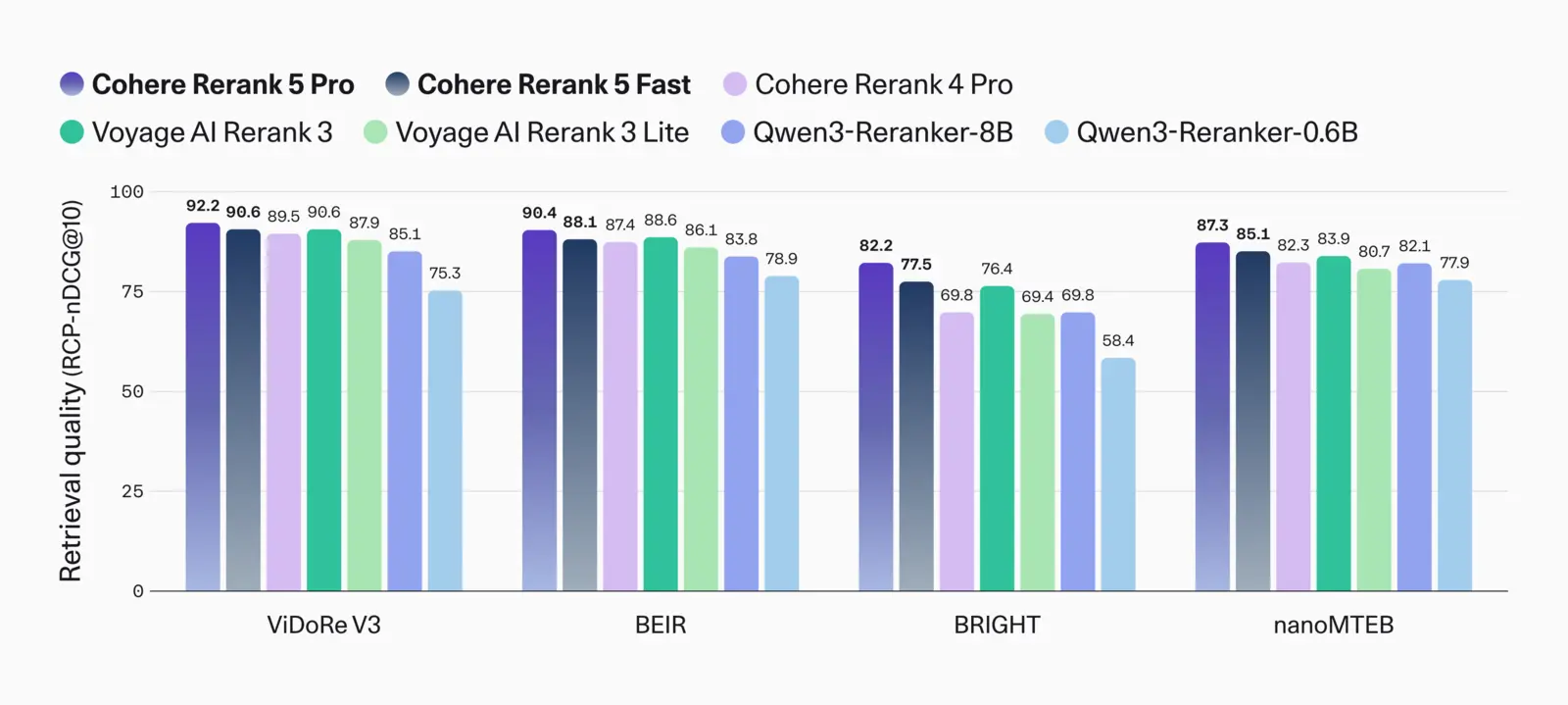
Reading the chart, the numbers for Rerank 5 Pro are 92.2 on ViDoRe V3, 90.4 on BEIR, 82.2 on BRIGHT and 87.3 on nanoMTEB. Rerank 5 Fast scores 90.6, 88.1, 77.5 and 85.1. The strongest external rival on each of the first, second and fourth tests is Voyage AI Rerank 3, at 90.6, 88.6 and 83.9, which gives Pro leads of 1.6, 1.8 and 3.4 points, matching Cohere's text.
The standout is BRIGHT, a benchmark of reasoning-intensive queries where the relevant document does not share obvious keywords with the question. Pro scores 82.2 there, 5.8 points above Voyage AI Rerank 3 (76.4) and 12.4 above Cohere's own Rerank 4 Pro (69.8). A jump of that size from one generation to the next is unusual in a mature category, and it is the clearest sign that Rerank 5 is aimed at agentic and analytical search rather than simple lookup.
Across Cohere's composite of 46 datasets, Pro ranked first on 39 and at least second on 43. On a set of 47 datasets built from parsed PDFs, Pro scored 89.9 and Fast 88.5, against 88.4 for Voyage AI Rerank 3 and 88.3 for Rerank 4 Pro. Note how tight that last comparison is: on messy real-world documents, the gap to the best competitor is a point or so, not a leap.
Domain and Language Results
Cohere also published domain-specific charts for finance, healthcare, scientific research and energy. We have reproduced the finance chart because it shows the pattern most clearly: the lead is largest where queries need reasoning.
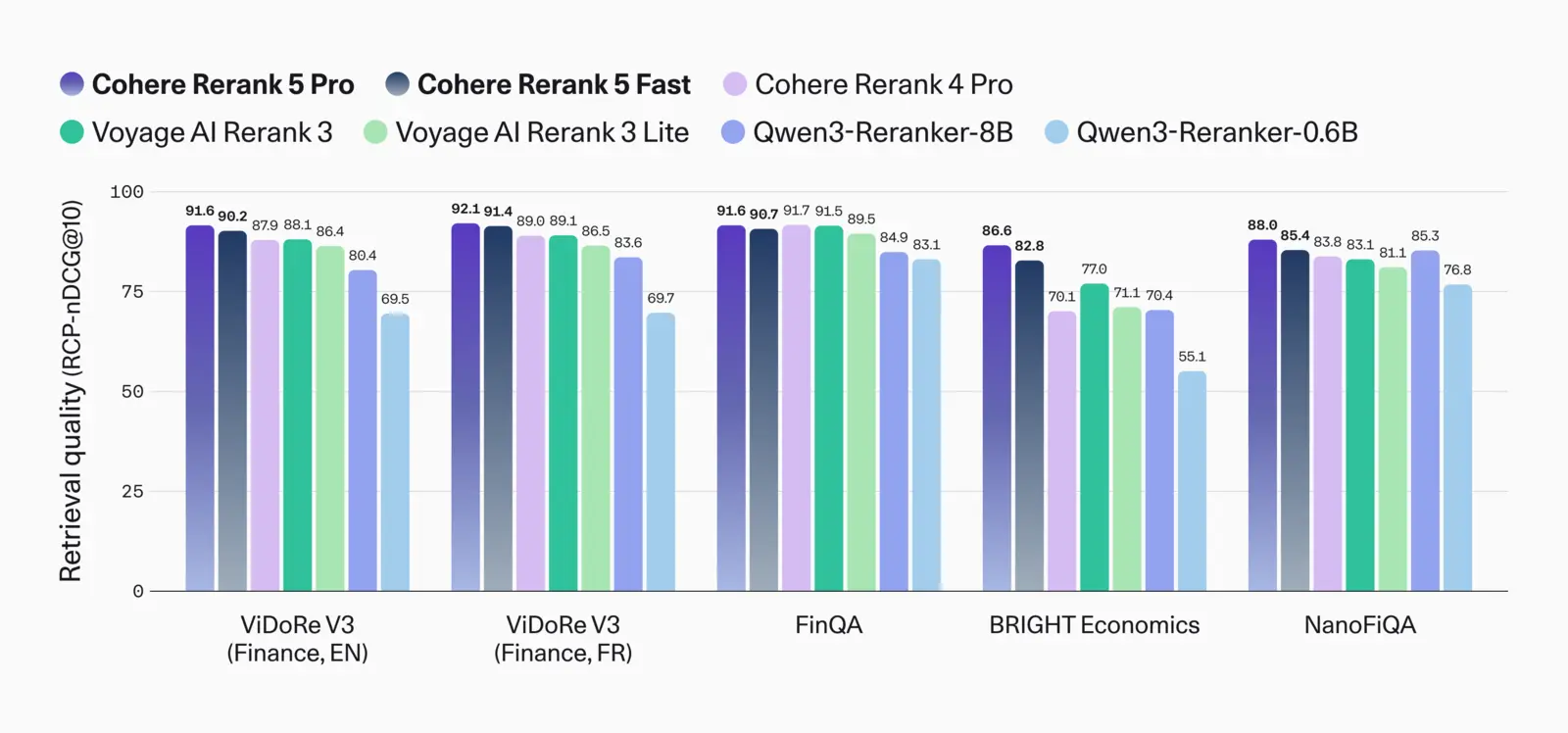
The finance chart rewards a careful read. On BRIGHT Economics, Pro scores 86.6 against 77.0 for Voyage AI Rerank 3, a gap of 9.6 points, which is the figure behind Cohere's claim of leading by up to 9.6 on finance and economics tasks. But on FinQA the picture is a dead heat: Pro is at 91.6, Rerank 4 Pro at 91.7 and Voyage Rerank 3 at 91.5. In other words, the advantage appears on hard, reasoning-style queries and mostly vanishes on simpler matching tasks.
On languages, Cohere says it evaluated 20 world languages across 74 datasets, and that Pro improves on Rerank 4 Pro in every one. It singles out six business languages, with Pro and Fast scores as follows: Spanish 91.2 and 88.6, French 90.5 and 88.6, German 90.6 and 88.6, Arabic 89.7 and 86.5, Japanese 89.4 and 86.8, and Korean 91.8 and 89.9. Pro ranks first on 14 of 19 non-English languages in Cohere's internal evaluation, with its widest margins over Voyage AI Rerank 3 in Japanese (+2.7), French (+2.3) and Arabic (+2.3). For UK teams searching multilingual contracts or customer records, that breadth is a real selling point, although the evaluation is internal.
Context Focus: Reranking Inside Documents
Traditional reranking works at the document level. If a 30-page report ranks highly, the whole report goes to the language model, even though the answer sits in two paragraphs. That wastes tokens, adds noise and, with long inputs, can degrade answer quality.
Context Focus is Cohere's fix. When enabled, the same Rerank call returns the relevant text spans within each document, each with its own score, alongside the document-level score. Two parameters control it: a relevance threshold and a max_spans limit (Cohere's example uses 0.4 and 10). You then pass only those spans to the model.
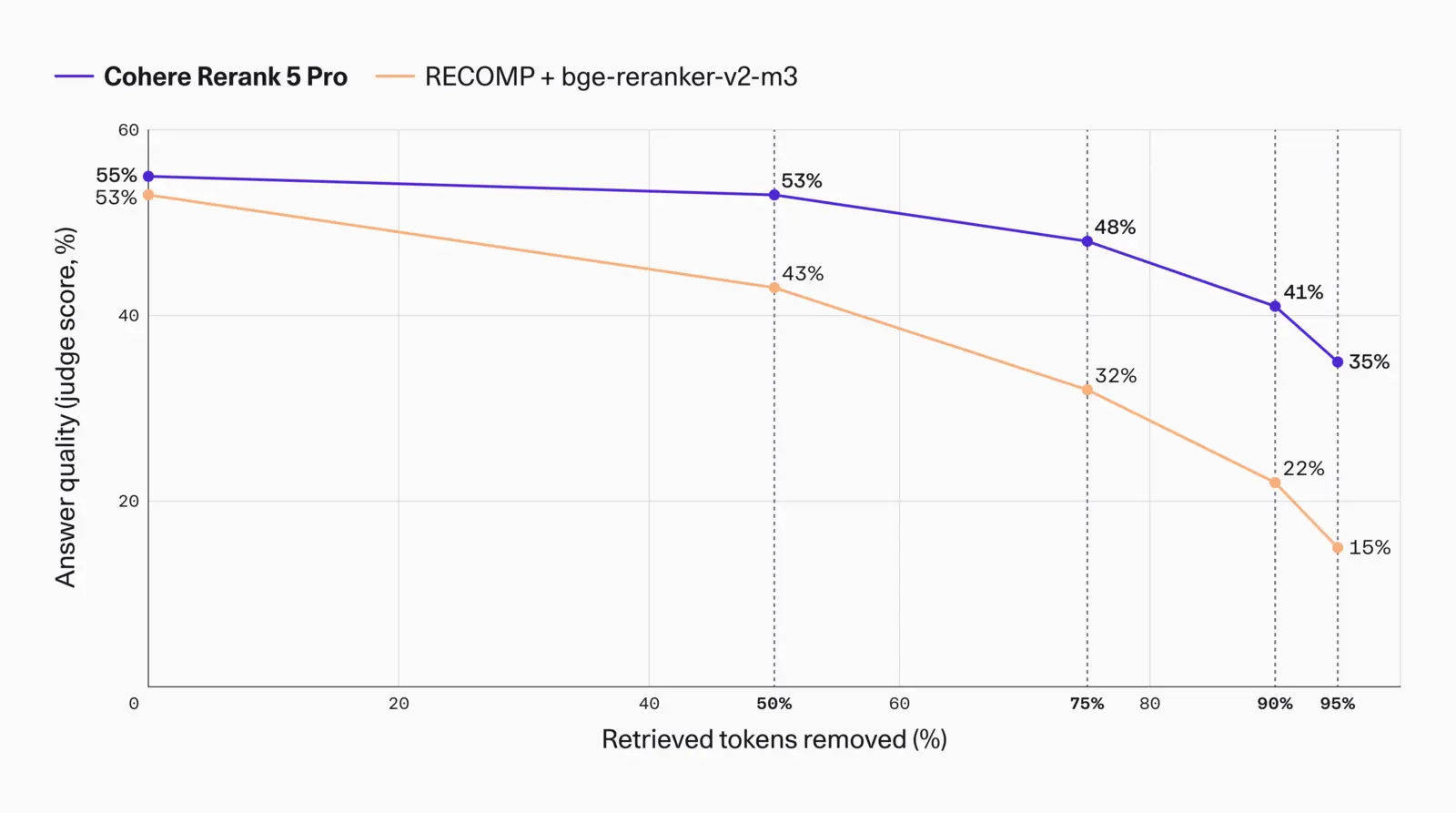
The chart compares Rerank 5 Pro with a baseline that pairs RECOMP, a context-compression method, with the open bge-reranker-v2-m3. With nothing removed, Pro scores 55% and the baseline 53%. Remove half the retrieved tokens and Pro holds at 53% while the baseline drops to 43%. At 75% removed it is 48% against 32%, at 90% it is 41% against 22%, and at 95% it is 35% against 15%. Cohere summarises this across 30 question-answering datasets as keeping 96% of answer quality when half the context is removed and 87% when three-quarters is removed.
To be clear about what this does and does not show: it is Cohere's comparison against one named baseline, scored by a model judge, not an independent audit. But the design is sensible. Compressing context with the same model that already read the document avoids a separate summarisation step, and it keeps you in control of how aggressive to be by tuning the threshold.
What It Does for Search Agents
The more commercially interesting test is end to end. Cohere ran a search agent, one that issues several queries and reasons over what it finds, and measured both accuracy and total tokens used per task. Adding a reranker alone helps accuracy slightly; adding Context Focus is what moves the cost line.
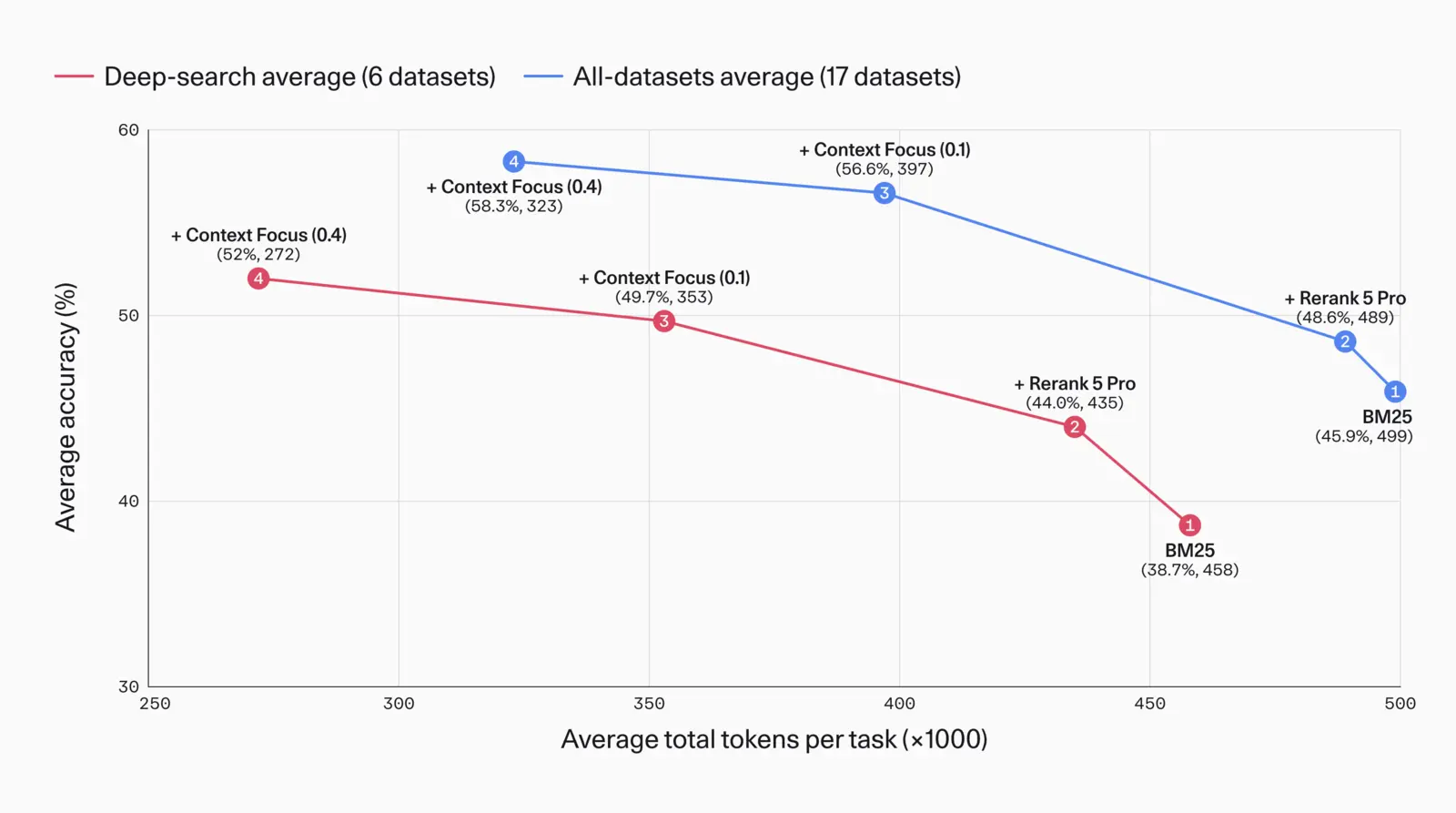
Across all 17 datasets in the chart, BM25 alone scores 45.9% accuracy at 499,000 tokens per task. Adding Rerank 5 Pro lifts that to 48.6% at 489,000. Adding Context Focus at a 0.1 threshold gives 56.6% at 397,000, and at 0.4 it reaches 58.3% at 323,000, which is about 35% fewer tokens and 12 points more accuracy than where it started.
On the six deep-search datasets, the effect is bigger: BM25 scores 38.7% at 458,000 tokens, Rerank 5 Pro 44.0% at 435,000, Context Focus at 0.1 gives 49.7% at 353,000, and at 0.4 it reaches 52.0% at 272,000. That is Cohere's "41% fewer tokens" claim, with accuracy up from 39% to 52%.
For anyone paying per token, that is the whole story. If agents are the future of knowledge work, as we argue in The Agentic Future of Work, then the cost of an agent's reading list is going to be a line item, and a feature that cuts it by a third while improving results is worth a pilot. A caution: these runs use Cohere's own agent set-up, and your savings will depend on how long and how noisy your documents are.
Calibrated Scores
A less-noticed Rerank 5 feature is that its scores are meant to mean something. Most rerankers produce a number that is only useful for sorting: 0.8 might be a great match in one query and a poor one in another. Cohere says Rerank 5 scores are calibrated, so a score of 0.7 means roughly a 70% chance the document is useful. That lets you set a sensible cut-off, such as "drop everything below 0.5", or decide when to answer "I could not find this" instead of guessing.
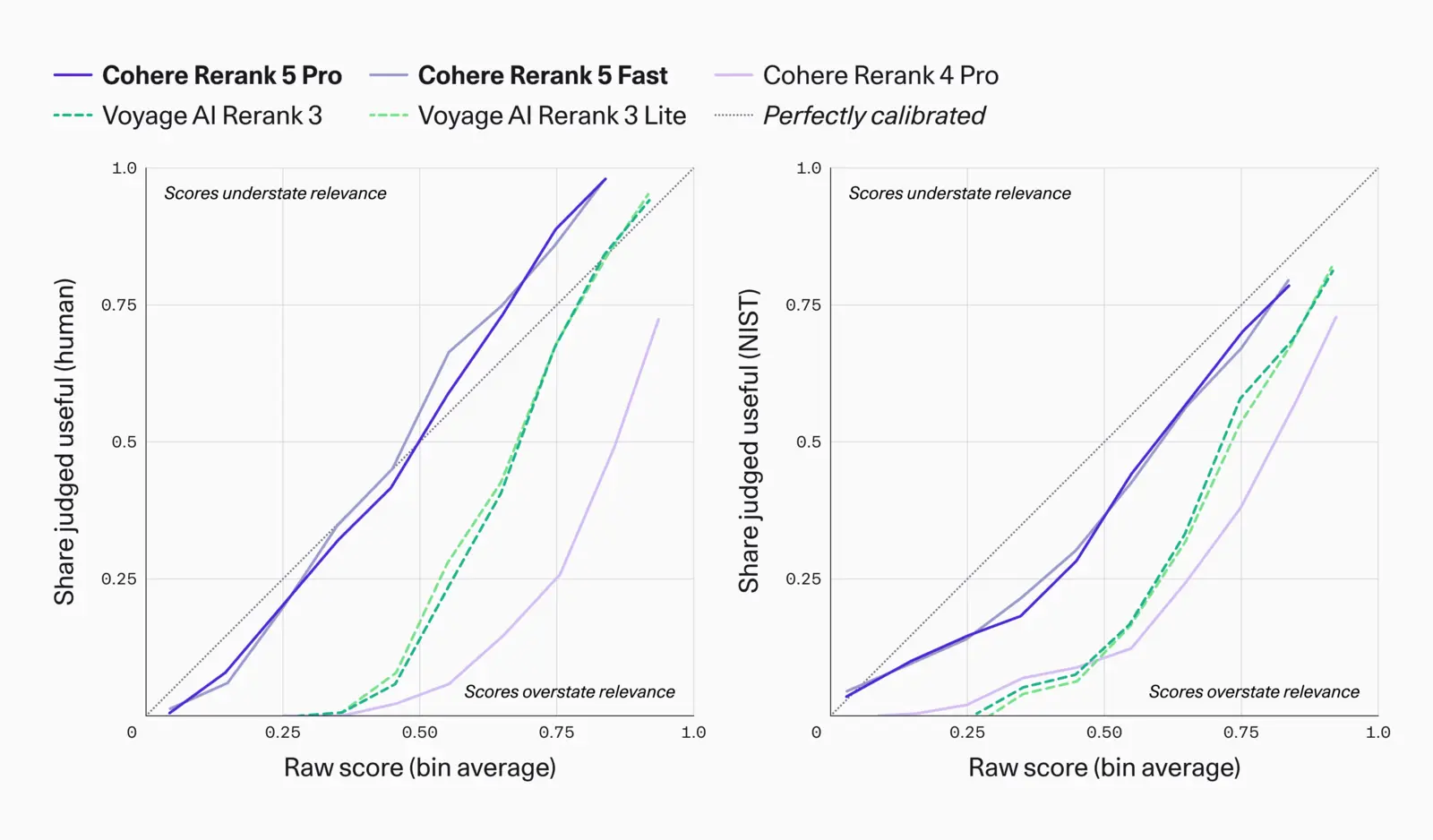
The chart shows the Rerank 5 lines hugging the diagonal while Rerank 4 Pro and the Voyage models sit well below it, meaning their scores overstate relevance. Cohere quantifies this with expected calibration error: 0.058 on human labels and 0.057 on NIST labels for Rerank 5 Pro (0.058 and 0.058 for Fast), compared with 0.384 and 0.309 for Rerank 4 Pro, and 0.234 and 0.307 for Voyage AI Rerank 3. The "more likely useful than not" threshold is 0.50 for Pro and 0.45 for Fast, and across BRIGHT, NanoBEIR and ViDoRe V3 the Pro default stays between 0.47 and 0.53.
Why does this matter? Because production RAG fails quietly. When a system always returns its top five documents, it will happily answer from irrelevant ones. A calibrated threshold gives you a principled way to say "nothing good enough was found", which is the honest behaviour compliance teams want. It is also the kind of control we expect to see in enterprise agent platforms; see how North 2 frames governance.
Throughput and Latency
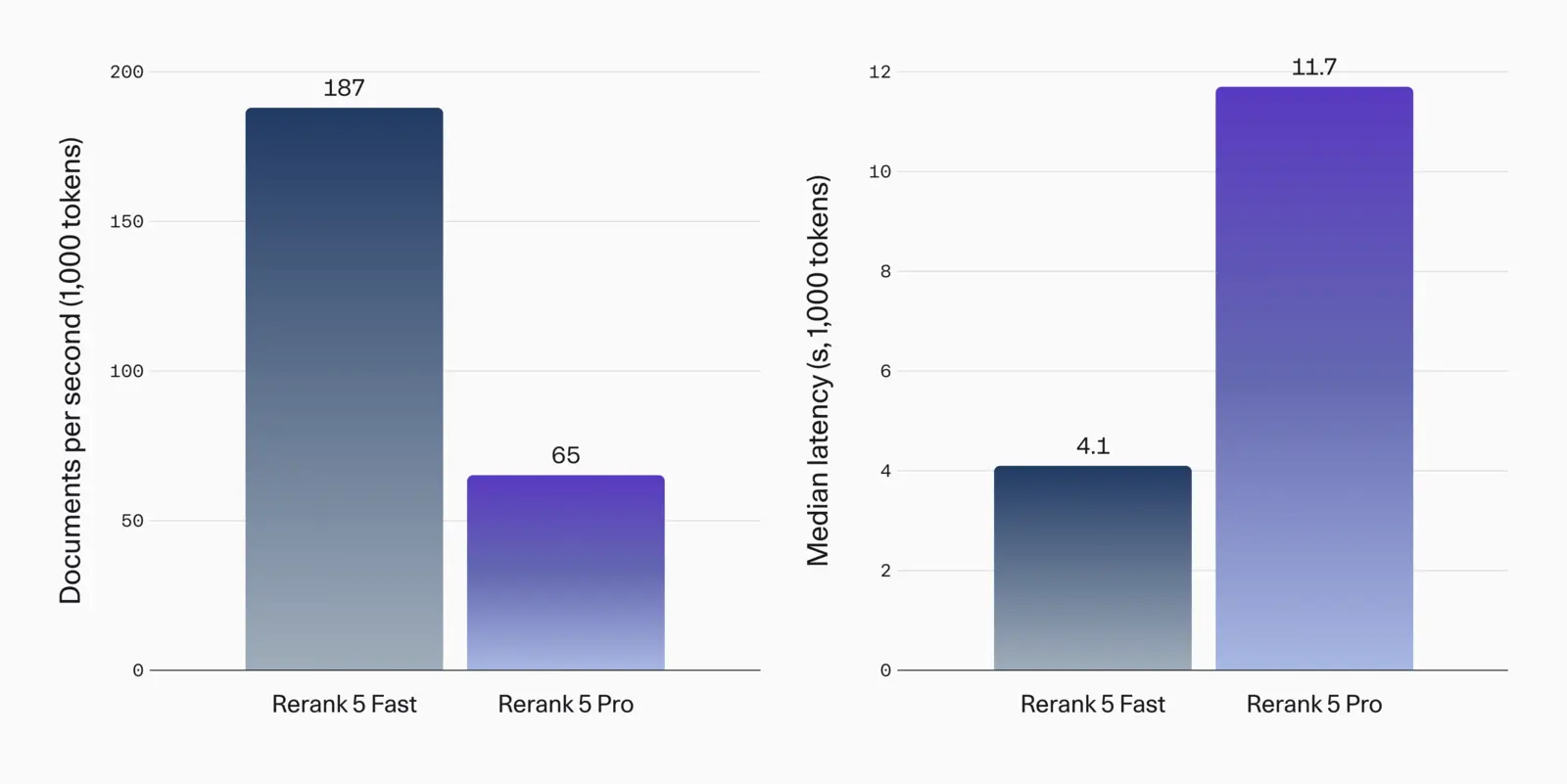
The speed chart explains the two-tier split. Fast handles 187 standard 1,000-token documents per second, which Cohere says is measured on an NVIDIA A100, against 65 for Pro, a ratio of 2.9. Median latency is 4.1 seconds for Fast and 11.7 seconds for Pro. The chart does not state how many documents were in each request, so treat the latency as relative, not as a promise for your workload.
The practical reading: if your reranker sits inside a chat product, where a user is waiting, Fast is the obvious default and you accept a few points of benchmark quality (for instance 77.5 against 82.2 on BRIGHT). If the work is batch analysis or a high-stakes research tool, Pro is the better fit.
Pricing and Availability
Cohere lists $0.05 per million tokens for Rerank 5 Pro (about 4p) and $0.02 per million tokens for Fast (about 1.5p). At those rates, reranking 100 candidate documents of 1,000 tokens each costs around half a penny with Pro, so the reranker is usually a rounding error next to the language model call it protects. Because Context Focus can cut what you send to that larger model, it may pay for itself on token savings alone, though that depends on your model's price and your document lengths.
Availability covers the Cohere API, Model Vault, Microsoft Foundry, Amazon SageMaker and North, with private deployments on request. Cohere also mentions Compass Cloud, a managed search platform that includes Rerank, which is in private beta. We could not find a stated context-length limit in the launch material, so check the documentation before sending very long documents.
How to Add It to a RAG Pipeline
For a team that already has a working retrieval system, the integration is small:
- Over-retrieve. Ask your existing search for 50 to 100 candidates rather than the top 5. Rerankers help most when the right answer is somewhere in a longer list.
- Rerank. Send the query and candidates to
rerank-v5.0-proorrerank-v5.0-fast, and keep the top handful. - Apply a threshold. Start near 0.5 for Pro (0.45 for Fast) and drop anything below it. If nothing survives, have the application say so.
- Try Context Focus. Enable it with a threshold of 0.1 for a gentle trim or 0.4 for an aggressive one, and send only the returned spans to your model.
- Measure. Build a small test set of real questions with known good answers, and compare answer quality and token cost with and without each change.
The same discipline applies to agent memory. Our piece on Hermes Agent and Obsidian shared memory shows how quickly an agent's notes can grow beyond what it can usefully read; a reranker is one way to decide what gets recalled.
How It Compares
Against Cohere's previous Rerank 4 Pro, the improvement is clear and consistent in the vendor data, including a 12.4-point jump on BRIGHT and far better calibration. Against Voyage AI Rerank 3, the closest commercial competitor in Cohere's charts, Pro leads by one to three points on three of the four headline benchmarks and by 5.8 on BRIGHT. Against the open Qwen3 rerankers, the gap is larger (for example 82.2 against 69.8 for Qwen3-Reranker-8B on BRIGHT), though open models bring self-hosting and no per-token fee, which some teams value above a few points of accuracy.
What the charts do not include: the largest general-purpose models used as rerankers, or other commercial providers beyond Voyage. If you already use a general model to judge relevance, or a hosted service from another vendor, you will need your own head-to-head test.
Caveats and Limitations
- Vendor-reported results. Every benchmark here comes from Cohere's launch post. We found no independent replication at the time of writing.
- Metric choice. RCP-nDCG@10 is Cohere's reporting metric, so scores are not directly comparable with leaderboards that use standard nDCG@10.
- Small margins on easy tasks. On FinQA and parsed PDFs, the lead over the best competitor is a point or less. The big gains are on reasoning-style retrieval.
- Judge-scored agent tests. The Context Focus and agent figures rely on model judges and Cohere's own agent harness.
- Unstated details. The launch material does not give a context-length limit, and the latency chart does not state the request size.
Who Should Use It
- RAG teams with a plateau: if answer quality has stalled and you have no reranker, adding one is the cheapest next step.
- Agent builders: Context Focus is aimed squarely at cutting the reading cost of multi-step search agents.
- Regulated industries: calibrated scores and private deployment options suit finance, legal and healthcare search.
- Multilingual organisations: the language coverage is a strong fit for European and Asian document sets.
- Hobbyists and cost-sensitive teams: open rerankers may be enough if you can self-host and your queries are simple.
The Bottom Line
Rerank 5 is a sound, incremental upgrade with two ideas that matter beyond the leaderboard. Context Focus turns the reranker into a context compressor, and calibration turns its scores into something you can build decisions on. Cohere's own numbers say both work well; the sensible response is to test them on your own documents. If you run RAG in production, a one-week trial of Fast and Pro against your current setup, measuring answer quality and token spend, will tell you more than any chart.
Sources
- Cohere: Rerank 5 launch post: benchmarks, pricing, Context Focus, calibration and all charts reproduced here.
- Julian Goldie SEO on YouTube: creator walkthrough embedded above.
Images: Cohere, from the Rerank 5 launch post, compressed and used for review and commentary with credit.
Last updated: 25/10/2026. Sourced from Cohere's launch post. We have not tested Rerank 5; all benchmark figures are as reported by Cohere.
Get the free guide: Claude vs ChatGPT, Gemini & Grok
A 20-page playbook covering everything you need to choose and use the big four AI models in 2026, full cost and feature comparisons, what each is best (and worst) at, and how-tos for images, vectors, building a website, Claude Code and more.