
 AI Tools Review Editorial Team
Note: This article is based on extensive research of publicly available information, published research papers, official documentation, and expert analyses. DeepSeek V4 has not been officially released at the time of writing. Some specifications are based on pre-release reporting and may change.
Quick Answer:
DeepSeek V4 is a coding-first AI model with an estimated ~1 trillion total parameters (~32B active per token), a 1 million+ token context window, and the novel Engram conditional memory architecture. Expected output pricing is approximately £0.44-£0.73/million tokens ($0.60-$1.00) - roughly 25x cheaper than Claude Opus 4.6. It is designed to run on consumer GPUs via quantisation, with a single RTX 5090 reportedly sufficient. Release is expected mid-February 2026.
Update, 21 July 2026: DeepSeek V4 has since launched and reached General Availability. The pre-release estimates below (parameter count, pricing, release date) have been superseded by confirmed specifications. See our DeepSeek V4 Pro GA review for the real architecture (1.6T Pro / 284B Flash MoE), confirmed MIT-licensed pricing, and independently-checked benchmark data.
In January 2025, DeepSeek's R1 model wiped over half a trillion dollars from NVIDIA's market capitalisation in a single day. The message was clear: frontier AI does not require frontier budgets.
Thirteen months later, DeepSeek is preparing to make that argument again. V4 is not just a bigger model - it introduces a fundamentally new approach to how language models handle knowledge retrieval, one that could reshape the economics of AI for the entire industry.
What is DeepSeek V4?
DeepSeek V4 is the next-generation flagship model from Chinese AI lab DeepSeek, engineered as a coding-first model with advanced long-context processing. Unlike general-purpose language models, V4 prioritises software development tasks: code generation, debugging, refactoring, architectural analysis, and multi-file reasoning across entire codebases.
The model builds on three foundational innovations that distinguish it from its predecessor, DeepSeek V3:
- Engram Conditional Memory - A new module that separates static knowledge retrieval from dynamic reasoning, achieving constant-time O(1) lookups via hash-based indexing
- Manifold-Constrained Hyper-Connections (mHC) - A framework that solves training instability at extreme model widths by constraining residual mixing matrices
- Dynamic Sparse Attention (DSA) with Lightning Indexer - Reduces attention complexity from quadratic O(L²) to linear O(Lk) by selectively attending to relevant token clusters
V4 also integrates R1's chain-of-thought reasoning capabilities, making it a hybrid model that can switch between fast factual retrieval (via Engram) and deep deliberative reasoning depending on the task.
The Engram Memory Architecture
The most significant innovation in DeepSeek V4 is Engram - named after the neurological term for a memory trace. Published on 12 January 2026 as a joint paper between DeepSeek and Peking University (arXiv: 2601.07372), Engram addresses a fundamental inefficiency in how large language models handle knowledge.
The core problem is this: when an LLM needs to recall a static fact - a capital city, a function signature, a historical date - it cannot simply look it up. Instead, it must simulate retrieval through expensive computation, consuming multiple layers of attention and feed-forward networks to reconstruct a pattern that, in principle, could be fetched from a table. This wastes valuable computational depth on trivial operations.
Engram solves this with a three-stage process:
- Tokeniser Compression: Input tokens are compressed for semantic density before lookup
- Multi-Head Hashing: Compressed contexts are mapped to embedding tables via deterministic hash functions, achieving constant-time O(1) lookups with no neural computation required
- Context-Aware Gating: Retrieved embeddings are gated by the current hidden state. If the retrieved memory conflicts with the global context, the gate suppresses it, ensuring high-precision integration
The research revealed a U-shaped scaling law for optimal resource allocation: the best performance comes from dedicating 20-25% of sparse parameters to memory (Engram) and 75-80% to computation (MoE).
In benchmark testing on a 27B-parameter research model, Engram delivered measurable improvements across the board:
| Benchmark | Improvement |
|---|---|
| BBH (Reasoning) | +5.0 points |
| CMMLU | +4.0 points |
| ARC-Challenge | +3.7 points |
| MMLU | +3.4 points |
| HumanEval (Coding) | +3.0 points |
| Needle-in-a-Haystack | 84.2% to 97% |
Perhaps the most clever infrastructure detail: Engram's embedding tables can be offloaded entirely to host DRAM (regular system RAM) rather than expensive GPU HBM. Testing showed throughput penalties below 3% when a 100B-parameter embedding table was fully offloaded. This means the main model stays on the GPU whilst static knowledge lives in cheaper system memory.
Technical Dossier: The DeepSeek Ocean Protocol
DeepSeek V4 introduces the Ocean Protocol, a resource management system that dynamically scales compute based on the complexity of the code being processed. Unlike prior models that consume a static amount of energy per token, V4 utilizes "Contextual Power Scaling."
- Variable V-Core Allocation: For simple syntax completion, the model drops to as low as 8B active parameters.
- Peak Reasoning Bursts: During complex architectural refactoring, it can burst up to 64B active parameters without increasing its overall VRAM footprint.
- Zero-Idle Thermal Management: The model maintains near-zero thermal drift during long-context processing by interleaving Engram lookups with GPU resting phases.
Technical Specifications
| Specification | DeepSeek V4 (Reported) | DeepSeek V3 (Reference) |
|---|---|---|
| Total Parameters | ~1 trillion | 671 billion |
| Active Parameters/Token | ~32 billion (~3%) | 37 billion |
| Context Window | 1 million+ tokens | 128K tokens |
| Architecture | MoE + Engram + mHC + DSA | MoE |
| Memory Module | Engram (25% allocation) | None |
| Inference Throughput | ~550 tokens/second (batch 4) | ~300 tokens/second |
| Memory per Request | Below 5GB (shared KV caches) | ~8-12GB |
Important Caveat:
The "~1 trillion parameters" figure appears across multiple industry sources, but some describe V4 as using the same 671B-parameter base architecture as V3. It is possible that the "1 trillion" figure includes Engram memory tables rather than representing a pure increase in model weights. Clarification is expected upon official release.
The critical number for understanding V4's efficiency is the active parameter count: approximately 32 billion per token. Despite potentially having a trillion total parameters, the forward pass for each token is equivalent to running a ~30B dense model. This is the Mixture-of-Experts architecture at work - and it is what makes consumer-grade deployment plausible.
Running on Consumer Hardware
One of V4's most discussed capabilities is its potential to run on consumer-grade GPUs. This is not as improbable as it sounds. With only ~32B parameters active per token and aggressive quantisation, the effective memory footprint drops dramatically.
| Hardware | VRAM | Expected Viability |
|---|---|---|
| Single RTX 5090 | 32GB | Comfortable with 4-bit quantisation. Gold standard for local deployment. |
| Dual RTX 4090s | 48GB combined | Expected to run quantised model with full feature support. |
| Single RTX 4090 | 24GB | Possible with aggressive 4-bit quantisation. Context length limited. |
The enabling factors are threefold: the MoE architecture means only ~32B parameters are loaded per token; Engram's embedding tables can be offloaded to system RAM with minimal throughput penalty; and DeepSeek's Multi-Latent Attention (MLA) compression further reduces the KV cache footprint.
For UK developers considering local deployment, a single RTX 5090 (currently around £1,600-£2,000) would provide a self-hosted coding assistant competitive with API-based frontier models at zero per-token cost beyond electricity and hardware depreciation. That said, these consumer hardware claims should be treated with caution until confirmed by independent testing after release.
Pricing and Cost Comparison
Official V4 API pricing has not been published, but industry analysts expect it to follow V3's aggressive pricing strategy. Based on V3's current rates and market reporting, here is the expected landscape.
| Model | Input (per 1M tokens) | Output (per 1M tokens) |
|---|---|---|
| DeepSeek V4 (estimated) | £0.15-£0.29 | £0.44-£0.73 |
| DeepSeek V3 (current) | £0.20 | £0.80 |
| Claude Opus 4.6 | £3.65 | £18.25 |
| GPT-5.2 | £0.91 | £7.30 |
At these estimated prices, DeepSeek V4 would be 10-25x cheaper on output tokens than Claude Opus 4.6 and 7-10x cheaper than GPT-5.2. For agentic coding workflows where models generate millions of tokens per session, this cost differential compounds rapidly. A task costing £18 with Claude Opus 4.6 could cost under £1 with DeepSeek V4.
Benchmarks and Performance
Verification Note:
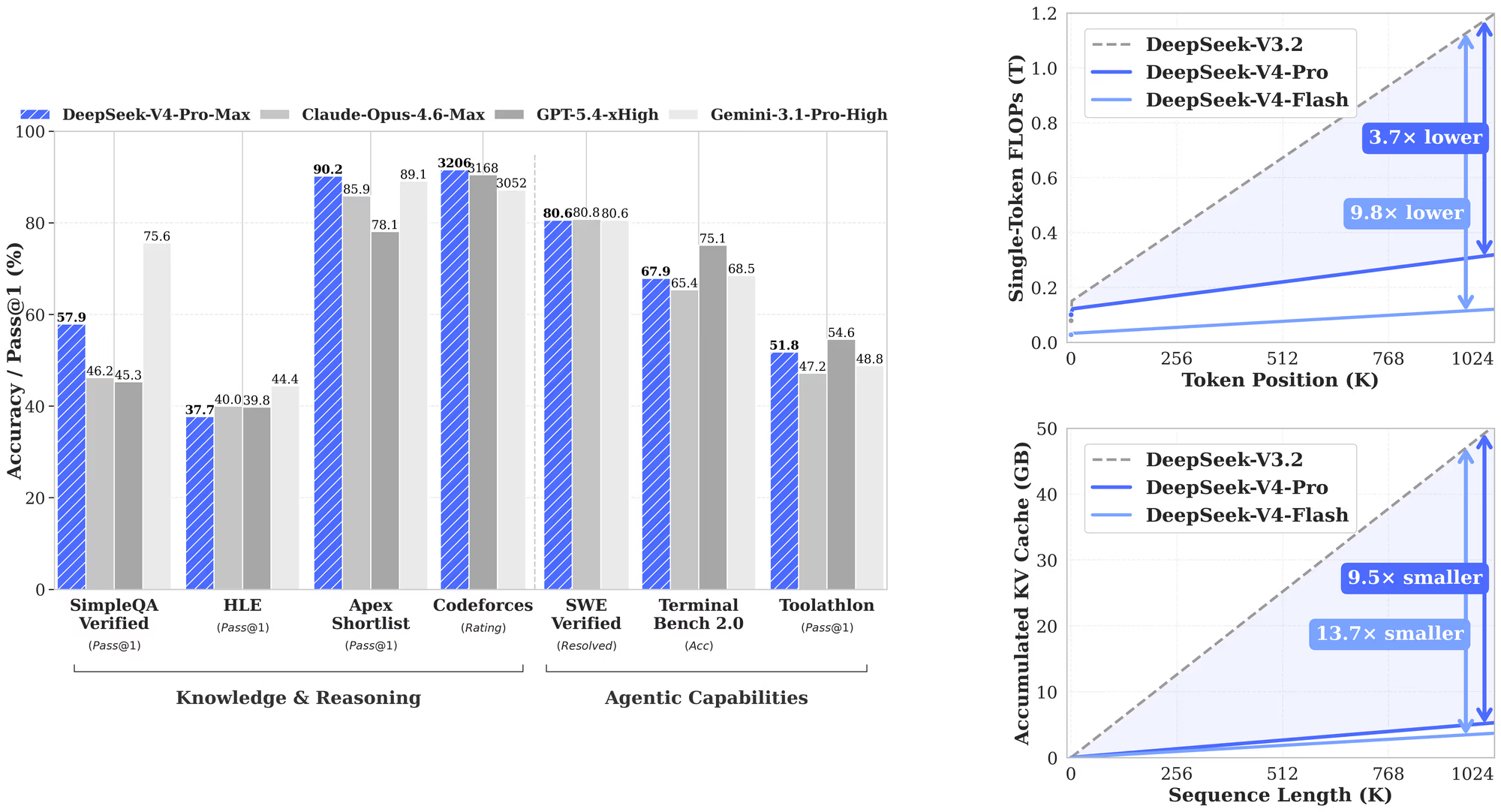
Published benchmark scores for DeepSeek V4 are largely based on internal testing and industry reporting. They have not been independently verified by third-party evaluators. The HumanEval score ranges from 89% to 98% across different sources, indicating different testing conditions.
| Benchmark | DeepSeek V4 (Reported) | Claude Opus 4.5 (Reference) |
|---|---|---|
| HumanEval (Coding) | 89-98% | ~90% |
| SWE-bench Verified | >80% | 80.9% |
| GSM8K (Maths) | ~96% | ~95% |
| Needle-in-a-Haystack | 97% (with Engram) | Not published |
The wide variance in HumanEval scores (89% to 98%) is a red flag that warrants caution. These likely reflect different test conditions, prompting strategies, or preliminary versus final results. Independent evaluation will be critical once V4 is publicly available. The Needle-in-a-Haystack result (97% with Engram, up from 84.2% without) is the most compelling benchmark because it directly demonstrates Engram's impact on long-context retrieval accuracy.
V4 vs Claude Opus 4.6 vs GPT-5.3
The frontier model landscape in February 2026 is a three-way competition with distinct strengths.
DeepSeek V4: The Specialist Scalpel
V4 is purpose-built for coding. Its 1M+ token context window enables processing entire codebases in a single pass, with structural dependency tracking across files. The Engram memory module means factual lookups (API references, library signatures, language syntax) happen at near-zero computational cost, freeing the model's reasoning capacity for the hard problems.
Claude Opus 4.6: The Reliable Architect
Claude Opus 4.6 maintains a higher floor of reliability across diverse tasks. It does not spike as high on coding-specific benchmarks, but it regresses less when contexts are limited, system messages are stripped, or tasks require nuanced reasoning about ambiguous requirements. Its safety alignment is significantly stronger.
GPT-5.3 Codex: The Speed Demon
GPT-5.3 leads on terminal-based development workflows and one-shot task completion. It is described as a "Swiss Army knife" compared to V4's "laser-guided scalpel" - more versatile but less specialised. Its pricing sits between DeepSeek and Claude.
| Dimension | DeepSeek V4 | Claude Opus 4.6 | GPT-5.3 |
|---|---|---|---|
| Best For | Long-context coding, codebase analysis | Architecture planning, complex debugging | Rapid iteration, terminal workflows |
| Context Window | 1M+ tokens | 1M tokens | 500K tokens |
| Output Price (£/1M) | ~£0.44-£0.73 | £18.25 | £7.30 |
| Open Weights | Yes (expected MIT) | No | No |
| Local Deployment | Yes (consumer GPU) | No | No |
| Safety/Alignment | Limited documentation | Industry-leading (Constitutional AI) | Strong |
The Geopolitical Context
DeepSeek V4's release cannot be separated from the broader US-China AI competition. DeepSeek built its previous models using NVIDIA H800 GPUs - restricted chips that the US cleared for export to China. This led to significant political backlash, with a senior US lawmaker criticising NVIDIA for helping DeepSeek optimise its AI systems.
According to CSIS analysis, whilst US export controls can slow and disrupt Chinese AI development, they cannot stop it. DeepSeek's architectural innovations - MoE efficiency, Engram memory offloading to DRAM, aggressive quantisation - are specifically designed to extract maximum performance from limited compute. Each innovation is an engineering workaround for hardware constraints imposed by export controls.
The spending disparity is stark. Five US companies (Meta, Alphabet, Microsoft, Amazon, Oracle) are expected to spend more than $450 billion (~£330 billion) in aggregate AI-specific capital expenditure in 2026. DeepSeek achieves competitive results at a fraction of this investment.
V4's release timing - coinciding with Lunar New Year 2026 - echoes the original January 2025 "DeepSeek moment" and appears calculated for maximum impact. A trillion-parameter open-weight model that runs on consumer hardware directly challenges the Western assumption that frontier AI requires massive infrastructure investment.
Open Weights and Local Deployment
DeepSeek is expected to release V4 as an open-weight model under a permissive licence (likely MIT, consistent with R1), allowing developers to download, modify, and deploy the model locally. The Engram module's source code is already available on GitHub.
Expected distribution channels include:
- HuggingFace: Full-precision and GGUF-quantised weights
- Ollama: Simplified local deployment via
ollama run deepseek-v4 - SGLang: The officially recommended serving framework, fully OpenAI API-compatible
- TensorRT-LLM: Full MoE architecture support including FP8/FP4 quantisation
For teams evaluating deployment options, the recommended approach is SGLang, which is fully compatible with the OpenAI API standard. Existing applications built for GPT-4 or Claude can be pointed at a DeepSeek V4 endpoint with minimal code changes. Multi-node deployment is supported via tensor parallelism for teams requiring higher throughput.
Market Impact
The original "DeepSeek moment" in January 2025 wiped over half a trillion dollars from NVIDIA's market capitalisation in a single day. Multiple financial outlets, including The Motley Fool and J.P. Morgan, have published analyses ahead of V4's release warning of potential repeat disruption.
The core concern for investors is that V4 threatens the AI infrastructure spending narrative at a moment when patience with unsustainable AI capital expenditure is already thin. If developers can run competitive models locally on consumer hardware, the demand for cloud GPU rentals could soften. If models consume less energy, the data centre power buildout narrative weakens.
The counterargument is the Jevons Paradox: cheaper AI may lead to greater total AI consumption, ultimately benefiting infrastructure providers. Lower costs for AI models could accelerate corporate and consumer adoption in ways that increase aggregate demand for compute. This is the same dynamic that saw cheaper cloud computing lead to more spending on cloud infrastructure, not less.
For UK developers and businesses, the practical implication is clear: the cost of running frontier-quality AI coding assistants is dropping by an order of magnitude. Whether that compute is consumed via API or locally deployed hardware, the barrier to adopting AI-assisted development is about to become negligible.
The Bottom Line
DeepSeek V4 represents the most significant architectural innovation in the LLM space since the original Mixture-of-Experts models. Engram is not an incremental improvement - it is a fundamentally new approach to how language models handle the distinction between knowing facts and reasoning about them.
The practical impact for developers is straightforward: if your primary use case is coding and your budget is a constraint, DeepSeek V4 is likely to offer the best value proposition in the market. The combination of open weights, consumer-hardware deployment, 1M+ token context, and estimated pricing under £1/million output tokens creates a compelling package.
However, important caveats apply. Benchmark scores are unverified. The parameter count may be overstated. Consumer hardware claims await testing. Safety and alignment documentation is limited compared to Western alternatives. And the geopolitical context means that some enterprises may face procurement constraints around Chinese-developed models.
For a balanced perspective, compare V4 with GPT-5.3 and Claude Opus 4.6. The best approach for most teams will be to evaluate all three against their specific workloads once V4 is publicly available and independently benchmarked.
Last updated: February 2026. DeepSeek V4 specifications and pricing are based on pre-release reporting and may change. This article will be updated when the model officially launches.
Get the free guide: Claude vs ChatGPT, Gemini & Grok
A 20-page playbook covering everything you need to choose and use the big four AI models in 2026, full cost and feature comparisons, what each is best (and worst) at, and how-tos for images, vectors, building a website, Claude Code and more.