 AI Tools Review Editorial Team
Quick answer:
Cognition, the maker of the autonomous coding agent Devin, had one of the busiest product months of any AI lab in July 2026. In three weeks it shipped its own coding model (SWE-1.7, built on a Kimi K2.7 base), an automated vulnerability-hunting product (Devin Security Swarm), a FedRAMP High listing that opens US federal agency access, an acquisition (incident-automation team TierZero), and a genuinely interesting internal study finding that Claude Fable 5 outperforms and undercuts Claude Opus 4.8 as the lead agent in Cognition's multi-agent "Fusion" architecture. All of it lands on top of a $1 billion-plus raise at a $26 billion valuation in May 2026, with annualised revenue up from $37 million to $492 million in twelve months. None of these releases individually would justify a YouTube thumbnail calling coding "10x easier": together, they show a company moving unusually fast.
Most AI coding news in July 2026 has been about model launches: Kimi K3, Qwen 3.8 Max, DeepSeek V4's General Availability. Cognition's news has been quieter and, in aggregate, arguably more substantial: nine blog posts in twenty days covering a new in-house model, a new security product with real benchmark numbers against Anthropic and OpenAI competitors, a federal compliance milestone, an acquisition, and an internal research finding about which frontier model actually works best as an orchestrator rather than a solo performer.
This article pulls that scattered run of announcements into one place, checks the numbers against Cognition's own published sources, and separates what's a genuine capability advance from what's a well-timed press cycle around a very large funding round.
Note: this analysis draws entirely on Cognition's own official blog posts and pricing pages, Wikipedia's entries for Devin AI and Cognition AI, and third-party funding reporting corroborated across multiple outlets. Several benchmark figures in this piece (SWE-1.7's scores, the Security Swarm comparison, and the Fable-vs-Opus study) come from Cognition's own testing on its own harness rather than an independent third party, and are flagged as such throughout. Prices are billed in US dollars.
Julian Goldie SEO's walkthrough of Devin AI in practice.
Summary
- $1bn+ raised in May 2026 at a $26bn valuation (Lux Capital, General Catalyst, 8VC), taking total funding past $2.5bn since Cognition's November 2023 founding.
- Revenue grew from $37m to $492m annualised in twelve months (1,230% year-on-year) with enterprise customers including Goldman Sachs, Mercedes-Benz, NASA and Santander.
- SWE-1.7, Cognition's own coding model, shipped 8 July 2026, trained from a Kimi K2.7 base, free within the Pro plan and served at roughly 1,000 tokens/sec via Cerebras.
- Devin Security Swarm, launched 1 July 2026, found 72% of real vulnerabilities in a 50-CVE test set at $90.23/run, ahead of Claude Security and Codex Security in Cognition's own comparison.
- FedRAMP High In-Process as of 13 July 2026, opening a path to US federal agency deployment.
- TierZero acquisition (20 July 2026) folds incident-detection and system-reliability automation directly into Devin.
- An internal study found Claude Fable 5 beats Claude Opus 4.8 as a lead orchestrator in Cognition's multi-agent Fusion architecture, scoring higher (60.7 vs 54.6 on FrontierCode 1.1) at a lower cost per run ($1.86 vs $2.04), a genuinely interesting, if self-reported, finding about agent orchestration design.
From stealth startup to $26bn: the timeline
Cognition was founded in November 2023 and emerged from stealth in March 2024 with Devin, positioned as "the first AI software engineer." CEO Scott Wu and CTO Steven Hao led a small team with competitive-programming backgrounds, initially backed by Peter Thiel's Founders Fund. Around July 2025, Cognition merged with Windsurf (the AI-assisted coding IDE company formerly known as Codeium), bringing the two products under one roof; Cognition's 14 July 2026 blog post marked the first anniversary of that merger.
The business has grown fast since. On 28 May 2026, Cognition announced it had raised over $1 billion at a $26 billion post-money valuation, led by Lux Capital, General Catalyst and 8VC, bringing total funding since founding past $2.5 billion. The headline growth numbers behind that raise: annualised revenue grew from $37 million in May 2025 to $492 million in May 2026, a 1,230% year-on-year increase, with enterprise customers growing month-over-month by 50% for six consecutive months. Named customers include Goldman Sachs, Mercedes-Benz, NASA and Santander, alongside multiple US government agencies. CEO Scott Wu framed the raise as a way to "stay independent" as OpenAI, Anthropic and Google all push their own coding agents into the same market. Cognition also disclosed that more than 90% of its own code is now written by Devin, a genuine, checkable claim about internal dogfooding rather than a marketing number about customers.
July 2026 then became an unusually dense month for product releases: Devin Security Swarm (1 July), a security vulnerability remediation program (2 July), a FrontierCode benchmark methodology update (7 July), the SWE-1.7 model (8 July), an open-source model trustworthiness research post (8 July), FedRAMP High In-Process status (13 July), the Fusion architecture study comparing Fable 5 and Opus 4.8 (13 July), the Windsurf merger anniversary post (14 July), and the TierZero acquisition (20 July), nine substantive posts in twenty days, an unusually fast cadence even by 2026's AI-industry standards.

SWE-1.7 and the Fusion architecture
SWE-1.7, released 8 July 2026, is Cognition's own coding model rather than a third-party frontier model routed through Devin. It's trained starting from a Kimi K2.7 base using reinforcement learning, with four specific technical additions Cognition details in its release post: entropy-preserving top-p sampling to stabilise training, multi-cluster training infrastructure spanning three continents with built-in fault tolerance, a data curation pipeline with automated execution tests to filter training examples, and a "self-compaction" technique intended to extend how long a task can run before it exhausts the model's native context window. Cognition positions it specifically for "longer-horizon asynchronous tasks", the kind of multi-hour, multi-step engineering work Devin is built around rather than single-shot code completion.
Separately, Cognition's 13 July post introduces what it calls the Fusion architecture: instead of one large model doing everything, a frontier "lead" model owns the session, talking to the user, planning, reviewing work and committing changes, while delegating discrete subtasks to a cheaper, faster "sidekick" subagent operating in its own context via plain-language handoff briefs. The pitch is straightforward: keep the expensive model focused on judgment and delegation rather than execution, and let the cheap model do the mechanical work, aiming for frontier-level output at a fraction of frontier cost.
Capabilities deep dive
Devin Security Swarm
Launched 1 July 2026, Security Swarm is Cognition's answer to a problem every security team recognises: automated scanners routinely surface 10 to 100 times more findings than a team can triage, most of them false positives. Security Swarm runs multiple agents in parallel across a codebase (what Cognition calls an "Agentic MapReduce" architecture) with each agent investigating a different code region and reasoning across files to spot business-logic flaws and multi-step attack chains, not just pattern-matched known vulnerability signatures. Findings are composed into complete attack paths, then reproduced inside an isolated sandbox to confirm they're actually exploitable before a patch is written and a pull request opened for human review. Supported languages span Go, Python, JavaScript, Rust, Ruby, C#, Java, Swift, PHP, Elixir, Erlang, C, Kotlin and Dart. Scan cadence is configurable, daily, weekly or custom, and subsequent scans process only changed code, which brings ongoing cost down after the first full pass.
TierZero and operational reliability
The 20 July 2026 TierZero acquisition extends Devin past writing and securing code into keeping it running. TierZero, led by Anhang and Yun, specialised in automating incident detection and system-health monitoring, catching problems before they spread rather than after an outage. Cognition's stated goal is to fold that expertise directly into Devin, so engineers spend less time firefighting production incidents and more time on new development. No financial terms or team size were disclosed.
FedRAMP High and government access
On 13 July 2026, Devin reached FedRAMP Class D (High) In-Process status and was listed on the FedRAMP Marketplace, the US government's security authorization framework for cloud services handling sensitive federal data. "In-Process" means the authorization is underway rather than complete, but it's a meaningful, checkable milestone: combined with Cognition's existing US government agency customers (disclosed alongside the May funding round), it signals a real push into federal deployment rather than an incidental market.
Benchmarks: SWE-1.7 and Security Swarm
SWE-1.7's published scores, per Cognition's own release post:
| Benchmark | SWE-1.7 score |
|---|---|
| FrontierCode 1.1 (Main) | 42.3% |
| Terminal-Bench 2.1 | 81.5% |
| SWE-Bench Multilingual | 77.8% |
Cognition's own framing is a genuine strengths-and-weaknesses picture rather than a sweep: SWE-1.7 beats Kimi K2.7 Code and GLM-5.2 across all three benchmarks, but trails GPT-5.5, Claude Opus 4.8 and Opus 4.7 specifically on FrontierCode. That is consistent with how Cognition actually positions the model, not as a frontier-beating flagship, but as a fast, free, "good enough for most tasks" default that Pro-tier users get without paying frontier-model API rates, with the option to route to GPT-5.5, Claude or Gemini models for harder work.
Security Swarm's comparison, tested against 50 real vulnerabilities drawn from GitHub Security Advisories across 14 programming languages:
| Tool | Recall | Cost per run |
|---|---|---|
| Devin Security | 72% | $90.23 |
| Claude Security | 68% | $131.87 |
| Codex Security | 48% | $118.20 |
| Cursor Security | 26% | $4.60 |
Devin Security led on recall and, notably, found three critical vulnerabilities (including a PHP sandbox bypass and a Spring Kafka deserialization flaw) that every competing tool in the test missed entirely. Cursor Security's far lower cost per run alongside its far lower recall (26%) is worth reading as a genuine speed/cost-vs-thoroughness trade-off rather than a straightforwardly worse tool: it may be the right choice for a lighter, faster first pass. This entire comparison is Cognition's own test, run on its own selected vulnerability set, so treat the specific percentages as Cognition's reported figures rather than independently reproduced results; no third-party evaluator such as Artificial Analysis has published a competing security-agent benchmark to check it against at the time of writing.
The Fable vs Opus orchestration study
The most conceptually interesting release of the month is arguably the least flashy: a 13 July blog post comparing Claude Fable 5 and Claude Opus 4.8 as the lead agent in Cognition's Fusion architecture, tested on FrontierCode 1.1.
| Configuration | Score | Cost per run |
|---|---|---|
| Fable 5 + Sidekick | 60.7 | $1.86 |
| Opus 4.8 + Sidekick | 54.6 | $2.04 |
| Fable 5 (standalone) | 60.8 | $4.03 |
| Opus 4.8 (standalone) | 55.4 | $3.06 |
Two things stand out. First, delegating to a cheaper sidekick barely costs Fable 5 any score at all (60.8 standalone vs 60.7 with delegation) while more than halving the cost ($4.03 vs $1.86), a genuinely strong result for the Fusion architecture's core premise. Second, and more surprising: Fable 5 with a sidekick both outscores and costs less than Opus 4.8 with a sidekick, meaning the "bigger, newer Anthropic model" isn't automatically the better choice as an orchestrator, even before price is considered.
Cognition's explanation is behavioural rather than architectural: Fable 5 delegates earlier and more aggressively, averaging 11.5 lead-agent turns per run versus Opus 4.8's 26.5, and the Fable-led lead agent never makes a single direct code edit in 81% of runs, against just 24% for Opus-led runs. In other words, Fable 5 seems to trust its sidekick and hand off work sooner, while Opus 4.8 tends to do more of the design and implementation work itself before delegating, a more expensive pattern that, on this benchmark, didn't pay off in a higher score.
The caveat is the same one that applies to every other benchmark in this article: this is Cognition's own study, on its own harness, using its own scoring methodology, comparing two competitors' models rather than its own product. It's a genuinely useful data point about agent-orchestration design, and notably, it doesn't touch DeepSeek V4, Kimi K3 or any other 2026 open-weight contender as either lead or sidekick, but it shouldn't be read as an independently verified, general-purpose "Fable 5 beats Opus 4.8" verdict outside this specific delegation setup.
Real-world traction vs the benchmark chart
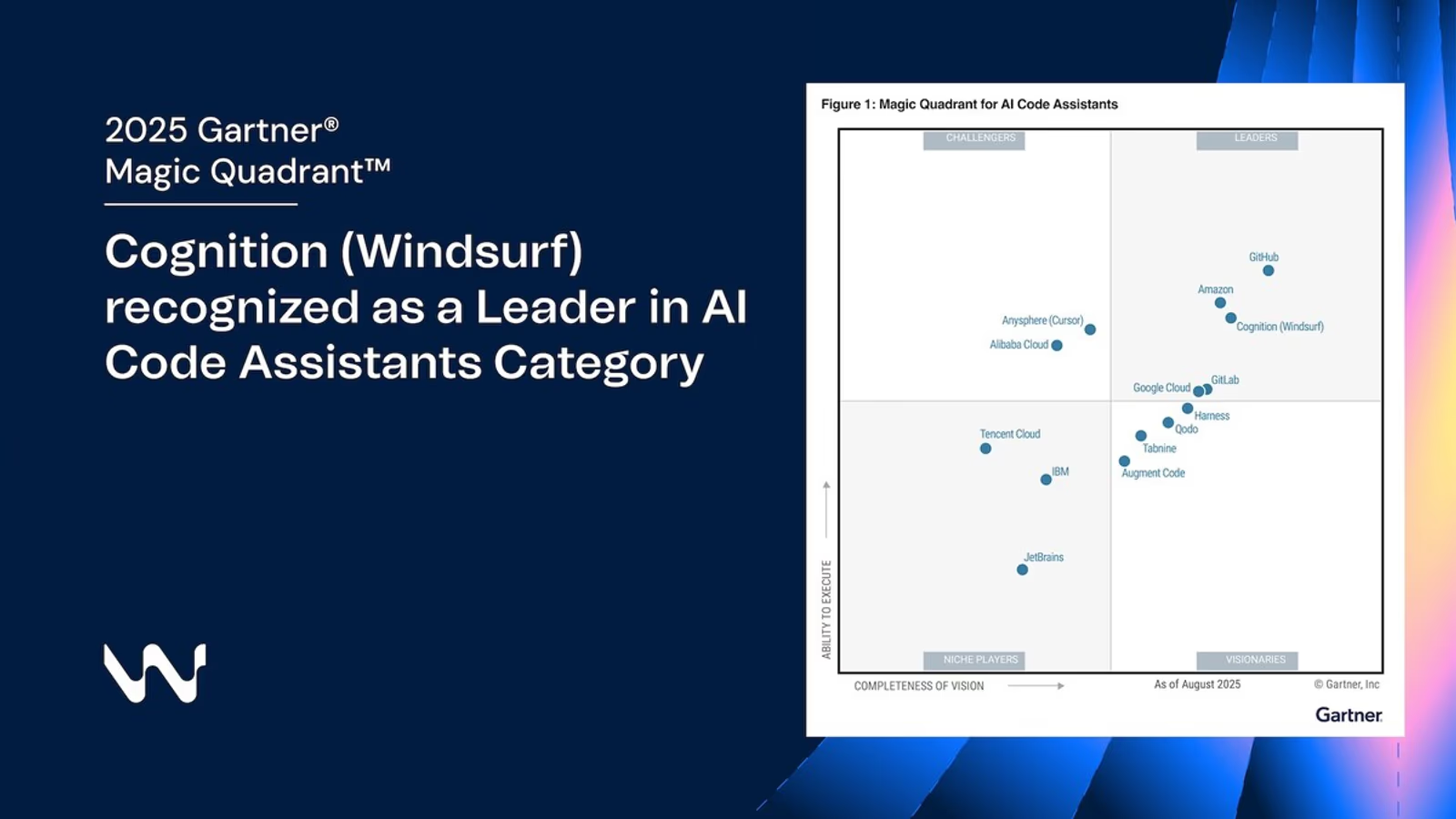
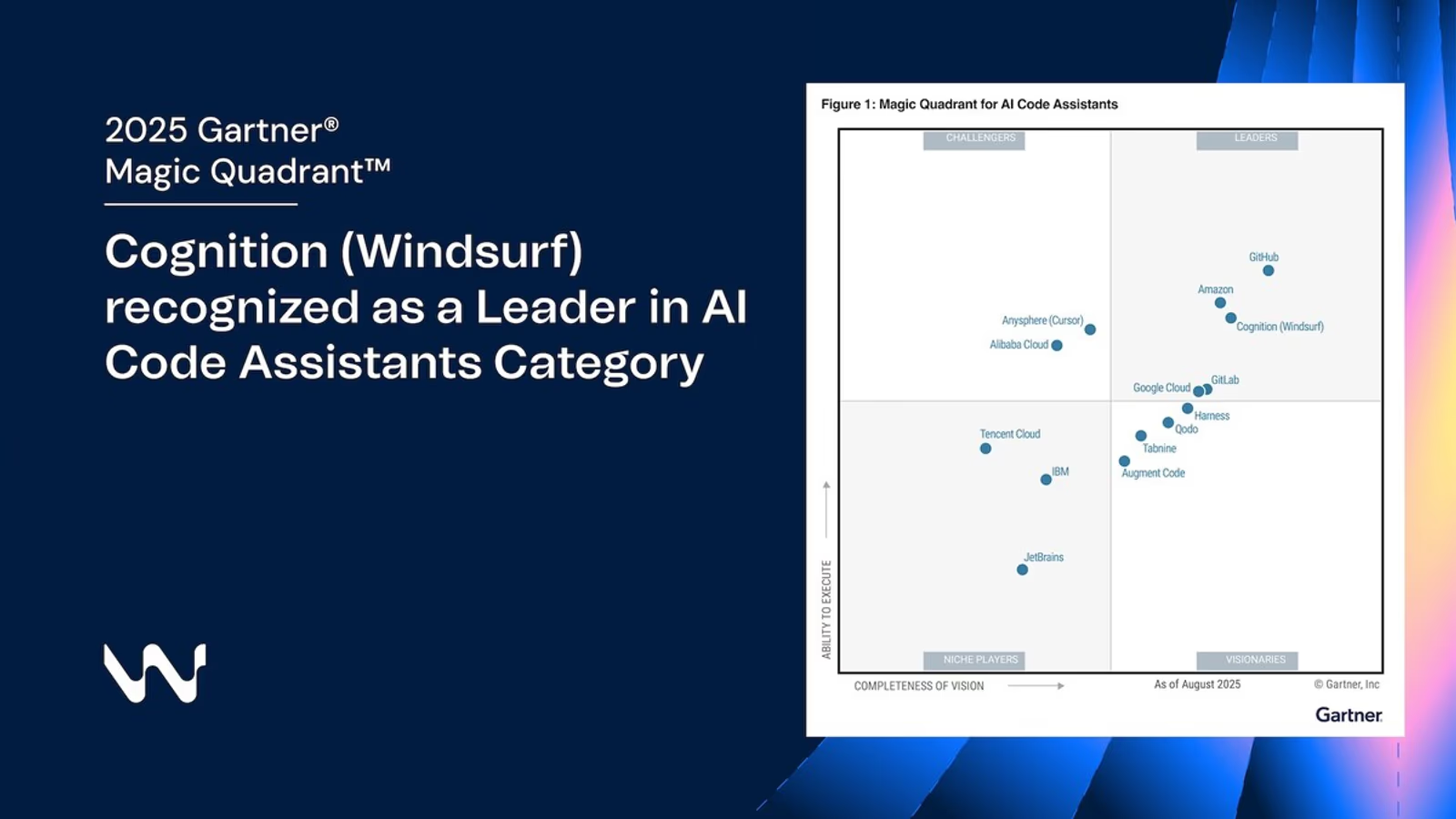
The strongest evidence for Devin's real-world usefulness in this batch of news isn't any individual benchmark. It's the combination of independently observable signals: a 2025 Gartner Magic Quadrant placement as a Leader in AI Code Assistants (shown below), named enterprise customers spanning finance (Goldman Sachs, Santander), automotive (Mercedes-Benz) and government (NASA and multiple federal agencies), a FedRAMP High authorization in progress, and Cognition's disclosure that over 90% of its own codebase is now Devin-written. None of those are benchmark scores that can be gamed by picking a favourable test set: they're operational facts a company either has or doesn't.
That said, revenue growth and Gartner placement measure adoption, not correctness, a company can grow fast on a product that still makes mistakes, and Devin's track record since its 2024 launch has included well-documented early stumbles on tasks it originally claimed to handle autonomously. The July 2026 releases don't erase that history; they show a company still iterating hard on the same core problem, how much of real software engineering an agent can actually own, three years in.
Pricing and availability
| Plan | Price | Includes |
|---|---|---|
| Free | $0 | Light usage quota, unlimited inline edits and Tab completions, limited model availability |
| Pro | $20/mo | Full model access (OpenAI, Claude, Gemini), free SWE-1.7 and open-source models, cloud agents, pay-as-you-go extra usage |
| Max | $200/mo | Everything in Pro, significantly higher quotas |
| Teams | $80/mo + $40/seat | Everything in Pro, unlimited members, shared billing, admin dashboard, priority support |
| Enterprise | Custom | SAML/OIDC SSO, dedicated account management, dedicated deployment |
Devin Security Swarm and the Security Vulnerability Remediation Program are positioned as separate enterprise offerings on top of the core Devin plans; Cognition has not published standalone list pricing for either. SWE-1.7's inclusion free within the Pro plan, alongside pay-as-you-go access to frontier models from OpenAI, Anthropic and Google, is the most immediately actionable pricing detail here: it makes Cognition's own model the default low-cost option, with frontier models available for tasks that need them.
Limitations
- SWE-1.7 trails the frontier on FrontierCode. Cognition's own numbers show it behind GPT-5.5, Opus 4.8 and Opus 4.7 on that specific benchmark, even as it beats Kimi K2.7 Code and GLM-5.2.
- Every headline benchmark in this article is Cognition's own, self-reported figure. No independent evaluator such as Artificial Analysis has published comparable third-party scoring for SWE-1.7, Security Swarm, or the Fable-vs-Opus study at the time of writing.
- The Fable-vs-Opus finding is scoped narrowly. It covers one benchmark (FrontierCode 1.1), one architecture (Fusion), and two models: it says nothing about how Fable 5 or Opus 4.8 perform standalone outside Cognition's harness, or how open-weight models like DeepSeek V4 or Kimi K3 would fare in the same setup.
- FedRAMP High is "In-Process," not complete. Federal agencies cannot yet treat Devin as fully authorized under that framework.
- No public financial terms for the TierZero acquisition: team size, price, or integration timeline are all undisclosed.
- Devin's broader track record includes documented early failures on tasks it was originally marketed as handling fully autonomously; July 2026's releases are incremental improvements on that same core challenge, not proof it has been solved.
How Devin compares
As a coding agent platform, Devin's closest comparison is less "which model is smartest" and more "how much of the engineering workflow does it actually own." Where a model review like our Kimi K3 or DeepSeek V4 coverage asks whether a single model is capable, Devin bundles model choice (its own SWE-1.7, or routed frontier models), multi-agent orchestration (Fusion), security scanning (Security Swarm), and now operational reliability (TierZero) into one product, a materially different pitch from a model API or an IDE plugin like Cursor.
Gartner's own 2025 Magic Quadrant placement is a useful independent anchor here: Cognition (Windsurf) sits in the Leaders quadrant alongside GitHub and Amazon, ahead of Cursor's parent Anysphere and Alibaba Cloud on the "Completeness of Vision" axis, and ahead of Google Cloud, GitLab, Harness, Qodo, Tabnine and Augment Code on "Ability to Execute", a genuinely independent (if vendor-influenced, as Magic Quadrants are compiled from vendor briefings and customer reference calls) data point that corroborates the growth story without relying on Cognition's own numbers.
Who should use it, and who should wait
Worth trying now: engineering teams that want a single platform spanning code generation, automated security scanning and (soon) incident response, rather than stitching together separate tools; teams already paying for frontier model API access who want a free, fast default (SWE-1.7) for routine tasks with the option to escalate to Claude, GPT or Gemini for harder work; and security teams drowning in scanner false positives, where Security Swarm's sandbox-verified exploitability check is a genuinely different approach from pattern-matching scanners.
Better to wait: regulated organisations that specifically need completed (not in-process) FedRAMP High authorization today; teams wanting independently verified benchmarks rather than Cognition's own self-reported figures before committing budget; and anyone treating the Fable-vs-Opus finding as a general model-quality verdict rather than what it actually is, a narrow result about orchestration behaviour inside one company's specific multi-agent architecture.
The bottom line
Strip away the "10x easier" YouTube framing and Cognition's July 2026 is still a genuinely busy, substantive month: a real in-house model, a real security product with a benchmarked comparison against Anthropic and OpenAI competitors, a real acquisition, real federal compliance progress, and a genuinely interesting piece of applied research about how to get more out of a frontier model by making it delegate sooner. None of it is independently verified end to end, and Devin's own history is a reason to treat any single benchmark with some scepticism, but the combination of a $26bn valuation, 1,230% revenue growth, and a Gartner Leaders placement suggests this is a company converting product velocity into real enterprise adoption, not just press-cycle noise.
Sources for this article include Cognition's official blog, its official pricing page, and third-party funding and Gartner-placement reporting via PR Newswire.
Last updated: 21 July 2026, one day after Cognition's TierZero acquisition announcement. This article will be revised if independent evaluators publish third-party scoring for SWE-1.7 or Security Swarm.
Get the free guide: Claude vs ChatGPT, Gemini & Grok
A 20-page playbook covering everything you need to choose and use the big four AI models in 2026, full cost and feature comparisons, what each is best (and worst) at, and how-tos for images, vectors, building a website, Claude Code and more.