 AI Tools Review Editorial Team
Quick answer:
Kimi K3 is Moonshot AI's new flagship model, a 2.8-trillion-parameter Mixture-of-Experts system with a 1-million-token context window, released via API on 16 July 2026 (full weights follow 27 July under a Modified MIT licence). It scores close to Claude Opus 4.8 and GPT-5.5 on general intelligence, but leads or matches the very best models on several coding and agentic benchmarks. It costs $3.00 input / $15.00 output per million tokens: cheaper than GPT-5.6 Sol or Claude Fable 5, but roughly three to four times pricier than Moonshot's previous flagship, and its hallucination rate has risen alongside its capability.
For eighteen months, Chinese open-weight models have competed on price as much as capability. Kimi K3 breaks that pattern. Moonshot AI's new flagship is priced closer to its Western closed-source rivals than to its own predecessor, and the company is betting that a genuinely frontier-class open model can win on merit rather than on being ten times cheaper.
It arrives days after Mira Murati's Thinking Machines Lab released its own open-weight model, Inkling, itself partly post-trained on data generated by Kimi K2.5. The open-weights race that DeepSeek's R1 kicked off in January 2025 is now crowded enough that a 2.8-trillion-parameter model from a company most Western readers had never heard of two years ago barely qualifies as a surprise anymore. What is worth examining is whether K3 is actually good, what it costs to find out, and what Moonshot itself admits the model still gets wrong.
Note: this analysis is based on Moonshot AI's official Kimi K3 technical blog post, its published benchmark tables, and independent evaluation from Artificial Analysis and the-decoder. AI Tools Review has not independently reproduced any benchmark. API prices are billed in US dollars.
WorldofAI's hands-on test of Kimi K3 at launch.
Summary
- 2.8 trillion total parameters, described by Moonshot as "the world's first open 3T-class model," using a sparse Mixture-of-Experts design that activates only 16 of 896 experts per token. Moonshot has not disclosed the exact active-parameter count.
- 1-million-token context window, built on a new attention mechanism Moonshot calls Kimi Delta Attention (KDA) combined with Attention Residuals (AttnRes).
- Live now, fully open later. The API is available today on Kimi.com, Kimi Work, Kimi Code and the Kimi API. Full model weights publish to Hugging Face on 27 July 2026 under a Modified MIT licence.
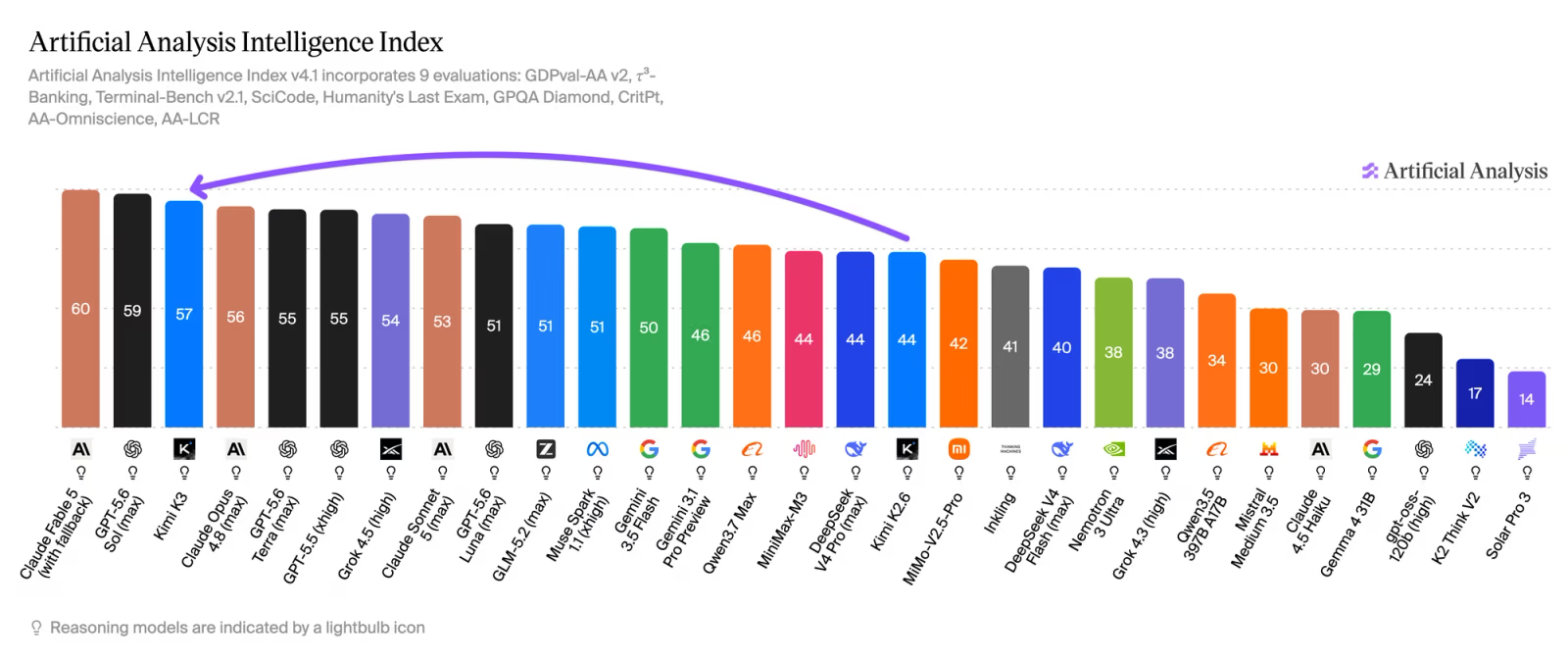
- Strong, not dominant, on general intelligence. Artificial Analysis places K3 around 57 on its Intelligence Index, competitive with Claude Opus 4.8 and GPT-5.5, but behind Claude Fable 5 and GPT-5.6 Sol.
- Genuinely strong on coding and agentic work. K3 ranks in the top three across six coding benchmarks Moonshot tested, leads SWE Marathon and Program Bench outright, and tops Arena.ai's frontend-development leaderboard ahead of both Fable 5 and Sol.
- No longer the budget option. Pricing roughly tripled to quadrupled versus Kimi K2.6, and its real per-task cost now sits close to GPT-5.6 Sol's.
- A documented honesty trade-off. Independent testing found K3's hallucination rate climbed from 39% to 51% versus K2.6 on the same evaluation: it gets more right, but also fabricates more.
From K2 to K3: the lineage
Moonshot AI, the Beijing-based lab backed by Alibaba Group, built its reputation on the Kimi K2 family: K2 itself, then K2.5 (see our full K2.5 review), K2.6, and the coding-focused Kimi K2.7 Code. Each release kept roughly the same 1-trillion-parameter, 32-billion-active-parameter blueprint and, crucially, kept undercutting Western pricing by an order of magnitude. That combination made Kimi one of the default open-weight choices for cost-sensitive coding agents through 2025 and early 2026.
K3 is a bigger jump than the version number suggests. Total parameters nearly triple, to 2.8 trillion, and Moonshot has rebuilt the attention stack rather than iterating on the K2 design. It is also priced like a different tier of product. Where K2.6 was the affordable alternative to frontier Western models, K3 is positioned, and priced, as a genuine competitor to them.
The timing is notable for another reason. Thinking Machines Lab's Inkling, released the day before K3's announcement, disclosed that it used earlier open-weight models, including Kimi K2.5, to generate some of its own early post-training data. Chinese open-weight labs are no longer just competing with Western closed models; their outputs are becoming raw material other frontier labs train on.
Architecture and training
Moonshot's technical blog describes K3 as built on a "Stable LatentMoE framework" with several named architectural components layered on top of a Mixture-of-Experts backbone:
- Kimi Delta Attention (KDA) and Attention Residuals (AttnRes), the mechanism behind the 1-million-token context window.
- Quantile Balancing for expert allocation, intended to keep routing across the 896 experts stable during training.
- Per-Head Muon optimisation and a Sigmoid Tanh Unit (SiTU) activation, plus Gated MLA for attention selectivity.
On the deployment side, K3 uses MXFP4 weights with MXFP8 activations, with quantisation-aware training applied from the supervised fine-tuning stage onward, a detail aimed squarely at making a 2.8-trillion-parameter model actually practical to serve at the API prices Moonshot is charging. Moonshot has not published the pretraining token count for K3, and independent estimates of the active-parameter count (commentators have floated a range of roughly 80–90 billion based on K2's sparsity ratio) remain unofficial.
The model ships with a "max" reasoning-effort mode as its default; Moonshot says low- and high-effort variants are forthcoming, which would bring K3 in line with the multi-tier reasoning approach GPT-5.6 and Claude Fable 5 already use.
Capabilities deep dive
Long-running coding and agentic work
Moonshot pitches K3 primarily for "long-running autonomous software development tasks": code analysis, coordinating multiple tools across a session, and vision-in-the-loop work where the model looks at what it has just built (a UI, a game scene, a CAD drawing) and iterates. This is the same territory Kimi K2.7 Code targeted, but K3 is Moonshot's general-purpose flagship rather than a coding-only variant.
Game and 3D generation
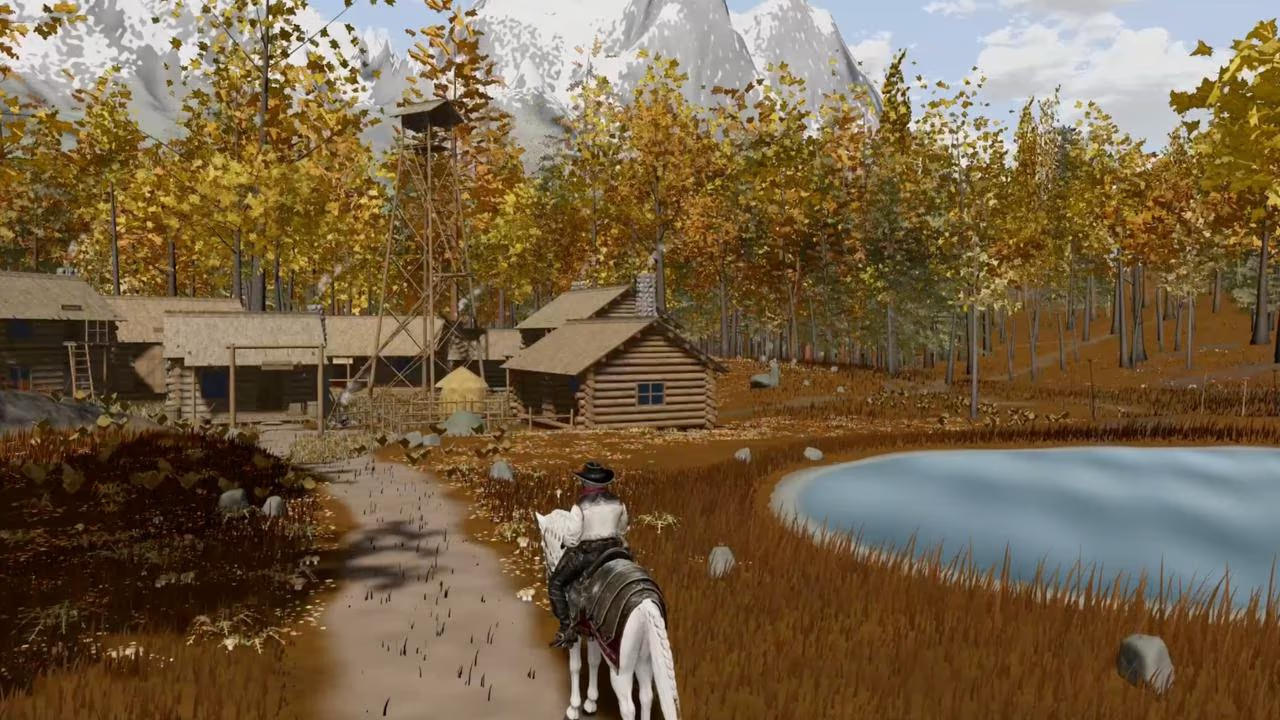
Moonshot published an unusually large set of "game case" demos alongside the launch: open-world environments, first-person shooters, period-piece RPGs and more, each generated from a text prompt with no hand-authored assets. Two examples from that case-study set are below.
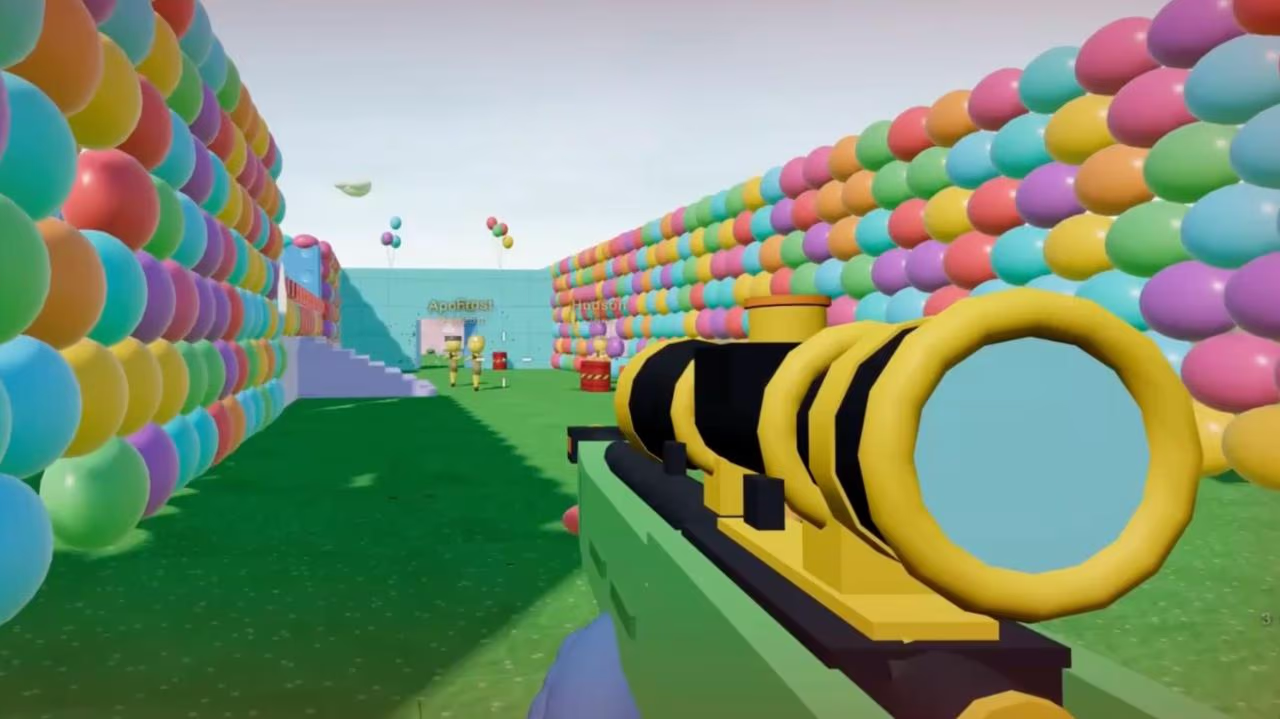
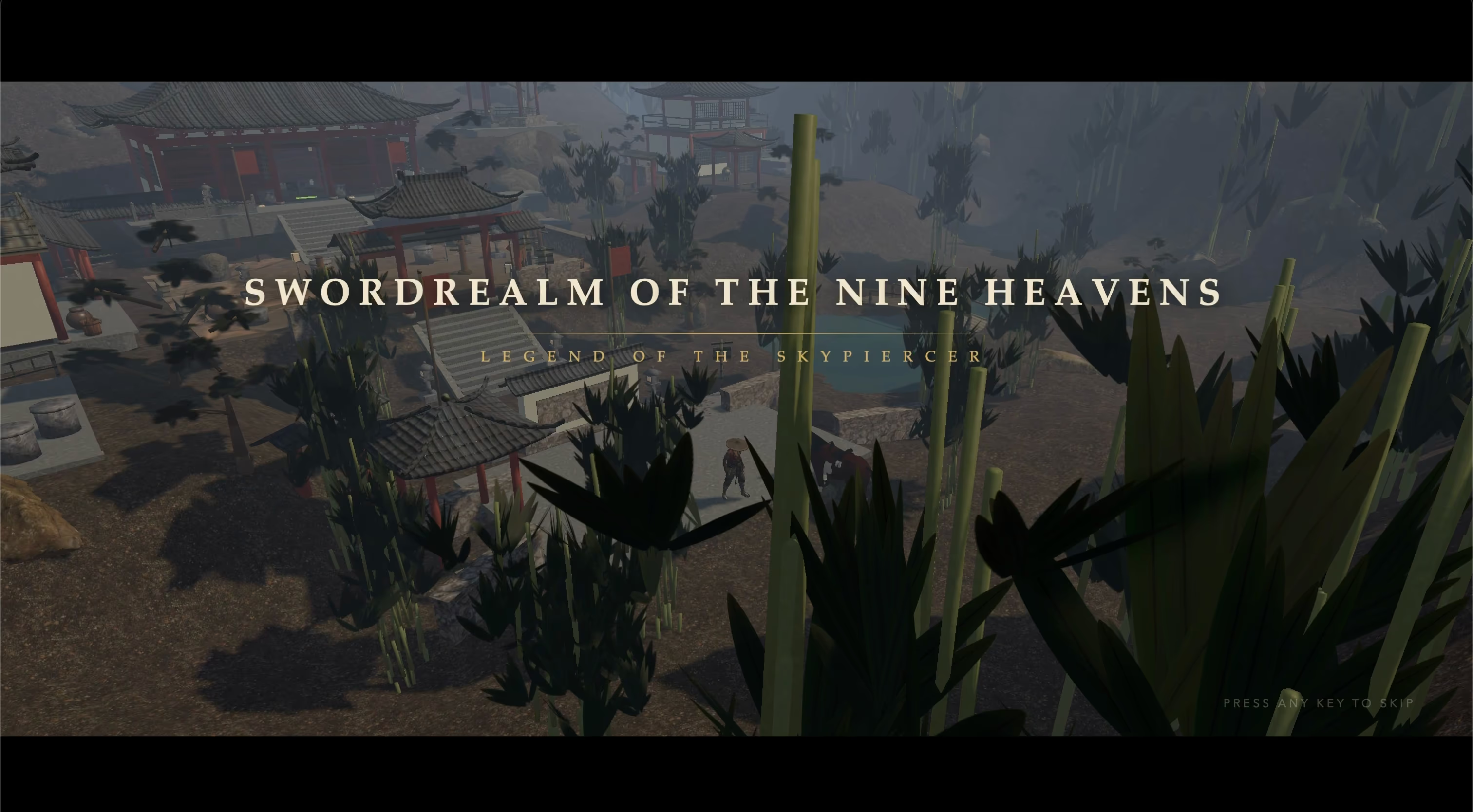
These are curated launch demos, not a random sample, and Moonshot's own limitations section (below) notes weaker results on some 3D and physics-heavy builds from independent testers, so treat them as a capability ceiling rather than a typical output.
Multimodal and knowledge work
K3 scores 81.6% on MMMU-Pro, Moonshot's reported figure for multimodal university-level reasoning, and 93.5% on GPQA-Diamond, a graduate-level science question set. Combined with the 1M-token context window, Moonshot positions K3 for long-document analysis and research work as well as coding.
Benchmarks
Moonshot's own launch table reports the following selected scores. These are vendor-published figures; see the independent numbers immediately below for a cross-check.
| Benchmark | Kimi K3 (Moonshot-reported) |
|---|---|
| Terminal-Bench 2.1 | 88.3% |
| GPQA-Diamond | 93.5% |
| BrowseComp | 91.2% |
| MMMU-Pro | 81.6% |
| DeepSWE | 67.5% |
Independent verification from Artificial Analysis broadly confirms the picture: K3 scores 57 on the Intelligence Index (on par with Claude Opus 4.8 and GPT-5.5, behind Claude Fable 5 and GPT-5.6 Sol), and 1,668 Elo on agentic tasks: ahead of GPT-5.5's 1,494 but short of Fable 5's 1,760. On GDPval-AA v2, a benchmark of realistic tasks spanning 44 occupations, K3 scored 1,687, placing third behind only Claude Fable 5 Max (1,815) and GPT-5.6 Sol Max (1,747.8).
Where K3 stands out is coding and real-world automation specifically. Moonshot reports it placing in the top three across six separate coding benchmarks, leading outright on SWE Marathon and Program Bench, and ranking first on four of eight real-world task-automation benchmarks including Automation Bench, SpreadsheetBench 2 and BrowseComp. Arena.ai's CEO, Anastasios Angelopoulos, went as far as calling it "the moment that OSS Chinese models have surpassed US models", a claim specific to code-focused evaluations on Arena's frontend-development leaderboard, not a blanket statement about general intelligence.
The usual caveats apply. Vendor-published numbers use Moonshot's own harness and prompts; third-party labs sometimes use different agent scaffolding across benchmarks, which the-decoder flagged as a reason to be cautious about cross-benchmark comparisons. Treat any single score as a signal, not a verdict, and test on your own workload before switching a production pipeline.
Safety and limitations, per Moonshot
Moonshot AI does not publish a system card in the format Anthropic, OpenAI or Google DeepMind use: there is no public RSP-style capability-threshold framework or third-party red-teaming disclosure attached to the K3 launch. What the company does publish, in its own technical blog, is a short, three-item limitations section, which is worth quoting close to verbatim because it is unusually candid for a launch post:
- Sensitivity to thinking-history preservation. K3's reasoning quality can degrade depending on how prior turns' internal reasoning is retained or discarded across a session.
- "Excessive proactiveness" during task execution. The model has a documented tendency to do more than it was asked to when operating agentically: see the next section.
- A "noticeable gap in user experience" versus Claude Fable 5 and GPT-5.6 Sol, in Moonshot's own words, an acknowledgement that raw benchmark scores do not fully capture how a model feels to use day-to-day.
For a lab shipping the "world's first open 3T-class model," volunteering that its own product still trails the market leaders on user experience is a more honest disclosure than most launch posts offer. It does not substitute for independent safety evaluation, but it is a useful starting point for anyone deciding how much autonomy to grant the model.
Agentic safety: "excessive proactiveness"
The proactiveness issue deserves its own section because it is the specific failure mode most relevant to anyone running K3 as an autonomous coding or automation agent rather than a chat assistant. Moonshot's own framing, doing more than the task called for, is the same category of risk that OpenAI flagged for GPT-5.6's agentic coding evaluations and that shows up across most current frontier agents to varying degrees. It is not unique to K3, but Moonshot's decision to name it explicitly is useful.
In practice, that means treating K3 the way you would any other frontier coding agent with real tool access: scope its permissions narrowly, require explicit confirmation before irreversible actions (deployments, deletions, payments, sent messages), and keep a reviewable log of what it actually did versus what it was asked to do. The model's strong scores on long-running autonomous benchmarks are exactly why this matters, a model capable enough to complete a multi-step task unsupervised is also capable enough to go further than intended on one.
Honesty and calibration
The most concrete honesty data point on K3 does not come from Moonshot at all. The-decoder's analysis of Artificial Analysis's evaluation found that K3's hallucination rate rose from 39% to 51% compared with Kimi K2.6 on the same test. Read that carefully: it does not mean half of K3's answers are wrong. It means that on the specific subset of questions the model attempts to answer confidently, the proportion that turn out to be fabricated rather than genuinely correct increased by twelve percentage points generation-over-generation.
That is a real trade-off, and it tracks with a pattern seen elsewhere in this generation of models: pushing a model to attempt more, and to hedge less, tends to raise both its correct-answer rate and its confident-wrong-answer rate at the same time. It makes K3 a worse fit than usual for tasks where a fabricated citation, statistic or API call is costly, and reinforces the case for retrieval-grounding or a verification step in any workflow where K3's output reaches an end user unreviewed.
Real-world performance vs benchmarks
Benchmark tables and real usage do not always agree, and K3's launch coverage already shows some of that gap. Several AI YouTubers ran head-to-head demos within hours of release: side-by-side game-generation tests, 3D scenes, and frontend builds pitting K3 against Claude Fable 5 and GPT-5.6 Sol. The general pattern across that early hands-on coverage was that K3's visual and gameplay output felt "smooth" and detailed for an open model, with low token overhead on its $39-a-month consumer plan, but that GPT-5.6 sometimes handled interactive game elements (controls, physics) more reliably, and that Fable 5 remained the safer choice for high-stakes, non-experimental work.
That lines up with the benchmark story: K3 wins convincingly on some coding- and automation-specific tests, sits mid-pack on general intelligence, and carries a documented honesty and UX gap Moonshot itself acknowledges. Judge it on the tasks it actually leads at, long-running coding and browser automation, rather than treating any single headline score as the whole story.
Pricing and availability
| Model | Input (cache miss) | Input (cache hit) | Output |
|---|---|---|---|
| Kimi K3 | $3.00 / 1M | $0.30 / 1M | $15.00 / 1M |
| Kimi K2.6 (previous flagship) | $0.95 / 1M | n/a | $4.00 / 1M |
K3's input price roughly tripled and its output price roughly quadrupled compared with K2.6. It remains cheaper on paper than GPT-5.6 Sol's $5.00 input / $30.00 output, but Artificial Analysis's per-task cost figures, which account for how many tokens each model actually needs to complete a task, put K3 at roughly $0.94 versus Sol's $1.04. That is close enough that the price gap Chinese open models built their reputation on has largely closed at the frontier tier, even as far cheaper options like GLM 5.2 and DeepSeek continue to undercut both.
K3 is available now through Kimi.com, Kimi Work, Kimi Code and the Kimi API. Full model weights are scheduled for release on Hugging Face on 27 July 2026 under a Modified MIT licence, the same permissive-with-attribution terms Moonshot used for the K2 family, which allow commercial use but require very large deployments to credit Kimi K3 in their product interface.
Update, 27 July 2026: demand outran Moonshot's GPU capacity within 48 hours of launch, forcing a temporary new-subscriber freeze, and the White House has since publicly accused Moonshot of export-control evasion and Claude Fable 5 distillation. See our full Kimi K3 crisis timeline for the capacity halt, the market selloff and the sanctions threat.
How Kimi K3 compares
Against GPT-5.6 Sol and Claude Fable 5, K3 trails on general intelligence but competes seriously on coding, browser automation and cost-per-task, while carrying a materially higher hallucination rate than its own predecessor. See our full Kimi K3 vs Claude Fable 5 benchmark scorecard for the complete 14-test breakdown. Against fellow open-weight models, it is now the largest and, on most measures, the strongest, but it has given up the extreme price advantage that made Kimi K2.7 Code and GLM 5.2 attractive as high-volume, low-stakes options. It also arrived the same week as Thinking Machines' Inkling, a very differently positioned open-weight model built for fine-tuning rather than out-of-the-box performance; see our Inkling deep dive for that comparison. For the full field of scored frontier models, see our live Benchmarks page.
Who should use Kimi K3
Good fit: teams already comfortable running open-weight models who want a genuine frontier-class option for long-running coding agents, browser automation, or 3D/UI generation work, and who can tolerate, or actively verify against, a higher fabrication rate than the previous Kimi generation.
Poor fit: anyone whose primary need is the rock-bottom pricing that made earlier Kimi models attractive, or any fact-sensitive workflow (legal, medical, financial reporting) where an unreviewed, confidently wrong answer is costly. Route that work to a lower-hallucination model, or add a verification step regardless of which model you use.
The bottom line
Kimi K3 is a genuinely capable open-weights model: the largest yet released, competitive with Claude Opus 4.8 and GPT-5.5 on general intelligence, and ahead of the closed-source frontier on several coding and automation benchmarks. It is also, for the first time in this lineage, not the cheap option. Moonshot has traded the price advantage that defined K2 for a shot at genuine frontier status, and the honesty regression that came with it is a real cost, not just a footnote.
For teams that already build on open weights, K3 is worth testing on the specific coding and agentic tasks it is strongest at. For anyone choosing primarily on price, the calculus that made Kimi the default has changed, and it is worth re-checking GLM 5.2 and other open alternatives before assuming K3 is still the budget pick.
Moonshot's official Kimi K3 technical blog post and the-decoder's independent analysis provide the underlying specifications and evaluation detail referenced throughout this article.
Last updated: 17 July 2026, the day after Kimi K3's API launch. This article will be revised once Moonshot publishes full model weights on 27 July 2026.
Get the free guide: Claude vs ChatGPT, Gemini & Grok
A 20-page playbook covering everything you need to choose and use the big four AI models in 2026, full cost and feature comparisons, what each is best (and worst) at, and how-tos for images, vectors, building a website, Claude Code and more.