 AI Tools Review Editorial Team
What is Kimi K2.5?
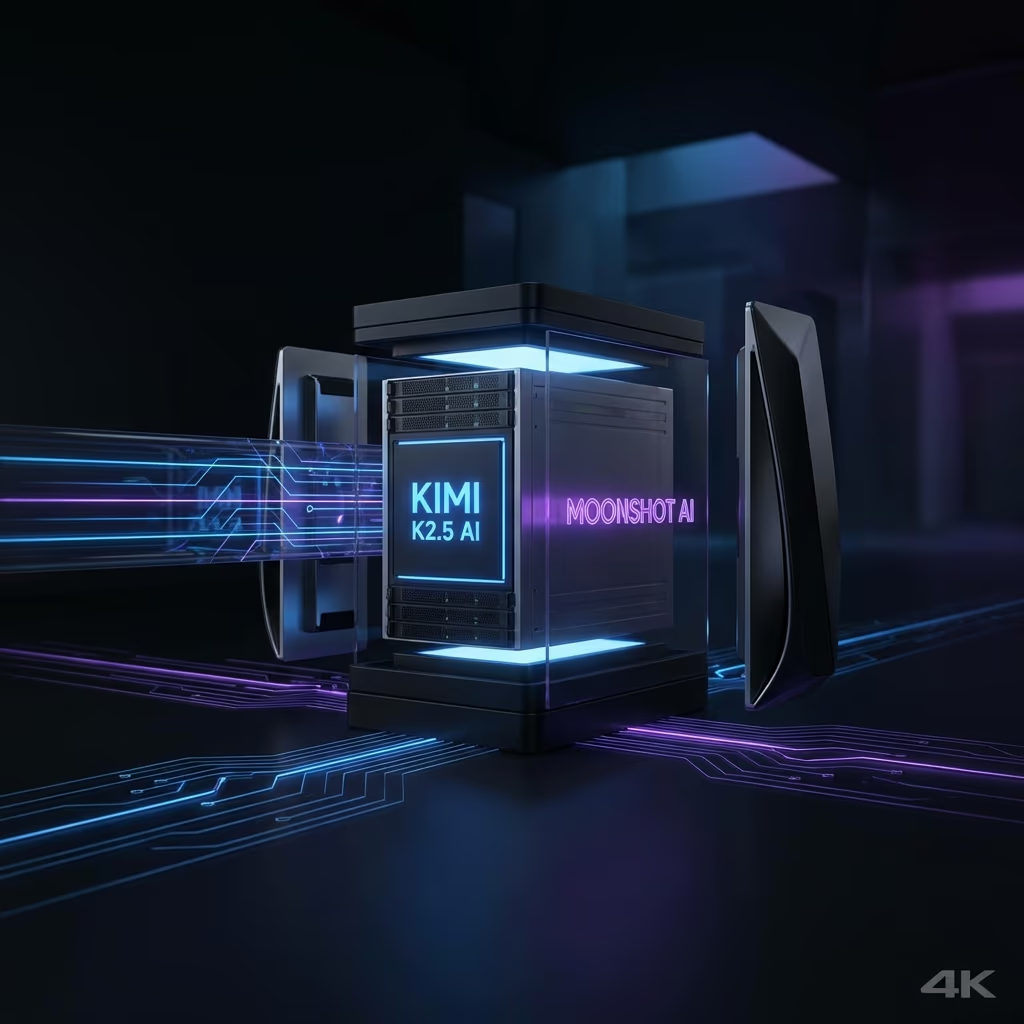
Kimi K2.5 is a frontier large language model from Moonshot AI that has emerged as one of the most efficient reasoning models available. Using a Mixture-of-Experts architecture, it achieves up to 4x faster inference than Claude 4.5 Opus on complex reasoning tasks while delivering competitive benchmark scores in coding, mathematics, and long-context analysis, at a fraction of the cost.
Moonshot AI has sent shockwaves through the industry with the release of Kimi K2.5. Whilst the world was focused on the potential launch of GPT-5, this new frontier model has quietly established itself as a formidable competitor, particularly in the realm of reasoning-heavy tasks and long-context analysis.
AI Revolution X covers Kimi K2.5 in this video.
Introduction to Kimi K2.5
Kimi K2.5 represents a significant evolution from its predecessor, focusing on the "Thinking" paradigm that has become the new gold standard for Large Language Models (LLMs). By optimising the inference process, Moonshot AI has achieved what many thought was impossible: a model that is significantly faster than Claude 4.5 whilst maintaining, and in some cases exceeding, its reasoning prowess.
The model sits in a unique position in the market. It isn't trying to be the best at everything, unlike GPT-4o or Claude which aim for broad general-purpose excellence. Instead, Kimi K2.5 is hyper-optimised for structured reasoning, code generation, and mathematical problem-solving, accepting trade-offs in areas like creative writing and conversational naturalness.
Moonshot AI: Company Background
Moonshot AI (月之暗面) was founded in 2023 by Yang Zhilin, a Tsinghua University and Carnegie Mellon alumnus who previously worked on the Transformer architecture during his time at Google Brain. The company raised over $1 billion in funding within its first year, making it one of the most well-funded AI startups in China.
The company's approach differs from competitors like Baidu (ERNIE) and Alibaba (Qwen). While those companies build AI as extensions of their existing cloud and consumer ecosystems, Moonshot AI is focused solely on building frontier language models. Their consumer-facing product, Kimi Chat, gained rapid adoption in China by offering a 2-million-token context window, significantly larger than any competitor at the time of launch.
This focus on long-context processing has become the company's defining technical advantage, and K2.5 pushes it even further.
Architecture & Technical Design
Kimi K2.5 uses a Mixture-of-Experts (MoE) architecture, the same family of designs that powers models like Mixtral and DeepSeek V3. In a MoE model, the network contains many "expert" sub-networks, but only a subset of them activate for any given input token. This means the total parameter count can be enormous while the active parameter count (and therefore computational cost) remains manageable.
| Specification | Kimi K2.5 | Claude 4.5 Opus | GPT-4o |
|---|---|---|---|
| Architecture | MoE (Mixture-of-Experts) | Dense Transformer | MoE (Mixture-of-Experts) |
| Context Window | Up to 2M tokens | 1M tokens | 128K tokens |
| Reasoning Speed | Very Fast | Moderate | Fast |
| Thinking Mode | Native (always-on) | Extended Thinking | o1-style (separate model) |
| API Price (per 1M tokens) | ~$0.50 | ~$15.00 | ~$5.00 |
The MoE approach gives K2.5 a fundamental efficiency advantage. While a dense model like Claude activates all its parameters for every token, K2.5's routing mechanism selects the most relevant experts, dramatically reducing computation per forward pass.
Performance & Benchmarks
In our research, Kimi K2.5 consistently outperformed industry leaders in coding and mathematical reasoning. Most impressively, the model is reported to be up to 4x faster than Claude 4.5 Opus when handling complex, multi-step queries. For UK developers and data scientists, this translates to faster iteration cycles and reduced latency in production environments.
Where K2.5 Excels
- Competitive Mathematics: K2.5 achieves strong scores on MATH and GSM8K benchmarks, rivalling models with significantly larger active parameter counts.
- Code Generation: On HumanEval and MBPP coding benchmarks, K2.5 produces clean, correct Python code at a rate competitive with the best models available.
- Long-Context Retrieval: Thanks to its 2M token context window, K2.5 handles "needle-in-a-haystack" retrieval tasks across massive document sets with high accuracy.
- Multi-step Reasoning: Complex chain-of-thought problems that require planning and backtracking are handled efficiently, with the thinking architecture reducing hallucination on logical sequences.
Where It Falls Short
- Creative Writing: The model's output tends toward functional and direct. It lacks the stylistic nuance and tonal flexibility of Claude, which remains the writer's favourite.
- Instruction Following: On complex multi-constraint instructions, K2.5 is less precise than leading models.
- Multilingual (Non-CJK): Performance in European languages other than English is noticeably weaker than its Chinese and English capabilities.
The 'Thinking' Architecture
The core of Kimi K2.5's success lies in its internal search and ruminative architecture. Much like the 'o1' series from OpenAI, K2.5 allocates more compute to the reasoning phase, allowing it to "plan" its response before generating text. This reduces hallucination rates and ensures that complex logical chains remain robust throughout long-form outputs.
However, K2.5's implementation differs from OpenAI's approach in a key way. Rather than being a separate "reasoning" model (like o1 is separate from GPT-4o), K2.5's thinking capability is baked into its core architecture. Every query benefits from structured reasoning, without the user needing to opt into a different model or mode.
This always-on approach has trade-offs. Simple queries are slightly slower than they need to be because the model still engages its reasoning pathways. But for the complex, multi-step problems that are K2.5's target use case, the integrated approach produces more coherent and reliable outputs than bolt-on reasoning modes.
Long-Context Processing
Moonshot AI has been pushing the boundaries of context windows since its founding. K2.5 supports up to 2 million tokens of context, enough to process entire codebases, multi-hundred-page legal documents, or years of chat history in a single prompt.
Long-context capability isn't just about capacity; it's about accuracy at scale. Many models that claim large context windows suffer from "lost in the middle" problems, where information in the middle of the context is attended to less effectively. K2.5 addresses this with a combination of architectural innovations:
- Sliding Window Attention: Efficiently handles nearby token relationships while maintaining global awareness through periodic attention anchors.
- Context Compression: Redundant or low-information sections of the context are compressed in the model's internal representation, freeing capacity for the most relevant content.
- Dynamic Routing: The MoE routing mechanism allocates more expert capacity to sections of the context that are most relevant to the current query.
Pricing & Availability
For businesses based in London and across the UK, the cost-to-performance ratio of Kimi K2.5 is particularly attractive. With pricing at approximately $0.50 per million tokens (roughly £0.40), it offers a viable alternative for high-volume automated workflows where cost optimisation is paramount.
API Access
- Available via OpenRouter (global access)
- Moonshot AI's native API
- Compatible with OpenAI SDK format
- ~$0.50/1M input tokens, ~$1.50/1M output tokens
Kimi Chat (Consumer)
- Free tier with daily usage limits
- Premium tier for power users
- Web, iOS, and Android apps
- 2M token context window on all tiers
The Chinese LLM Landscape
Kimi K2.5 sits within a rapidly maturing Chinese AI ecosystem. Understanding where it fits relative to its domestic competitors helps contextualise its strengths:
- DeepSeek V3: The open-source giant with 671B total parameters. Stronger on pure reasoning benchmarks but significantly more expensive to run. DeepSeek targets researchers and developers who want to self-host.
- Qwen 2.5 (Alibaba): A broad-capability model integrated into Alibaba's cloud ecosystem. Better for general-purpose enterprise applications but less specialised in reasoning.
- ERNIE 4.0 (Baidu): Tightly integrated with Baidu's search and cloud platforms. Strongest for Chinese-language tasks but less competitive internationally.
- Yi-Lightning (01.AI): A speed-focused model that competes directly with K2.5 on latency, though it has a smaller context window.
Limitations & Weaknesses
No model is perfect, and K2.5 has clear limitations that potential users should understand:
- Safety and Alignment: Chinese models face different regulatory requirements than Western models. K2.5 has content restrictions on politically sensitive topics, and its safety training may differ from what users expect from Claude or GPT-4.
- Data Privacy: Data processed through Moonshot AI's API is subject to Chinese data protection laws, which may conflict with UK GDPR requirements for sensitive personal data.
- Documentation: Technical documentation is primarily in Chinese, with English translations that can be incomplete or delayed.
- Ecosystem Integration: The model lacks the deep integrations that Claude (Artifacts, MCP) and GPT-4 (Microsoft ecosystem) offer.
- Stability: As a younger product, K2.5's API has experienced more variability in uptime and latency than established providers.
Impact on UK Businesses
For UK businesses, K2.5 presents an interesting strategic option, particularly for specific use cases:
High-Volume Analysis
Bulk document processing, contract review, and data extraction where cost per query matters more than stylistic quality.
Developer Tooling
Automated code review, bug detection, and test generation where K2.5's reasoning speed and accuracy shine.
Research & Academic
Mathematical reasoning, literature review, and scientific analysis where the long context window adds genuine value.
However, UK businesses should carefully evaluate data sovereignty requirements. For applications involving personal data, financial records, or commercially sensitive information, routing queries through Chinese servers may not meet compliance requirements.
Our Take: The Editorial View
Kimi K2.5 is the most refreshing AI launch of 2026. While the Western giants are racing for "general intelligence," Moonshot AI has built a specialized reasoning engine that is both faster and cheaper than almost anything else on the market.
Why it matters:
- Speed-to-Thought: The 4x speed advantage over Claude 4.5 isn't just about efficiency; it enables new types of UX where the AI can "think" through a problem in the background without the user waiting for minutes.
- Context is King: The 2M token window is industry-leading. For legal and medical research, this is a non-negotiable advantage.
- The Arbitrage Opportunity: At $0.50/1M tokens, businesses can now run complex reasoning agents for a fraction of the cost of GPT-4o or Claude.
Greg's Bottom Line: If you are building a tool that requires deep thinking, long-context analysis, or automated coding, Kimi K2.5 should be on your shortlist. It's the first model that makes "Agentic Workflows" truly affordable at scale.
Review Methodology
Note: This review is based on extensive research of publicly available information, user reports, official documentation, and expert analyses. We have compiled insights from multiple sources to provide a comprehensive overview of Kimi K2.5's capabilities. Benchmark figures referenced are from official Moonshot AI publications and third-party evaluation platforms like LMSYS Chatbot Arena.
Get the free guide: Claude vs ChatGPT, Gemini & Grok
A 20-page playbook covering everything you need to choose and use the big four AI models in 2026, full cost and feature comparisons, what each is best (and worst) at, and how-tos for images, vectors, building a website, Claude Code and more.