
 AI Tools Review Editorial Team
Quick answer:
Inkling is Thinking Machines Lab's first in-house AI model, released on 15 July 2026 by Mira Murati's startup. It is a 975-billion-parameter Mixture-of-Experts model (41B active) with a context window up to 1 million tokens, pretrained on 45 trillion multimodal tokens, and released open-weight on Hugging Face. Thinking Machines is explicit that it is "not the strongest model available today, open or closed": the bet is that organisations fine-tuning it on their own data via Tinker, the company's commercial platform, will outperform generic frontier chatbots on their specific work.
Mira Murati left OpenAI in September 2024 as its chief technology officer, raised billions of dollars, and spent nearly a year and a half building a company before shipping a single model of her own. Inkling is that model, and its release is less a benchmark play than a statement of strategy: Thinking Machines is betting that customisable, self-hosted AI beats the one-size-fits-all chatbots the biggest labs sell: even when, by the company's own admission, its base model isn't the strongest one on the market.
The launch lands one day before Moonshot AI's Kimi K3, and the two releases are quietly connected: Thinking Machines has disclosed that some of Inkling's own post-training data was generated using earlier open-weight models, including Moonshot's Kimi K2.5. Chinese open-weight labs are no longer just competing with the Western frontier: their outputs are becoming training material for it.
Note: this analysis is based on Thinking Machines Lab's official Inkling announcement, its published specifications, and reporting from TechCrunch, Axios, Fortune and other outlets covering the launch. AI Tools Review has not independently reproduced any benchmark.
Summary
- 975 billion total parameters, 41 billion active, a Mixture-of-Experts Transformer with 256 routed experts plus 2 shared experts per layer, activating 6 routed experts per token.
- Pretrained on 45 trillion tokens of text, images, audio and video, though outputs are currently text-only.
- Context window up to 1 million tokens, using interleaved sliding-window and global attention layers rather than the rotary position embeddings most frontier models use.
- Open-weight, not open-source. Full weights (standard and NVFP4-quantised) are on Hugging Face; training data and code are not released.
- Inkling-Small preview ships alongside it: 276B total / 12B active parameters, for lower-cost, lower-latency use cases.
- Deliberately not the strongest model. Thinking Machines states this outright; the value proposition is fine-tuning readiness via Tinker, not out-of-the-box benchmark supremacy.
- Revenue comes from Tinker, the company's commercial fine-tuning platform, not from Inkling itself. Client Bridgewater Associates reportedly built a financial-reasoning model on Tinker that beat proprietary systems at roughly a fourteenth of the running cost.
Who built it, and why now
Thinking Machines Lab was founded in February 2025 by Mira Murati, who spent six and a half years at OpenAI, the last several as chief technology officer, before departing in 2024. The company raised $2 billion at a $12 billion valuation in its first year, one of the largest seed-stage rounds in AI history, and was reportedly in talks for a follow-on round that would have valued it at $50 billion. According to TechCrunch, that larger round had stalled by January 2026, and the company has seen departures of its own, including two co-founders who left for OpenAI that same month. Thinking Machines now employs roughly 200 people.
Inkling is the company's first model release since Tinker, its fine-tuning platform, launched in 2025. That sequencing matters: Thinking Machines built the tool for customising models before it built a flagship model of its own, and Inkling reads as the reference model designed to showcase what Tinker is for, rather than a bid to top the leaderboards outright.
Murati's framing, as reported by Fortune and Axios, centres on what she calls "interaction models", AI systems designed for more natural, adaptable human-AI collaboration rather than a single frozen personality serving everyone identically. Thinking Machines' own announcement puts it more bluntly: centrally-trained, one-size-fits-all models underperform because "so much expertise is specific to the people who hold it," and organisations that can adapt a model for themselves will ultimately outperform those renting a generic one.
The wider context matters here too. US labs have generally lagged Chinese counterparts on competitive open-weight releases since DeepSeek's R1 landed in January 2025, and several outlets covering Inkling's launch explicitly framed it as America's most credible answer to that gap, a genuinely frontier-adjacent open-weight model from a Western lab, rather than another closed API. Whether Inkling closes that gap on capability alone is debatable, as the benchmarks and independent testing below show, but its release is the clearest signal yet that a major Western lab now sees open weights as core strategy rather than a side project.
Architecture and training
Inkling is a Mixture-of-Experts Transformer with 975 billion total parameters, of which roughly 41 billion are active for any given token. Each layer carries 256 routed experts plus 2 shared experts always in use, with 6 routed experts activated per token by the router. That puts its sparsity ratio in a similar range to other 2026-era frontier MoE models, though its total parameter count sits below Kimi K3's 2.8 trillion.
The attention design is unusual. Rather than the rotary positional embeddings (RoPE) most current frontier models use, Inkling relies on relative positional embeddings across interleaved sliding-window and global attention layers, in a 5:1 ratio, with 8 key-value heads. Thinking Machines says this combination is what makes the up-to-1-million-token context window practical to serve.
Pretraining covered 45 trillion tokens spanning text, images, audio and video, genuinely multimodal training data, even though the released model currently produces text-only outputs. Images are processed as 40×40 pixel patches via a mechanism Thinking Machines calls hMLP, and audio is handled through dMel spectrograms. Inkling-Small, the lighter preview variant, uses 276 billion total and 12 billion active parameters, trained with an improved data recipe relative to the full model.
Capabilities deep dive
Agentic web development
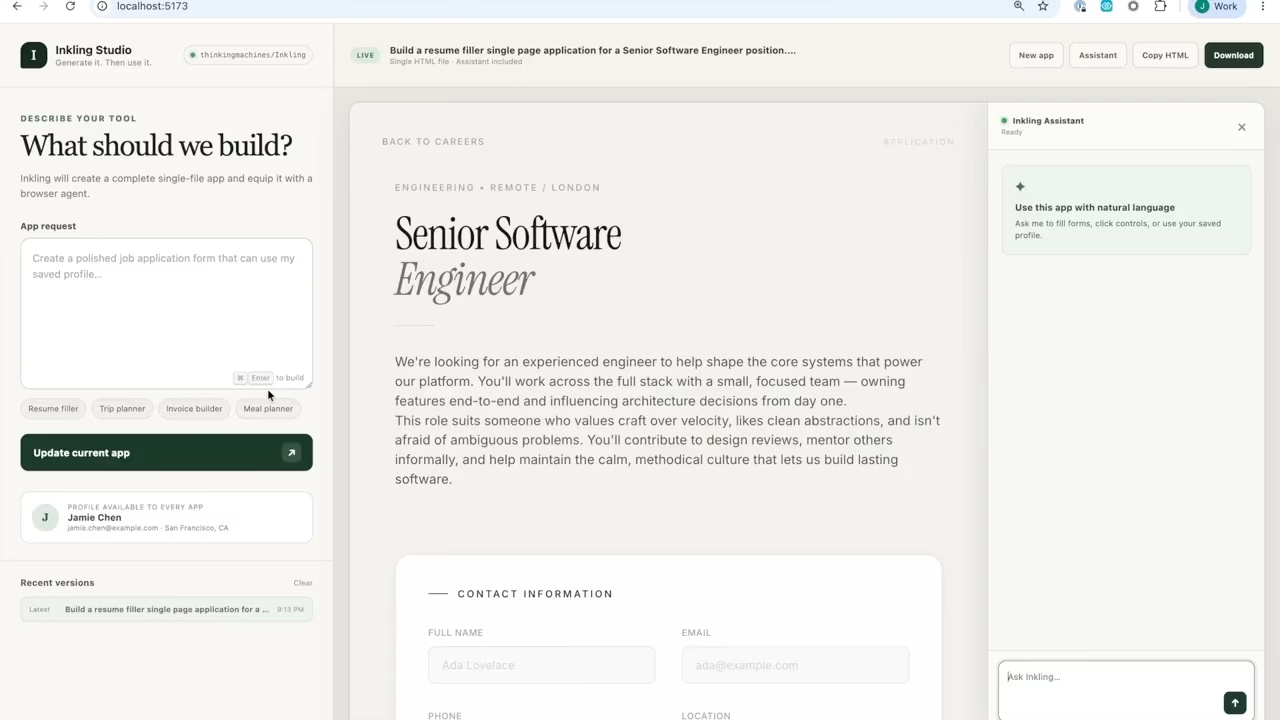
Thinking Machines showcased Inkling through "Inkling Studio," a natural-language app builder that generates complete single-file web applications and equips them with a browser agent for further natural-language editing. The screenshot below shows the tool mid-build, generating a job-application form with an assistant sidebar for further natural-language edits.
Agentic gameplay
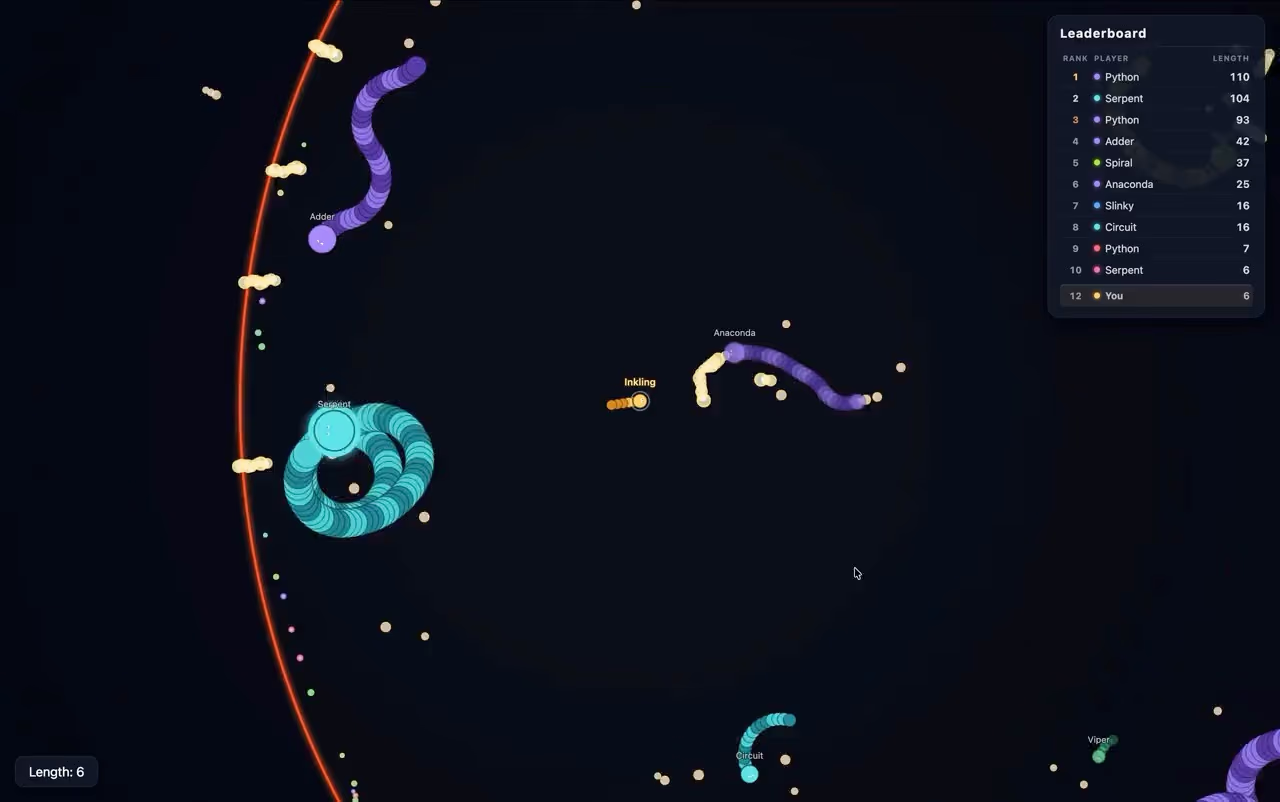
Thinking Machines also demonstrated Inkling playing a real-time multiplayer Snake-style game against both other bots and, in the demo shown below, models with names drawn from other labs' releases ("Python," "Anaconda,"), competing on a shared leaderboard, a lightweight but public test of tool use, reaction to changing game state, and sustained multi-step play rather than a single-shot text response.
Calibration and uncertainty
Thinking Machines emphasises calibrated, uncertainty-flagged answers as a design goal rather than an afterthought: Inkling is trained to say when it doesn't know rather than to answer confidently regardless. Its ForecastBench score (below) is the concrete evidence for that design choice, and it is a meaningfully different emphasis from labs that optimise primarily for benchmark accuracy.
Benchmarks
Thinking Machines' launch materials report the following selected results for the full Inkling model:
| Benchmark | Inkling (Thinking Machines-reported) |
|---|---|
| AIME 2026 | 97.1% |
| GPQA Diamond | 87.2% |
| SWE-Bench Verified | 77.6% |
| HLE with tools | 46.0% |
| ForecastBench (Brier Index, with search) | 63.7 ± 0.82 |
| Design Arena Agentic Web Dev | Rank 1257 (≈ Claude Opus 4.6) |
Thinking Machines also claims roughly one-third the token cost of Nvidia's Nemotron 3 Ultra on coding benchmarks for comparable results, a token-efficiency argument rather than a raw-capability one, consistent with the company's stated focus on customisation cost rather than leaderboard position.
Two things are worth flagging about this table. First, these figures come from Thinking Machines' own evaluation harness; there is no equivalent independent Artificial Analysis or similar third-party confirmation publicly available yet at the time of writing. Second, the individual benchmark strength (a 97.1% AIME score, for instance) sits in tension with the company's own framing of Inkling as "not the strongest model" overall, a reminder that any single benchmark tells you about one narrow skill, not general capability.
Safety, calibration and training transparency
Thinking Machines says Inkling's training explicitly emphasised "calibration, instruction following, and resistance to censorship," and that external safety testing included the FORTRESS and StrongREJECT benchmarks, both established third-party evaluation suites for jailbreak resistance and harmful-content refusal, rather than an internally designed test. The company frames its broader mission as building "AI that extends human will and judgment," language that leans toward user agency and away from the more restrictive, centrally-governed assistant model some larger labs favour.
The most interesting transparency disclosure has nothing to do with jailbreaks. Thinking Machines confirmed that Inkling was pretrained from scratch on its own data, but that some of its post-training data was generated using other open-weight models, including Moonshot AI's Kimi K2.5. The company has committed to fully self-contained post-training for its next model, which reads as a tacit acknowledgement that using a competitor's model to help train your own is not where the industry wants to settle. Separately, the Financial Times and other outlets reported that Inkling's broader design draws on ideas from China's DeepSeek architecture, a claim about intellectual lineage that is more contested and harder to verify independently than the post-training data point Thinking Machines has confirmed itself; treat it as reported rather than established.
Unlike Kimi K3's launch post, Thinking Machines does not publish a specific list of known model weaknesses alongside Inkling. Fine-tuning responsibility is explicitly placed on the customer: the company says using Tinker effectively "requires serious machine-learning talent," which is a meaningful caveat for any organisation expecting a plug-and-play customisation experience.
Real-world performance vs benchmarks
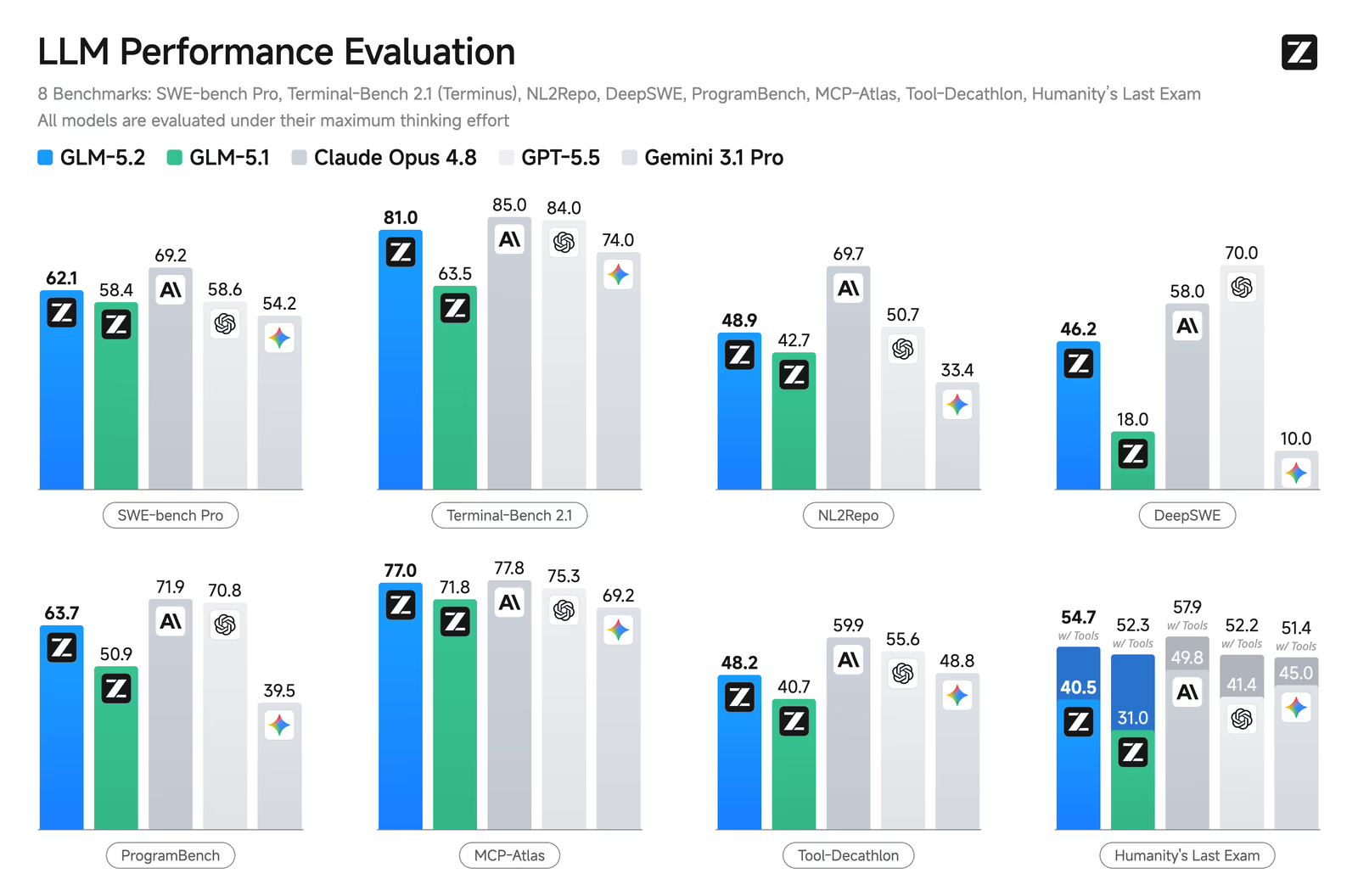
Early independent hands-on testing paints a more mixed picture than the headline benchmark table. One detailed review, testing Inkling through OpenCode against roughly 30 other models on a broad task set ("Goldy Bench," roughly 50 tasks), ranked it 14th overall with an average score of 6 out of 10, ahead of some open models, but well behind GLM 5.2 specifically on head-to-head game-building demos. The same testing found Inkling's visual, one-shot webpage and design outputs genuinely strong in places, but its 3D and physics-based game builds frequently broke or felt unfinished, a capability gap the vendor benchmarks above don't capture.
That split (strong on structured reasoning and web/app generation, weaker on physics-heavy generative work) is broadly consistent with Inkling's design goals. It was never positioned to win every category; it was positioned to be efficient and adaptable enough to be worth fine-tuning. Bridgewater Associates' result on Tinker (84.7% on financial reasoning tests, reportedly beating proprietary systems at roughly one fourteenth the cost) is the more relevant data point for judging whether that strategy works, and it is a genuinely strong one, though it reflects a fine-tuned, domain-specific model, not the out-of-the-box Inkling checkpoint.
Availability, pricing and Tinker
Inkling's weights are available now on Hugging Face as both a standard checkpoint and an NVFP4-quantised variant for lower-memory deployment. The model is supported across the major open inference stacks, SGLang, vLLM, llama.cpp, TokenSpeed and the Hugging Face transformers library, and is hosted by several third-party inference providers, including TogetherAI, Fireworks, Modal, Databricks and Baseten, so running it does not require self-hosting the full 975-billion-parameter checkpoint.
Thinking Machines' own commercial product is Tinker, its fine-tuning platform, which currently offers 64K and 256K context fine-tuning options at a 50% limited-time discount. Inkling and Inkling-Small are both live on Tinker now. This is where the company expects to make money: not from Inkling's weights, which are free to download, but from the tooling and infrastructure organisations use to adapt it.
That two-layer structure (a free, open-weight base model plus a paid fine-tuning layer) is a different commercial shape from most frontier labs, which charge per token for API access to a single, centrally-hosted model. It only works if enough organisations decide fine-tuning is worth the machine-learning investment Thinking Machines says it requires, rather than defaulting to a general-purpose API. The NVFP4-quantised release variant is a practical nod to that audience: it trades some precision for a substantially smaller memory footprint, making self-hosted experimentation more realistic for teams without hyperscale GPU budgets.
Industry reaction
Microsoft CEO Satya Nadella framed the broader argument for open, customisable models in remarks reported by Axios: enterprises building on proprietary, closed models effectively "pay twice": once in subscription costs, and again by embedding their own business knowledge into prompts that the vendor, not the enterprise, ultimately captures. Hugging Face CEO Clem Delangue predicted that frontier closed models will increasingly handle experimentation and prototyping, while "most production AI work shifts to private or open source alternatives", a trend Inkling and Kimi K3's same-week launches both feed into, even though the two models target different ends of that shift.
How Inkling compares
Inkling and Kimi K3 launched a day apart and both are open-weight, but they are answering different questions. K3 is Moonshot chasing frontier benchmark parity at a (still relatively competitive) price; Inkling is Thinking Machines explicitly not chasing that, betting instead on fine-tuning economics via Tinker. Against GLM 5.2, independent hands-on testing found Inkling behind on some generative tasks despite a smaller total parameter count advantage on paper. Against the closed frontier (GPT-5.6, Claude Fable 5, Gemini), Thinking Machines isn't claiming parity at all; the comparison it wants made is cost-and-capability-after-fine-tuning, which is much harder to benchmark from the outside. For the scored frontier field, see our live Benchmarks page.
One useful way to place Inkling is by what it is not trying to be. It is not a ChatGPT, Claude or Gemini competitor for general consumer use: Thinking Machines has no chat app of its own to speak of, and the model's outputs are text-only despite multimodal training. It is not primarily a coding-agent model in the way Kimi K2.7 Code or GPT-5.6 Sol are, though its SWE-Bench Verified score is respectable. It is closest in spirit to a research-grade foundation model released specifically so a smaller set of technically sophisticated customers can build something more specific on top of it, closer to how Meta positioned early Llama releases than to how OpenAI or Anthropic position their flagships.
Who should use Inkling
Good fit: organisations with in-house ML talent that want to fine-tune a capable multimodal-pretrained base model on proprietary data, particularly for structured-reasoning or knowledge-work domains (finance, research, internal tooling), and that are comfortable using Tinker or self-hosting via vLLM/SGLang.
Poor fit: anyone wanting a strong model out of the box with no fine-tuning step, or teams without the machine-learning capacity Thinking Machines itself says Tinker requires. For 3D, physics or game-style generative work specifically, early testing suggests Kimi K3 or GLM 5.2 currently perform more reliably out of the box.
The bottom line
Inkling is an unusually honest launch. Thinking Machines built a genuinely large, multimodal-pretrained, million-token-context open-weight model and then told the market, in its own announcement, that it isn't the strongest one available. That is a coherent bet, not a hedge: the company's entire business is Tinker, and Inkling exists to prove that a strong-but-not-best base model, properly fine-tuned, beats a generic frontier chatbot on work that is specific enough to benefit from customisation.
Whether that bet pays off will show up in Tinker's customer results, not in Inkling's benchmark table. Bridgewater's early result is a genuinely strong data point in Thinking Machines' favour. Independent hands-on testing showing Inkling struggling with 3D and physics generation, and ranking outside the top tier on broad multi-skill evaluation, is a fair reminder that the out-of-the-box model is a starting point, not a finished product, which is exactly what Thinking Machines says it is.
Thinking Machines' official Inkling announcement and TechCrunch's launch coverage provide the underlying specifications and company context referenced throughout this article.
Last updated: 17 July 2026, two days after Inkling's launch. This article will be revised as independent third-party benchmark results and further Tinker customer case studies become available.
Get the free guide: Claude vs ChatGPT, Gemini & Grok
A 20-page playbook covering everything you need to choose and use the big four AI models in 2026, full cost and feature comparisons, what each is best (and worst) at, and how-tos for images, vectors, building a website, Claude Code and more.