

 AI Tools Review Editorial Team
Quick Answer
Quick Answer:
As of 23 September 2026, both threads this article was tracking have resolved: Claude Fable 5.1 and Mythos 5.1 launched 1 September 2026, and Claude Opus 5.5 launched 22 September 2026, replacing Opus 5 as the flagship at $4/$20 per million tokens (both 20% down) and cache reads cut 60%. Opus 5.5 confirmed a leak from just two days earlier almost exactly, including its exact price and launch date, though Claude Fable 5.2, the other name in that leak cluster, never shipped. See the full leak-versus-reality scorecard in Claude Opus 5.5 & Fable 5.2 Release Date. Anthropic says Sonnet 5.5 and Haiku 5.5 follow "in the coming weeks".
This piece first ran in June 2026, while Anthropic's most capable model sat suspended by government order and Sonnet 5 was still just a rumour. Three updates on, Sonnet 5, Fable/Mythos 5's restoration, Opus 5 and now Fable 5.1/Mythos 5.1 have all resolved from rumour to shipped fact, and a new rumour cluster, Opus 5.2, Fable 5.2 and Opus 5.5, has opened up in their place.
This is the full, sourced picture, updated for what has actually shipped since: the complete Claude lineage through September 2026, the release cadence, the recall and its resolution, what is genuinely confirmed against what is pure speculation on the current rumour cluster, and our updated prediction for what comes next.
The Claude Timeline So Far
To work out what comes next, you have to see the shape of what came before. The Claude lineage is one of the clearest cadence stories in the industry, starting slow and then accelerating hard through 2025 and 2026.
Here is the confirmed timeline, drawn from Anthropic's own announcements and contemporaneous reporting.
- March 2023: Claude 1, Anthropic's first public model.
- July 2023: Claude 2, the first model most people could try freely.
- November 2023: Claude 2.1, with a longer context window and fewer refusals.
- March 2024: The Claude 3 family lands as a trio, Haiku, Sonnet and Opus, the small, mid and large tiers that still define the lineup.
- June 2024: Claude 3.5 Sonnet, a mid-tier model that punched above the original Opus.
- October to November 2024: Claude 3.5 Sonnet v2 and Claude 3.5 Haiku.
- February 2025: Claude 3.7 Sonnet, the first hybrid reasoning model.
- May 2025: Claude Opus 4 and Sonnet 4, the start of the version 4 generation.
- August 2025: Claude Opus 4.1.
- September to October 2025: Claude Sonnet 4.5 and Haiku 4.5.
- November 2025: Claude Opus 4.5.
- February 2026: Claude Opus 4.6 and Sonnet 4.6 arrive close together.
- April 2026: Claude Opus 4.7.
- 28 May 2026: Claude Opus 4.8, the current general-purpose flagship.
- 9 June 2026: The Mythos-class arrives publicly with Fable 5 (safeguarded) and Mythos 5 (unrestricted, partner-only).
- 12 June 2026: Fable 5 and Mythos 5 suspended worldwide under a US export-control directive.
- 30 June 2026: Claude Sonnet 5 launches, delivering near-Opus performance at a lower price and finally resolving months of Sonnet 5 speculation.
- 1 July 2026: Fable 5 and Mythos 5 access is restored, ending the 19-day suspension.
- 9 July 2026: A research checkpoint codenamed "Claude Honeycomb EAP" briefly appears in Cursor's model picker, widely read as an early Opus 5 preview, then disappears within hours.
- 24 July 2026: Claude Opus 5 launches, confirming the Honeycomb leak cycle. It becomes the new general-purpose flagship, with a five-rung effort ladder (low, medium, high, xhigh, max) and benchmark scores that match or exceed the original Fable 5 on several evaluations, at a fraction of the cost.
- 26 July 2026: X posts from Pankaj Kumar and Andrew Curran claim "Fable 5.1" is finished internally and due in August, with Curran suggesting Anthropic is timing the release against OpenAI's next model.
- 3 August 2026: AI Tools Review's Fable 5.1 fact-check finds no Anthropic announcement, model card or pricing for the rumoured model, only the two unverified X posts.
- 1 September 2026: Anthropic officially launches Claude Fable 5.1 and Claude Mythos 5.1, confirming the July leak's pricing claim exactly and adding a 75% cut to prompt-cache read pricing the leak had not predicted.
- 14–17 September 2026: Developers report routing anomalies on Claude Opus 5, with some requests answered by a terser, self-iterating backend and screenshots showing a
claude-opus-5-2identifier in Microsoft Foundry; Anthropic cuts the channel on the night of 17 September without comment. - 18 September 2026: The first "Fable 5.2" demos appear on X, showing pure-JavaScript game and animation generation and a claim it beats GPT-6 Astra. Reuters separately reports, citing unnamed sources, that Anthropic is evaluating a new release to counter GPT-6 Astra, tied to its IPO narrative, without naming a model.
- 20 September 2026: X account @lyraxana claims Anthropic is stealth-testing
claude-opus-5-5under the codenameclaude-wafer-eap, targeting a release the week of 21 September, with a leaked price sheet posted the same day. A supporting demo (a Waymo self-driving clip) is retracted hours later as recycled footage. - 22 September 2026: Anthropic officially launches Claude Opus 5.5, confirming the leak's price ($4/$20 per million tokens) and date exactly. It replaces Opus 5 as the general-purpose flagship. Claude Fable 5.2, the other name in the same leak cluster, is not mentioned and does not ship.
There is one important strand that sits alongside the numbered models: the Mythos-class. Before the public Mythos 5, Anthropic ran a Mythos Preview, an unreleased frontier model with extreme coding and vulnerability-finding ability, kept out of public hands and instead fed into Project Glasswing, a cyber-defence initiative. Mythos 5 was the productised version of that lineage, and Fable 5 was its safeguarded public sibling built on the same weights.
Two naming notes worth fixing, because the rumour mill keeps getting them wrong. There was never a Claude Sonnet 4.7, the line went 4.6 then jumped to a planned 4.8. And the leaked early-2026 checkpoint codenamed Fennec, which half the internet assumed was Sonnet 5, shipped as the far more modest Sonnet 4.6.
Update, 13 August 2026: a new round of "Claude Sonnet 5.5 'Fennec' + Opus 6 leak" videos is circulating again, reusing the same Fennec codename addressed above. There is still no corroborating evidence for either name in any leaked API string, Cursor model-picker sighting, or reporting from established trackers - the pattern is identical to the original Fennec mix-up, a six-month-old identifier being recirculated rather than a fresh signal. Anthropic's naming has also moved by decimal point on Opus (4.5 through 4.8, then 5) rather than whole-number jumps, and its newest capability tier has gone into the Mythos/Fable class above Opus rather than a numbered "Opus 6" - both reasons to treat this specific claim with the same scepticism as the original Fennec leak until Anthropic publishes anything itself.
Stepping back, the lineage tells a story in three acts. Act one, from Claude 1 in 2023 to the Claude 3 family in 2024, was about establishing the three-tier Haiku, Sonnet and Opus structure and proving the models could compete at the frontier. Act two, through 2025, was about reasoning: Claude 3.7 introduced hybrid thinking, and the version 4 line turned that into a reliable, agentic workhorse. Act three, in 2026, is about speed and specialisation: a blistering point-release cadence on Opus and Sonnet, plus the entirely new Mythos-class aimed at the very top of capability. The next model belongs to act three, which is why cadence and the Mythos-class track matter more to the prediction than any single benchmark.
It is also striking how the centre of gravity has shifted within the lineup. In 2024, Sonnet was the headline-grabber, the mid-tier model that outran the previous Opus. In 2026, Opus reclaimed the spotlight as the fast-moving flagship, Sonnet fell a step behind at 4.6, and the genuine frontier conversation moved up again to the Mythos-class. That drift upward is part of why a Sonnet refresh feels overdue, and why the most exciting "next" candidates sit at the Mythos-class top of the range rather than in the middle tiers.

Release Cadence & The Gaps
The single most useful signal for predicting the next Claude model is the gap between the last few. The pattern is unambiguous: it is shrinking fast.
In the early years the gaps were measured in quarters. Claude 1 to Claude 2 was around four months. Claude 2 to the Claude 3 family was about eight months. Claude 3 to Claude 3.5 Sonnet was roughly three months. Through 2025 the Opus line moved from version 4 in May to 4.1 in August to 4.5 in November, broadly a quarterly rhythm.
Then 2026 broke the pattern. Look at the Opus cadence alone:
- Opus 4.6: early February 2026.
- Opus 4.7: mid-April 2026, roughly ten weeks later.
- Opus 4.8: late May 2026, roughly six weeks after that.
- Fable 5 (Mythos-class): 9 June 2026, less than two weeks after Opus 4.8.
That is a clear acceleration, from quarterly to roughly six-to-eight-week point releases, with the Mythos-class layered on top as a separate track. The implication is straightforward. If nothing had disrupted the rhythm, the next new Claude model would have been due in late June or July 2026, on pure trend extrapolation.
But something did disrupt it. The 12 June recall means Anthropic's near-term engineering attention is split between shipping the next thing and getting its flagship Mythos-class models back online. That tension is the heart of the whole roadmap question right now.
It is worth pausing on why the cadence accelerated at all, because the reasons tell you whether it can continue. Three forces compressed the gaps. The first is method maturity: Anthropic moved to a hybrid reasoning architecture with Claude 3.7 in early 2025, and once that base was in place, improvements arrived as incremental post-training and tuning passes rather than full rebuilds. Point releases like 4.6, 4.7 and 4.8 are exactly the kind of thing you can ship every few weeks when the underlying recipe is stable. The second is competitive pressure, which we cover later. The third is sheer capacity, the compute that lets you train and evaluate candidates in parallel rather than in series.
There is also a naming pattern hiding in the cadence that helps decode what "next" looks like. Anthropic uses the decimal to signal scope. A jump like 4.5 to 4.6 tends to mean a broad refresh across capabilities. A smaller-feeling step like 4.7 to 4.8 has tended to mean targeted gains, in the Opus 4.8 case on agentic reliability, long-horizon task completion and calibration rather than a headline reasoning leap. If the next release is another decimal bump, expect it to be narrow and fast. If Anthropic ever does reach for a whole number, that is the signal to expect a genuine architecture or training-scale change, and so far it has consistently declined to send that signal.
One more cadence nuance matters for prediction. The Mythos-class is on its own clock, decoupled from the Opus and Sonnet point-release rhythm. Mythos Preview ran quietly inside Project Glasswing for weeks before any public model appeared, then Fable 5 and Mythos 5 arrived as a pair. That means the next Mythos-class move does not have to wait for, or align with, the next Opus or Sonnet number. The two tracks can and do move independently, which is part of why pinning a single "next Claude model" date is so hard.
The Recall That Changed Everything
You cannot answer "what's next?" without understanding what just happened. On 12 June 2026, three days after launch, the US government ordered Anthropic to suspend Fable 5 and Mythos 5 for all foreign nationals under an export-control directive citing national security. Rather than try to fence access by nationality across a global product, Anthropic switched both models off for everyone worldwide.
The trigger, as Anthropic described it, was a narrow cyber jailbreak: getting the model to read a codebase and fix software flaws, a dual-use capability that is exactly what defenders do daily and exactly what an attacker would want. Anthropic complied with the directive but publicly disagreed, arguing the capability is widely available from other models including OpenAI's GPT-5.5, and that applying this standard industry-wide "would essentially halt all new model deployments." We covered the full episode in Claude Fable 5 Banned: Why It Was Pulled Offline.
The recall reshapes the roadmap in three ways. First, it adds a regulatory gate that did not exist before: any future Mythos-class release now has to clear an export-control review that can move in hours. Second, it makes the safeguarded versus unrestricted split central to product strategy, because Fable, the safe one, was the one that got pulled. Third, it puts a question mark over the exact thing the cadence pointed to, a fast follow-on frontier model.
On restoration, Anthropic said it was working to bring access back as soon as possible. Our detailed read on the timing, the three routes back, and the identity-verification rollout that could matter is in When Is Claude Fable 5 Coming Back?. The short version: there is no official date, restoration is more likely than not in the near term, and verified US access could plausibly return before full international access.
The deeper significance for the roadmap is the precedent. Before 12 June, the binding constraints on a new Claude model were internal: did it pass Anthropic's own red-team and Responsible Scaling Policy thresholds, and was it commercially ready. After 12 June, there is a fourth, external constraint that can fire after launch, not just before it. A model can pass every internal gate, ship, and still be pulled by directive within days. No amount of pre-release safety work fully removes that risk, which changes how a lab thinks about when, and to whom, it exposes its most capable systems.
That precedent cuts directly against the unrestricted half of the Mythos-class strategy. Mythos 5 was never a public product; it was the unsafeguarded sibling reserved for vetted Project Glasswing partners precisely because of its cyber-offence ability. Yet it was named in the same suspension as Fable. If even the carefully gated partner model attracts an export-control order, Anthropic's calculus for the next Mythos-class release has to weight regulatory exposure far more heavily than capability marketing. Expect the next high-capability release to come wrapped in more conspicuous safeguards, clearer access tiers, and possibly geographic or identity gating from day one rather than as an afterthought.
There is a counter-pressure too, and it is commercial. Fable 5 was pitched as Anthropic's most capable widely released model, with always-on adaptive thinking and a one-million-token context window, aimed at hundreds of millions of users. Every day it stays dark is revenue and mindshare ceded to rivals and to open-weights alternatives. So the company is caught between moving fast to restore and ship, and moving carefully to avoid a second recall. How it resolves that tension is, in effect, the roadmap.
What's Confirmed vs Rumoured
This is where most "next Claude model" coverage falls apart, by blending fact and guesswork. Here is the clean separation.
Confirmed (from Anthropic or its filings):
- Claude Opus 5 launched 24 July 2026 and is now the general-purpose flagship, replacing Opus 4.8.
- Fable 5 and Mythos 5 launched 9 June 2026, were suspended 12 June 2026, and were restored 1 July 2026.
- Claude Sonnet 5 launched 30 June 2026, with near-Opus performance at a lower price.
- Claude Fable 5.1 and Mythos 5.1 launched 1 September 2026, confirming the leak this section tracked in August: pricing unchanged at $10/$50 per million tokens, plus a 75% cut to prompt-cache reads that the leak did not predict.
- Project Glasswing has been expanded to 150 additional organisations across more than 15 countries.
Since resolved:
- Claude Opus 5.5 launched 22 September 2026, confirming the leak cluster's price ($4/$20 per million tokens) and date exactly. Routing anomalies from 14–17 September and a 20 September X post from @lyraxana naming the internal codename
claude-wafer-eapboth turned out to be substantively accurate. Claude Fable 5.2, the other name circulating in the same cluster, was not mentioned at launch and has not shipped. See the full leak-versus-reality scorecard in Claude Opus 5.5 & Fable 5.2 Release Date.
Rumoured or speculative (treat with caution):
- A clean Claude 5 generation, distinct from any single product line. Prediction markets have floated a 2026 window, but Anthropic has not announced it and has so far always preferred point releases and product-line names (Sonnet, Opus, Fable) over a whole-number generational jump, a pattern every launch since has reinforced rather than broken.
- A Haiku refresh on the latest generation. Logical, given Haiku 4.5 shipped in late 2025 and every other tier has since moved, but Anthropic has now confirmed Haiku 5.5 will follow Opus 5.5 "in the coming weeks", alongside Sonnet 5.5.
The honest position is that Sonnet 5, Fable 5's return, Opus 5, Fable 5.1/Mythos 5.1 and now Opus 5.5 are all settled fact. The one open question left from the September leak cluster, Fable 5.2, appears to have been noise or an internal experiment that never shipped publicly, though "not shipped yet" and "never will" are different claims; this piece will be updated if that changes.
It helps to understand why the rumour cycle is so persistent, and was right on Opus 5 in shape if not in exact date. Three recurring sources feed it. The first is accidental disclosure, like the Honeycomb EAP checkpoint that surfaced in Cursor's model picker and turned out to genuinely prefigure Opus 5, or the earlier Fennec identifier that was misread as Sonnet 5 and shipped instead as Sonnet 4.6. The lesson is that an internal checkpoint name tells you a model exists, not necessarily what it will be called or exactly when it ships. The second source is prediction markets, which put real but soft probabilities on windows like "Claude 5 by mid-2026." Those are useful as sentiment, not as schedule. The third is individual named sources on X, exactly the pattern behind the current Fable 5.1 leaks, which can be right in substance while still being unconfirmed in specifics.
Anthropic's own behaviour is the best corrective. The company has repeatedly had the option to badge a release as a new generation and declined, preferring the decimal, and Opus 5 continued that pattern rather than breaking it. That is a deliberate signal: it reserves the whole number for a step it considers genuinely generational, and it is in no rush to spend that signal. So when you read "Claude 5 is coming," the right mental translation is "a capable new checkpoint is plausibly coming, and Anthropic will most likely call it something-point-something within an existing product line."
Update, 16 August 2026: the "Mythos 6" / "Model 2" leak cycle.
A second, louder rumour has since layered on top of the Fable 5.1 story. On 13 July 2026, TheWinCentral published an unsourced claim that Anthropic "has already completed training a more capable Mythos-class model," floating the names Mythos 5.1 or Mythos 6. The report cited no internal document, screenshot or named source, and Anthropic did not acknowledge it. Independent trackers found nothing to corroborate it at the time.
That claim has since resurfaced and mutated. Through the second week of August, a wave of "leak" videos from AI YouTube channels began referring to an unreleased "Model 2" and "Claude Mythos 6" in the same breath, alongside a separate, unconnected "Sonnet 5.5 Fennec plus Opus 6" leak narrative. Our own tracked-creator feed picked up the same pattern on 15-16 August, including a video headlined "Claude Mythos 6 = Model 2! HUGE Leaks" and another framing it as "Anthropic's New Model 2," embedded below.
A representative example of the mid-August 'Mythos 6 / Model 2' leak coverage circulating on AI YouTube - treat the naming and claims here as unverified, not confirmed.
Nothing about this round changes the confirmed-vs-rumoured line drawn above. As with the original TheWinCentral report, none of the August coverage has produced a benchmark score, a system card, a leaked API identifier or an official Anthropic statement - the same evidentiary bar that Fable 5.1 leaks also have not cleared. The one thing that has changed is volume: two unconnected naming rumours (a "Mythos 6"/"Model 2" successor to the Mythos-class, and a separate "Sonnet 5.5 Fennec"/"Opus 6" pairing) are now circulating simultaneously, which tends to happen in the run-up to a real announcement but is not itself evidence of one. This section will be updated the moment any of these names is confirmed or debunked by Anthropic directly.
Likely Next Names & Versions
Every candidate this section has ranked so far has shipped: Fable 5 and Mythos 5 were restored on 1 July, Claude Sonnet 5 launched 30 June, Claude Opus 5 launched 24 July, Claude Fable 5.1 and Mythos 5.1 launched 1 September, and Claude Opus 5.5 launched 22 September, exactly matching this section's previous top pick down to the leaked codename and price. Here is the ranking updated for what is actually still open.
1. Claude Sonnet 5.5 and Haiku 5.5. Confirmed by Anthropic itself in the Opus 5.5 launch post as following "in the coming weeks", with many of the same performance, efficiency and safety improvements. This is now a confirmed-but-undated near-term release rather than a leak-based guess, the first time this section has been able to say that.
2. Claude Mythos 5.5. Not yet announced, but every prior Opus-class refresh (Fable 5 to Fable 5.1) shipped alongside a matching Mythos update, and Opus 5.5's system card already discusses biology and cyber capability "comparable to Mythos 5.1", which would make a Mythos 5.5 the natural next specialist-tier release.
3. A clean "Claude 5" generational rebrand. Still the least likely near-term move. Anthropic has now shipped Sonnet 5, Opus 5, Fable 5.1 and Opus 5.5 as product-line version numbers, not a Claude-wide generational reset, confirming the pattern we predicted in June: version numbers climb within Opus, Sonnet, Haiku, Fable and Mythos independently, rather than the whole Claude brand jumping to "5" at once.
A word on Fable as a name, because it is still easy to misread. Fable is not a tier in the way Haiku, Sonnet and Opus are. It sits on the Mythos-class lineage above Opus, and the "5" in Fable 5 and Mythos 5 was a Mythos-class version number, not a Claude generation number. That is precisely why Fable 5 shipping did not imply a Claude 5, and why both Sonnet and Opus reaching "5" separately, each on its own product-line clock, is the instructive precedent for how a rumoured Fable 5.1 would most likely be named and scoped: as a Mythos-class point release, not a company-wide jump.
What did Opus 5 actually ship with, now that the leaks are resolved into fact? A five-rung effort ladder (low, medium, high, xhigh, max) that lets you trade intelligence against cost and speed, and benchmark scores that, at the higher rungs, match or exceed what Fable 5 offered at launch, at a fraction of the price. That effort-ladder design is also a direct, structural answer to the Fable 5 recall: a way to route work to a cheaper, already-cleared configuration without needing a separate model.
For practical planning, the takeaway for builders has shifted from "wait and watch" to "adopt and monitor." If you depend on the absolute frontier, Opus 5 is now your answer rather than a rumour to wait on, with Opus 4.8 as a stable fallback if you need a longer-evaluated model. If you depend on cost-efficiency, Sonnet 5 remains the answer. If you depend on the very top of the frontier with fewer guardrails, the Mythos-class remains the most regulation-exposed track, as the June recall demonstrated, and any Fable 5.1 leak should be treated with the same caution until Anthropic actually confirms it.
Funding, Valuation & Investor Interest
Whatever ships next, money is not the bottleneck. Anthropic's capital position in 2026 is extraordinary.
In February 2026 the company raised around £23bn ($30bn) in a Series G round at a roughly £287bn ($380bn) post-money valuation. Just months later it raised about £49bn ($65bn) in a Series H round at a roughly £728bn ($965bn) post-money valuation, closing in on the £755bn ($1tn) mark. The Series H was co-led by a deep bench including Altimeter, Coatue, Dragoneer, Greenoaks, Sequoia, Capital Group and GIC, with strategic memory and infrastructure partners such as Samsung, SK Hynix and Micron also taking part.
On 1 June 2026, Anthropic confidentially filed a draft S-1 with the SEC, opening the door to an IPO that the market widely expects to target a £755bn ($1tn)-plus valuation.
Revenue has tracked the valuation. Run-rate revenue was reported at around £11bn ($14bn) in February 2026 and crossed roughly £35bn ($47bn) in May 2026, having grown more than tenfold annually in each of the past three years. That growth is the engine behind the accelerating release cadence, more revenue funds more compute funds faster models.
The two strategic backers are central. Amazon's roughly £6bn ($8bn) investment is now reported to be worth well over £53bn ($70bn), with its overall stake estimated in the mid-to-high teens of percent. Google holds roughly 14% in straight equity, contractually capped near 15%, worth on the order of £102bn ($135bn) at the current valuation. Reporting in 2026 even suggested that a large share of Google's and Amazon's headline AI profits traced back to their Anthropic stakes rather than their core businesses, a measure of how much investor interest now rides on the next Claude model performing.
Why does any of this matter for predicting the next model? Because the funding structure removes the usual excuse for delay. A lab that is capital-constrained ships when it can afford to. Anthropic is the opposite case: it has more committed capital and compute than it can deploy at once, and a pending IPO that rewards visible momentum. That combination pushes towards a steady drumbeat of releases, restored access and point-bumps, because each one is a proof point for the public-market story. The recall complicates the narrative, but it does not change the underlying incentive to keep shipping.
The IPO filing adds a subtler pressure. Once a company is in a registration process, every product decision is also a disclosure decision, and a recalled flagship is exactly the kind of risk that ends up described in an S-1. That gives Anthropic a strong reason to resolve the Fable 5 and Mythos 5 situation cleanly and publicly before any listing, which is another argument for restoration being a near-term priority over a flashy new generation. Investors want to see a frontier lab that can both reach the frontier and operate it within the rules.
It is also worth keeping the figures honest. The conversions here put pounds first with dollars in brackets at an indicative rate, and the run-rate revenue numbers are reported figures rather than audited results, so they should be read as direction and scale rather than precise accounting. What is not in doubt is the order of magnitude: a near-trillion-pound valuation, tens of billions in annualised revenue, and two hyperscaler backers whose own results now move with Anthropic's. That is the financial backdrop against which the next Claude model will land.
Compute & Capacity
The other precondition for a new frontier model is raw compute, and Anthropic has locked in a multi-cloud, multi-gigawatt position that is among the largest in the industry.
In late 2025 Google committed up to roughly £30bn ($40bn) in cash and TPU compute, giving Anthropic access to up to one million TPUs and creating multi-gigawatt capacity through 2026, a deal later framed alongside a 3.5GW Broadcom-built TPU buildout.
Then on 20 April 2026, Amazon announced it would invest up to around £19bn ($25bn) more in Anthropic, with Anthropic committing over £75bn ($100bn) across ten years to AWS and the two deploying up to 5GW of new Trainium capacity. Roughly 1GW of combined Trainium2 and Trainium3 capacity is expected online by the end of 2026. Industry observers called it the largest single-customer endorsement of non-Nvidia silicon in AI training history.
The takeaway for the roadmap is simple. Anthropic has the silicon to train and serve the next several generations. If the next Claude model slips, it will be because of safety, regulation or product strategy, not because the company ran out of chips.
The multi-cloud, multi-silicon shape of these deals matters in its own right. By committing to both AWS Trainium and Google TPUs at gigawatt scale, Anthropic reduces its dependence on any single supplier, including Nvidia, and gives itself parallel training and serving capacity. For release cadence, parallel capacity is the quiet enabler: it lets the company train candidate checkpoints, run extensive evaluations and serve production traffic at the same time, which is exactly the workflow behind a six-to-eight-week point-release rhythm. A serial, single-cluster lab simply cannot move that quickly.
There is a strategic wrinkle worth naming. Massive serving capacity is what made it commercially sensible to offer a frontier model with always-on adaptive thinking and a one-million-token context window to hundreds of millions of users, as Fable 5 was. The same capacity is what makes a fast restoration feasible once the regulatory issue is resolved, because the infrastructure to serve it never went away. In other words, the hard, slow part, building the compute, is already done. The constraint on the next model is now almost entirely about permission and safety rather than physics.
Safety Trajectory: RSP, ASL & Glasswing
Safety policy is now a first-class input to the release schedule, not an afterthought. Anthropic published Responsible Scaling Policy version 3.0, effective 24 February 2026, a comprehensive rewrite that introduces Frontier Safety Roadmaps with detailed safety goals and Risk Reports that quantify risk across deployed models.
The RSP is built on proportional protection, with AI Safety Level (ASL) standards that tighten as capability rises. ASL-3 safeguards, triggered when a model could meaningfully help someone with basic technical skill create or deploy CBRN weapons, involve enhanced security and deployment controls including stronger protection of model weights. ASL-4 measures are not yet fully written; Anthropic's commitment is to define them before reaching ASL-3, and they may require assurance methods that are still open research problems, such as using interpretability to show mechanistically that a model will not behave catastrophically.
Project Glasswing is the cyber arm of this trajectory. It pairs the Mythos-class with critical-infrastructure defenders to find and patch vulnerabilities before attackers can. Launch partners included AWS, Apple, Broadcom, Cisco, CrowdStrike, Google, JPMorganChase, the Linux Foundation, Microsoft, NVIDIA and Palo Alto Networks, and partners have reportedly surfaced more than 10,000 high or critical-severity flaws, including some in every major operating system and browser.
The recall is the friction point where this safety machinery met government power. Anthropic's whole Fable design was meant to keep offensive cyber behind classifiers that fall back to Opus 4.8. The directive treated a reported gap as reason to pull the product entirely. For the next model, expect the safety and classifier story to be even more central, because regulators are now watching the cyber capability of every Mythos-class release closely.
The RSP v3.0 machinery is itself a roadmap signal, because it dictates what Anthropic must do before it can ship at higher capability. The commitment to write ASL-4 measures before reaching ASL-3 is, in effect, a self-imposed gate that can slow a generational leap. If the next model would cross into territory that triggers higher ASL standards, then by Anthropic's own policy it cannot ship until the corresponding safeguards and, for ASL-4, the underlying assurance research exist. That is one structural reason to expect point releases within the current capability band rather than a sudden jump: staying inside a known ASL tier is faster than clearing a new one.
Glasswing also reframes how to read the cyber capability that caused the recall. The same vulnerability-finding ability that worries export-control officials is the ability Anthropic is using, through partners, to patch flaws in critical infrastructure at scale, reportedly more than 10,000 high or critical issues including some in every major operating system and browser. That is the dual-use bind in a single programme: the capability that makes a model dangerous to release widely is the capability that makes it valuable to defenders. The next Mythos-class release will have to thread that needle more visibly than Fable 5 did, probably by leaning harder on the safeguarded-public versus vetted-partner split that the recall stress-tested.
The publication of Frontier Safety Roadmaps and quantified Risk Reports is the other thing to watch. These are the documents in which Anthropic effectively pre-announces the kinds of capability it is preparing to handle and the safeguards it is building for them. They are not a product roadmap, but they are the closest thing to an official signal about the direction of the next frontier model, and they are worth reading alongside any release rumour as a sanity check on what is actually plausible.
How It Compares to OpenAI's Roadmap
Anthropic does not set its cadence in a vacuum. OpenAI is on a parallel, equally fast track, and the two roadmaps push each other.
OpenAI released GPT-5.5, codenamed Spud, on 23 April 2026, with API access the following day. GPT-5.6 (Sol, Terra, Luna) followed on 9 July 2026 after a US Commerce Department regulatory clearance. On 1 August 2026, OpenAI named its next major model, Astra, via a blog post about claimed mathematics results, then on 7 August said preliminary Astra evaluations were strong enough that it could not rule out the model meeting its "Critical" cybersecurity capability threshold, tightening internal safeguards while testing continues.
So both labs are now in a strikingly similar posture, and not by coincidence: rapid point releases at the top of the range, a next-generation model already named and demonstrated (Astra, and whatever Anthropic calls its own next Mythos-class step), and a safety-driven disruption arriving right as that model neared readiness. Anthropic's disruption came after Fable 5 and Mythos 5 had already shipped publicly; OpenAI's came before Astra shipped at all, while it was still in internal testing. We track the OpenAI side in full in our sister piece, What's the Next GPT Model?.
There is still an asymmetry in how the two companies talk about generations, though it has narrowed. OpenAI has repeatedly signalled that a whole-number GPT-6 is plausible, yet it has now had multiple opportunities to badge Astra that way since 1 August and has declined each time. Anthropic's position has stayed consistent throughout: Opus 5 shipped as a product-line version number, not a Claude-wide generational reset, exactly the pattern this article predicted in June. Both labs, in other words, are proving more cautious about spending a "5" or "6" label than the rumour mill around either of them assumed.
The regulatory parallel is now the more interesting story than the naming one. Anthropic's Fable 5 and Mythos 5 were pulled by external government directive after a cyber capability was found post-launch. OpenAI's Astra was flagged by the company itself, pre-launch, for a cyber capability it "cannot rule out." Whichever pattern proves more effective at avoiding a public recall while still shipping a genuinely more capable model is likely to become the template the rest of the industry follows.
Our Prediction
Our June prediction called the restoration of Fable 5 and Mythos 5 as the next visible move, and that happened on 1 July. Our July update called Opus 5 as the next genuinely new model, and that shipped on 24 July. Our August update called a Fable 5.1 refresh as the most likely next new model, and that shipped on 1 September. Our September update called "some version of the current leak cluster, most likely branded Opus 5.5" as next, with real reservations given a debunked fake demo in the same cluster, and it shipped on 22 September at exactly the leaked price and date. Four calls, four hits on substance, each within the window we flagged. Here is our updated call for what comes next.
We think Claude Sonnet 5.5 and Haiku 5.5 are the next models to ship, and for the first time in this article's run, that is not speculation: Anthropic confirmed both directly in the Opus 5.5 launch post, "in the coming weeks". The genuinely open question now is Claude Mythos 5.5, unannounced but a natural companion release given Opus 5.5's system card already benchmarks it against Mythos 5.1 on biology and cyber capability.
We continue to expect Anthropic to avoid badging any near-term release as a clean "Claude 5" generation. The naming pattern has now held through four consecutive product-line "5" or "5.5" launches (Sonnet, Opus, Fable/Mythos, and now Opus again) without ever touching the Claude brand itself, the strongest evidence yet that the whole-number label is being deliberately reserved for something larger than an incremental refresh.
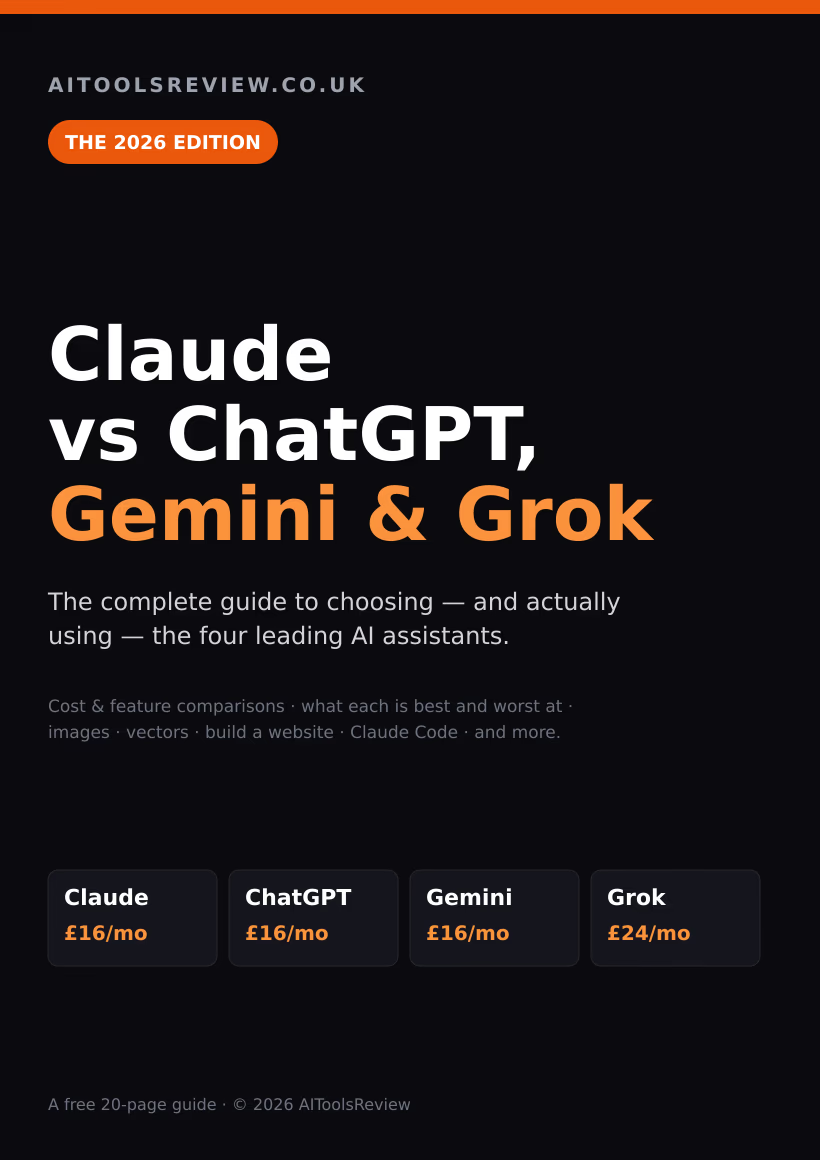
Get the free guide: Claude vs ChatGPT, Gemini & Grok
A 20-page playbook covering everything you need to choose and use the big four AI models in 2026, full cost and feature comparisons, what each is best (and worst) at, and how-tos for images, vectors, building a website, Claude Code and more.
The Bottom Line
The next Claude model is once again being shaped less by Anthropic's labs alone than by the safety and regulatory apparatus now wrapped around frontier releases industry-wide. The June recall forced Anthropic to prove Fable 5 and Mythos 5 were safe before the world would trust them again; Opus 5 and Fable 5.1's clean, leak-confirmed launches since show that apparatus can also work smoothly when nothing goes wrong post-launch.
What is confirmed is a fast-moving, well-funded, compute-rich lab that has now successfully shipped five rumoured models (Sonnet 5, restored Fable/Mythos 5, Opus 5, Fable 5.1/Mythos 5.1, Opus 5.5) inside three months, each time roughly matching, and in Opus 5.5's case exactly matching, what the leak cycle described. What is confirmed-but-undated is Sonnet 5.5 and Haiku 5.5, named directly by Anthropic as following soon. What is rumoured is Mythos 5.5, and Claude Fable 5.2, the one name from the September leak cluster that never shipped. The roadmap keeps running through safety and regulation, and Anthropic's cadence, if anything, has accelerated since this article was first published.
Last updated: 23 September 2026, adding Claude Opus 5.5's confirmed 22 September launch, which resolved the Opus 5.2/Fable 5.2/Opus 5.5 leak cluster (Opus 5.5 shipped exactly as leaked; Fable 5.2 did not). Based on Anthropic's official announcements and filings plus contemporaneous reporting. Confirmed facts and speculation are separated throughout; predictions are our own and may change as Anthropic ships, restores or announces new models.