
 AI Tools Review Editorial Team
Quick Answer:
Claude Fable 5 is back. After the US export-control directive of 12 June 2026 forced Anthropic to pull Fable 5 (and Mythos 5) offline worldwide, the controls were lifted on 30 June and Anthropic confirmed that Fable 5 returns globally on Wednesday 1 July 2026 across the Claude Platform, Claude.ai, Claude Code and Claude Cowork. Mythos 5, the same model with fewer safeguards, has had access restored to a set of US Project Glasswing partners after the government's 26 June approval, with wider access to follow. And Anthropic did not stop there: on 30 June it also launched Claude Sonnet 5, a cheaper, highly agentic mid-size model. This piece explains what actually came back, on what terms, and how it fits alongside the new Sonnet 5.
Three weeks ago, the most capable model Anthropic had ever shipped was switched off three days after launch by a government directive. Now the story has resolved: on 30 June the export controls were lifted, and on 1 July 2026 Claude Fable 5 comes back online for everyone.
The AI community ran ahead of the facts more than once during this saga, so we tracked it carefully to the end. Here is exactly what returned, on what terms, how Mythos 5 differs, and how the whole thing lands in the same week Anthropic shipped Claude Sonnet 5.
AI Revolution X covers Fable 5 Returns in this video.
Summary
The Fable 5 recall was the biggest AI governance story of 2026, and its reversal is shaping up to be just as significant. A frontier model being pulled by an export-control directive was unprecedented; a frontier model being phased back online under nationality-based access controls is new territory too. Both things can be true at once, and right now they are.
- Controls lifted: the US export controls on Fable 5 and Mythos 5 were lifted on 30 June 2026.
- Fable 5 is global again: Anthropic confirmed Fable 5 returns worldwide on 1 July across the Claude Platform, Claude.ai, Claude Code and Claude Cowork.
- Mythos 5 is partner-gated: access restored to a set of US Project Glasswing organisations after the government's 26 June approval, with broader domestic and international access to follow.
- The model is unchanged: the same frontier system, 1 million-token context window and Opus-4.8 safeguards; what moved was the legal access layer around it.
- A busy week: Anthropic also launched Claude Sonnet 5 on 30 June (a cheaper, highly agentic mid-size model), turning a governance crisis into a product moment.
If you only take one thing away: the comeback everyone speculated about is now official, confirmed by Anthropic rather than by a screenshot. Trusting the company's own statements over viral posts was the right call throughout, and it still is.
Where Things Stand Right Now
As of 1 July 2026, the comeback is no longer a prediction. On 30 June the US export controls on Fable 5 and Mythos 5 were lifted, and Anthropic announced that Fable 5 becomes available again to users globally on Wednesday 1 July across the Claude Platform, Claude.ai, Claude Code and Claude Cowork. The long stretch where the company kept correcting premature "it's back" posts (as late as 25 June, Anthropic's Sam McAllister said it was "serving exactly 0 traffic to Fable 5") has ended with the real thing.
The earlier official signals proved right. On 17 June, Anthropic's Managing Director of International, Chris Ciauri, had said the company was "very confident that in the coming days, the models will become available again"; the coming days simply turned into two weeks of legal process. Mythos 5, the less-safeguarded sibling, is following a narrower path: access has been restored to a set of US Project Glasswing partners after the government's 26 June approval, with Anthropic saying it will keep working to widen that circle. Throughout all of this, Claude Opus 4.8 and Anthropic's other models stayed online and unaffected.
How We Got Here: A Quick Recap
If you are catching up, the timeline is short and dramatic. Anthropic released Claude Fable 5 to the public on 9 June 2026. Three days later, on 12 June, the US government issued an export-control directive ordering the company to suspend Fable 5 and Mythos 5 for foreign nationals; Anthropic complied by disabling both models worldwide. The cited reason was a narrow cyber jailbreak, getting the model to read a codebase and fix its security flaws, reframed as an offensive cyber capability after a security team flagged it to the White House.
Two details matter for the comeback. First, Fable 5 and Mythos 5 are the same underlying model: Fable 5 is the safeguarded public version that routes high-risk cyber and biology requests to Opus 4.8, while Mythos 5 is the unrestricted version limited to vetted partners. Second, Anthropic complied with the directive but publicly disagreed with it, arguing the capability in question is widely available elsewhere and that recalling a model used by hundreds of millions over a non-universal jailbreak was disproportionate. We covered the suspension in full in Claude Fable 5 Banned: Why It Was Pulled Offline, and the prediction of its return in When Is Claude Fable 5 Coming Back?.
The Return Signals
The shift from "when will it come back" to "it is coming back" happened fast, and the AI channels covering it daily captured the turn in real time. AI Revolution X's breakdown below walks through the restoration clues that moved the story from speculation to an active comeback.
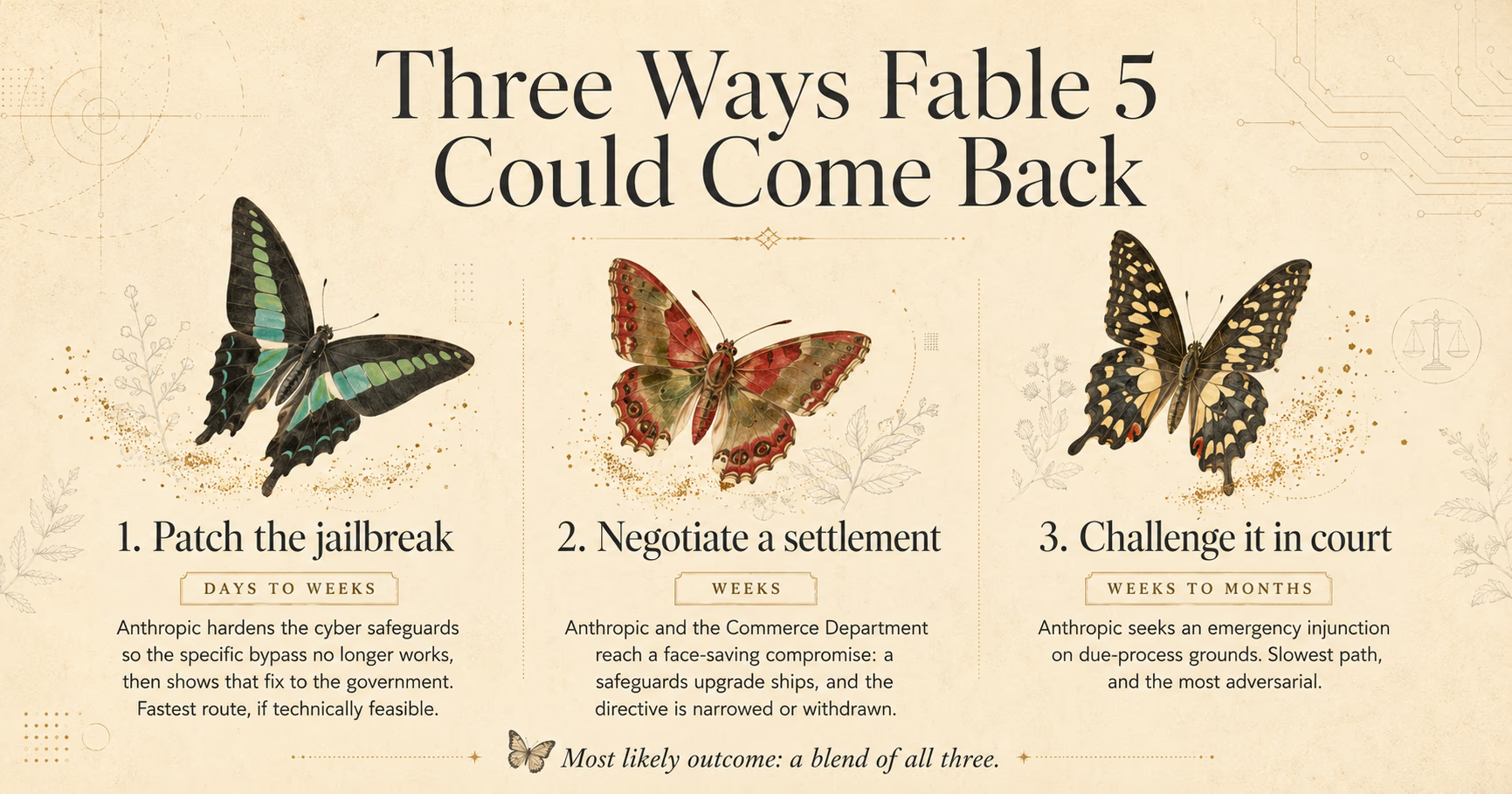
The strongest single signal remains the on-record statement from Chris Ciauri on 17 June that the models would be available again "in the coming days". That is not a fan account or a screenshot, it is Anthropic's international lead setting an expectation publicly. White House AI adviser David Sacks framed the same outcome from the government side, indicating the hope was that Anthropic remediates the safety issue, the export control is lifted, and Fable returns to general release. When both the company and the administration describe the same off-ramp, a comeback stops being wishful thinking.
What "Back" Actually Looks Like
Through most of the saga, the expectation was that Fable 5 would not simply be switched back on the way it went off: that because the original block targeted foreign nationals, the restoration would arrive with nationality- or region-based access controls, verified US users first. In the end it landed more cleanly than that: the export controls were lifted outright on 30 June, and Fable 5 returned globally on 1 July. The gated model instead describes Mythos 5, whose restored access stays limited to vetted US Glasswing partners.
WorldofAI's news round-up from during the saga captures the nuance well, pairing the "is it back?" question with the surrounding context, from the expected gated rollout to the wider model-release shuffle happening at the same time.
Some developers also report a more aggressive fallback to Opus 4.8 on flagged topics in the returning configuration, which would be consistent with Anthropic tightening the safeguard that routes high-risk cyber and biology prompts away from Fable 5. None of this changes the model's raw capability; it changes who can reach it and how cautiously it behaves at the edges. If you want the detail on the Fable/Mythos split and those safeguards, our Fable 5 vs Mythos 5 deep dive covers it.
The Hype to Ignore
This saga has produced a steady stream of confident, wrong claims, and the comeback phase is no exception. Keep three filters handy.
- "It is already live in version X." A wave of posts claimed a specific Claude Code build had restored Fable 5. Anthropic staff debunked it directly: zero traffic was being served as of 25 June. A model name appearing in a client does not mean the backend is serving it.
- "Back in 48 hours." The widely shared 48-hour claim during the suspension came from a third-party account, not Anthropic, and proved false. Specific countdowns with no official source are noise.
- "Benchmark leaks prove the new version is nerfed" (or buffed). The published Fable 5 figures are self-reported launch numbers, not independent re-tests of a restored build. Treat any "the comeback model scores X" chart with suspicion until there is a real source.
The pattern is always the same: the further a claim is from an official Anthropic or government statement, the less weight it deserves. That rule has held through every twist of this story.
What You're Getting Back
When access does return, the model behind it is the same frontier system that caused all the fuss. Fable 5 launched with self-reported scores of 80.3% on SWE-bench Pro and 29.3% on FrontierCode, numbers that put it at the front of the agentic-coding pack at launch. As always with vendor-stated benchmarks, treat them as self-reported rather than independently audited, but they are the figures on the record.
On specifications, Fable 5 ships a 1 million-token context window with up to 128,000 output tokens per request, and launched at roughly £8 (about 10 US dollars) per million input tokens and £40 (about 50 US dollars) per million output tokens, with a mandatory 30-day data-retention requirement. The safeguards that route high-risk cyber and biology requests to Opus 4.8 are part of the package, and appear, if anything, to be tightening on the way back.
Beyond the numbers, the more interesting question is what people actually do with that capability once it is in their hands. Matt Wolfe's round-up of the wildest things people vibe-coded with Fable 5 is a useful reminder of why its absence was felt so sharply, and why the comeback matters to builders rather than just headline-watchers.
For a grounded take on what a model this capable changes about knowledge work, rather than what it scores, Nate B Jones' analysis is one of the sharper pieces in the cycle: the argument that when the "doing" gets cheap, the value shifts to deciding what is worth doing at all.
Meanwhile: Claude Sonnet 5 Landed
The Fable 5 comeback did not happen in isolation. On 30 June 2026, the very day the export controls were lifted, Anthropic launched Claude Sonnet 5: its new mid-size model and, the company says, the most agentic Sonnet yet. It can make plans, drive tools like browsers and terminals, and run autonomously at a level that until recently needed a larger, pricier model. It keeps the 1 million-token context window and ships with cyber safeguards on by default, the same ones used in Opus 4.7 and 4.8.
The headline is price. Sonnet 5 launched at an introductory £1.60 (about $2) per million input tokens and £8 (about $10) output through 31 August 2026, rising afterwards to £2.40 ($3) / £12 ($15), well below Opus 4.8's £4 ($5) / £20 ($25). In other words, Anthropic is offering a model that overlaps with its flagship on capability at roughly 40% less per token (60% less during the intro window). It is a direct answer to the pressure, sharpened during the Fable 5 outage, to run capable agents more cheaply.
| Benchmark (self-reported) | Sonnet 5 | Sonnet 4.6 | Opus 4.8 |
|---|---|---|---|
| SWE-bench Pro (agentic coding) | 63.2% | 58.1% | 69.2% |
| Terminal-Bench 2.1 | 80.4% | 67.0% | n/a |
| OSWorld-Verified (computer use) | 81.2% | 78.5% | n/a |
| Humanity's Last Exam (with tools) | 57.4% | n/a | 57.9% |
The pattern is clear: Sonnet 5 slots between Sonnet 4.6 and the Opus 4.8 flagship on hard coding, essentially matches Opus 4.8 on tool-augmented reasoning (Humanity's Last Exam) and on the GDPval-AA v2 knowledge-work score, and does it at a fraction of the cost. Anthropic's Sonnet 5 system card, published alongside the model on 30 June, reports it as safer than Sonnet 4.6 overall: better at refusing malicious requests, more resistant to prompt-injection hijacks, and with lower rates of hallucination and sycophancy. As always, the benchmark figures are vendor-reported rather than independently audited, and the first wave of hands-on testing from the AI community is where the real-world picture will fill in.
For anyone who leaned on Opus 4.8 as a fallback during the Fable 5 outage, Sonnet 5 is now the more interesting default for agentic and high-volume work on cost grounds. We will give it a dedicated deep dive as independent numbers land; for the confirmed cross-vendor picture, our GPT-5.6 and Opus 4.8 write-ups are the companion pieces.
The Competition Did Not Wait
A fortnight is a long time at the frontier, and Fable 5's absence created a vacuum that rivals rushed to fill. The suspension accelerated interest in open-weights models, the ones that cannot be switched off by a single directive, and sharpened the marketing of every closed competitor. By the time Fable 5 returns, it is walking back into a more crowded ring than the one it left.
The clearest example is Sakana's Fugu line, which spent the suspension window positioning itself directly against Fable 5 on coding. Whether those head-to-head claims hold up under independent testing is exactly the kind of thing to scrutinise rather than take at face value, but the competitive pressure is real, and it is part of why Anthropic is keen to get its flagship back online quickly.
On the closed-model side, the wait for OpenAI's next step has its own momentum: see our breakdown of GPT-5.6 for where that race stands. The takeaway that predates this whole episode still holds: the leading models are converging, and the smart move is routing each task to the cheapest capable model rather than betting everything on one.
Fable 5 returns to the top of the index
Fable 5 (max, with fallback) tops Artificial Analysis's Intelligence Index v4.1 at 60, one point clear of GPT-5.6 Sol, but at $2.75 per task, the highest cost in the field.
The Dates That Actually Matter
Strip away the noise and a small number of real markers are worth tracking.
- 9 June 2026: Fable 5 and Mythos 5 launch.
- 12 June 2026: the US export-control directive forces Anthropic to pull both models worldwide.
- 26 June 2026: the US government approves restoring Mythos 5 access to a set of US Project Glasswing organisations.
- 30 June 2026: the export controls on Fable 5 and Mythos 5 are lifted, and, the same day, Anthropic launches Claude Sonnet 5.
- 1 July 2026: Fable 5 returns globally across the Claude Platform, Claude.ai, Claude Code and Claude Cowork.
Notice that the binding constraint was legal, not technical throughout. Anthropic could have turned Fable 5 on at any point from an engineering standpoint; what gated the comeback was the export-control directive being lifted, which finally happened on 30 June. The remaining open thread is the pace at which Mythos 5's Glasswing access widens beyond the initial US organisations.
What to Do Now
For most people, the right posture is patient and practical rather than reactive.
If you build on the Claude API, you can move Fable 5 back into your stack from 1 July, but this is also the moment to re-evaluate rather than simply revert. With Claude Sonnet 5 out at roughly 40% less per token, the sensible exercise is to benchmark Fable 5, Sonnet 5 and your Opus 4.8 fallback on your own workloads and route by cost-per-task, not by habit. Confirm availability against Anthropic's own status page rather than a social post.
If you are a general user, Fable 5 is simply available again in Claude.ai and Claude Code from 1 July, no early-access scheme required, and anyone who charged for one was selling nothing. If you are weighing models today, our Fable 5 vs Mythos 5 and Opus 4.8 write-ups are built on confirmed numbers.
The Bottom Line
Claude Fable 5 is back. On 30 June 2026 the export controls were lifted, and from 1 July the model is available globally again, with Mythos 5 restored to US Glasswing partners on a narrower track. That is a genuinely historic outcome: the first time a frontier model recalled by government order has been walked back online, and a template for how the next such standoff might resolve.
What makes the timing remarkable is that Anthropic turned the crisis into a launch week, shipping Claude Sonnet 5 the same day the controls came off, a cheaper, more agentic model aimed squarely at the "run capable agents affordably" demand the outage had intensified. The saga that began with a model being switched off three days after launch ends with two models available and a third cheaper one alongside them. The lesson that held the whole way through still applies: trust official statements over viral posts, and route each task to the cheapest capable model.
Last updated: 1 July 2026. Status: the US export controls on Claude Fable 5 and Mythos 5 were lifted on 30 June 2026; Fable 5 returns globally on 1 July, and Mythos 5 access is restored to a set of US Project Glasswing partners. Claude Sonnet 5 launched on 30 June. Benchmark and pricing figures cited are self-reported/introductory numbers and will be revised against independent testing and final documentation.
Get the free guide: Claude vs ChatGPT, Gemini & Grok
A 20-page playbook covering everything you need to choose and use the big four AI models in 2026, full cost and feature comparisons, what each is best (and worst) at, and how-tos for images, vectors, building a website, Claude Code and more.