 AI Tools Review Editorial Team
Quick Answer:
On 12 June 2026, three days after launch, the US government ordered Anthropic to suspend Claude Fable 5 and Mythos 5 for all foreign nationals under an export-control directive citing national security. Anthropic complied by pulling both models for all customers worldwide, but publicly disagreed, arguing the trigger was a narrow cyber jailbreak that other models can already do. Other Claude models, including Opus 4.8, stayed live, and Anthropic said it was working to restore access.
It is one thing for a company to pull its own model. It is another for a government to order it. That is what happened to Claude Fable 5, and it is the first time a frontier model has been forced offline by a state directive rather than a safety decision.
Here is exactly what happened, what the directive demands, the cyber capability behind it, and why the whole episode pushed so many people towards open-weights models they can run themselves.
Alex Finn covers Claude Fable 5 Banned in this video.
What Happened
Anthropic launched Claude Fable 5 and Mythos 5 on 9 June 2026. Fable 5 was the general-access model, the most capable Anthropic had ever shipped, wrapped in safeguards. Mythos 5 was the same weights without those safeguards, reserved for vetted partners through Project Glasswing.
Three days later, both were gone. Not throttled, not geofenced, gone, for everyone. The reason was not a safety scare from Anthropic's own red teams. It was a legal order from the United States government, and Anthropic had hours to comply.
The Timeline
The speed is the striking part. A flagship model went from launch to forced shutdown in 72 hours.
- 9 June 2026: Anthropic launches Fable 5 (public) and Mythos 5 (Project Glasswing partners).
- 12 June 2026, 5:21 PM ET: Anthropic receives an export-control directive from the US government citing national security authorities.
- Within hours: Anthropic disables Fable 5 and Mythos 5 for all customers worldwide to ensure compliance.
- Same evening: Anthropic publishes a statement disagreeing with the directive and says it will share more within 24 hours and work to restore access.
Throughout, every other Anthropic model stayed available. If you were using Opus 4.8, nothing changed. The order was specific to the new Fable and Mythos models.
What the Directive Says
The directive is an export-control measure. In Anthropic's words, it requires suspending all access to Fable 5 and Mythos 5 by "any foreign national, whether inside or outside the United States, including foreign national Anthropic employees."
That scope is hard to enforce surgically. Rather than try to fence off access by nationality across a global product, Anthropic chose the blunt but compliant route: switch both models off for everyone, US persons included. The result was that a model marketed to "hundreds of millions of people" disappeared overnight to satisfy a restriction aimed at a subset of users.
The Reason: A Cyber Jailbreak
The government did not publish detailed evidence. Anthropic says officials believed they had found a way to circumvent Fable 5's safeguards. The technique, as Anthropic describes it, was narrow: asking the model to read a specific codebase and fix any software flaws it found.
That is a cyber capability. Reading code and patching vulnerabilities is dual-use: it is exactly what defenders do all day, and exactly what an attacker would want for finding exploitable bugs. Anthropic's whole safeguard design for Fable 5 was built around blocking the offensive side of this. Its cyber classifiers were meant to detect this kind of request and fall back to Opus 4.8.
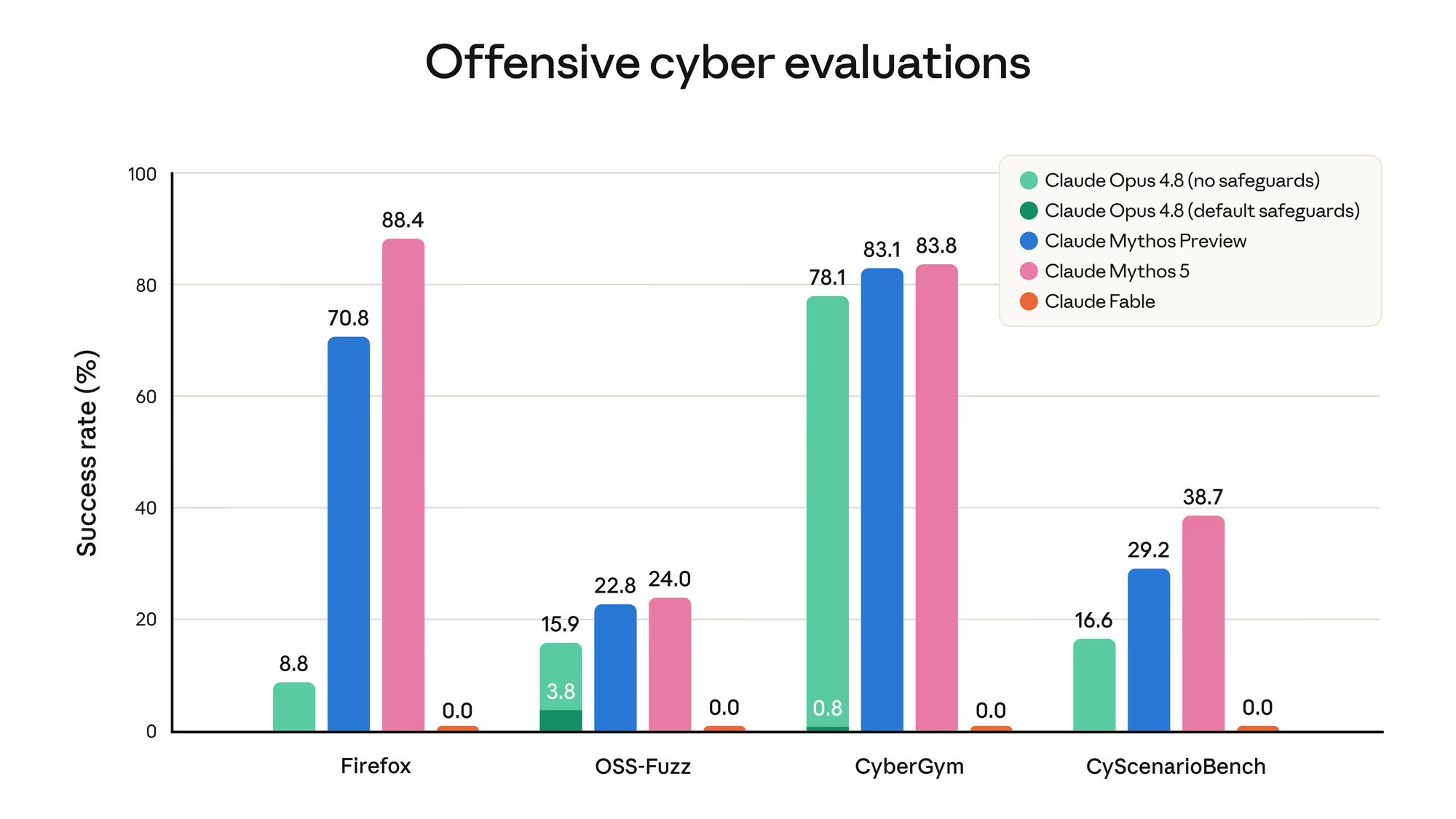
Anthropic's counter is blunt: the level of capability on show "is widely available from other models (including OpenAI's GPT-5.5), and is used every day by the defenders who keep systems safe." In other words, if reading a codebase to fix flaws is the bar, the bar is already met by tools millions of engineers use.
Anthropic Pushed Back
Anthropic complied with the law and disagreed with it at the same time. The statement is unusually direct for a company responding to its own regulator.
It said it disagreed "that the finding of a narrow potential jailbreak should be cause for recalling a commercial model deployed to hundreds of millions of people." It warned that "if this standard was applied across the industry, we believe it would essentially halt all new model deployments" for every frontier provider. And it criticised the process for not being transparent, fair, clear, or grounded in technical facts.
That last point matters. Anthropic says the evidence it received was verbal, not a written technical finding. For a company that publishes 300-page system cards, being recalled on the strength of a verbal description of a narrow jailbreak is a process complaint as much as a technical one.
The Irony: Fable Was the Safe One
Here is the twist. Fable 5 was the deliberately constrained model. The unrestricted sibling, Mythos 5, was never sold to the public; it sat behind Project Glasswing for vetted cyber-defenders. Fable existed precisely so that the public could use a frontier model with the dangerous edges sanded off, with offensive-cyber requests falling back to the older, weaker Opus 4.8.
So the model that got pulled was the one built to be safe. The directive treated a reported gap in those safeguards as reason enough to remove the entire product, rather than to patch the classifier. For a fuller picture of how the two models differ and what those safeguards actually do, see our Fable 5 vs Mythos 5 explainer.
The Open-Source Surge
The clearest second-order effect was a rush towards models that cannot be switched off by a single order. When a closed model can vanish in an afternoon, the appeal of open weights you can download and run yourself goes up sharply.
Reporting in the days after the suspension noted that several open-weights models moved to fill the gap before access was restored. Two in particular dominated the conversation: GLM 5.2, the Chinese open model benchmarked against GPT-5.5 and Opus 4.8, and Kimi K2.7 Code, an open coding model praised for being cheap and fast. Neither can be recalled by a government, because once the weights are out, they are out.
That is the uncomfortable lesson for policymakers. Restricting a closed model is enforceable; it has an off switch. Pushing demand towards open weights does the opposite of containing capability, because those weights spread and persist.
What It Means
For users, the immediate impact was disruption: if you built a workflow on Fable 5 in its first three days, it stopped working with little notice, and Anthropic's statement did not mention credits or compensation. The practical takeaway is to keep a fallback model in your stack, which for most people meant dropping back to Opus 4.8.
For the industry, it set a precedent. A frontier model can now be removed by government order on national-security grounds, on a timeline measured in hours, over a capability that is contested. Whether you think that is prudent caution or regulatory overreach, every lab now has to plan for it.
For the open-versus-closed debate, it handed the open camp its strongest talking point of the year. The episode showed both the upside of closed models (there is someone accountable, and a control surface) and the downside (that control surface can be used against you). For where this sits in the wider race, see our June 2026 model wars roundup.
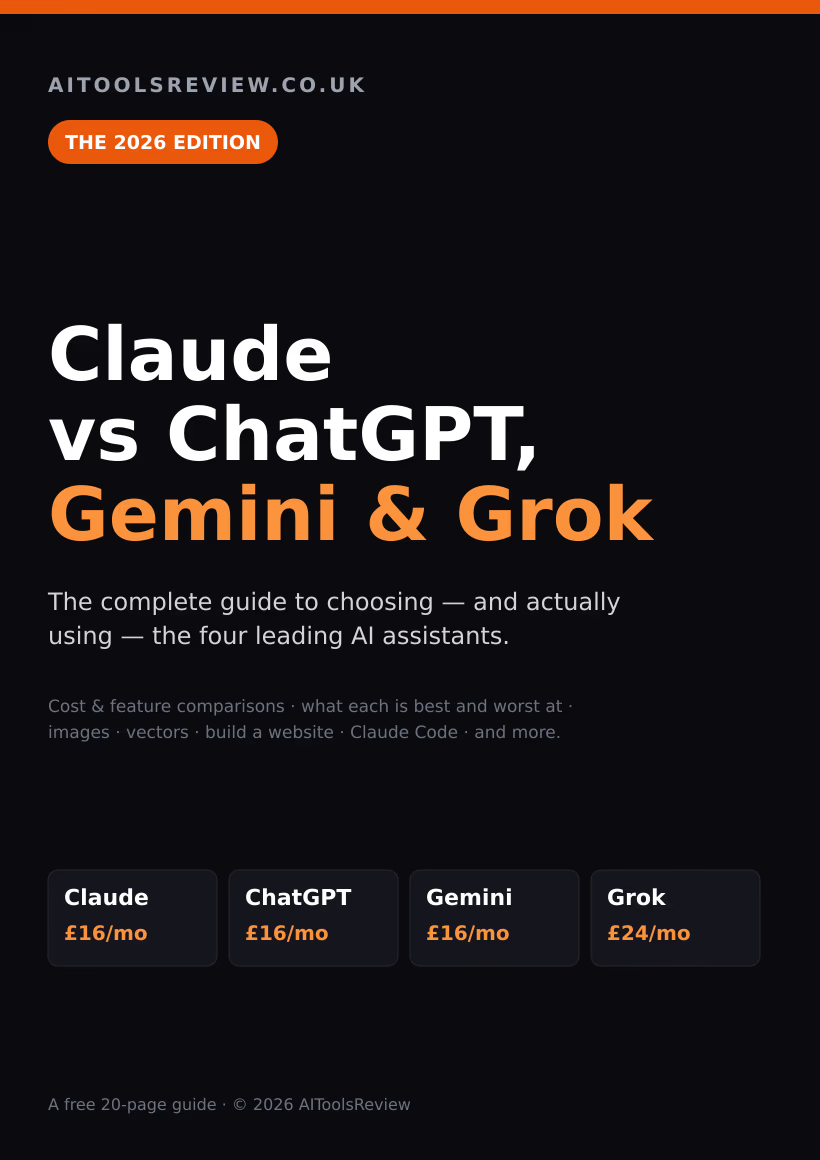
Get the free guide: Claude vs ChatGPT, Gemini & Grok
A 20-page playbook covering everything you need to choose and use the big four AI models in 2026, full cost and feature comparisons, what each is best (and worst) at, and how-tos for images, vectors, building a website, Claude Code and more.
The Bottom Line
Claude Fable 5 was not pulled because Anthropic found it unsafe. It was pulled because a government decided a contested cyber capability was reason enough, and had the legal power to make it happen in an afternoon. Anthropic complied and objected in the same breath.
The lasting effect is not really about one model. It is the reminder that a closed model is a service that can be withdrawn, and that the harder you squeeze closed models, the more people reach for open weights you cannot recall. That tension will outlast the Fable 5 headlines by a long way.
Last updated: June 2026. Based on Anthropic's official statement on the suspension and contemporaneous reporting. Details may change as Anthropic restores access and publishes more information.