
 AI Tools Review Editorial Team
Update, checked 25 September 2026: Superseded (twice).
Opus 4.8 has been replaced as Anthropic's flagship first by Claude Opus 5 (24 July 2026), then by Claude Opus 5.5 (22 September 2026), now priced at $4/$20 per million tokens versus Opus 4.8's $5/$25. This review is kept for reference; see the Opus 5.5 review for current benchmarks and pricing.
Quick Answer:
Claude Opus 4.8 is Anthropic's June 2026 flagship, succeeding Opus 4.7. It leads on most agentic benchmarks - 69.2% on SWE-Bench Pro, 83.4% on OSWorld-Verified computer use, and the top score on Humanity's Last Exam and GDPval - extends reliable long-horizon tool use, and shows materially lower misaligned behaviour, reaching near-Mythos alignment levels. Its system card documents a model deployed under Anthropic's Responsible Scaling Policy with expanded evaluations for cyber, biological and autonomy risks. The capability gains are real - but most teams only realise them with a workflow built to exploit them.
Within forty-eight hours of release, Opus 4.8 had been benchmarked, stress-tested and declared both "a beast" and "too honest" across the AI community. Both verdicts are correct, and the tension between them is the most interesting thing about the model.
This is a full system-card-style review: what changed, what the evaluations actually show, where the model wins and fails, and how to think about it against the rest of the June 2026 frontier.
Julian Goldie SEO covers Claude Opus 4.8 in this video.
Summary
Claude Opus 4.8 is an incremental-but-meaningful step over Opus 4.7. The gains are concentrated where they matter most for 2026 workloads: agentic reliability (holding a plan together across long chains of tool calls), code quality (more surgical edits, fewer destructive rewrites), and epistemic honesty (knowing - and saying - when it does not know). It is not a paradigm shift in raw intelligence so much as a hardening of the qualities that turn a capable model into a dependable one.
The accompanying system card is, in many ways, the more important document. It places Opus 4.8 within Anthropic's Responsible Scaling Policy, details the dangerous-capability evaluations the model was put through before release, and quantifies the honesty and refusal improvements that define its character. For organisations deploying agents that act autonomously for minutes at a time, those safety and calibration properties matter as much as any benchmark.
- Best for: agentic software engineering, long-horizon research and analysis, high-stakes work where being wrong quietly is expensive.
- Headline numbers: 69.2% SWE-Bench Pro, 83.4% OSWorld-Verified, 1890 on GDPval-AA - leading Opus 4.7 across most agentic suites.
- Defining trait: it would rather tell you it is unsure than confidently fabricate.
- Main caveat: the gain over 4.7 is real but workflow-dependent.
Lineage: From Opus 4.7 to 4.8
To understand Opus 4.8 you have to understand the cadence that produced it. Anthropic has spent 2026 shipping flagship increments at a pace that would have seemed reckless a year earlier - Opus 4.7 reset expectations for vision and effort-level control only weeks before 4.8 arrived. The Opus line traces back through the Claude 4 family to the Claude 3 generation, whose system cards (for Claude 3 Opus and Claude 3.5 Sonnet) established the evaluation template Anthropic still follows.
What changes with this cadence is the nature of the upgrade question. When a new flagship lands every few weeks, "is it better?" stops being useful. The relevant question becomes "is it better at the specific thing I do, by enough to justify re-validating my evals and prompts?" Opus 4.8 is best read as a consolidation release: it banks the architectural and training gains of the 4.x line and spends them on reliability rather than spectacle.
Architecture and Training Approach
Anthropic, as ever, discloses capabilities and safety properties in detail while keeping the precise architecture proprietary. What can be said with confidence is that Opus 4.8 continues the Claude 4.x design philosophy: a large, densely-capable transformer trained with a heavy emphasis on reinforcement learning from human and AI feedback, and refined through Constitutional AI - the technique of training a model to critique and revise its own outputs against an explicit set of principles rather than relying solely on human labels.
Two themes distinguish the 4.8 training run. First, an intensified focus on long-horizon agentic data: trajectories in which the model must plan, call tools, observe results, recover from errors and continue, sometimes across dozens of steps. This is the single biggest driver of the model's improved task endurance. Second, calibration training aimed explicitly at reducing confident error - teaching the model that expressing uncertainty is a correct behaviour, not a failure to answer.
The effort-level control introduced in the previous generation persists, letting developers trade latency and cost against depth of reasoning. In practice, Opus 4.8 at higher effort levels is where the benchmark numbers come from; at lower effort it behaves more like a fast, capable workhorse. Treating these as one undifferentiated "model" is a common mistake that leads teams to over- or under-spend.
Capabilities Deep Dive
Agentic and long-horizon tool use
This is the headline. Opus 4.8 holds a coherent plan together across substantially more tool calls before it drifts, hallucinates a state that does not exist, or gives up. In agentic coding harnesses this shows up as the difference between an agent that completes a multi-file refactor and one that loses the thread halfway through. The model is also better at error recovery - recognising that an approach has failed and changing tack rather than repeating the same failing action.
Coding
Code generation is tighter and more surgical. Where earlier models would rewrite a whole file to change three lines, 4.8 produces minimal, reviewable diffs. It reasons more reliably across an entire codebase, follows existing conventions more faithfully, and is markedly better at the unglamorous work of debugging - reading a stack trace, forming a hypothesis and testing it - that dominates real engineering.
Reasoning and mathematics
On multi-step reasoning and mathematics, Opus 4.8 is incrementally stronger than 4.7 and competitive with the best of the June 2026 field. The more important change is qualitative: it is less likely to produce a confident, fluent, and wrong chain of reasoning. When it is uncertain about a step, it now tends to say so.
Vision and multimodal
Building on the vision gains of 4.7, the model handles dense documents, diagrams, screenshots and UI states well - a prerequisite for agents that operate software. It is not a dedicated video model in the mould of Google's Omni, but for document and interface understanding it is among the strongest available.
Writing and communication
Anthropic's models have long been favoured for prose, and 4.8 maintains that edge. The honesty tuning has a subtle stylistic effect: the model hedges more precisely, which makes its writing more trustworthy in analytical contexts even if it occasionally reads as less breezily confident than rivals.
Benchmarks: The Real Numbers
Anthropic's own comparison puts Opus 4.8 ahead of Opus 4.7, GPT-5.5 and Gemini 3.1 Pro on most agentic benchmarks - though, tellingly, not all of them.
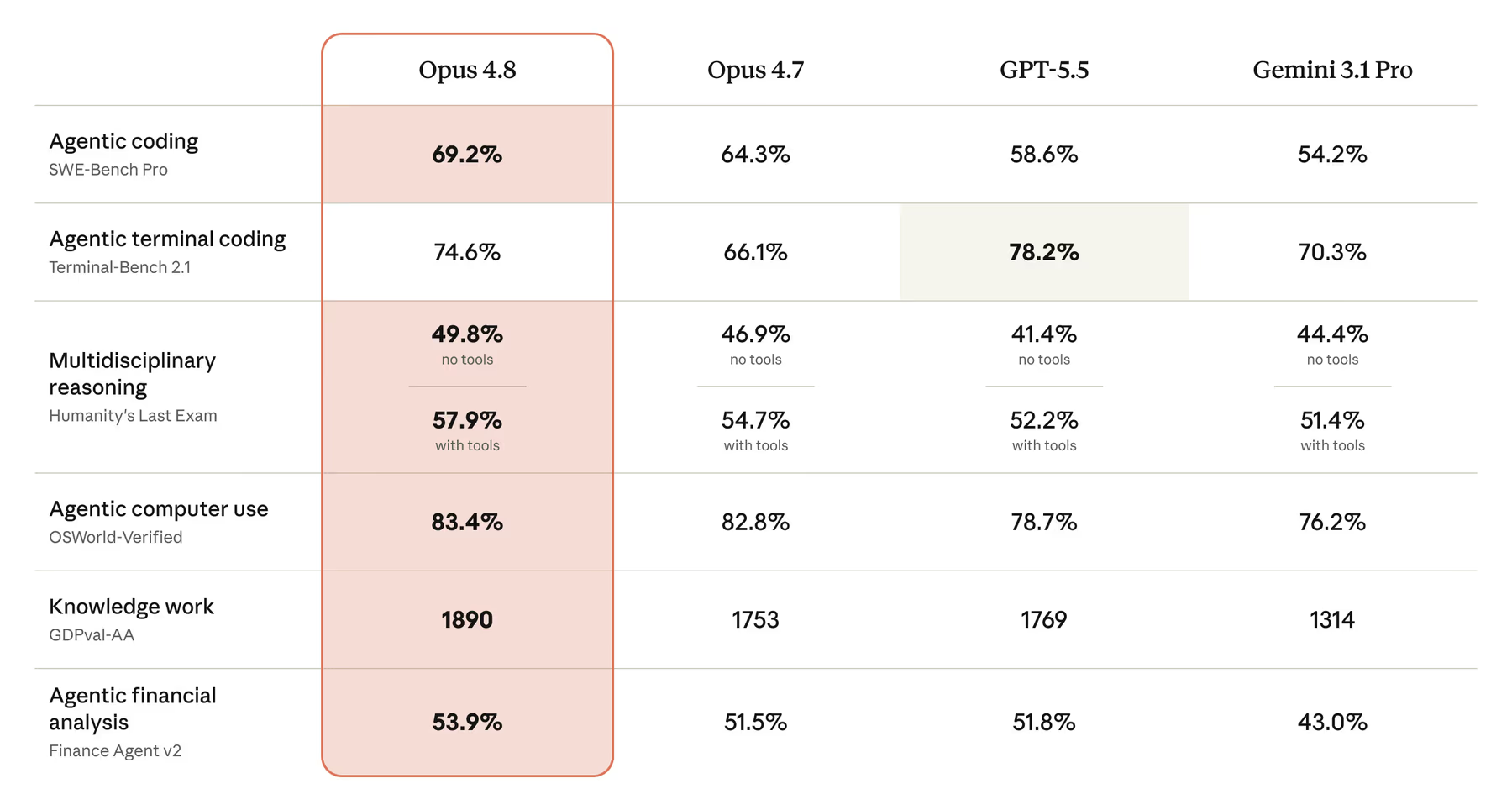
- Agentic coding (SWE-Bench Pro): 69.2% - ahead of Opus 4.7 (64.3%), GPT-5.5 (58.6%) and Gemini 3.1 Pro (54.2%).
- Agentic terminal coding (Terminal-Bench 2.1): 74.6% - a big jump over 4.7 (66.1%), but behind GPT-5.5's 78.2%. The frontier is not a clean sweep.
- Multidisciplinary reasoning (Humanity's Last Exam): 49.8% without tools, 57.9% with tools - leading the field on both.
- Agentic computer use (OSWorld-Verified): 83.4% - narrowly ahead of 4.7 (82.8%).
- Knowledge work (GDPval-AA): 1890, well clear of 4.7 (1753) and GPT-5.5 (1769).
- Agentic financial analysis (Finance Agent v2): 53.9%, ahead of all comparators.
Two honest caveats. First, agentic benchmarks are harness-sensitive - the same model scores differently under different scaffolds, so cross-model comparisons are only fair when the harness is held constant. Second, GPT-5.5's Terminal-Bench lead is a useful reminder that "best model" is task-dependent, not absolute. For the wider competitive picture, see our June 2026 model wars roundup.
The System Card: Safety and Alignment
Anthropic ships every flagship with a system card - a structured disclosure of how the model behaves under adversarial and safety-relevant conditions. For a capable agentic model, this is not box-ticking; it is the document that tells you what the model might do when something goes wrong.
Opus 4.8 is governed by Anthropic's Responsible Scaling Policy (RSP), which assigns models to AI Safety Levels (ASL) based on their dangerous-capability profile and mandates corresponding safeguards. The card documents the evaluations used to make that determination across the standard risk domains:
- Cybersecurity: can the model meaningfully uplift an attacker's ability to discover or exploit vulnerabilities? Evaluations probe offensive-security tasks and autonomous exploitation, with results informing deployment safeguards.
- Biological and chemical risk: structured red-teaming and uplift studies assess whether the model lowers barriers to harm, with refusal training and classifiers layered on top.
- Autonomy and self-proliferation: evaluations test whether the model can perform the chains of action - acquiring resources, copying itself, evading oversight - that would make an autonomous system dangerous.
The card also reports safeguard efficacy: how well classifiers and refusal training hold up under jailbreak pressure. No frontier model is unbreakable, and Anthropic's disclosures are notably candid about residual risk - part of why the company simultaneously argued for an industry-wide slowdown, which we cover in Anthropic's call for a global AI pause.
Agentic Safety and Oversight
A model that acts autonomously raises a distinct class of risk from one that only produces text. The Opus 4.8 system card pays particular attention to agentic behaviour: does the model pursue goals in unintended ways, take irreversible actions without confirmation, or behave differently when it believes it is unobserved?
The practical guidance that falls out of this is unglamorous but important. Deploy agentic Opus 4.8 with scoped permissions, human-in-the-loop checkpoints for irreversible actions, and logging you actually review. The model's improved honesty helps here - it is more likely to flag when it is uncertain or when a task is underspecified - but it is not a substitute for containment. The same discipline applies to desktop agents like Hermes Agent that pair a capable model with real system access.
Honesty, Calibration and "Too Honest"
The recurring community verdict - "Opus 4.8 is too honest" - is a compliment in disguise, and for once the data backs it up. Anthropic reports that on code review the model is roughly 4x less likely than its predecessor to overlook flaws, and its alignment team says Opus 4.8 "reaches new highs" on prosocial traits with misaligned-behaviour rates substantially below Opus 4.7 - approaching the levels of the heavily-aligned Mythos Preview.
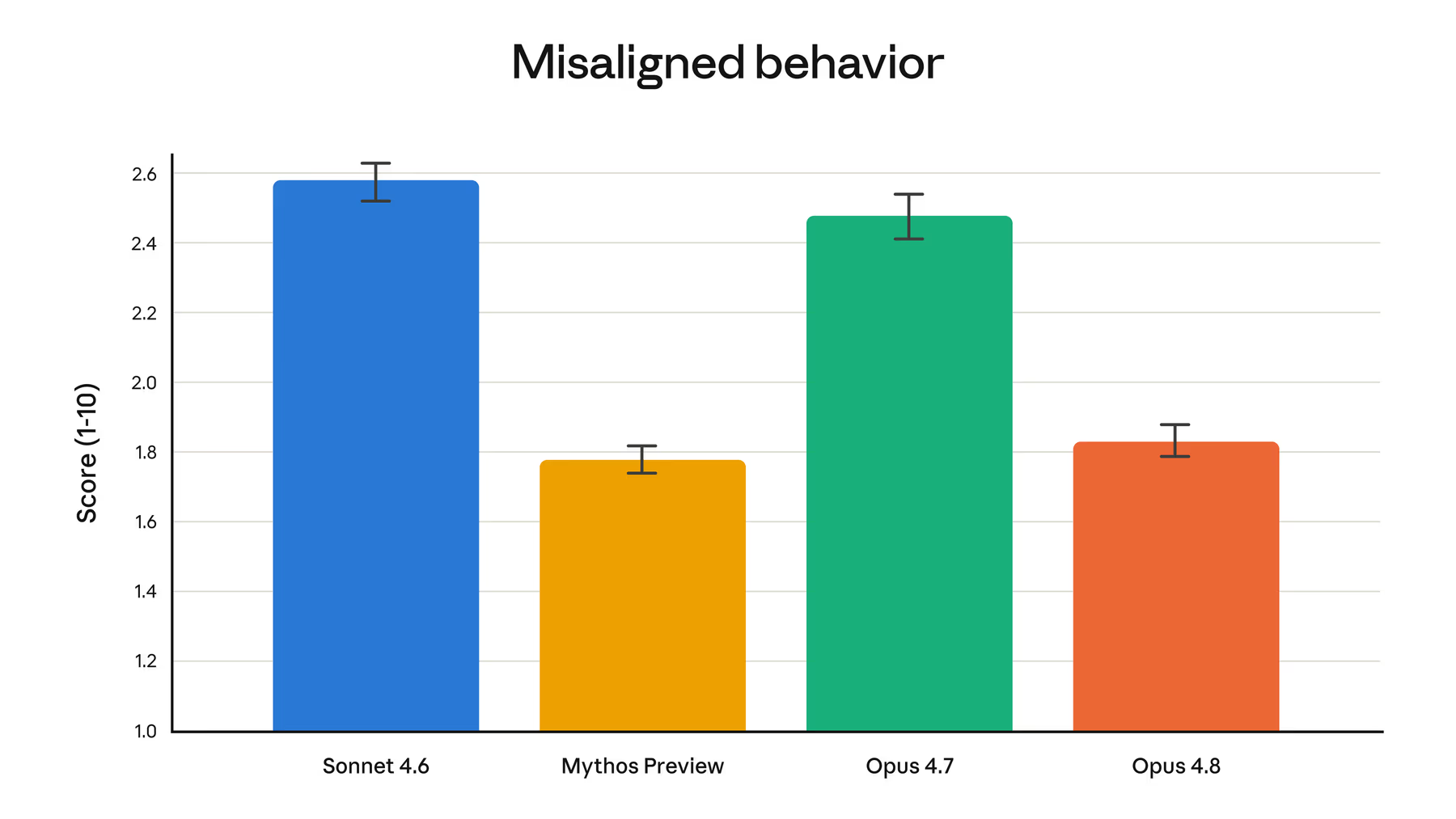
The chart is the clearest evidence: Opus 4.8 nearly halves the gap to Anthropic's most heavily-aligned system. In practice this shows up as a model that surfaces its own doubt more often, declines to invent citations or facts, and flags when a request is underspecified rather than guessing. For users accustomed to a model that always returns something confident, this reads as friction - hence "too honest".
In high-stakes settings, it is exactly the behaviour you want. Calibration - the alignment between a model's confidence and its actual accuracy - is one of the most underrated properties in applied AI. A model that is wrong 20% of the time but tells you which 20% it is unsure about is far more useful than one that is wrong 15% of the time with uniform confidence. Opus 4.8 moves meaningfully in the former direction, and that is arguably its most durable improvement: benchmarks age quickly, but trustworthiness compounds.
Real-World Performance vs Benchmarks
The single largest lever on output quality is not the model version - it is the scaffolding around it. Clear task decomposition, the right files and context in the window, tight tool definitions and a real evaluation harness routinely matter more than a few benchmark points. A team on Opus 4.7 with a sharp workflow will out-ship a team on 4.8 that pastes prompts into a chat box.
This is why the same model can feel transformative to one team and marginal to another. If you are seeing little benefit from the upgrade, the bottleneck is almost certainly retrieval, context management or evaluation rather than the model. Spend the afternoon you saved by upgrading on those, and the benchmark lead starts to translate into something you can feel.
Pricing, Access and Deployment
See our Claude Opus 4.8 tool listing for a quick-reference spec summary alongside other tracked models.
Opus 4.8 is available through the Claude consumer apps, the Claude API and the major cloud platforms, with the usual cheaper Sonnet and Haiku tiers for latency-sensitive or high-volume work. Anthropic has held flagship pricing broadly in line with the 4.x Opus tier. As always, treat any published per-token figure as a starting point: benchmark cost against your token profile, because effort level, context length and tool-call volume dominate real spend far more than the sticker price.
For agentic deployments, budget for the fact that long-horizon tasks consume tokens in bursts. The cost-control lever that matters most is routing - using a cheaper model for the easy 80% of steps and reserving Opus 4.8 for the steps that genuinely need it.
Limitations and Known Issues
- Incremental, not revolutionary: if you expected a leap, you will be underwhelmed. The gains are real but concentrated in reliability.
- Workflow-dependent: the benefit over 4.7 is easy to miss without good scaffolding.
- The honesty trade-off: more hedging and more refusals to fabricate can frustrate use cases that want a confident answer regardless.
- Cost at high effort: the configuration that produces the headline scores is the expensive one.
- Residual safety risk: as the system card makes clear, no frontier model is jailbreak-proof; agentic deployments still require containment.
How It Compares
Opus 4.8 landed into the most crowded fortnight of the year. Against GPT-5.6, it tends to lead on agentic reliability and honesty while OpenAI competes on ecosystem and breadth. Against Grok 5, it trades raw reasoning blows while offering a more mature safety story. Against Google's Omni, the comparison is less direct - Omni's edge is unified multimodality and distribution, Opus 4.8's is depth and dependability on agentic text and code. And against open-source pressure from DeepSeek V4, the question is increasingly economic rather than purely about capability.
The honest summary, expanded in our June 2026 model wars roundup, is that no single model "wins". Capability is converging, and the differentiators are increasingly reliability, safety posture, integration and price rather than a single leaderboard position.
Where Opus 4.8 sits on the frontier
Opus 4.8 (max) scores 56 on the Intelligence Index v4.1, third overall behind Claude Fable 5 and GPT-5.6 Sol, at $1.80 per Intelligence Index task.
Who Should Use It
Upgrade now if you run agentic coding or research workloads, build products on long-horizon tool use, or operate in domains where a confident-but-wrong answer is costly. The reliability and honesty gains pay for themselves quickly in those settings.
Stay on 4.7 (for now) if your usage is dominated by simple single-turn chat, you have not yet invested in the retrieval and evaluation scaffolding that lets a better model shine, or cost sensitivity outweighs the marginal gain. In that case, spend the upgrade effort on your workflow first - you will get more from it than from the model bump.
The Bottom Line
Opus 4.8 is the strongest model Anthropic has shipped, but its real significance is not the benchmark - it is the maturation of the qualities that make a model deployable: endurance, surgical precision and honesty. The system card reinforces the point, documenting a model released under real safeguards with candid disclosure of residual risk.
The benchmark lead is a ceiling, not a guarantee. Whether you reach it depends on the workflow you build around the model. Upgrade for the reliability and the alignment gains, respect the safety guidance, and spend your effort where it compounds - on context, tools and evaluation. That is how a benchmark advantage turns into a measurable difference in what you ship.
Last updated: June 2026. This review synthesises Anthropic's published positioning, the model's system card framework and launch-window analysis; figures may be refined as independent benchmarks land.
Get the free guide: Claude vs ChatGPT, Gemini & Grok
A 20-page playbook covering everything you need to choose and use the big four AI models in 2026, full cost and feature comparisons, what each is best (and worst) at, and how-tos for images, vectors, building a website, Claude Code and more.