 AI Tools Review Editorial Team
Quick Answer:
Hermes Agent is a desktop AI application that acts on your computer rather than just chatting - opening apps, moving and renaming files, running tools and stringing multi-step tasks together. It has become a creator favourite because it turns "ask the AI" into "the AI does it", runs well on both frontier and capable local models, and works best when paired with a strong agentic model like Claude Opus 4.8. Its power - real access to your machine - is also the thing to respect.
Update, 23 July 2026: Hermes Agent is built by Nous Research, and shipped its largest release to date on 20 July 2026 - v0.19.0, "Quicksilver" - cutting cold-start latency by roughly 80% and making independent-reviewer "smart approvals" the default safety behaviour. See our full Hermes Agent v0.19 Quicksilver review for the release changelog, real pricing detail and how it compares to Claude Code and Codex.
Update, 19 August 2026: Hermes Desktop now ships Bot Mode by default (v0.20.3, 16 August 2026), turning your agent profiles into a roster of named Bots that each keep their own model, memory and skills, and can message each other or meet in shared 2-6 bot collaboration rooms. See our full Hermes Agent Bot Mode review for how it works and how it compares to Grok Bot.
For weeks, one creator after another has called Hermes Agent "the greatest AI tool ever made" - and then quietly rebuilt their entire workflow around it.
Hyperbole aside, Hermes represents a genuine shift in how we use AI: from talking to an assistant to delegating to one. This is the complete guide to what that means in practice.
Julian Goldie SEO's walkthrough of Hermes Agent OS.
Summary
Hermes Agent is a desktop-native AI agent: instead of living in a browser tab, it operates as an application with access to your local environment - the file system, installed software and the screen. You give it a goal, and it plans and executes the steps, pausing for a decision when it needs one. The result is the first tool many users have tried that genuinely does the work rather than describing how to do it.
The enthusiasm is justified, with two important caveats. First, reliability tracks the underlying model closely - Hermes on a weak model is frustrating; on a strong one it is transformative. Second, an autonomous process with access to your machine is a category of tool that demands real care around permissions and supervision. This guide covers both the upside and the discipline required to capture it safely.
- Best for: repetitive, multi-app work - content production, file management, research and developer chores.
- Defining trait: it changes real state on your computer.
- Killer feature: runs locally for full privacy, including on a DGX Spark.
- Main caveat: autonomy plus desktop access is powerful and risky in equal measure.
What Hermes Agent Is
Hermes Agent is a desktop AI agent that treats your computer as its workspace. Where a conventional assistant is confined to a chat window, Hermes can see the screen, read and write files, launch and drive applications, and chain those actions together into a workflow. It is the practical embodiment of the "agentic" idea that has dominated AI in 2026: software that pursues goals rather than merely answering questions.
That framing - workspace, not chat window - is the key to understanding both its appeal and its risks. Everything Hermes can do for you, it can also do to your system, which is why the rest of this guide spends as much time on discipline as on capability.
The Agentic Shift: Advice to Action
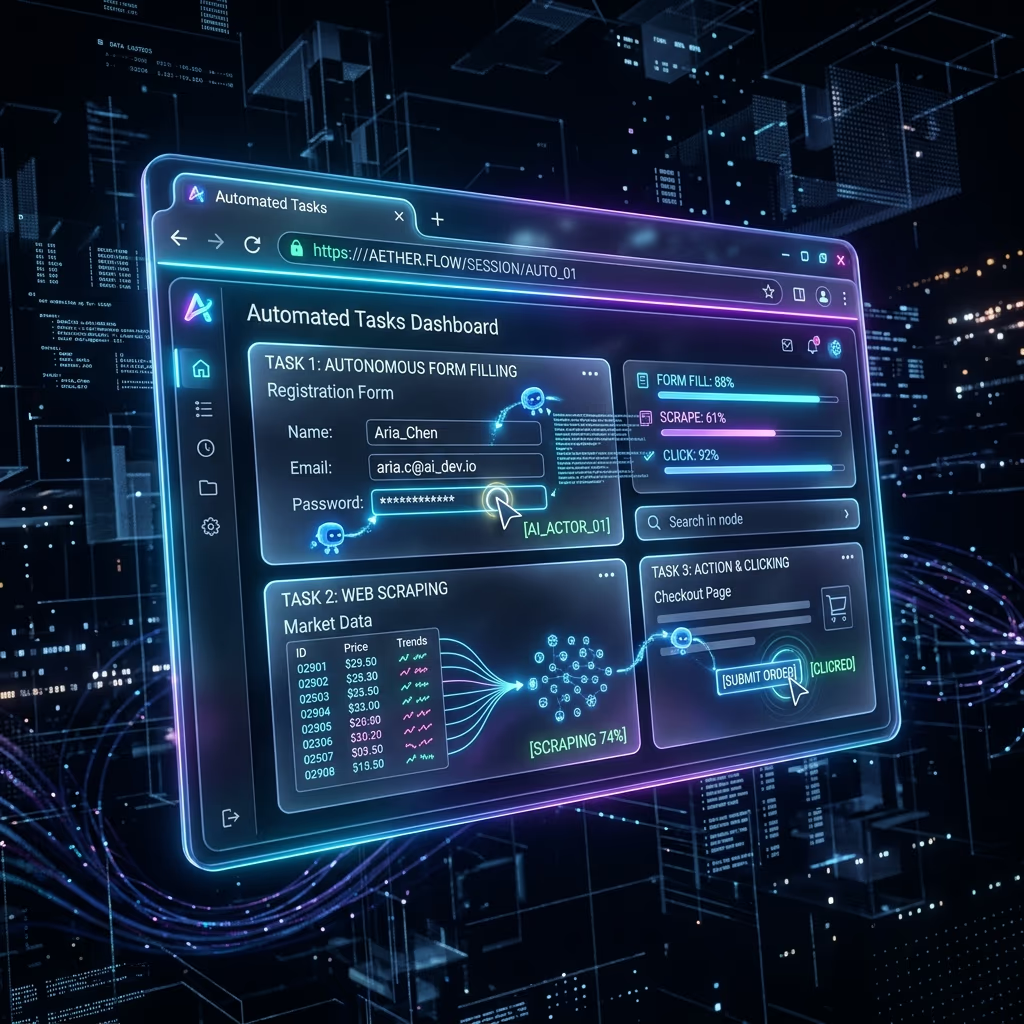
A chatbot returns text; an agent changes state. That distinction is the whole story. Ask a chatbot to "tidy this folder, rename the exports by date and draft a summary email" and you get instructions. Ask Hermes, and it actually does it - reads the folder, renames the files, opens your mail client and drafts the message.
This is the same shift powering browser automation agents, but pointed at the entire desktop rather than a single tab. The difference between "the AI tells me how" and "the AI does it" sounds small and is enormous: it changes AI from a consultant into a worker, and changes your role from operator to supervisor.
How It Works
Under the hood, Hermes follows the now-standard agent loop: it interprets your goal, forms a plan, takes an action (a file operation, a tool call, a UI interaction), observes the result, and decides what to do next - repeating until the task is done or it needs you. Its desktop integration gives it a richer action space than a browser-bound agent: it can touch the file system, drive native applications and read the screen directly.
The quality of that loop depends on two things: the planning ability of the underlying model, and the robustness of the integration layer that translates intentions into safe, reliable system actions. When both are strong, Hermes feels uncannily competent. When the model is weak or the action fails silently, it can loop, stall or do the wrong thing confidently - which is exactly why supervision matters early on.
Real Use Cases
- Content production: drafting, formatting and organising assets across multiple applications - the connective tissue work that eats a creator's day.
- Developer chores: scaffolding projects, running scripts, cleaning up directories and automating the repetitive parts of a workflow.
- Research: gathering, summarising and filing information into structured notes, then producing a deliverable from them.
- Repetitive admin: the file-shuffling, renaming and reformatting that quietly consumes hours and that no one enjoys.
The common thread is delegation of multi-step, multi-app tasks that are too fiddly to script and too tedious to do by hand. That middle ground - too bespoke for a macro, too boring for a human - is where Hermes earns its keep.
Setup and Configuration
Setup follows a familiar pattern: install the desktop application, connect a model provider (or a local model), and grant the permissions Hermes needs to act on your machine. The step most people skip - and the most important - is scoping. Before you let an autonomous agent loose on anything irreversible, point it at a sandboxed folder and low-stakes tasks, and watch what it does.
Treat the first sessions as supervised probation. Confirm that it asks before destructive actions, that its file operations land where you expect, and that it recovers sensibly when something fails. Only once you have that confidence should you widen its remit. The few minutes this takes are far cheaper than recovering from an agent that helpfully "cleaned up" the wrong directory.
Local Models and the DGX Spark
One of the most-shared Hermes demos showed it running on local models on an Nvidia DGX Spark - "basically magic", as the creator put it. The appeal is obvious: an agent with full desktop access that never sends your files to a third party. For anyone handling sensitive material, the combination of autonomy and on-device privacy is genuinely compelling.
As capable local models continue to improve, the private-agent setup is shifting from novelty to practical option. There is a trade-off - local models generally trail the frontier on the hardest planning tasks - but for many everyday workflows, a strong local model on dedicated hardware is more than enough, and the privacy benefit is decisive.
The Model Underneath
Hermes is a harness, and a harness is only as good as the model it drives. Pair it with a strong agentic model - Claude Opus 4.8 is a natural fit, given its long-horizon reliability and error recovery - and the agent plans better, fails less and recovers more gracefully. Pair it with a weak model and even a well-built harness will struggle.
This is the same lesson playing out across the agent ecosystem and the 2026 model wars: the harness and the model are a system, and you tune both. Choosing the right model for the task - frontier for hard planning, local for privacy-sensitive routine work - is part of using Hermes well.
Safety and Permissioning
Desktop agents are powerful precisely because they can change real state, which is also the risk. The safety model for Hermes is the same one that applies to any capable agent: scoped permissions, human confirmation for irreversible actions, and logs you actually review. An agent that can delete files, send messages and run commands on your behalf is an agent that can do those things wrongly.
The improved honesty of modern models helps - a model that flags uncertainty is easier to supervise - but it is not a substitute for containment. The discipline here mirrors the agentic-safety guidance in the Opus 4.8 system card: capability and constraint should be designed together, not bolted on after the first mishap.
Limitations
- Reliability tracks the model: a weak model makes Hermes frustrating rather than magical.
- Silent failures: when an action fails without the agent noticing, it can loop or proceed on a false assumption.
- Risk surface: full desktop access is a serious responsibility, especially for irreversible operations.
- Setup discipline required: the tool rewards careful scoping and punishes "give it everything and hope".
- Best on capable hardware: local-model setups need real compute to perform well.
How It Compares
Against browser-bound agents, Hermes trades a narrower, safer sandbox for a far larger action space - the whole desktop rather than a single tab. Against general autonomous agents like Manus, its edge is local-first operation and tight system integration rather than cloud-hosted task running. And against in-editor coding agents like Cursor, it is complementary: Cursor owns the code, Hermes owns everything around it.
The honest summary is that Hermes occupies a distinct niche - the local, desktop-wide, do-it-on-my-machine agent - and within that niche it is one of the most compelling tools available. It is also increasingly a team member rather than a solo tool: Hermes now ships direct integrations with Buzz, Block's open-source Slack-and-GitHub rival, letting a single Hermes agent read and post in shared channels alongside humans.
Who It Is For
Hermes is for creators, developers and power users whose work is full of repetitive, multi-application tasks they would happily delegate - and who are willing to invest a little upfront discipline in scoping and supervision. If that is you, it is a genuine force multiplier. If you want a hands-off magic button with no responsibility attached, an autonomous agent with the keys to your machine is not it.
The Bottom Line
Hermes Agent is one of the clearest examples yet of AI moving from advice to action. Used carefully - scoped, supervised and paired with a capable model - it is a genuine force multiplier that collapses hours of multi-app drudgery into a single delegated request.
Used carelessly, it is an autonomous process with the keys to your machine. The tool deserves both the enthusiasm and the caution it has attracted. Treat it as a capable new team member rather than a magic button, and it will earn its place in your workflow.
Last updated: June 2026. Based on creator coverage and hands-on demonstrations circulating at launch.