 AI Tools Review Editorial Team
Quick Answer:
Hermes Agent v0.19.0 "Quicksilver", released 20 July 2026 by Nous Research, cuts cold-start time from roughly 4.3 seconds to 0.9 seconds, an 80% reduction across the CLI, gateway, TUI, desktop app and cron jobs, and makes "smart approvals" (an independent LLM reviewer checking flagged commands) the default safety behaviour. It is free and open-source under the MIT licence; you pay only for the compute you host it on and the LLM API calls it makes. It is not a model (it is a model-agnostic agent harness, newly wired up to GPT-5.6, Grok 4.5, Kimi K3 and Claude Fable 5 among others) which puts it in the same category as Claude Code, OpenAI's Codex CLI and Gemini's Antigravity, but aimed at power users who want one persistent agent working across their terminal, desktop and messaging apps at once.
Most agent releases this year have been about a smarter model underneath. Quicksilver is not that story. It is a release almost entirely about what happens in the seconds and milliseconds around the model call, the cold start, the streaming, the approval, the crash recovery, and it is a useful reminder that an agent's felt reliability has as much to do with plumbing as with intelligence.
Here is what actually shipped, what the numbers mean, and where Hermes Agent sits against the other agent harnesses this site covers.
Julian Goldie SEO covers the same Quicksilver-era Hermes upgrades.
Summary
Hermes Agent v0.19.0, codenamed Quicksilver, is Nous Research's July 2026 release of its open-source AI agent framework, a large one, spanning roughly 2,245 commits and 1,065 merged pull requests from over 450 contributors since the prior version. The headline change is speed: cold-start "Initializing agent..." latency drops from around 4.3 seconds to around 0.9 seconds, an 80% cut that applies uniformly across every surface Hermes runs on.
But the release is really three releases in one. Alongside the speed work sits a substantial safety and security pass (smart approvals by default, native password-manager integration, hardened webhook signing) and a genuine feature expansion (durable background delegation to subagents, profile-based multi-tenant gateway routing, six new export formats for session data). None of these individually would justify a deep dive. Together, they mark Hermes crossing from "impressive open-source demo" territory into something closer to production-grade agent infrastructure.
- Best for: developers and power users who want one open-source, model-agnostic agent operating across a terminal, a desktop app and messaging platforms, with real memory and delegation.
- Headline numbers: ~80% cold-start reduction (4.3s to 0.9s), 14x less CPU in the desktop app's markdown renderer, ~5x faster skill-manifest builds.
- Defining trait: an open-source agent harness, not a model: you point it at whichever LLM you want, including this week's Gemini 3.6 Flash refresh, GPT-5.6 or Claude Fable 5.
- Main caveat: free software with real hosting and API costs behind it; total monthly spend depends heavily on which model you choose.
What Hermes Agent Is
Hermes Agent is built by Nous Research, an AI research organisation whose earlier claim to fame was the Hermes line of fine-tuned open-weight language models. Hermes Agent is a different, newer product: an agent harness: the orchestration layer that gives a language model memory, tools, scheduling and a place to run, rather than a model in its own right. That distinction matters, because it means Hermes' quality is a function of two things: the harness itself, and whichever model you choose to plug into it.
The project is free and open-source under the MIT licence, and it is unusually platform-agnostic even by the standards of 2026's crowded agent-CLI field. It runs as a command-line tool, a terminal UI, a native desktop application for Windows and macOS, or a server-hosted gateway, and it bridges into more than twenty external surfaces (Telegram, Discord, Slack, WhatsApp, Microsoft Teams, Matrix, Google Chat and custom webhooks among them) all sharing one underlying agent identity and memory. That "one agent, many surfaces" model is the project's clearest point of differentiation from more IDE- or terminal-centric competitors like Claude Code or OpenAI's Codex app.
We previously covered Hermes Agent in a general explainer back in June 2026, before this level of detail about its provenance and architecture was as clear from creator coverage. This article supersedes that piece for anyone tracking the project closely: see our original Hermes Agent explainer for the broader introduction to the product.
The Quicksilver Release: What Shipped
Nous Research published the Quicksilver changelog on GitHub on 20 July 2026, tagged v2026.7.20. By the numbers, it is one of the larger releases in the project's history: roughly 2,465 files changed, around 300,000 lines added and 36,000 removed, and about 3,300 issues closed. That scale is worth noting on its own: it signals a genuinely large, active open-source contributor base rather than a small core team shipping incremental point releases.
The release note structure breaks into distinct workstreams: performance (the headline), reasoning and model support, subscription and billing, secrets management, approvals and safety, subagent delegation, delivery reliability, and a large desktop-application overhaul. Each is substantial enough to have anchored a release on its own in an earlier era of the project; Quicksilver ships all of them together.
Capabilities Deep Dive
Reasoning and model selection
Quicksilver adds max and ultra reasoning-effort tiers usable across every surface, plus per-model effort overrides and per-slot effort controls inside Mixture-of-Agents presets, letting a single Hermes configuration run some sub-agents at low effort for speed and others at maximum effort for depth. A new session-scoped /reasoning command lets users adjust this mid-conversation rather than only at startup.
Provider and model support
The release adds Fireworks AI as a first-class provider with built-in cost estimation, hardens DeepInfra support, and adds Upstage Solar. On the model side, it wires in GPT-5.6 (across its Sol, Terra, Luna and Pro variants), Grok 4.5 at general availability, Moonshot AI's Kimi K3, both Claude Fable 5 and Claude Sonnet 5, and Tencent's hy3 model at GA. GLM-5.2 is set as a catalogue-labelled silent default for certain configurations. Practically, this means Hermes can be pointed at almost any current frontier or open-weight model within days of that model's own release: including, as of this week, Google's newly-cut-price Gemini 3.6 Flash.
Delegation and subagents
Hermes' delegate_task mechanism, dispatching work to subagents that run independently, gains live transcript files so a user can tail a delegated task's progress in real time, and durable background delegation backed by an ownership-checked ledger, meaning results survive a process restart rather than being lost if the host machine reboots mid-task. This is the kind of unglamorous reliability work that determines whether "run this overnight" is actually usable in practice.
Profile-based gateway routing
A single Hermes gateway can now multiplex across multiple isolated profiles, separate configs, skills, memory and secrets per profile, so, for example, a work Discord server and a personal Discord server can be handled by the same running gateway process without sharing context or credentials. A second hardening pass specifically prevents a misconfigured profile from taking the entire gateway down, which matters once a single Hermes instance is serving more than one identity.
Desktop application overhaul
The desktop app received more than twenty targeted performance pull requests: a 14x reduction in CPU usage for markdown rendering via incremental block lexing, virtualised diff rendering that eliminates full-page freezes on large code reviews, and elimination of per-token sidebar re-renders during streaming. A new consolidated "Capabilities" page brings skills, tools and MCP server management into one interface, and a "Hermes Cloud Connection Mode" adds a soft gateway switch with health-probed backend picking.
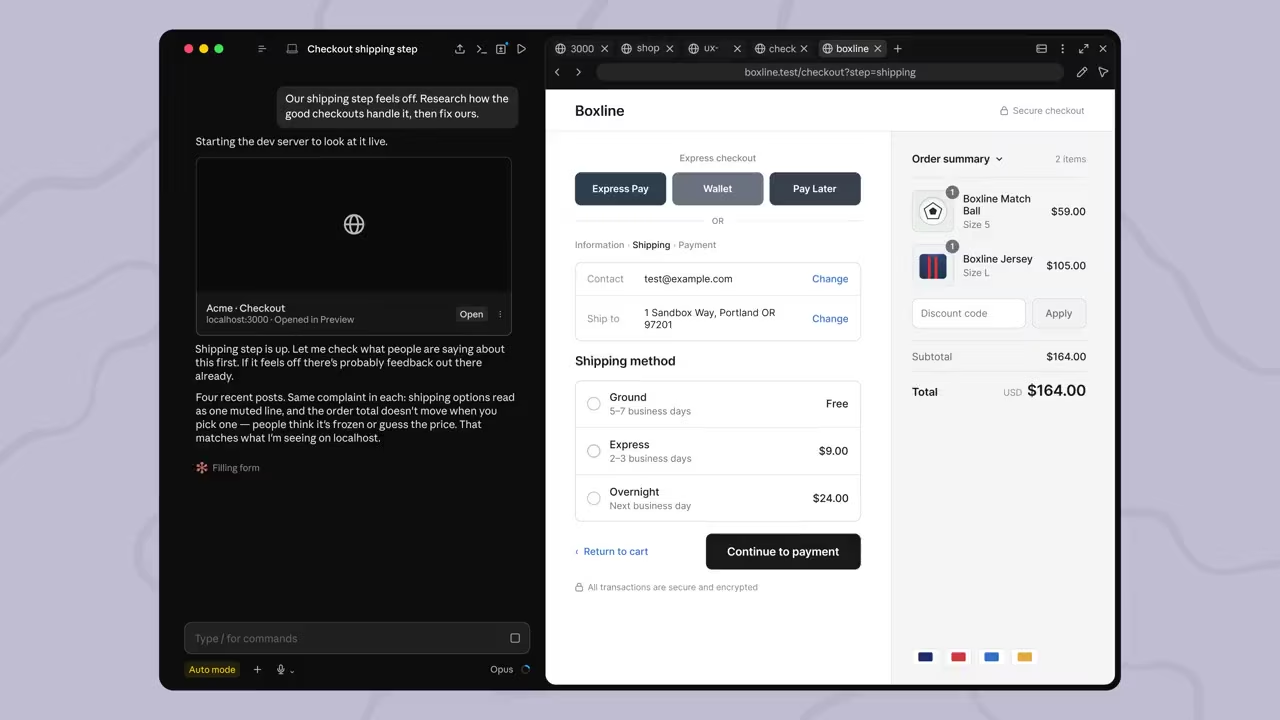
A closer look at Hermes' newer agent tooling, released in the same cycle.
That Kanban agent, and a wave of adjacent claims about a "3D office" and a Grok Bot win, are worth reading carefully rather than at face value: we fact-checked what Nous Research actually shipped versus community add-ons circulating in the same coverage cycle.
The Performance Numbers
The single most quoted figure from this release is the cold-start improvement: from roughly 4.3 seconds down to roughly 0.9 seconds before a user's first turn reaches the model, an approximately 80% cut, achieved by removing blocking work during agent initialisation and adding token-keyed disk caching for capability detection on platforms like Discord. Nous Research reports this applies uniformly across the CLI, gateway, TUI, desktop app and scheduled cron jobs, rather than being specific to one surface.
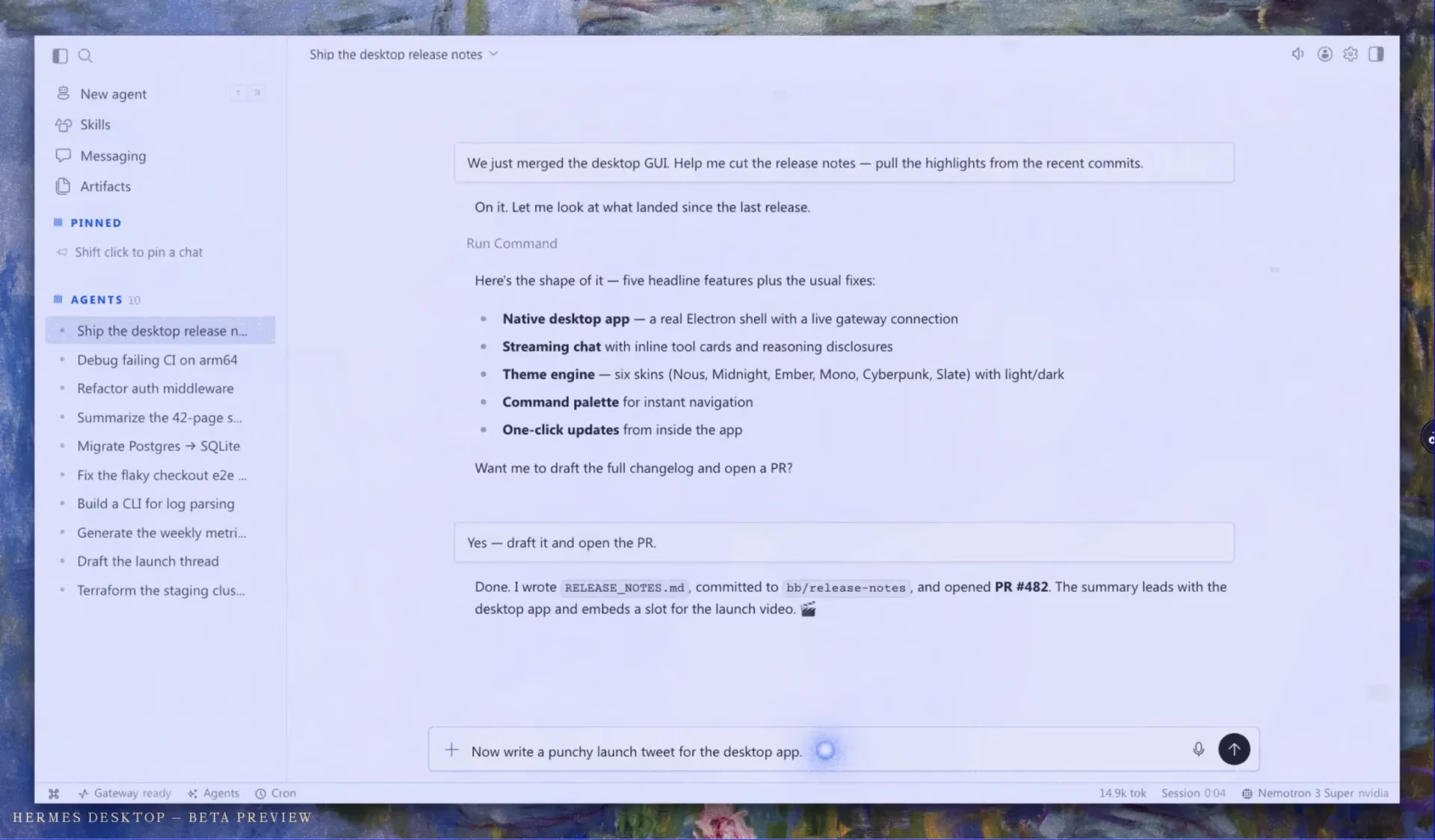
Beyond cold start, the desktop app's markdown splitter reportedly uses 14x less CPU via incremental lexing rather than re-parsing the whole message on every token, and skill-discovery caching is said to improve manifest build times by roughly 5x. Streamed reasoning traces now paint per-token rather than per-line, addressing a common complaint about earlier versions where a reasoning model's thinking appeared to freeze for 20-30 seconds before any visible output.
As with any vendor-reported performance figure, these numbers come from Nous Research's own release notes rather than an independent benchmark, and "cold start" specifically measures time-to-first-token rather than end-to-end task completion time, which still depends primarily on the underlying model you connect. That said, the consistency of the reported gain across five distinct platforms (CLI, gateway, TUI, desktop, cron) is a reasonably strong signal that the underlying initialisation-path fix is real, rather than a cherry-picked single-surface number.
Security, Approvals and Secrets
The most consequential change for anyone running Hermes with real system access is that smart approvals became the default. Previously, a flagged command (one Hermes judges risky enough to need sign-off) would simply block on a yes/no prompt to the user. Now, an independent LLM reviewer assesses each flagged command on its own merits before it reaches the user, and every command gets its own verdict rather than a blanket approval. Users can also define deny rules that block specific commands even under fully autonomous "yolo mode," and a new /deny <reason> command lets a user relay why they refused a specific action back to the agent, rather than a silent no.
Secrets management also matured meaningfully: Hermes now integrates natively with Bitwarden and 1Password through a pluggable SecretSource interface, supporting multiple vaults with deterministic precedence and per-variable provenance tracking, a real improvement over the common (and risky) pattern of pasting API keys into plaintext agent config files. On the hardening side, the release closes a handful of specific vulnerability classes: credential-injection paths for Vertex AI are now scoped through profile secret storage rather than environment variables, webhook signatures are timestamp-bound to prevent replay, and an OAuth-token time-of-check-to-time-of-use (TOCTOU) race in the dashboard was closed with atomic file writes.
None of this makes Hermes categorically "safe" in the way a sandboxed evaluation environment is safe: it is still an autonomous agent capable of running arbitrary commands with real system access, the same category of risk that this site covered in detail around the Hugging Face/OpenAI agent-evaluation security incident this same week. What Quicksilver's safety work amounts to is better default posture and fewer footguns, not a fundamentally different risk model. Scoped permissions, a sandboxed working directory, and reviewed logs remain the baseline discipline for running any agent with desktop or server access.
Real-World Use vs the Changelog
A changelog this large inevitably reads better than it feels day to day, and the honest caveat is that Hermes' actual reliability in any given task is still overwhelmingly determined by which model sits behind it. The Quicksilver release improves the harness, how fast it starts, how safely it asks permission, how well it survives a crash, but it does not change the reasoning quality of GPT-5.6, Claude Fable 5 or whichever model a user selects. Pairing Hermes with a weaker or cheaper local model will still produce a noticeably less reliable agent than pairing it with a frontier model, regardless of how fast the harness itself starts.
Where the release genuinely changes day-to-day usability is in the small-friction places: not waiting several seconds for every new session to spin up, being able to tail a long-running delegated task instead of wondering if it died, and not needing to paste an API key into a config file to get started. None of that shows up in a benchmark, but for a tool meant to be invoked dozens of times a day across a terminal, a desktop app and several messaging platforms, that kind of friction reduction compounds.
Pricing and Access
Hermes Agent the software is free and open-source under the MIT licence: there is no subscription or per-seat fee for the agent framework itself, and Nous Research's own documentation is explicit on this point. The costs come from two places instead. First, hosting: Nous Research's docs cite a roughly $5-a-month VPS as a workable minimum, or a serverless backend such as Daytona or Modal that costs close to nothing while idle. Second, the underlying LLM API calls Hermes makes for every reasoning step, which are billed by whichever model provider you connect, running Hermes against a frugal model can cost a few pounds a month, while pointing it at a frontier reasoning model at high effort for heavy daily use can run considerably higher.
Nous Research also operates an optional Nous Portal subscription that bundles model access and a set of built-in tools (web search, content extraction, browsing, vision, image generation and text-to-speech) into a single credit-based plan, with Quicksilver adding in-app /subscription and /topup commands so users can see their plan, preview an upgrade's cost, and manage billing without leaving the CLI or desktop app. Nous Research had not published a single, fully itemised public breakdown of every portal tier's exact price and credit allowance at the time of writing; independent cost breakdowns from third-party reviewers estimate realistic all-in running costs (VPS plus model usage, with or without a portal plan) somewhere in the range of $5 to $80 a month depending on model choice and usage volume. Treat that range as a third-party estimate rather than Nous Research's own published figure, and check the current plan list on the Nous Portal directly before budgeting.
Limitations and Known Issues
- Harness, not intelligence: Quicksilver improves speed, safety and reliability plumbing, not the reasoning quality of whichever model you connect: results are only as good as your model choice.
- Real-world cost is variable and not fully published: the software is free, but hosting plus model API usage (and an optional portal subscription with tier pricing Nous Research hasn't fully published) means total monthly cost is harder to predict up-front than a flat-fee competitor.
- Genuine system access carries genuine risk: smart approvals and vaulted secrets reduce but do not eliminate the risk inherent in an autonomous agent with real command execution and file access.
- Several features shipped and were then reverted in this same release, dynamic-workflow orchestration and a memory provider-actions extension point were both pulled before release, a reminder that even a mature open-source project's roadmap moves in both directions.
- Self-hosting still requires real setup compared with a fully managed SaaS agent product, choosing a terminal backend, a model provider and (optionally) a secrets vault is more configuration than opening a polished consumer app.
How It Compares
Hermes Agent's closest comparison points are the other agent harnesses this site tracks closely: Claude Code, OpenAI's Codex app, and Claude Code workflow patterns more broadly. The distinguishing feature is model-agnosticism combined with surface-agnosticism: Claude Code and Codex are both tied to their maker's own models by default and centre on the terminal and IDE, while Hermes is explicitly built to be pointed at almost any model provider and to run identically across a CLI, a desktop app and more than twenty messaging platforms sharing one persistent memory.
The trade-off is exactly what you would expect from open-source infrastructure versus a vertically integrated product: Hermes asks more of the user upfront (choosing a model, a terminal backend, optionally a secrets vault) in exchange for more flexibility and no vendor lock-in. For a developer who already has a strong preference for one frontier model and just wants the smoothest possible experience with it, a purpose-built tool from that model's own maker will likely still feel more polished out of the box. For a developer who wants one agent identity that follows them across a terminal, a desktop and Discord or Slack, and who wants the freedom to swap the underlying model as the frontier shifts week to week: including, this week, into the newly-discounted Gemini 3.6 Flash: Hermes' architecture is the more natural fit.
Who Should Use It
Use Hermes Agent if you want a single, persistent, open-source agent that follows you across a terminal, a desktop app and your messaging platforms, you are comfortable choosing and paying for your own model provider, and you value the ability to swap models freely over a single vendor's polish.
Look elsewhere if you want a fully managed, single-vendor experience with predictable flat pricing and zero setup, or if the idea of self-hosting infrastructure (even a $5 VPS) is more overhead than you want for what is, at its core, still a coding and automation tool.
The Bottom Line
Quicksilver is not a flashy release, and that is precisely its value. An 80% cut in cold-start time, smart approvals by default, real password-manager integration and durable subagent delegation are the unglamorous engineering that separates a demo people share on social media from infrastructure people actually run in production. None of it changes what model is doing the thinking: that choice, and its cost, remains squarely on the user.
For anyone already invested in the open-source, model-agnostic agent approach, Quicksilver is an unambiguous upgrade worth pulling immediately. For anyone still deciding between Hermes and a single-vendor tool like Claude Code or Codex, this release strengthens Hermes' case on reliability and safety, without changing the fundamental trade-off: more flexibility and no lock-in, in exchange for more of the setup and cost-management work landing on you.
Last updated: 23 July 2026. Sourced from Nous Research's official GitHub release notes for Hermes Agent v0.19.0 "Quicksilver," the project's own documentation, and independent cost-breakdown reporting where Nous Research's own pricing pages were not fully accessible at time of writing.
Get the free guide: Claude vs ChatGPT, Gemini & Grok
A 20-page playbook covering everything you need to choose and use the big four AI models in 2026, full cost and feature comparisons, what each is best (and worst) at, and how-tos for images, vectors, building a website, Claude Code and more.