 AI Tools Review Editorial Team
Quick Answer:
On 21 July 2026, Google shipped Gemini 3.6 Flash, Gemini 3.5 Flash-Lite and a restricted-access Gemini 3.5 Flash Cyber. The headline is efficiency, not a new frontier: 3.6 Flash uses 17% fewer output tokens than 3.5 Flash while scoring higher across DeepSWE (49% vs 37%), MLE-Bench (63.9% vs 49.7%) and OSWorld-Verified (83.0% vs 78.4%), and its output price dropped from $9 to $7.50 per million tokens. 3.5 Flash-Lite roughly doubles 3.1 Flash-Lite's Terminal-Bench 2.1 score (54% vs 31%) at $0.30/$2.50 per million tokens. Gemini 3.5 Pro is still not out, and Google confirmed pre-training has begun on Gemini 4.
Two days after Alibaba and Nvidia dominated the AI news cycle with Qwen 3.8 Max and Nemotron 3, Google quietly did the thing that actually moves the needle for most developers: it made the mid-tier and budget models in its lineup meaningfully better and meaningfully cheaper, on the same day.
No flagship reveal, no keynote. Just three models, a blog post, and a set of benchmark charts that are worth taking seriously precisely because they are not trying to win a headline.
Julian Goldie SEO covers Gemini 3.6 Flash in this video.
Summary
Gemini 3.6 Flash and Gemini 3.5 Flash-Lite are Google's mid-July refresh of its two highest-volume model tiers, launched 21 July 2026 alongside a third, access-restricted model, Gemini 3.5 Flash Cyber. None of the three is a new flagship, Gemini 3.5 Pro remains in partner testing, but together they represent the workhorse tier that actually processes the overwhelming majority of real-world Gemini API traffic: agentic coding assistants, high-volume search and document pipelines, and now, in a narrow pilot, automated vulnerability remediation.
The pattern matters more than any single number. Google is now shipping efficiency-focused Flash refreshes on a roughly six-to-eight-week cadence (3.1 Flash-Lite, then 3.5 Flash, now 3.6 Flash and 3.5 Flash-Lite), each one cutting output-token usage and cost while nudging benchmark scores upward. That is a different competitive strategy from a single dramatic flagship drop, and it is the one most likely to matter to teams paying per-token bills at scale.
- Best for: high-volume agentic coding, document processing, search-integrated retrieval, and any workload where cost-per-task and latency matter as much as raw capability.
- Headline numbers: 3.6 Flash: 83.0% OSWorld-Verified, 49% DeepSWE, 17% fewer output tokens. 3.5 Flash-Lite: 54% Terminal-Bench 2.1 (vs 31% for 3.1 Flash-Lite), 350 output tokens/second.
- Defining trait: both models beat their predecessors while getting cheaper, 3.6 Flash's output price fell from $9 to $7.50 per million tokens.
- Main caveat: every benchmark cited here is Google's own methodology; independent verification from Artificial Analysis or similar had not landed at the time of writing.
Lineage: The Flash Line So Far
Google's Flash tier exists to answer a question the Pro tier cannot: what happens when you need to run millions of inferences a day rather than a handful of carefully considered ones? Gemini 3.5 Pro anchors the top of the lineup once it ships, but Gemini 3.5 Flash (launched at I/O on 19 May 2026) has been carrying real production traffic for two months, and its budget sibling 3.1 Flash-Lite has quietly powered a huge share of Google's own Search and Workspace features.
This release replaces both. Gemini 3.6 Flash succeeds 3.5 Flash as the mid-tier default; Gemini 3.5 Flash-Lite succeeds 3.1 Flash-Lite as the budget/high-throughput option. The naming is confusing by design, Flash-Lite jumps a full version number to 3.5 while Flash only moves a point release to 3.6, a reminder that Google's version numbers track internal training lineage rather than a clean, linear generation count.
The third model, Gemini 3.5 Flash Cyber, has no direct predecessor. It is the first Flash-tier model built for a single vertical use case, cybersecurity vulnerability discovery and remediation, rather than general-purpose deployment, and it slots into Google's CodeMender initiative rather than the consumer-facing Gemini app.
What Actually Changed
Google has not published architecture details for either model, as with prior Flash releases, the company discloses benchmarks and pricing rather than parameter counts or training data composition. What it has been explicit about is the efficiency mechanism: Gemini 3.6 Flash reaches the same or a better answer using roughly 17% fewer output tokens than 3.5 Flash, according to the Artificial Analysis Index cited in Google's own announcement. That is not just a cost saving; fewer output tokens generally means fewer reasoning steps and fewer redundant tool calls, which is also why the model's agentic scores move as much as they do.
Google frames this explicitly as "fewer reasoning steps and tool calls" translating into better computer-use and coding outcomes, not just a cheaper version of the same behaviour. In practice this is the same efficiency-first playbook the Flash line has followed since 3.1 Flash-Lite: rather than scaling parameters, each refresh tightens the model's internal path to a correct answer.
Both new models also received updated Frontier Safety Framework evaluations, with Google noting enhanced safeguards against CBRN (chemical, biological, radiological, nuclear) and cyber-offense misuse specifically for Gemini 3.6 Flash, alongside training intended to reduce unnecessary refusals for legitimate, beneficial requests, the same balancing act every frontier lab is now navigating between over-refusal and dangerous-capability uplift.
Capabilities Deep Dive
Gemini 3.6 Flash: the mid-tier workhorse
3.6 Flash is positioned as the default choice for agentic coding assistants, computer-use agents and knowledge-work automation. Its knowledge cutoff advances from January 2025 to March 2026, a meaningful jump that reduces how often the model needs retrieval to answer questions about anything from the last year and a half. Google reports it now available inside Google Antigravity (the agent-first development platform covered in our Antigravity skills guide), the Gemini Enterprise Agent Platform, the Gemini Enterprise app, and the consumer Gemini app.
Gemini 3.5 Flash-Lite: throughput over depth
Flash-Lite is explicitly not trying to be a reasoning model. It is built for the high-volume, latency-sensitive end of the stack: search ranking, document classification, high-frequency agentic loops where dozens of small model calls happen per user action. At 350 output tokens per second (per the Artificial Analysis Index), it is Google's fastest model, and its jump on Terminal-Bench 2.1 (54% vs 31% for 3.1 Flash-Lite) suggests it can now handle real agentic terminal tasks it previously could not attempt reliably. Google is rolling it into Google Search itself, which is as strong a signal as any of how much production traffic this tier actually carries.
Multimodal and long-context handling
Neither release claims a multimodal leap on the scale of Gemini's Omni work, but Flash-Lite's long-context recall score (GDM-MRCR v2: 72.2% vs 60.1% for 3.1 Flash-Lite) is a genuinely useful gain for document-heavy agentic pipelines that need to track information across long conversation or file histories without losing the thread.
Model routing: the practical skill this release rewards
The more Google's Flash tier fragments into distinct roles, the more the actual engineering challenge shifts from "which model do I use" to "how do I route between them." A well-built agent harness now has at least three sensible tiers to call on: Flash-Lite for cheap, high-frequency steps such as classifying a request or checking a simple condition; 3.6 Flash for the bulk of agentic reasoning, coding and tool-calling; and a frontier model (Gemini 3.5 Pro once it ships, or a comparable tier from another lab) reserved for the small fraction of steps that genuinely need deeper reasoning. Teams that only ever call the most capable model available are, in effect, paying frontier prices for steps a $0.30-per-million-token model would handle identically.
This is not a new idea, but the widening capability gap between Flash-Lite and Flash makes it a more consequential one with every release. A year ago, routing a task to the wrong tier cost you a few benchmark points. Today, with Flash-Lite clearing benchmarks that used to require the full Flash model, misrouting mostly just wastes money rather than materially harming quality, which is precisely the incentive structure that makes routing worth the engineering time to set up properly.
Benchmarks: The Real Numbers
Google published side-by-side comparisons against each model's direct predecessor rather than against competitors, which is worth noting as a framing choice: these charts tell you the generational improvement, not where the models sit against Claude or GPT.
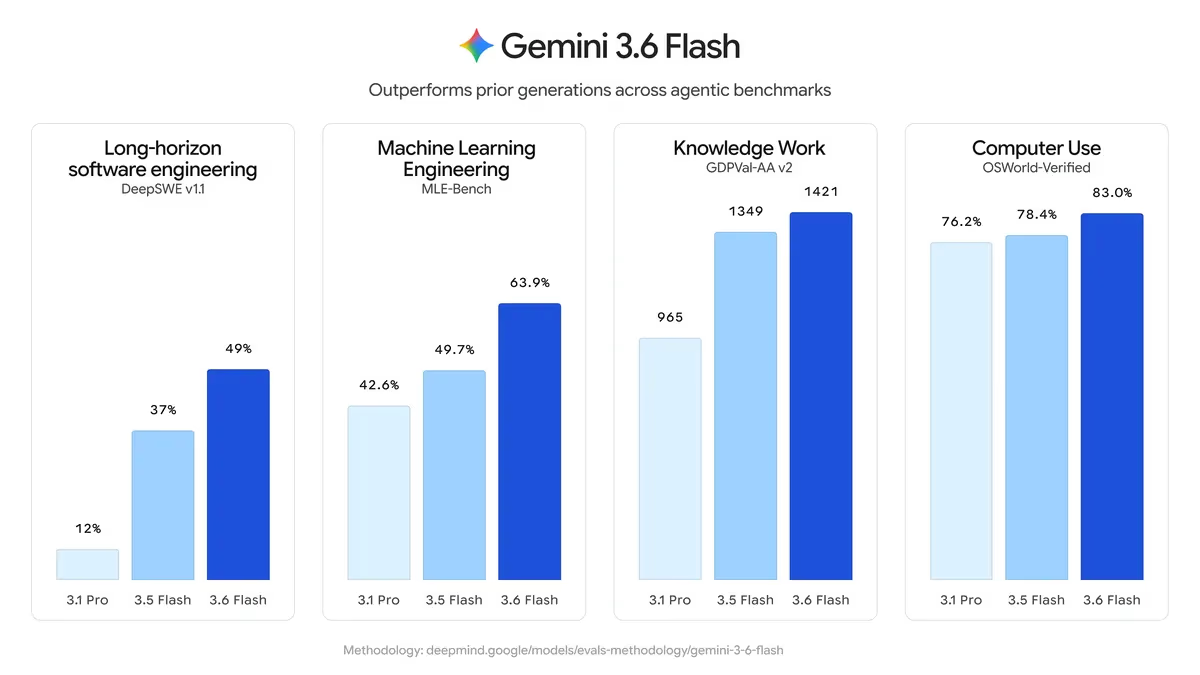
- Long-horizon software engineering (DeepSWE v1.1): 3.6 Flash reaches 49%, up from 37% on 3.5 Flash and 12% on 3.1 Pro, the largest relative jump of any metric Google published.
- Machine learning engineering (MLE-Bench): 63.9% for 3.6 Flash vs 49.7% (3.5 Flash) and 42.6% (3.1 Pro).
- Knowledge work (GDPval-AA v2): 1421 for 3.6 Flash vs 1349 (3.5 Flash) and 965 (3.1 Pro).
- Computer use (OSWorld-Verified): 83.0% for 3.6 Flash vs 78.4% (3.5 Flash) and 76.2% (3.1 Pro), a smaller but still meaningful step.
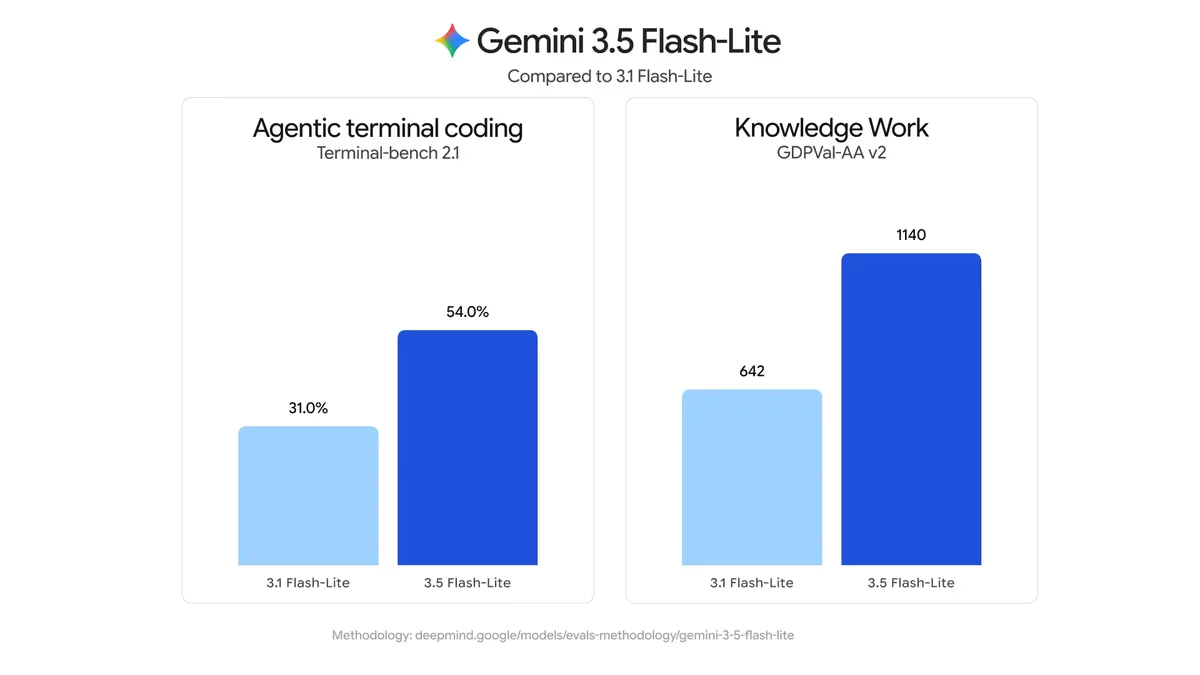
The Flash-Lite jump on Terminal-Bench 2.1 (31.0% to 54.0%) is arguably the more surprising result of the two releases: it means a model explicitly optimised for speed and cost now clears a bar that would have required the larger, slower 3 Flash model just two generations ago (54.2% for Flash-Lite vs 49.6% for 3 Flash on SWE-Bench Pro, per Google's figures). For teams that route the bulk of their agentic traffic to the cheapest viable model, that is the number to watch.
Two honest caveats apply to all of the above. First, every figure here is Google's own methodology, scored against Google's own evaluation harness (documented at deepmind.google/models/evals-methodology), independent third-party reproduction from outlets like Artificial Analysis had not been published for either model at the time of writing. Second, Google compares each model only to its direct predecessor, not to Claude, GPT or Qwen; for a same-day comparison against the wider Chinese open-weight wave, see our coverage of Qwen 3.8 Max and DeepSeek V4's GA launch.
Flash Cyber and the Safety Angle
Gemini 3.5 Flash Cyber is the least accessible but arguably the most interesting of the three releases. It is a version of Flash fine-tuned specifically to detect and help remediate software vulnerabilities "at a lower price per token than larger models," according to Google, and it is designed to be run as multiple concurrent agent instances inside CodeMender (Google's automated vulnerability-patching tool) where the ensemble reaches what Google describes as competitive frontier performance on the CyberGym benchmark.
Access is restricted to governments and trusted partners, not opened to ordinary API customers or the Gemini app. That positioning is consistent with how frontier labs have started handling dual-use security capability generally: a model that is very good at finding vulnerabilities is, by construction, also a model that could be repurposed to find them for attack rather than defence, so the deployment surface is deliberately narrow. It is worth reading alongside our coverage of the Hugging Face/OpenAI agent-evaluation security incident from the same week, a reminder that autonomous security-focused agents cut both ways, and every lab shipping one is now explicit about who gets to use it.
The multi-agent framing is the detail worth dwelling on. Google is explicit that Flash Cyber "reaches competitive frontier performance" only when several instances of it work together inside CodeMender, not as a single model call. That is a meaningfully different deployment shape from a chat-style model: it is closer to a coordinated swarm of specialised reviewers, each looking at a slice of a codebase or a candidate patch, than to one model producing one answer. It is the same architectural instinct behind multi-agent coding tools like Cognition's Devin Security Swarm, covered in our Devin/Cognition July 2026 review: cheaper, narrower models coordinated in parallel are increasingly how the industry approaches security-critical agentic work, rather than routing everything through a single very large model.
Real-World Performance vs Benchmarks
Flash-tier releases live or die on cost-adjusted throughput, not peak capability, and that is genuinely hard to judge from a launch-day blog post. The DeepSWE and Terminal-Bench gains are real by Google's own testing, but agentic benchmarks are notoriously harness-sensitive: the same model can score meaningfully differently depending on the scaffolding, tool definitions and retry logic wrapped around it. Treat the headline percentages as evidence the models improved, not as a guarantee of a specific uplift in your own pipeline.
The more actionable signal is the pricing move. A 17% output-token reduction combined with a lower per-token rate compounds fast at scale: for a team running millions of Flash calls a month, that is a real, immediate cost reduction independent of whether the benchmark gains show up in your specific workload.
There is also a subtler real-world factor Google's charts cannot capture: the knowledge-cutoff advance from January 2025 to March 2026 on 3.6 Flash. For agentic coding assistants that reason about current library versions, API changes or recent security advisories, a fifteen-month-newer cutoff meaningfully reduces how often the model needs a retrieval step or a web search to answer correctly, which in turn reduces both latency and the chance of the model confidently citing an outdated API surface. This kind of gain never shows up on a benchmark chart, but it is one of the more reliable ways a model refresh improves day-to-day agentic reliability.
Pricing, Access and Availability
- Gemini 3.6 Flash: £1.20 ($1.50) per million input tokens, £6.00 ($7.50) per million output tokens, down from £7.20 ($9.00) output on 3.5 Flash.
- Gemini 3.5 Flash-Lite: £0.24 ($0.30) per million input tokens, £2.00 ($2.50) per million output tokens.
- Gemini 3.5 Flash Cyber: no public pricing, access-gated through the CodeMender program for governments and trusted partners only.
3.6 Flash and 3.5 Flash-Lite are both live now through the Gemini API, Google AI Studio and Android Studio, with 3.6 Flash additionally available in Google Antigravity, the Gemini Enterprise Agent Platform and the Gemini Enterprise app. Flash-Lite is also rolling into the consumer Gemini app and, notably, into Google Search itself. Neither model requires an upgraded subscription tier beyond standard API billing or existing Gemini app access.
Limitations and Known Issues
- No independent verification yet: every benchmark in this article is Google's own, scored on Google's own harness; wait for Artificial Analysis or similar third-party reproduction before treating the exact percentages as final.
- Not a flagship release: Gemini 3.5 Pro is still in partner testing, so anyone waiting for a frontier-class Gemini upgrade gets nothing new here.
- Flash Cyber is inaccessible to the vast majority of developers and organisations: it is not a tool you can currently evaluate yourself.
- Comparisons are predecessor-only: Google did not publish head-to-head numbers against Claude, GPT or Qwen for either model.
- Version-number confusion: Flash-Lite jumping to 3.5 while Flash only reaches 3.6 makes the lineup harder to reason about at a glance than a strictly sequential numbering scheme would.
How It Compares
This release lands in the same week as Alibaba's Qwen 3.8 Max claims and Nvidia's Nemotron 3, but the comparison that actually matters for most teams is against Google's own prior generation, not the wider frontier race: see our Gemini vs Claude showdown for the cross-lab picture. Within Google's own lineup, 3.6 Flash now closes a meaningful chunk of the gap to where 3.5 Pro is expected to land, which raises the obvious question of how much daylight will remain between the tiers once Pro finally ships.
Against the agentic coding tools covered elsewhere on this site, Claude Code, OpenAI's Codex app, and the newly refreshed Hermes Agent, 3.6 Flash is a model these tools can call, not a competing product in its own right. Its relevance to that comparison is almost entirely about cost-per-agentic-task, where the combination of fewer output tokens and a lower headline price makes it one of the more attractive mid-tier options for teams building their own agent harnesses on top of the Gemini API.
It is also worth situating this release against the same week's other mid-tier news. Nvidia and Alibaba's Qwen 3.8 Max push and Nvidia's Nemotron/Cosmos announcements are aimed squarely at open-weight and edge deployment, a genuinely different axis from Google's API-first, efficiency-tuned Flash tier. The more relevant like-for-like comparison is with OpenAI and Anthropic's own budget tiers (GPT-5.6's smaller variants and Claude's Haiku line) where the real competitive question is not "which model is smartest" but "which lab gets the most useful work out of the cheapest possible token."
Who Should Use It
Switch to 3.6 Flash now if you are already on 3.5 Flash: it is strictly better on Google's own benchmarks and cheaper on output tokens, with no migration cost beyond updating a model identifier in your API calls.
Switch to 3.5 Flash-Lite if your workload is latency- or cost-bound: high-frequency search, classification, or agentic loops that fire many small model calls per user action. The Terminal-Bench and long-context gains mean it can now handle tasks that previously needed a heavier model.
Wait if you specifically need frontier-tier reasoning depth: that is still 3.5 Pro's job, and it has not shipped yet. Track our Gemini 3.5 Pro tracker for the GA date.
The Bottom Line
Gemini 3.6 Flash and 3.5 Flash-Lite are not the release that decides who wins the frontier race: that argument is still waiting on Gemini 3.5 Pro and, further out, Gemini 4. What they are is a genuine, cheaper, faster improvement to the tier of models that actually processes most real-world Gemini traffic, delivered on the same efficiency-first cadence Google has followed since 3.1 Flash-Lite.
If you are building agentic products on the Gemini API, the practical move is simple: swap in 3.6 Flash or 3.5 Flash-Lite, re-run your own evaluation harness rather than trusting the percentages above verbatim, and bank the cost saving either way. The Flash Cyber pilot is worth watching less for what you can use today and more as a signal of where Google intends to take security-focused agents once the CodeMender program graduates beyond a restricted pilot.
Last updated: 23 July 2026. Sourced from Google's official announcement, DeepMind's evals-methodology documentation, and launch-day reporting; benchmark figures are Google's own and may be revised as independent evaluators publish results.
Get the free guide: Claude vs ChatGPT, Gemini & Grok
A 20-page playbook covering everything you need to choose and use the big four AI models in 2026, full cost and feature comparisons, what each is best (and worst) at, and how-tos for images, vectors, building a website, Claude Code and more.