 AI Tools Review Editorial Team
Quick Answer:
Gemini 3.5 Pro is Google's incoming flagship, and it is running very late. Google unveiled the Gemini 3.5 family at I/O on 19 May 2026 and shipped Gemini 3.5 Flash that day with a full benchmark set, but the larger Pro model, originally promised for "next month", slipped from June to July 2026 after enterprise testing flagged quality issues, and multiple outlets now report Google scrapped an earlier build and restarted parts of pretraining, pushing the target to 17 July 2026. Google has published no official Pro benchmarks, pricing or model card. What is reported: a 2 million-token context window (double most rivals), a strengthened Deep Think reasoning mode, and premium pricing around £12/£48 (about $15/$60) per million tokens. Early testers reportedly found Pro trailing Claude Fable 5 and GPT-5.6 on coding and long-horizon reasoning, and the rebuild lands into a market where both GPT-5.6 Sol and Grok 4.5 opened to the public on 9 July. This piece separates what Google has confirmed from what is still reporting.
Google spent I/O 2026 telling a confident story about "frontier intelligence with action". The Gemini 3.5 generation was framed as the moment Google's models stopped merely answering and started doing, driving agents, tools and long-horizon workflows. Then the flagship of that story quietly slipped its date.
This is a status report on Gemini 3.5 Pro as it approaches launch: what Google has actually shipped and benchmarked, what remains reported rather than confirmed, and how the picture stacks up against Claude Opus 4.8, Claude Fable 5 and GPT-5.6.
Wes Roth covers Gemini 3.5 Pro in this video.
Summary
The cleanest way to understand Gemini 3.5 is as a split launch. Google announced the family at Google I/O on 19 May 2026 under the banner "frontier intelligence with action", and it shipped the smaller, faster Gemini 3.5 Flash the same day, complete with a detailed benchmark table. The flagship Gemini 3.5 Pro was promised for "next month" and then held back; by late June it was in limited enterprise preview on Vertex AI, with general availability now expected in July 2026.
That gap matters, because almost everything specific about Pro (its context window, pricing and headline scores) currently comes from reporting rather than an official Google model card. Google's own I/O materials said little about Pro beyond that it was "already being used internally". So this review does something slightly unusual: it treats the confirmed Flash data as the solid ground and clearly flags every Pro claim as reported.
- Confirmed: Gemini 3.5 Flash launched 19 May 2026 with a full benchmark set; the family ships under Google's Frontier Safety Framework with strengthened cyber and CBRN safeguards.
- Reported: Gemini 3.5 Pro carries a 2M-token context window, a Deep Think reasoning mode, and pricing near £12/£48 (about $15/$60) per million tokens.
- The concern: early-tester reporting suggested Pro trailed Claude Fable 5 and GPT-5.6 on advanced reasoning, coding and long-horizon tasks, with token-efficiency issues, the reasons cited for the delay.
- Defining trait: Google's traditional strengths, enormous context and multimodality, remain the clearest reasons to care, even as coding parity stays unproven.
What's Officially Confirmed
At I/O on 19 May 2026, Google introduced Gemini 3.5 as a generation "for agents and coding" that "excels at complex long-horizon tasks". The concrete, shipped deliverable was Gemini 3.5 Flash, positioned as roughly four times faster on output tokens than other frontier models while posting benchmark numbers that, in several categories, beat the previous-generation Gemini 3.1 Pro outright.
Google also confirmed the family is developed under its Frontier Safety Framework, with "strengthened cyber and CBRN safeguards" and interpretability tools intended to inspect the model's internal reasoning. Alongside the models, Google previewed Gemini Spark, a consumer-facing product rolling out to trusted testers. What Google conspicuously did not provide on stage was any Gemini 3.5 Pro benchmark, price or model card: Pro was described only as coming "next month" and being used internally.
The Flash Benchmarks
Because Pro's numbers are not public, the Gemini 3.5 Flash benchmark table is the best confirmed evidence of what the generation can do. Google published Flash results across coding, agentic, multimodal, long-context and reasoning categories, benchmarked against Gemini 3 Flash, Gemini 3.1 Pro, Claude Sonnet 4.6, Claude Opus 4.7 and GPT-5.5.
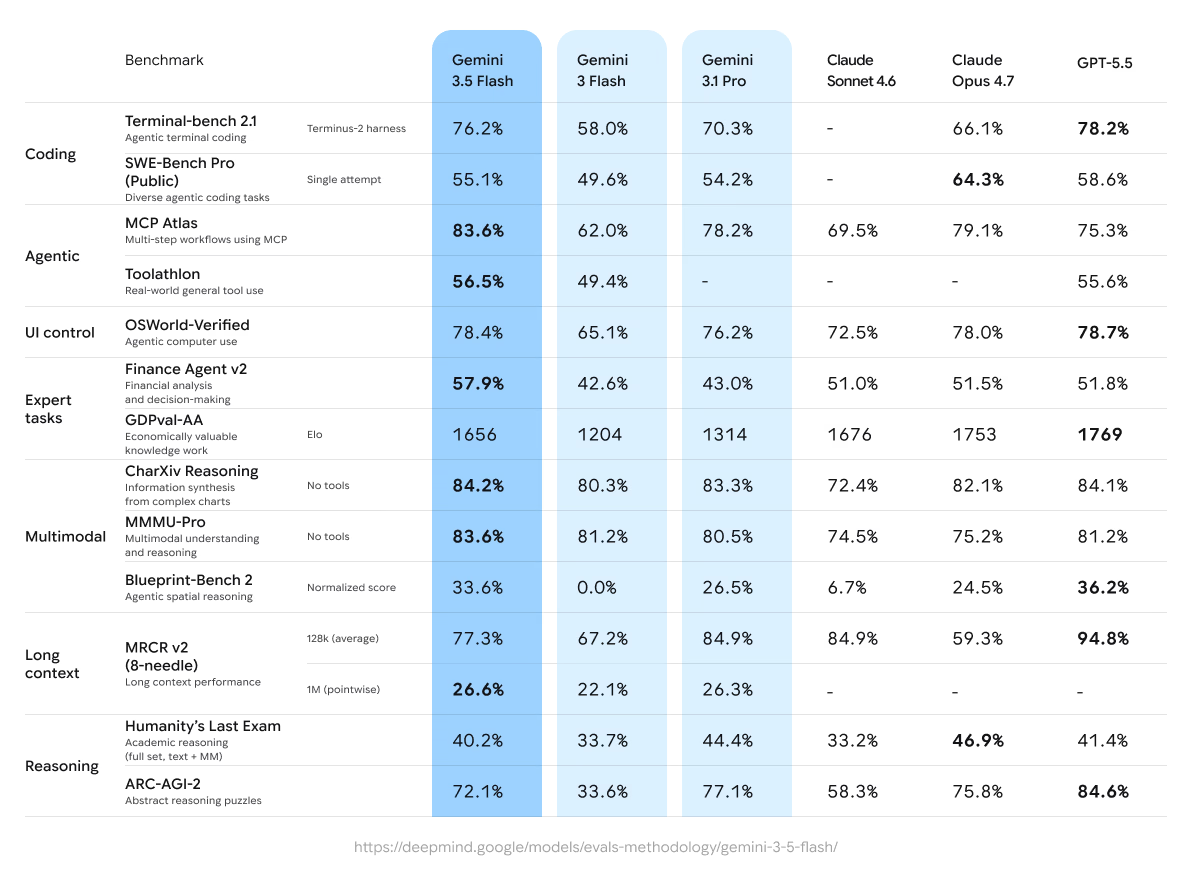
The pattern is instructive. Flash leads its column on multimodal understanding, 84.2% on CharXiv Reasoning and 83.6% on MMMU-Pro, both ahead of Claude Opus 4.7 and GPT-5.5, and on the MCP Atlas agentic benchmark (83.6%). It is competitive on computer use (78.4% on OSWorld-Verified) and expert financial analysis (57.9% on Finance Agent v2, the best in its row).
But on the hardest coding and reasoning evals, Flash sits behind the frontier: 76.2% on Terminal-Bench 2.1 trails GPT-5.5's 78.2%; 55.1% on the public SWE-Bench Pro set is below Claude Opus 4.7's 64.3%; and on reasoning, its 72.1% ARC-AGI-2 and 40.2% Humanity's Last Exam both trail Claude Opus 4.7 and GPT-5.5. On long-context recall (MRCR v2) Flash leads the 1M-token pointwise test at 26.6%, consistent with Google's context-length strength. The takeaway: this is a strong Flash-tier model whose job is speed and multimodality, and Pro will need to add real coding and reasoning headroom to change the competitive story.
Gemini 3.5 Pro: The Reported Picture
Everything in this section is drawn from pre-launch reporting rather than an official Google spec sheet, and should be treated accordingly. With that caveat firmly in place, the reported profile of Gemini 3.5 Pro is a large, context-heavy flagship built for the hardest agentic and reasoning work.
Google originally targeted general availability for June 2026, but pushed the date to July 2026, reportedly citing quality refinements after early enterprise testing. As of late June, coverage described Pro as sitting in a limited Vertex AI enterprise preview, available only to select customers. The reasons given for the delay were pointed: reports flagged that Pro was struggling on advanced reasoning, coding and long-horizon task execution, with token-efficiency issues, using more tokens than expected to reach an answer, and coding performance "not yet where a flagship tier needs to be". Some coverage placed Pro, in its preview state, behind both Claude Fable 5 and GPT-5.6.
The delay then deepened. As of mid-July, multiple outlets are reporting that Google DeepMind went further than a quality pass: it reportedly scrapped an earlier Pro build and restarted portions of pretraining, moving the target date to 17 July 2026. As with every other Pro-specific detail in this article, the precise technical cause is reported rather than officially confirmed by Google, and every reported date so far has moved at least once, so treat 17 July as the current best estimate rather than a locked commitment. The rebuild also lands into a considerably more crowded market than the one Google faced at I/O: both GPT-5.6 Sol and Grok 4.5 opened to the public on 9 July 2026, meaning Pro will now launch directly against two already-shipped, independently benchmarked frontier rivals rather than into an open field.
Set against that are the reported strengths that have always defined Google's flagship: a 2 million-token context window, twice Claude Opus 4.8's 1M and larger than most competitors, and stronger multimodal handling of text, images, audio and video. If the delay buys Google a Pro that closes the coding gap while keeping the context and multimodal lead, the wait will have been worth it. If it ships behind the frontier on coding, the 2M context becomes its main differentiator rather than raw capability.
Deep Think & Long Context
The reasoning story for Gemini 3.5 Pro centres on Deep Think, Google's extended-reasoning mode, the equivalent of Anthropic's extended thinking or OpenAI's high-effort reasoning. Gemini 3.1 Pro already shipped a tiered thinking system (LOW / MEDIUM / HIGH, with HIGH activating a "Deep Think Mini"), and Pro 3.5 is expected to inherit and strengthen it, with Deep Think driving the headline abstract-reasoning numbers.
The reported 2M-token context is the other half of the pitch. Long context is genuinely useful for the agentic, long-horizon workloads Google is targeting: entire codebases, multi-document research packs, or hours of transcript can sit in a single prompt. The caveat, visible even in the confirmed Flash numbers, is that raw context length and effective long-context recall are different things: Flash scored 77.3% on the 128k MRCR v2 test but only 26.6% at the full 1M pointwise setting. A 2M window is only as valuable as the model's ability to actually use what is inside it, so Pro's real long-context recall will be worth scrutinising once it is measurable.
Safety: The Frontier Safety Framework
Google confirmed that the Gemini 3.5 family is developed under its Frontier Safety Framework, with what it described as strengthened cyber and CBRN (chemical, biological, radiological and nuclear) safeguards, plus interpretability tools designed to check and understand the model's internal reasoning. This mirrors the direction of travel across the frontier labs, where the most capable models now ship with tighter default safeguards on the highest-risk capability categories.
As with the benchmarks, the detailed safety picture for Pro specifically, the equivalent of a full system card with capability-threshold evaluations, was not available at the time of writing. Anthropic and OpenAI have both moved to publishing model cards alongside launch; the Gemini 3.5 Pro model card, when it lands with general availability, will be the document to read for the cyber, bio and autonomy evaluations that determine how the model can actually be deployed.
Pricing & Access
Reported Gemini 3.5 Pro pricing sits at roughly £12 (about 15 US dollars) per million input tokens and £48 (about 60 US dollars) per million output tokens, approximately ten times the cost of Gemini 3.5 Flash, and a clear premium-tier position. For comparison, that output rate would sit above Claude Opus 4.8 and well above GPT-5.6 Sol's reported output pricing, so Pro would need to justify the premium on capability, context length or multimodality rather than price.
On access, the confirmed path is enterprise-first: Gemini 3.5 Pro was reported to be in limited Vertex AI preview for select enterprise customers ahead of a broader July 2026 general availability, with consumer access through the Gemini apps expected to follow. As always, these figures are pre-launch estimates, the official pricing page and model card at GA are the authoritative source, and this article will be updated against them.
How It Compares
The honest comparison today is between a known Gemini 3.5 Flash and unknown Gemini 3.5 Pro, set against well-documented rivals. On the confirmed Flash numbers, Google leads on multimodal understanding and context length but trails Claude Opus 4.7/4.8 and GPT-5.5 on the hardest coding and reasoning evals. That is the Flash tier, though: Pro is expected to be materially stronger.
Against the current frontier, the bar is high. GPT-5.6 Sol set a Terminal-Bench 2.1 record at 88.8%, and Claude has held the agentic-coding lead on SWE-bench Pro. Meanwhile, open-weight challengers such as GLM-5.2 are now posting Claude-adjacent coding numbers at a fraction of the cost. For a premium-priced Gemini 3.5 Pro to reset the conversation, it needs to convert its context and multimodal advantages into competitive coding and long-horizon reasoning, precisely the areas early testers reportedly flagged as weak. The delay reads as Google trying to close exactly that gap before shipping.
Google's scored models on the frontier
Gemini 3.5 Flash scores 50 and Gemini 3.1 Pro Preview 46 on Artificial Analysis's Intelligence Index v4.1 (marked), the gap to the GPT-5.6 and Claude flagship tier is exactly what Gemini 3.5 Pro must close at GA.
Limitations & Open Questions
- No official Pro benchmarks: Google published no Gemini 3.5 Pro scores at I/O; every Pro capability claim here is reported, not confirmed.
- The delay is a signal: slipping GA from June to July 2026 over coding, reasoning and token-efficiency concerns, followed by reports of a scrapped build and a restarted pretraining pass pushing the target to 17 July, suggests Pro needed more than a quality pass to reach flagship-ready.
- Reported coding gap: early testers reportedly placed preview Pro behind Claude Fable 5 and GPT-5.6 on the hardest tasks: the gap Google is presumably working to close.
- Long-context recall unproven: a 2M window is only useful if the model can retrieve from it; Flash's steep drop from 128k to 1M recall is a caution flag.
- Pricing is estimated: the £12/£48 (about $15/$60) figures are reported, not official; the premium only makes sense if capability lands.
- No Pro model card yet: the full safety and capability-threshold evaluations will only be readable when Google publishes Pro's card at GA.
Who Should Use It
Watch Gemini 3.5 Pro closely if your workloads are multimodal or context-hungry: long-document analysis, video and audio understanding, or research that benefits from a 2M-token window. Those are the areas where Google's confirmed strengths and reported specs align, and where Pro is most likely to be worth the premium once it lands.
Hold off if your core need is frontier-grade agentic coding or long-horizon autonomy today. On current evidence, Claude and GPT-5.6 have the stronger track record on those tasks, and the reporting behind Gemini 3.5 Pro's delay points at exactly those weaknesses. The sensible move is to trial Gemini 3.5 Flash now for multimodal and speed-sensitive work, and re-evaluate Pro against its own official benchmarks the moment they are published, not against the pre-launch numbers.
The Bottom Line
Gemini 3.5 is a confident generation with a cautious flagship. Google shipped a genuinely strong Flash model, best-in-class multimodality, huge context, real speed, and then held Pro back rather than ship it behind the frontier on coding and reasoning. That is a defensible call, but it means the most important model in the family is, for now, a set of reported specifications rather than a benchmarked product.
The verdict, then, is a deferred one. If Gemini 3.5 Pro arrives in July 2026 with its reported 2M context, a strengthened Deep Think mode and coding scores that finally match Claude and GPT-5.6, it will be a serious flagship. Until Google publishes an official Pro model card, benchmarks and pricing, the honest position is to treat the hype as hype, and judge the model on the numbers it has yet to show. This article will be updated against those figures when they land.
Last updated: 15 July 2026. This review draws on Google's Gemini 3.5 announcement at I/O 2026 (published 19 May 2026) for confirmed Flash benchmarks and safety framing; the reported 17 July target date and base-model rebuild are drawn from mid-July pre-launch reporting. All Gemini 3.5 Pro specifications, pricing and performance claims remain reported rather than confirmed and will be revised against Google's official Pro model card at general availability.
Get the free guide: Claude vs ChatGPT, Gemini & Grok
A 20-page playbook covering everything you need to choose and use the big four AI models in 2026, full cost and feature comparisons, what each is best (and worst) at, and how-tos for images, vectors, building a website, Claude Code and more.