 AI Tools Review Editorial Team
Quick Answer:
Grok 4.5 is xAI's new flagship, and its pitch is value rather than raw supremacy. Released publicly on 8 July 2026, it scores 54 on the Artificial Analysis Intelligence Index, fourth place, behind Claude Fable 5, GPT-5.5 and Claude Opus 4.8, but does it at $2/$6 per million input/output tokens, roughly a fifth of Opus 4.8's or Fable 5's cost. It leads outright on the SWE Marathon coding benchmark and matches GPT-5.5 in the Codex harness on the Coding Agent Index (76), while using 3–4x fewer tokens per task than its priciest rivals. The catch: xAI has not published a Grok 4.5 model card, and Artificial Analysis' own testing found its hallucination rate more than doubled versus Grok 4.3, from 25% to 54%, alongside a genuine accuracy gain. This review separates the real, sourced numbers from the marketing.
Elon Musk called it an “Opus-class model, but faster, more token-efficient and lower cost.” That is xAI's entire pitch for Grok 4.5 in one sentence, and, unusually for a frontier-lab launch claim, the independent numbers mostly back it up, just not in the way the marketing implies.
Grok 4.5 does not top the intelligence leaderboard. It sits fourth, behind Claude Fable 5, GPT-5.5/5.6 and Claude Opus 4.8. What it does instead is compress the gap between frontier and affordable further than any model has managed so far, while raising a genuine, benchmarked honesty concern that the launch materials didn't mention.
Summary
xAI released Grok 4.5 to the public on 8 July 2026, its first model since SpaceXAI (the merged SpaceX/xAI entity) went public. It followed a private beta with select customers, including Cursor, whose IDE session traces were used as supplemental training data for the model's agentic coding behaviour.
On independent testing from Artificial Analysis, Grok 4.5 lands solidly in the upper-middle of the frontier pack: 54 on the Intelligence Index, 76 on the Coding Agent Index. It is not the smartest model available, but it is dramatically cheaper and faster than the models it is closest to in capability, and it outright leads on a couple of agentic benchmarks (SWE Marathon and τ³-Banking) where efficient tool-use matters more than raw reasoning depth.
- Intelligence: 54 on the AA Intelligence Index (4th of 187 tracked models), up 16 points from Grok 4.3.
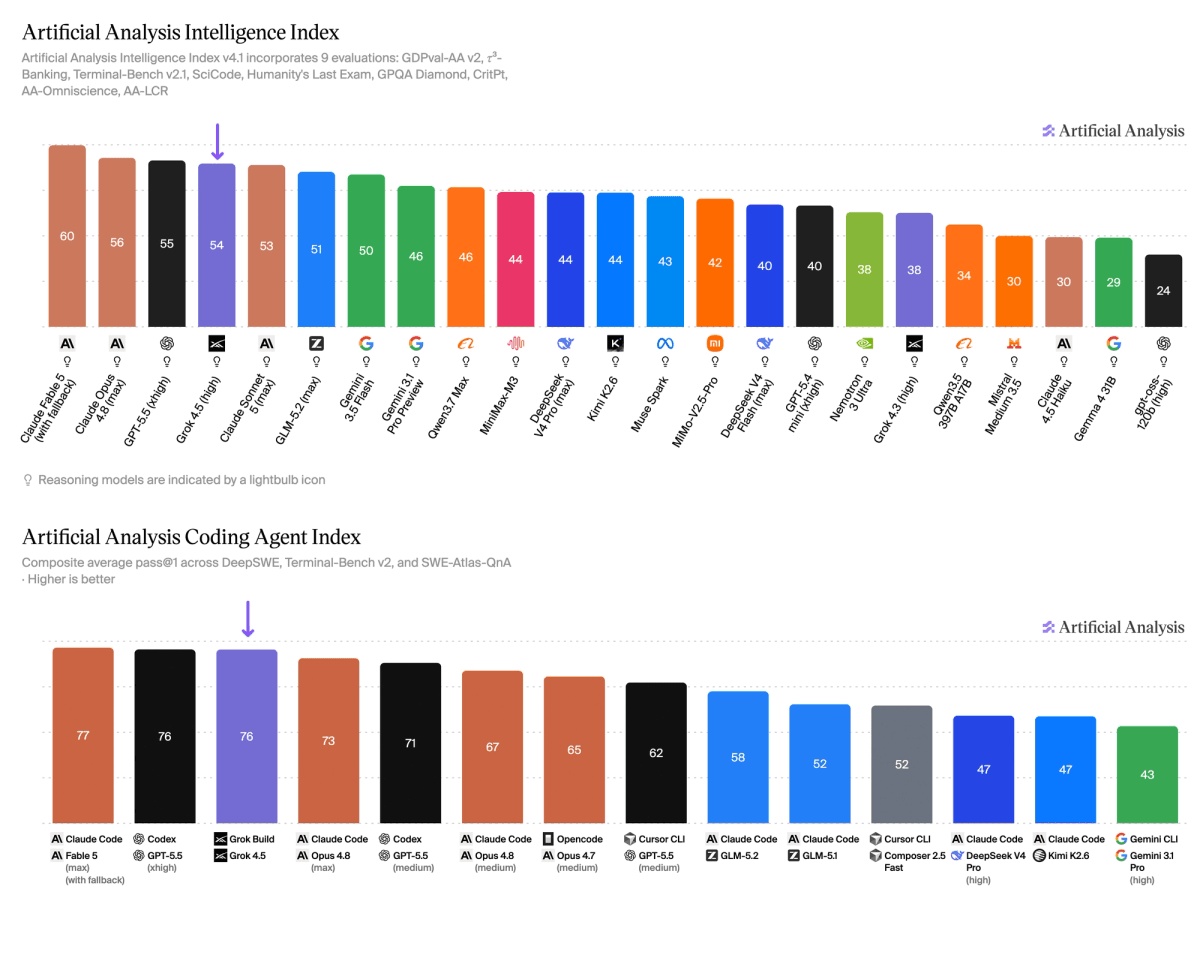
- Coding: 76 on the Coding Agent Index in the Grok Build harness, on par with GPT-5.5 xhigh in Codex, just below Fable 5's 77.
- Price: $2/$6 per million input/output tokens, a fifth of Opus 4.8, a tenth of Fable 5.
- Efficiency: 1.9M average tokens per coding task, versus 6.2M (GPT-5.5) and 7.2M (Fable 5).
- The concern: hallucination rate on AA-Omniscience jumped from 25% to 54% between Grok 4.3 and 4.5, and no xAI model card has been published for this release.
From Grok 4 to 4.5
Grok 4.5 follows a fast release cadence that has become xAI's signature: Grok 4 in mid-2025, Grok 4 Fast that September, Grok 4.1 in November, and now Grok 4.5 in July 2026, each iteration narrowing the capability gap to Anthropic and OpenAI's flagships while keeping price and speed as the headline differentiator. What makes 4.5 different is context: it is the first model xAI has shipped since SpaceXAI's public listing, and the company explicitly framed the release around customer feedback from a beta programme rather than a from-scratch capability leap.
The most concrete evidence of that shift is the Cursor partnership. Grok 4.5 was, in xAI's own description, “trained alongside Cursor”, meaning real IDE session data from Cursor users informed the model's post-training for coding and agentic tasks, rather than relying solely on synthetic or scraped coding data. That is a meaningfully different training strategy from a pure benchmark-chasing update, and it shows up in where Grok 4.5 actually wins: agentic coding-in-context, not abstract reasoning puzzles.
Architecture & Training
Grok 4.5 is built on a foundation model xAI calls V9, reported at roughly 1.5 trillion parameters, trained on the company's Colossus supercomputer cluster using tens of thousands of Nvidia GB300 (Blackwell-generation) GPUs. On top of that foundation, xAI applied heavy data filtering, deduplication and domain-specific selection, then reinforcement learning across what the company describes as hundreds of thousands of agentic and coding tasks, with the Cursor session data folded in as one of those domains.
The model supports a 500,000-token context window and both text and image input, generating text output. It is a reasoning model in the same category as Opus, GPT-5.5's high-effort modes and Fable 5: it thinks before answering, and that reasoning budget is configurable (the “high” variant benchmarked throughout this review is the one xAI and Artificial Analysis both use as the flagship configuration).
On raw output speed, Grok 4.5 generates around 119 tokens per second with a time-to-first-token of roughly 13.7 seconds, not the fastest model on the board, but combined with its low per-task token consumption, it produces finished agentic work faster and cheaper than models that generate tokens quicker but need far more of them to finish the same task.
Capabilities Deep Dive
Coding and agentic tool use
This is where Grok 4.5 is genuinely competitive. In the Grok Build harness it scores 76 on the Coding Agent Index (a composite of DeepSWE, Terminal-Bench v2 and SWE-Atlas-QnA), putting it on par with GPT-5.5 (xhigh) running in Codex and just one point behind Fable 5 (max, with fallback) running in Claude Code. On Terminal Bench 2.1 specifically it scores 83.3%, within a point of both Fable 5 (84.3%) and GPT-5.5 (83.4%), and clearly ahead of Opus 4.8 (78.9%).
Where it genuinely leads
Grok 4.5 takes the outright top spot on SWE Marathon, a pass-at-one measure of resolving realistic software-engineering tasks in one attempt, at 29% against Opus 4.8's 26% and Fable 5's 24%. It also edges GPT-5.5 xhigh on τ³-Banking, an agentic tool-use benchmark simulating banking customer-service workflows, scoring 33% versus 31%. Both wins point to the same strength: efficient, single-pass task completion rather than exhaustive multi-attempt reasoning.
Where it trails
On harder, longer-horizon coding evaluations the gap widens. DeepSWE 1.1: Grok 4.5 scores 53%, well behind GPT-5.5's 67% and Fable 5's 70%. SWE-Bench Pro, a tougher and less-contaminated successor to the original SWE-bench: 64.7% for Grok 4.5, against Opus 4.8's 69.2% and Fable 5's 80.4%, the widest deficit in this review. These are the tasks that require sustained multi-step reasoning over large codebases, and it is precisely there that Grok 4.5's efficiency-first design shows its limits.
Benchmarks
On the Artificial Analysis Intelligence Index v4.1, a composite of nine evaluations including GDPval-AA v2, τ³-Banking, Terminal-Bench v2.1, SciCode, Humanity's Last Exam, GPQA Diamond, CritPt, AA-Omniscience and AA-LCR: Grok 4.5 (high) scores 54, placing 4th among tracked frontier models, 16 points above its predecessor Grok 4.3.
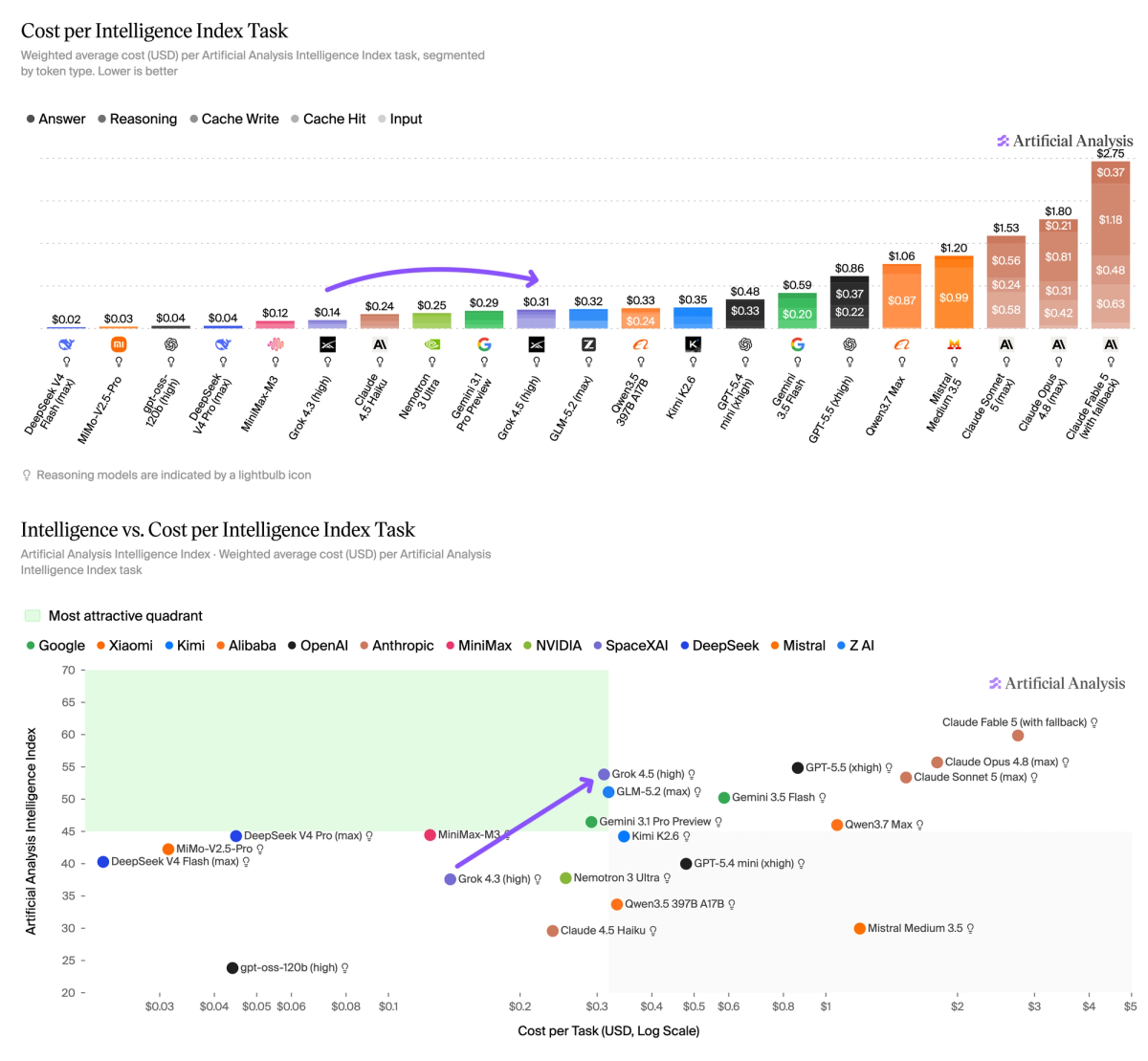
xAI's own launch materials, notably, benchmarked the tasks where Grok 4.5 does best and omitted its scores on GPQA Diamond and other pure-reasoning evaluations, a common launch-day pattern across labs, and one reason to lean on independent scoring bodies like Artificial Analysis rather than vendor marketing pages alone.
Grok 4.5 on the Artificial Analysis Intelligence Index
Grok 4.5 (high) scores 54: fourth place, behind Claude Fable 5, GPT-5.5 (xhigh) and Claude Sonnet 5 (max), and just ahead of GLM-5.2.
The GDPval-AA v2 Elo rating (which measures performance on realistic, economically valuable professional tasks) puts Grok 4.5 at 1543, between Opus 4.8 (1600) and GLM-5.2 (1513). Token efficiency is the standout number throughout: Grok 4.5 used just 1.9 million average tokens per coding-agent task, against 6.2M for GPT-5.5 and 7.2M for Fable 5, a 4.2x reduction versus Opus 4.8 on SWE-Bench Pro specifically.
Safety & the Missing Model Card
xAI publishes model cards for its frontier releases (Grok 4, Grok 4 Fast and Grok 4.1 all shipped with one) under a Risk Management Framework the company released in August 2025. That framework sorts risks into three buckets: abuse potential (e.g. susceptibility to jailbreaks), concerning propensities (e.g. a tendency to deceive the user), and dual-use capabilities (e.g. offensive cyber capability).
At the time of writing, xAI had not published a Grok 4.5-specific model card or system card. That is a notable gap: Anthropic's Opus 4.8 and OpenAI's GPT-5.6 both shipped with detailed capability-threshold evaluations covering cyber, biological and autonomous-replication risk categories at launch. xAI's existing Risk Management Framework has itself drawn criticism from independent safety researchers, a widely cited analysis on LessWrong and AI Lab Watch characterised it as inadequate relative to peer labs' commitments. Compliance teams evaluating Grok 4.5 for regulated use, particularly under the EU AI Act's general-purpose AI model transparency requirements, should treat the absence of a published safety evaluation as an open item, not an oversight to ignore.
Honesty & Hallucination Rate
The single most important number in this review that xAI did not put on a slide: on Artificial Analysis' AA-Omniscience Index, which tests whether a model knows what it doesn't know, Grok 4.5's accuracy improved substantially, from 35% (Grok 4.3) to 52%. But its hallucination rate rose even faster over the same period, from 25% to 54%: meaning Grok 4.5 is now more likely to confidently state something false than its own predecessor was, even as its raw knowledge improved.
That pairing (better knowledge, worse calibration) is a real and measurable regression in a dimension that matters most for unsupervised or high-stakes agentic use: a model that doesn't know when to say “I don't know” is more dangerous in production than one that is simply less capable. Anyone deploying Grok 4.5 for tasks where factual reliability matters (research assistance, customer-facing agents, financial or legal summarisation) should weight this figure alongside the coding and pricing wins.
Real-World vs Benchmarks
Benchmarks reward the profile Grok 4.5 was built for: fast, single-pass, tool-heavy agentic work where token efficiency compounds into real cost savings at scale. Early coverage of Grok Build and Cursor integration echoes that pattern: reviewers reported Grok 4.5 completing routine coding-agent tasks noticeably cheaper and faster than Opus 4.8 or Fable 5, with quality that was “close enough” for iterative work but less reliable on the hardest, most novel problems, consistent with the SWE-Bench Pro gap in the benchmark data.
The elevated hallucination rate is also the kind of issue that benchmarks catch before typical hands-on usage does: it tends to surface as subtle factual drift in long sessions rather than an obvious single failure, which is exactly why an independent, adversarial evaluation like AA-Omniscience is valuable and why teams should specifically test for it in their own domain before trusting Grok 4.5 with unsupervised, high-volume output.
Pricing & Access
See our Grok 4.5 tool listing for a quick-reference spec summary alongside other tracked models.
Grok 4.5 costs $2 per million input tokens and $6 per million output tokens, with a $0.50 per million rate (a 75% discount) on cache hits. For comparison, Claude Opus 4.8 charges $5/$25 and GPT-5.5/5.6 charges roughly $5/$30 per million tokens, Grok 4.5 undercuts both by a wide margin on output pricing specifically, which is where agentic workloads accumulate most of their cost.
It is available through Grok Build (xAI's own agentic coding product), inside Cursor on all plans, via the xAI console API, and through Microsoft Office plugins for Word, PowerPoint and Excel. EU availability was not live at launch; xAI indicated a mid-July 2026 rollout for European users, so check current access before committing a regulated EU workflow to it.
Limitations
- No published model card: xAI has not released Grok 4.5-specific safety documentation, unlike its Grok 4-series predecessors and unlike Anthropic/OpenAI's latest flagships.
- Rising hallucination rate: 25% → 54% on AA-Omniscience versus Grok 4.3, a real regression in calibration even as raw accuracy improved.
- Trails on hard, long-horizon coding: a 15.7-point gap to Fable 5 on SWE-Bench Pro (64.7% vs 80.4%) shows the efficiency-first design has real ceilings.
- GPQA/AIME scores undisclosed: xAI's own launch page omitted pure-reasoning benchmark scores where Grok 4.5 likely underperforms.
- EU availability delayed at launch, limiting immediate use for European regulated workflows.
How It Compares
Against Claude Opus 4.8 and Claude Fable 5, Grok 4.5 trades roughly 15-25 Intelligence Index points and a meaningful SWE-Bench Pro gap for a 5-10x reduction in per-token cost and 3-4x fewer tokens burned per task, a trade that favours Grok 4.5 for high-volume, cost-sensitive agentic deployment and favours the Claude models for the hardest, highest-stakes single tasks.
Against GPT-5.5/5.6, the two are close on coding-agent performance (76 vs GPT-5.5's comparable Codex score) but Grok 4.5 wins clearly on price and token efficiency, while GPT-5.5 likely wins on pure reasoning depth given Grok's undisclosed GPQA/AIME scores. Against open-weight rivals like GLM-5.2, Grok 4.5 keeps a modest Intelligence Index lead (54 vs 51) at a broadly similar cost profile, the gap between frontier-lab and open-weight pricing has narrowed to the point where Grok 4.5's main differentiator versus GLM-5.2 is closed-weight polish and first-party tooling, not raw economics.
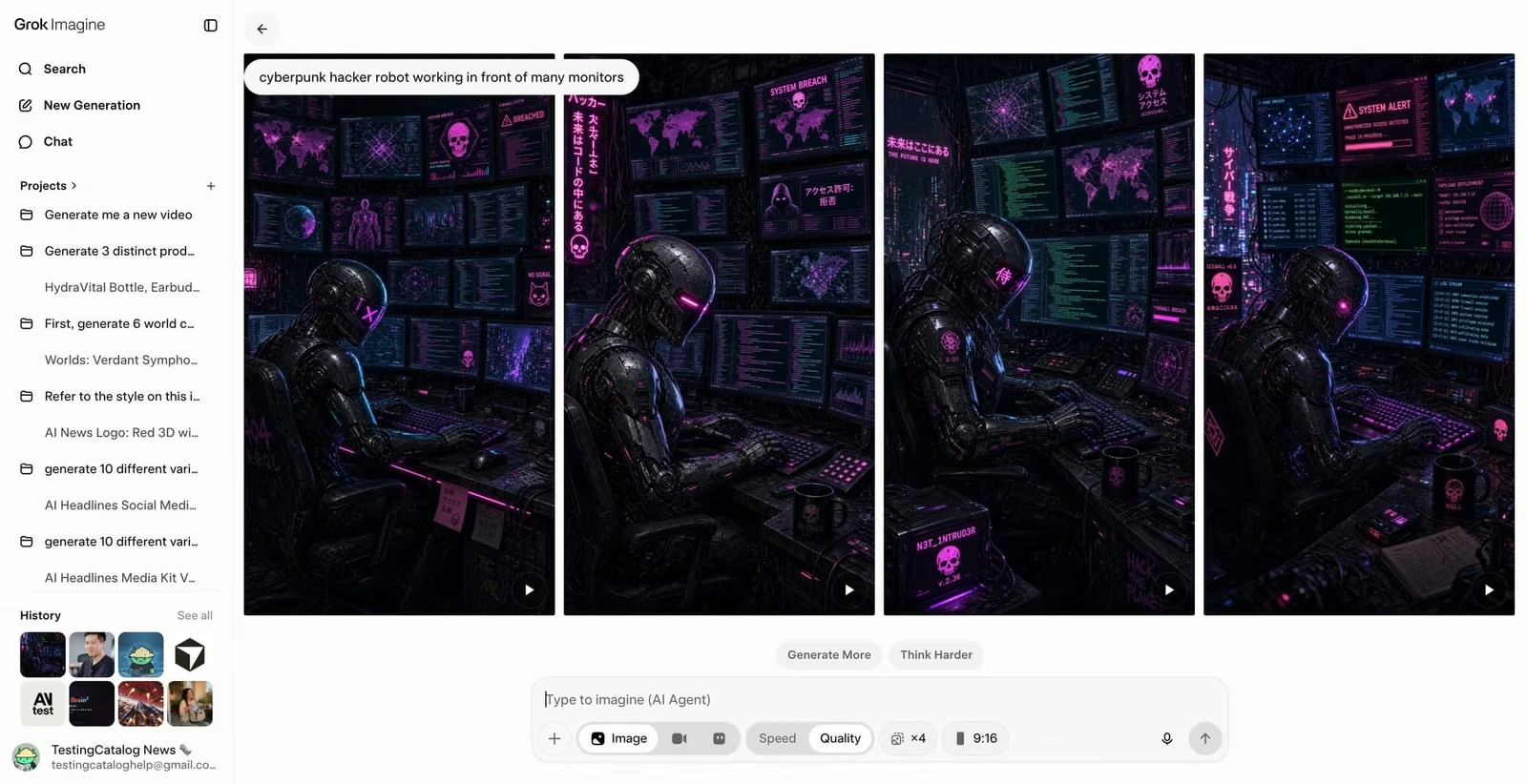
On the image side of xAI's product line, Grok Imagine Image 2.0 launched in early August 2026 with region-level editing and multi-reference generation, ranking second in the world on both the Arena text-to-image and image-editing leaderboards, a reminder that Grok 4.5's reasoning gains are only one part of xAI's broader push across its model line.
Who Should Use It
Choose Grok 4.5 if you are running high-volume agentic or coding workloads where cost per task and token efficiency directly affect your margins, customer-support automation, routine code review, high-throughput data-processing agents, and where the occasional wrong answer can be caught by a human-in-the-loop or automated check rather than shipped unsupervised.
Choose Opus 4.8, Fable 5 or GPT-5.5/5.6 instead if your workload is unsupervised, high-stakes, or depends on getting the hardest single task right the first time: complex refactors, novel research problems, or any use case where a 54% hallucination rate on knowledge-boundary questions is not an acceptable risk. Given the missing model card, regulated industries should also hold off until xAI publishes formal safety documentation.
The Bottom Line
Grok 4.5 delivers exactly what xAI promised on price and speed: it is genuinely the most cost-efficient near-frontier model available at launch, backed by independent Artificial Analysis data rather than just vendor claims. The Cursor-trained coding-agent performance is real, and the SWE Marathon and τ³-Banking wins show it is not simply a cut-price also-ran.
But “Opus-class” oversells it: Grok 4.5 sits fourth on intelligence, trails badly on the hardest coding evaluation, and, most importantly, comes with a benchmarked honesty regression and no published safety documentation. Treat it as a highly capable, highly efficient workhorse for well-scoped, checkable agentic work, not yet as a drop-in replacement for Opus 4.8 or Fable 5 on your most important, least-supervised tasks. This article will be updated if xAI publishes a Grok 4.5 model card, and see our Grok 4.6 & 4.7 tracker for what comes next.
Last updated: 14 July 2026. Benchmark figures sourced from Artificial Analysis' Grok 4.5 coverage and Intelligence Index (9-10 July 2026); pricing and availability details from xAI's launch reporting via TechCrunch, Axios and The Decoder. This article will be revised if xAI publishes an official Grok 4.5 model card.
Get the free guide: Claude vs ChatGPT, Gemini & Grok
A 20-page playbook covering everything you need to choose and use the big four AI models in 2026, full cost and feature comparisons, what each is best (and worst) at, and how-tos for images, vectors, building a website, Claude Code and more.