
 AI Tools Review Editorial Team
Quick Answer:
In 2026 the four big assistants split cleanly by strength. Claude leads on coding, agents and long-form writing. ChatGPT is the best all-rounder with the widest ecosystem and multimodal features. Gemini wins on raw context (a 1-million-token window) and Google integration. Grok owns real-time social data from X. The entry tiers all cost around £16 ($20)/month, so the right pick is about the work, not the price.
Capability has converged at the frontier, every one of these models is excellent. The real differences now are reliability on long tasks, ecosystem, context size, and what each is tuned to do best.
This is a practical, current comparison of Claude against ChatGPT, Gemini and Grok, features, pricing and honest strengths, followed by a guide to what you can actually do with Claude once you pick it.
Quick Verdict
- Best for coding & agents: Claude, the most reliable for software engineering, long agent runs and Claude Code.
- Best all-rounder: ChatGPT, broadest ecosystem, voice, image generation and consumer polish.
- Best for huge documents & Google users: Gemini, a 1-million-token context and deep Workspace integration.
- Best for real-time / social data: Grok, live access to X and a less filtered style.
- Best for sourced research: Perplexity, citation-first answers (an honourable mention alongside the big four).
At a Glance
| Assistant | Flagship model | Best at | Context | Entry price |
|---|---|---|---|---|
| Claude | Opus 4.8 / Fable 5 (Sonnet 4.6 default) | Coding, agents, long-form writing | Large | £16 ($20)/mo |
| ChatGPT | GPT-5 series | All-round use, multimodal, ecosystem | Large | £16 ($20)/mo |
| Gemini | Gemini 3 Pro | Huge context, Google Workspace | 1M tokens | £16 ($19.99)/mo |
| Grok | Grok 4 | Real-time X/social data | Large | £24 ($30)/mo |
Model names and limits move quickly; treat the flagship column as the current generation rather than a fixed spec.
Pricing Compared
The headline is how close the entry tiers are. UK prices shown in pounds first, US dollars in brackets (approximate, excluding tax).
| Tier | Claude | ChatGPT | Gemini | Grok |
|---|---|---|---|---|
| Free | Yes (Sonnet 4.6) | Yes | Yes | Yes (on X) |
| Entry paid | Pro £16 ($20) | Plus £16 ($20) | AI Pro £16 ($19.99) | SuperGrok £24 ($30) |
| Power tier | Max £80-£160 ($100-$200) | Pro £160 ($200) | AI Ultra £200 ($249.99) | Heavy £240 ($300) |
| Team | £20-£100/seat ($25-$125) | £20-£24/seat ($25-$30) | Via Workspace | Enterprise |
For the full Claude breakdown, Pro, Max and Team, with UK pricing, see our Claude pricing guide and Team vs Max comparison.
Feature-by-Feature
| Capability | Claude | ChatGPT | Gemini | Grok |
|---|---|---|---|---|
| Coding & agents | Best-in-class | Very strong | Strong | Good |
| Long-form writing | Best-in-class | Very strong | Strong | Casual/edgy |
| Reasoning | Top tier | Top tier | Top tier | Strong |
| Context window | Large | Large | 1M tokens | Large |
| Image generation | No (text/vision in) | Yes | Yes | Yes |
| Voice mode | Limited | Best-in-class | Yes | Yes |
| Real-time web/social | Web search | Web search | Google Search | Live X data |
| Ecosystem | API, Code, Cowork, MCP | Widest | Google Workspace | X / Tesla |
| Honesty/calibration | Field-leading | Good | Good | Looser |
Two honest caveats. First, these ratings are directional, every model trades benchmark wins back and forth, and the right test is your workload. Second, Claude deliberately does not generate images; if that matters, ChatGPT or Gemini are the better home base. For the wider competitive picture, see our June 2026 model wars roundup.
What You Can Do With Claude
If you land on Claude, here is where it earns its keep. These are the jobs it is genuinely best at, not a generic feature list.
1. Ship real software with Claude Code
Claude Code is the agentic coding tool that runs in your terminal and editor. It reads a whole codebase, plans multi-file changes, runs tests, fixes its own errors and holds a coherent plan across long sessions. This is the single strongest reason developers pick Claude over the alternatives, it completes multi-step engineering tasks that other models lose the thread on.
2. Write and edit long, technical documents
Reports, documentation, proposals, essays, Claude's prose is precise and it hedges accurately rather than bluffing. It is the assistant most likely to tell you when it is unsure, which is exactly what you want for anything you will put your name to.
3. Research and analyse documents
Drop in PDFs, contracts, spreadsheets, screenshots or diagrams and ask Claude to summarise, extract, compare or critique. Its vision and document understanding are strong, and its calibration means fewer confident-but-wrong answers in high-stakes analysis.
4. Build agents and automations
Through the Claude API and the Model Context Protocol (MCP), Claude connects to your tools, GitHub, Slack, databases, your own systems, and acts on your behalf. See our connectors directory for what it can plug into. Claude Cowork extends this to your desktop, letting it operate apps directly.
5. Day-to-day knowledge work
Drafting emails, planning, brainstorming, learning a topic, turning messy notes into something usable, the everyday tasks that justify a subscription on their own. For most people, Claude Pro at £16 ($20)/month covers all of this comfortably.
Who Should Pick Which
- Choose Claude if you code, build agents, or write seriously and value reliability and honesty over flashy extras.
- Choose ChatGPT if you want one tool that does everything well, including its turnless GPT-Live voice mode, images, broad app integrations and the largest ecosystem.
- Choose Gemini if you live in Google Workspace or routinely work with enormous documents and codebases.
- Choose Grok if real-time X/social data and a less filtered style matter to you.
- Run two if you can: many professionals pair Claude (for building and writing) with ChatGPT or Gemini (for multimodal and search). At ~£16/month each, a two-tool stack is affordable.
Get the Guide
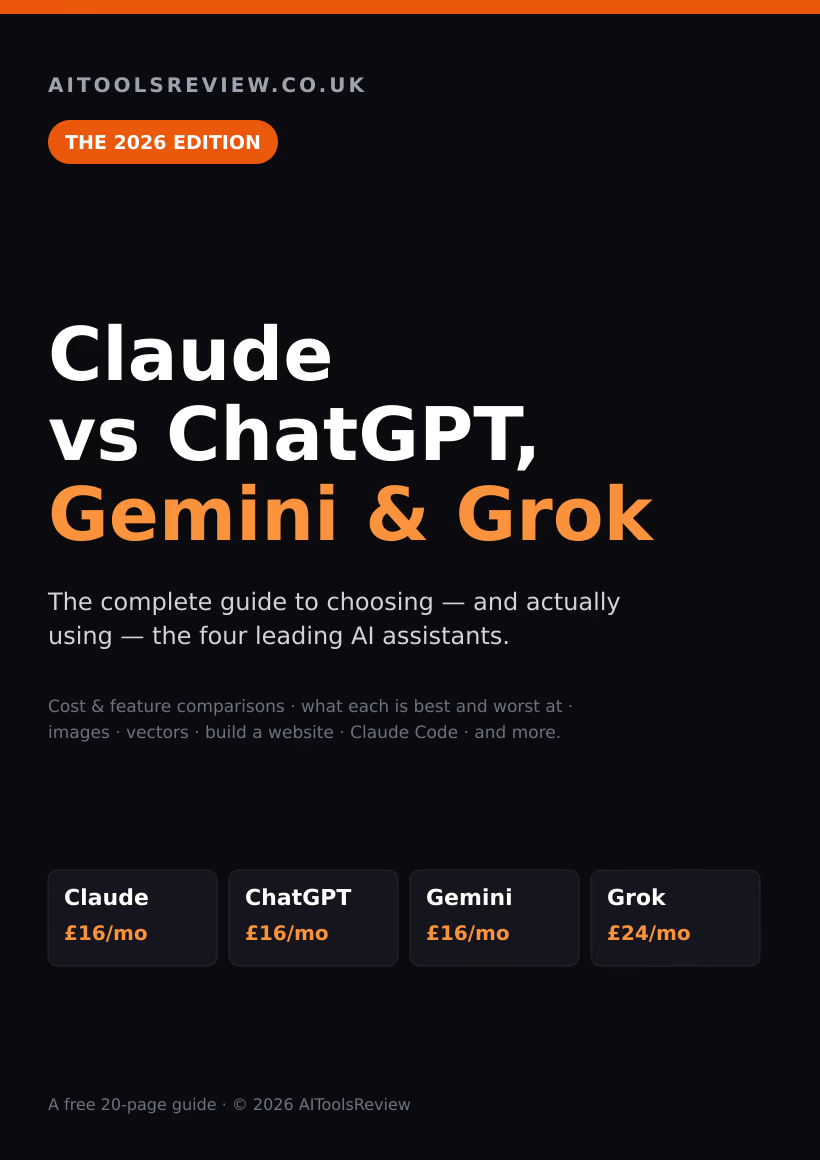
Want this comparison to keep? Download the full guide as a PDF, the tables, the pricing and the what-you-can-do playbook in one file.
Download this comparison as a free PDF
Claude vs ChatGPT, Gemini & Grok, the full 2026 features, pricing and what-you-can-do guide, in one file to keep.
The Bottom Line
There is no single winner in 2026, there is a best tool for each job. Claude is the one to reach for when the work is building software, running agents, or writing something that has to be right. ChatGPT is the safest all-rounder, Gemini the context and Google champion, and Grok the real-time specialist. Since the entry tiers all cost about the same, choose on capability, not price.
If you have decided on Claude, our pricing guide breaks down exactly which plan fits, or grab the PDF above to take this comparison with you. And if you are wondering how any of these models actually stack up against people rather than each other, see the 100,000-human benchmark.
Last updated: June 2026. Pricing and model names change frequently, check each provider’s site for the latest. Prices exclude tax; GBP figures are approximate conversions.