 AI Tools Review Editorial Team
Quick Answer:
Gemini 4 is not out, and Google has not said when it will be. On 21 July 2026, buried at the end of its Gemini 3.6 Flash launch post, Google confirmed: “We have already started our most ambitious pre-training run yet, for Gemini 4.” CEO Sundar Pichai repeated the claim two days later on Alphabet's Q2 2026 earnings call, adding that Gemini 4 will need “a larger base model to compete at the frontier” and that coding and autonomous agents are priorities for the generation. No release date, parameter count, benchmark, price or context window has been disclosed. Everything beyond those two statements, including the widely repeated November/December 2026 release estimate, is analyst inference from Google's past release cadence, not a company commitment. This article separates the two confirmed sentences from the surrounding speculation.
Update, 29 September 2026: Gemini 4 is in post-training
Google has now said more than the two July sentences. As of 28 September 2026, Google DeepMind's Koray Kavukcuoglu has said Gemini 4 is in early post-training and that it is expected “much earlier” than the end of 2026. He gave no release date, so the October estimate below is still inference. Google's newest released model remains Gemini 3.8 Flash, launched on 2 September 2026. Sources: The Next Web and 9to5Google.
Meanwhile its rivals shipped again: Anthropic released Claude Sonnet 5.5 on 28 September and OpenAI launched GPT-6.1 Sol on 29 September. See how they rank in our best AI models guide.
Update, 26 September 2026:
Still not released, and Google has still said nothing beyond the two confirmed sentences above. A second unconfirmed checkpoint report followed the 17 September one: on 26 September, a suspected Gemini 4 Pro build reportedly surfaced in Arena generating complex 3D scenes markedly faster than the checkpoint spotted the previous week, alongside separate, unrelated leaks naming Kimi K4 and DeepSeek V4.1 Pro. As before, there is no evaluation log, benchmark file or Google statement behind this, only arena behaviour and social-media reports, so treat the “huge upgrade” framing some coverage used as unverified. Combined with the earlier 17 September 2026 report, where X posts claimed a model labelled gemini-3.8-flash on the LMArena leaderboard was producing output far beyond what a Flash-tier model should manage, the pattern of anomalous-checkpoint sightings is building, but none of it is a Google commitment. As of 26 September 2026, Gemini 4 remains unavailable in any Google product, API or preview programme, and independent trackers still estimate a public rollout around October 2026, sooner than this article's original November/December estimate.
Google has a habit of announcing its next frontier model inside the announcement for a completely different one. That is exactly what happened with Gemini 4: no keynote, no dedicated blog post, no roadmap slide. Just one sentence, tucked into the close of a Tuesday-morning post about a mid-tier Flash refresh, that every AI outlet immediately led with instead.
That sentence, and the earnings-call remarks that followed it 48 hours later, are the entirety of what Google has said about Gemini 4 as of this article's publication. Here is exactly what was said, what it implies, and what is still nothing more than an educated guess dressed up as a leak.
WorldofAI covers the same Gemini 4 checkpoint leak this article verifies.
Update, 02/10/2026:
Gemini 4 Argon has now launched. Google announced it on 30/09/2026 with a 1 million token output limit, 77.9% on DeepSWE v1.1 and a staged release to trusted cyber defenders. Read our full Gemini 4 Argon review with benchmarks, pricing and safety data; this page is kept as a record of pre-launch expectations.
Summary
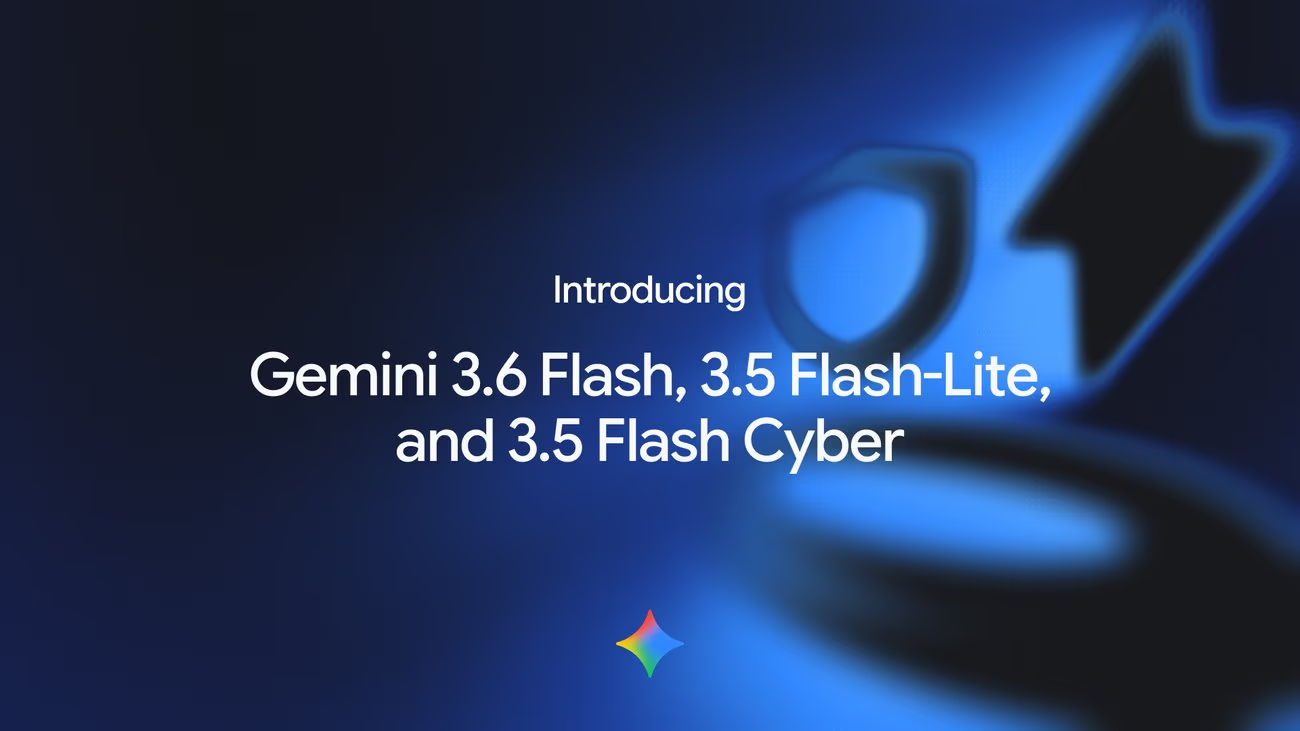
On 21 July 2026, Google published a blog post titled “Introducing Gemini 3.6 Flash, 3.5 Flash-Lite, and 3.5 Flash Cyber,” announcing three efficiency-focused updates to its Flash tier. The post itself is a routine mid-cycle refresh. What made it a story is the final paragraph, where Google confirmed, for the first time, that pre-training has begun on Gemini 4.
Two days later, on the 23 July 2026 Alphabet Q2 earnings call, Sundar Pichai fielded an analyst question about frontier competition and repeated the confirmation with more colour: Gemini 4 will require a larger base model, coding and agents are stated priorities, and Google is now targeting an almost-monthly release cadence for the Gemini 3.x Flash line while Gemini 4 trains in parallel.
- Confirmed: Pre-training has started, on Google's largest compute budget for a single run to date.
- Confirmed: Gemini 4 will be a larger base model than Gemini 3 Pro, per Pichai directly.
- Confirmed: Coding and autonomous agents are the stated capability priorities for the generation.
- Not confirmed: Release date, parameter count, context window, pricing, or any benchmark figure.
- Not confirmed: Whether Gemini 3.5 Pro (still in partner testing as of writing) ships before or is superseded by Gemini 4.
The One Line That Started It
The exact sentence, from Google's official blog: “We have already started our most ambitious pre-training run yet, for Gemini 4, and can't wait to share more.” That is the entire public statement from the post itself. It appears after the technical detail on Gemini 3.6 Flash, 3.5 Flash-Lite and 3.5 Flash Cyber, functioning as a closing teaser rather than an announcement in its own right.
The placement matters. Google has form for surfacing its biggest future-model news as an aside inside a smaller release, rather than as a standalone announcement, a pattern explored further below. It means outlets covering “Gemini 4 news” are, for now, entirely reverse-engineering intent from a single confirmed sentence plus whatever Google's leadership adds in interviews and earnings calls.
Pichai's Earnings Call Remarks
On the 23 July 2026 Q2 earnings call, Pichai was asked directly about Google's position in the frontier-model race. His answer went further than the blog post, in tone if not in hard detail:
“We have started our most ambitious pre-training run yet, for Gemini 4, and are excited by the progress we are seeing at the frontier.”
“We want to compete at the frontier level of where the frontier will be when Gemini 4 comes out.”
“I am very excited by the progress I'm seeing internally on Gemini 4, and I'm confident that people will be pleased when we are putting it outside.”
The second quote is the most substantive one in the entire public record on Gemini 4: it is a direct acknowledgment that Google is deliberately not targeting today's frontier, it is targeting a moving target, wherever GPT, Claude and Grok's flagships land by the time Gemini 4 actually ships. Pichai also confirmed a related point on model sizing, telling analysts Google needs “a larger base model to compete at that frontier model,” the clearest signal yet that Gemini 4 is being built as a straightforward capability increase over Gemini 3 Pro rather than an efficiency-focused refresh like the 3.6 Flash line.
Notably absent from the call: any reference to a specific quarter, any parameter count, and any mention of Gemini 3.5 Pro's own release timing, which remains in partner testing and has itself not shipped publicly as of this article's publication.
What Is Actually Confirmed
Strip away the framing and reporting, and the confirmed public record on Gemini 4 is exactly four data points, all traceable to Google's own words:
- Pre-training has started, described internally as Google's most ambitious pre-training run to date.
- It will use a larger base model than Gemini 3 Pro, per Pichai's direct statement to analysts.
- Coding and autonomous agents are stated development priorities for the generation.
- Google is targeting near-monthly releases for the Gemini 3.x Flash line in the interim, meaning Gemini 4 is being developed alongside, not instead of, continued Flash-tier iteration.
Everything else circulating, including specific release windows, rumoured parameter counts, and comparisons to unreleased rival models, is analysis or extrapolation layered on top of those four points, not additional Google disclosure. That is worth stating plainly because search results and social feeds on “Gemini 4” already blend confirmed fact with speculation without a clear seam between them.
What Gemini 3.6 Flash Tells Us
The release that contained the Gemini 4 teaser is itself informative, both about Google's current priorities and about the baseline Gemini 4 will need to clear. Gemini 3.6 Flash shipped on 21 July 2026 as an efficiency-first update: it uses 17% fewer output tokens than 3.5 Flash on the Artificial Analysis Index while scoring higher across every agentic benchmark Google published.
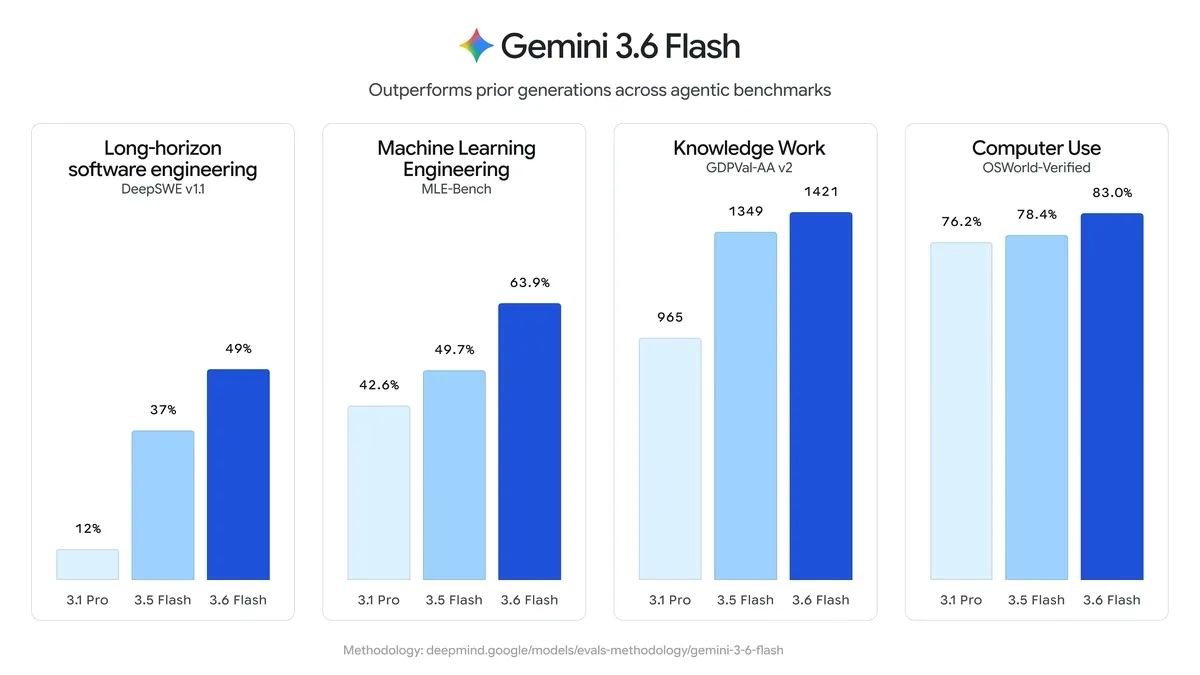
On DeepSWE v1.1, a long-horizon software-engineering benchmark, 3.6 Flash scores 49% against 3.5 Flash's 37% and 3.1 Pro's 12%, a substantial jump inside the same Flash tier. On MLE-Bench (machine learning engineering tasks) it reaches 63.9% versus 49.7%, and on OSWorld-Verified (computer-use tasks) it hits 83.0% versus 78.4%. Pricing for 3.6 Flash sits at $1.50/$7.50 per million input/output tokens, down from $9 output previously.
None of these numbers are Gemini 4's. But they establish two things relevant to it: first, that Google's current internal priority (coding and agentic tool-use over raw knowledge benchmarks) matches exactly what Pichai named as Gemini 4's focus, suggesting continuity of strategy rather than a pivot; second, that whatever Gemini 4 ships with will be measured against a Flash tier that has already closed much of its gap to the frontier, raising the bar for what counts as a meaningful Pro-tier or Gemini 4 improvement.
Gemini's Release History So Far
Gemini 4 will be the fifth major generation of Google's flagship model line since it consolidated its Bard and PaLM-era chatbot efforts under the Gemini name in December 2023. Gemini 1.0 launched that month across Nano, Pro and Ultra tiers. Gemini 1.5 followed in February 2024, introducing the long-context breakthrough (up to 1 million, later 2 million tokens) that defined the line's early reputation. Gemini 2.0 arrived in December 2024 with native multimodal output and the first Flash Thinking reasoning variant, and Gemini 2.5 shipped across March to June 2025, introducing Deep Think and cementing Gemini's position on coding and reasoning leaderboards. Gemini 3 then launched in late 2025, with the 3.x Flash-tier refreshes (3.1 through 3.6, plus the specialised 3.5 Flash Cyber variant) iterating through the first half of 2026.
Laid end to end, that history shows Google shipping a new major generation roughly every seven to nine months, with two to four Flash-tier or Pro-tier refinements released inside each generation's lifespan. Gemini 4 pre-training beginning in July 2026, a little over half a year after Gemini 3's initial launch, is broadly consistent with that established rhythm, which is the entire basis for the November/December 2026 estimate discussed below, and also why that estimate deserves to be treated as pattern-matching rather than insider knowledge.
Google's New Release Cadence
The most concrete near-term commitment from the earnings call was about pace, not about Gemini 4 itself: Google is targeting “releasing models almost at a monthly cadence” for continued Gemini 3.x Flash-tier iteration, with a continued focus on agentic coding improvements. Read alongside the Gemini 4 pre-training confirmation, the strategy Google is describing is a two-track one: keep shipping fast, cheap Flash-tier improvements on a near-monthly rhythm to hold developer mindshare and pricing competitiveness, while training the next full-generation model in the background on a longer, higher-compute cycle.
That is a meaningfully different cadence from the Gemini 1.x and 2.x eras, where major and minor releases were spaced further apart and less clearly delineated into two explicit tracks. It also mirrors, in structure if not specifics, the approach other labs have taken this year: xAI's rapid Grok 4.5-to-4.6-to-4.7 cycle (covered in our companion piece on Grok 4.6 and 4.7) and OpenAI's own incremental GPT-5.x releases both show frontier labs increasingly treating rapid point releases and a slower-moving flagship generation as two separate, parallel workstreams rather than a single linear roadmap.
When Might Gemini 4 Actually Ship
Google has given no date. The most commonly cited estimate in independent coverage, a November or December 2026 window, is derived from Google's historical spacing between major Gemini generations: Gemini 2.5 to Gemini 3 was roughly a seven-month gap, and prior major-to-major transitions have generally landed in a six-to-nine-month range. Applying that same spacing to a pre-training start confirmed in July 2026 produces a late-2026 estimate, but this is pattern-matching against past cycles, not a disclosed roadmap, and pre-training duration for a “most ambitious run yet” is not guaranteed to match prior, smaller runs.
There is also a live variable Google has not addressed: whether Gemini 3.5 Pro, the Pro-tier model still sitting in partner testing as of this article's publication, ships before Gemini 4 pre-training completes, gets folded into or superseded by the Gemini 4 line entirely, or continues as a separate parallel release. Until Google clarifies that relationship, treat any specific month-and-year Gemini 4 release date you see quoted elsewhere as an estimate, not a leak.
What to Expect: Coding & Agents
The one substantive capability signal Google has given is directional, not specific: coding and autonomous agents are priorities for the Gemini 4 generation. That statement, combined with where Gemini 3.6 Flash actually improved (DeepSWE, MLE-Bench, OSWorld-Verified, all agentic or tool-use-heavy evaluations rather than static knowledge tests), points toward Gemini 4 being positioned first as a stronger agentic and coding model, in line with where every major lab has concentrated its 2026 roadmap, rather than primarily as a jump in general knowledge or reasoning benchmarks like GPQA or Humanity's Last Exam.
That is an inference from stated priorities and adjacent-release evidence, not a confirmed feature list. No context window, no multimodal capability, no agent-framework integration, and no specific tool-use benchmark target has been named for Gemini 4 itself.
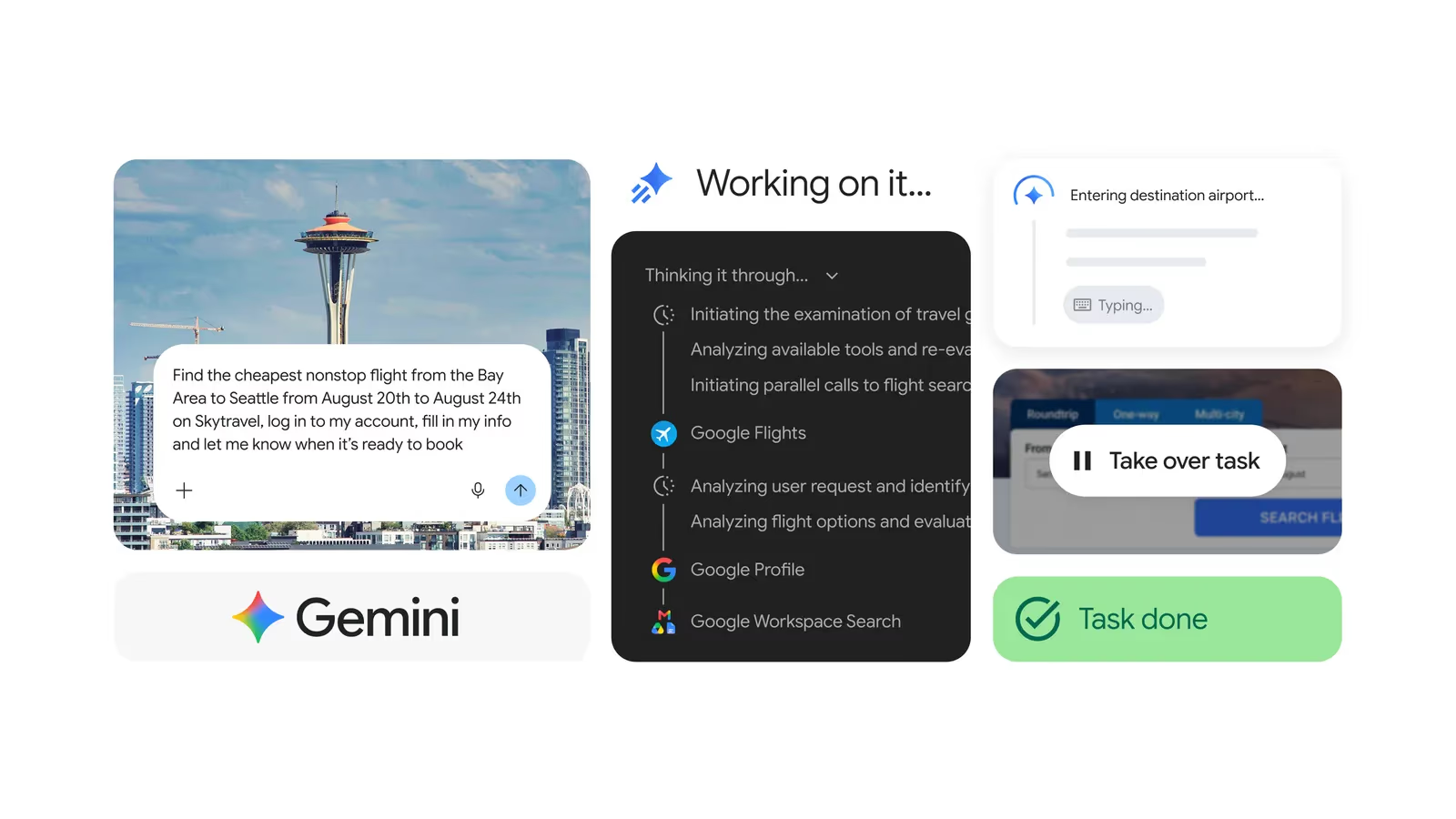
The agent priority is not purely theoretical, either - Google has already shipped a product built on this year's Gemini 3.5 generation to prove the direction out. Gemini Spark, the always-on personal AI agent announced at Google I/O 2026, is the clearest evidence yet of what “agents are a priority” means in practice for Google, and a reasonable preview of the kind of persistent, tool-connected behaviour a Gemini 4-powered successor might inherit.
The Frontier Race Around It
Gemini 4's pre-training confirmation lands in the middle of the busiest few weeks the frontier-model race has had in 2026. Claude Opus 5 shipped days earlier from Anthropic. xAI publicly committed to shipping both Grok 4.6 and Grok 4.7 within a single month of each other, per Elon Musk's own X posts (detailed in our companion article). GPT-5.6 is rolling out from limited partner access toward a broader public release. Every major lab is, in other words, either shipping or pre-announcing its next move at the same time, which is the direct context for why Pichai framed Gemini 4's target as “where the frontier will be when Gemini 4 comes out” rather than where it sits today: by the time any of these models with a multi-month training cycle actually ships, the competitive baseline will already have moved.
That dynamic, several labs simultaneously training or pre-announcing generation-defining models against a target that keeps moving, is arguably the more interesting story than any individual model's eventual spec sheet. It also means comparisons like “Gemini 4 vs GPT-6” circulating online are, at this stage, comparisons between one confirmed pre-training run and, in most cases, an entirely unconfirmed rival product name.
Google's Track Record on Pre-Announcements
Burying a major future-model confirmation inside a minor release's announcement post is a recognisable Google pattern, not a one-off. The company has repeatedly used earnings calls and Flash-tier launch posts as the venue for forward-looking model teasers, preferring understated internal-progress language (“excited by the progress,” “ambitious pre-training run”) over the more definitive launch-event framing Anthropic and OpenAI tend to use for their own flagship announcements.
That track record is a reasonable basis for two expectations: first, that Google will likely continue drip-feeding Gemini 4 detail through similar low-key channels (a future earnings call, a developer conference keynote, or another Flash-tier release note) rather than a single dedicated reveal; second, that the gap between an internal-progress confirmation like this one and an actual public launch has historically run into multiple months, supporting the scepticism around near-term release estimates.
Open Questions
A single confirmed sentence leaves considerably more unanswered than answered. The list below is not a set of predictions, it is a deliberate inventory of exactly what Google has left open, useful as a checklist for what to watch for in the company's next disclosure rather than as a guess at the answers.
- Does Gemini 3.5 Pro ship at all before Gemini 4? Google has not clarified the relationship between the two, and 3.5 Pro remains in partner testing as of writing.
- What architecture will Gemini 4 use? No confirmation of dense vs. mixture-of-experts design, parameter count, or training compute has been given.
- Will there be a Gemini 4 Flash tier at launch, or will the near-monthly Flash cadence continue on the 3.x line for some time after Gemini 4 Pro/Ultra ships?
- What safety evaluation will accompany it? Google's Frontier Safety Framework has applied CBRN and cyber-offense safeguards to recent Flash releases; no detail exists yet on what threshold testing Gemini 4 will undergo before release.
- Pricing and access model: entirely unaddressed, though Google's recent releases have consistently undercut rival frontier-lab pricing at launch.
Community Leak-Testing: What's Circulating Now
Since late September 2026, independent AI-testing channels have reported access to a checkpoint circulating under names including “Barium-B”, run against demos like SVG generation, voxel scenes and small games, and compared informally against Opus 5.5 and GPT-6 Astra. None of this is a Google disclosure: no benchmark table, model card or release note has come from Google itself, and the same channels are also tracking a separate, unrelated “Pixel Canary” stealth model surfacing inside Cline and renewed chatter about Kimi K4, itself still unconfirmed by Moonshot AI. Treat community demo videos as evidence that testing activity exists, not as Gemini 4's actual specs or scores; the confirmed record remains exactly the four points listed above.
A follow-up report on 26 September 2026 claimed a newer suspected checkpoint had appeared in Arena, generating complex 3D scenes markedly faster than the one spotted the week before, alongside separate, unrelated leaks naming Kimi K4 and DeepSeek V4.1 Pro. As with every report in this section, that is a claim about arena behaviour, not a Google benchmark or disclosure.
Coverage of the 26 September checkpoint report, the most recent unconfirmed Gemini 4 Pro sighting tracked by this article.
Who Should Care Now
Teams planning multi-quarter model-dependency roadmaps (enterprise buyers, platform integrators, anyone budgeting API spend for late 2026) should treat Gemini 4 as a confirmed future event worth tracking, but not yet a planning input: there is no spec to build against. Developers currently on Gemini 3.x should expect continued near-monthly Flash-tier improvements in the meantime, per Google's stated cadence, rather than a long wait for Gemini 4 before seeing further gains. Anyone comparing frontier labs' roadmaps (this site included) should be explicit, as this article tries to be, about which claims trace to a company's own words and which are analyst inference, given how quickly the two blend together once a story like this one starts circulating. Casual Gemini users on the free or subscription app tiers have the least reason to act on any of this now: the near-monthly Flash-tier cadence Google has committed to means the day-to-day product will keep improving incrementally regardless of when the Gemini 4 generation itself lands.
The Bottom Line
Gemini 4 is real, confirmed, and already in training on what Google describes as its most ambitious pre-training run to date. That is a genuinely significant piece of news for anyone tracking the frontier-model race. It is also, currently, the entire extent of what is known: one blog-post sentence, three earnings-call quotes, and a stated priority on coding and agents, with every date, spec and benchmark you might see attached to it elsewhere being inference rather than disclosure.
The most useful thing to do with a story at this stage is track it accurately rather than fill in the blanks: watch for Google's next earnings call, watch the LMArena leaderboard for further anomalies like the 17 September report, and treat any specific release date, October included, as a guess until Google says otherwise. This article will be updated as soon as Google discloses anything further.
Last updated: 29 September 2026, adding Koray Kavukcuoglu's 28 September comments that Gemini 4 is in early post-training and expected “much earlier” than end of 2026 (via The Next Web and 9to5Google). Previously updated 26 September 2026, adding a follow-up unconfirmed Gemini 4 Pro checkpoint report from the same date, on top of the 17 September LMArena stealth-testing report. Quotes sourced from Google's official 21 July 2026 blog post “Introducing Gemini 3.6 Flash, 3.5 Flash-Lite, and 3.5 Flash Cyber” and Sundar Pichai's remarks on Alphabet's 23 July 2026 Q2 earnings call. This article will be revised as Google discloses further detail on Gemini 4.
Related update (11/10/2026)
Gemini 4 Carbon leak: what we know so far: Reporting on Argon, Carbon and the Antigravity context options spotted ahead of the wider rollout.
Get the free guide: Claude vs ChatGPT, Gemini & Grok
A 20-page playbook covering everything you need to choose and use the big four AI models in 2026, full cost and feature comparisons, what each is best (and worst) at, and how-tos for images, vectors, building a website, Claude Code and more.