 AI Tools Review Editorial Team
Google DeepMind has had one chief executive for its entire existence. On 5 August 2026, that changed: Demis Hassabis, who co-founded the company in 2010 and led it through its 2014 acquisition by Google, its landmark AlphaFold and AlphaGo breakthroughs, and its 2023 merger with Google Brain to form the unified Google DeepMind, is stepping down from the CEO role.
He is not leaving the company. The reshuffle is a genuine restructuring of who runs what at one of the world's most important AI labs, arriving in the same week as reports of a Gemini 3.7 Flash model in preparation, continued uncertainty around Gemini 3.5 Pro's release, and a separate high-profile departure at the very top of Alphabet's research organisation. This article sets out exactly what changed, who the new operational lead is, and what remains genuinely uncertain.
Note: this analysis draws on the 5 August 2026 reporting from Axios, Bloomberg, Fortune, Engadget, Semafor and Dataconomy, which independently confirmed the core facts of the reshuffle from Google/Alphabet sources and public statements. Direct quotes are attributed to their original outlets throughout.
Covers the Google DeepMind leadership reshuffle (Hassabis stepping aside, Jeff Dean's departure) alongside Gemini 3.7 Flash reports and the wider week's AI news.
Summary
- Announced 5 August 2026: Demis Hassabis steps down as Google DeepMind CEO, becoming chairman of Google DeepMind and chief scientist of Alphabet.
- Koray Kavukcuoglu, Google DeepMind's CTO, becomes senior vice president and takes over day-to-day operations, reporting directly to Sundar Pichai.
- Hassabis keeps Isomorphic Labs, the AI drug-discovery spinoff he founded, and remains at the company rather than departing.
- Jeff Dean is leaving the Alphabet chief scientist role (which Hassabis is taking) to found Discovery Loop, a startup building AI systems that automate scientific experimentation.
- Google is investing in Discovery Loop and will act as its cloud provider, an unusual structure for a departing senior executive's new venture.
- No stated link to Gemini's roadmap. Google has not tied the reshuffle to Gemini 3.7 Flash, Gemini 3.5 Pro, or any change in release cadence.
What actually changed on 5 August 2026
Multiple outlets, including Axios, Bloomberg, Fortune, Engadget and Semafor, independently reported the same core facts on 5 August: Hassabis is stepping down as CEO of Google DeepMind, the unified research organisation formed in 2023 from the merger of DeepMind and Google Brain. He is not leaving Google or Alphabet. Instead, he takes on two new titles simultaneously: chairman of Google DeepMind and chief scientist of Alphabet, the latter a role previously held by Jeff Dean.
Bloomberg's framing was the most structurally precise: Hassabis "moves to chairman role in leadership reshuffle," language that signals a shift from operational command to strategic and scientific oversight rather than a demotion or exit. Fortune and Axios both characterised it as part of "a major AI leadership shake-up" at Google, tying it explicitly to the simultaneous Jeff Dean departure rather than treating the two as unrelated news.
Hassabis's new roles: chairman and chief scientist
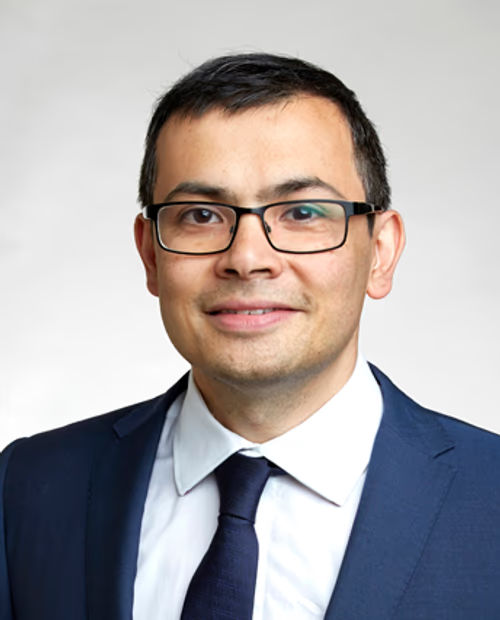
As chairman, Hassabis retains a governance and strategic-direction role over Google DeepMind without owning its day-to-day execution, a structure common in large technology companies where a founder steps back from operations while remaining the public face and long-term-vision owner of the organisation they built. As Alphabet's chief scientist, a title he inherits directly from Jeff Dean, Hassabis takes on a company-wide research-direction remit that extends beyond Google DeepMind alone, a scope broader than his prior CEO title in some respects, even as it hands away line-management authority over the division itself.
Crucially, Hassabis also continues to run Isomorphic Labs, the AI-driven drug-discovery company he founded as a DeepMind spinoff and has continued to lead alongside his DeepMind CEO duties. That continuity, unaffected by this reshuffle, suggests Hassabis's post-2026 priorities lean toward the specific scientific problems (protein structure, drug discovery, and by extension Alphabet-wide research direction) that have defined his career since AlphaFold, rather than a full step back from science into pure governance.
Koray Kavukcuoglu: the new operational lead
Koray Kavukcuoglu, Google DeepMind's chief technology officer prior to this reshuffle, becomes senior vice president and takes over day-to-day operations, reporting directly to Sundar Pichai rather than through Hassabis. That reporting line is the clearest signal of what actually changed: Google DeepMind's operational leadership now sits one level closer to Alphabet's CEO than it did before, with Hassabis's chairman role sitting alongside rather than above that reporting structure.
Kavukcuoglu is not a newly hired outsider. As CTO, he had direct technical oversight of Google DeepMind's engineering and research infrastructure, giving him institutional continuity that an external hire would have lacked. Neither Google nor the reporting outlets have detailed Kavukcuoglu's specific mandate beyond "day-to-day operations," leaving open exactly how research-prioritisation decisions, previously Hassabis's call as CEO, will now be split between Kavukcuoglu's operational authority and Hassabis's chairman and chief-scientist input.
Jeff Dean exits to found Discovery Loop
The reshuffle's second half is Jeff Dean's departure from the Alphabet chief scientist role, the position Hassabis now occupies, to found Discovery Loop, a startup focused on AI systems that can automate scientific experimentation with minimal human intervention. Dean, a legendarily influential Google engineer whose career spans the original MapReduce and TensorFlow systems through to leading Google's AI research, is reportedly bringing several colleagues with him.
The most structurally unusual detail is Google's own involvement in Dean's new venture: the company is investing an undisclosed amount in Discovery Loop and will serve as its cloud provider. Dean summarised the thesis directly: "We think there is opportunity for AI to more fully automate what has traditionally been a very human-intensive experimental loop." A senior departing executive founding a startup that Google itself backs and hosts is a hedge as much as a departure, keeping Dean's new research programme within Google's commercial orbit even as he leaves its organisational chart.
Why this is happening now
Google and the individuals involved have framed the changes as a natural evolution of a rapidly scaling organisation rather than a response to any single external trigger. No activist investor pressure, board dispute, or performance shortfall has been publicly cited by any of the outlets that broke the story, and Alphabet's own public statements describe the move in terms of allowing Hassabis to focus on long-term scientific direction across the whole company while a dedicated operational lead runs Google DeepMind day to day.
That said, the timing is not without context. Google DeepMind has grown enormously since the 2023 Brain merger, now spanning frontier language models (Gemini), agentic systems (Gemini Spark, Antigravity), robotics (Gemini Robotics), and scientific research (AlphaFold's successors), a scope that arguably outgrew a single CEO managing both strategic vision and daily execution personally. Splitting that load between a chairman/chief-scientist and a dedicated operations SVP is a structurally sensible response to scale, whether or not any specific external pressure hastened the decision.
What it means for Gemini and Google DeepMind research
No announcement accompanying the reshuffle has tied it to Gemini's product roadmap. Reports of a Gemini 3.7 Flash model being prepared, and continuing uncertainty about Gemini 3.5 Pro's release timeline, are being covered as separate stories by the outlets reporting both, not as consequences of the leadership change. Readers should treat any claim linking the two directly (for example, that the reshuffle was caused by or will delay a specific Gemini release) as speculation until Google says otherwise.
What has changed structurally is who now owns day-to-day prioritisation decisions across Google DeepMind's portfolio, spanning Gemini model development, Gemini Spark's agentic push, and the research programmes Hassabis previously oversaw directly. Kavukcuoglu inherits that portfolio's operational management; whether his priorities differ meaningfully from Hassabis's is simply not yet knowable from public information.
How this compares to other frontier-lab leadership moves
Frontier AI labs have seen a wave of senior leadership churn through 2025 and 2026, from OpenAI's repeated executive reshuffles to Meta's creation of Meta Superintelligence Labs under Alexandr Wang. Google DeepMind's change is notable for its relative stability by comparison: Hassabis is not departing, the successor is an internal promotion with deep institutional knowledge rather than an outside hire, and the company's own framing (evolution, not crisis) has gone largely unchallenged by the outlets covering it.
The closer parallel may be Anthropic, where Dario Amodei has remained CEO throughout the company's growth without a comparable operational split, and OpenAI, where Sam Altman's role has weathered its own governance turbulence but likewise without a chairman/operations split of this kind. Google DeepMind choosing a founder-to-chairman transition while its two closest Western rivals have not suggests a distinctly Alphabet-style approach to scaling a research organisation, prioritising continuity and internal promotion over either founder-centralised control or outside operational hires.
Open questions
- How research-prioritisation authority splits between Kavukcuoglu's operational role and Hassabis's chairman/chief-scientist input has not been detailed publicly.
- Whether Gemini's release cadence changes under the new operational structure is unknown; no roadmap commitment has been made either way.
- What Discovery Loop actually builds beyond Dean's stated thesis (automating scientific experimentation) remains largely undisclosed, as does the size of Google's investment.
- Whether more departures follow, given that Dean is reportedly bringing several colleagues to Discovery Loop, is not yet clear from public reporting.
Bottom line
This is a genuine, multi-part leadership restructuring at one of the world's most consequential AI organisations, not a Hassabis exit and not, on current evidence, a crisis response. Hassabis moves from CEO to chairman and Alphabet chief scientist, keeps Isomorphic Labs, and hands daily operations to an internally promoted, technically credible successor in Koray Kavukcuoglu. The more unusual thread is Jeff Dean's departure to a Google-backed startup, a structure that keeps his new research programme commercially tied to Google even as he leaves its formal leadership.
The practical question for anyone tracking Google's AI output, Gemini's release cadence, Google DeepMind's research priorities, and Isomorphic Labs' drug-discovery pipeline, is whether Kavukcuoglu's operational leadership changes anything in practice. Nothing in the public record answers that yet; it is a question for the coming months of Gemini and Google DeepMind announcements, not for this reshuffle's launch-day coverage.
Sources: reporting from Axios, Bloomberg, Fortune and Engadget, all published 5 August 2026.
Last updated: 8 August 2026. This article will be revised if Google DeepMind or Alphabet publish further detail on the new reporting structure, Discovery Loop, or any Gemini roadmap changes.
Get the free guide: Claude vs ChatGPT, Gemini & Grok
A 20-page playbook covering everything you need to choose and use the big four AI models in 2026, full cost and feature comparisons, what each is best (and worst) at, and how-tos for images, vectors, building a website, Claude Code and more.