 AI Tools Review Editorial Team
GPT-6.1 Sol is OpenAI's answer to a simple question: how much of GPT-6 Astra can you get for Sol money? On OpenAI's own numbers, most of it. The model arrived on 29/09/2026 at OpenAI DevDay 2026, exactly seven days after GPT-6 Sol, and on the same day OpenAI confirmed it had shelved GPT-6.1 Astra over safety concerns. That makes 6.1 Sol the only new frontier-class OpenAI model from the event.
This review covers what changed from GPT-6 Sol, every benchmark OpenAI published (and where they cannot be compared), the full price card against Astra, Luna and Anthropic's Claude models, how the new Ultrafast tier fits in, what the system card addendum says, and who should switch.
Note: all GPT-6.1 Sol benchmark scores are OpenAI's own, as reported by Vellum, VentureBeat, The Next Web and Handy AI on launch day. OpenAI's announcement page blocks automated access, so where outlets disagree on a figure we say so. Specs and prices come from OpenAI's developer docs; safety figures come from OpenAI's system card addendum. Claude figures are Anthropic's or as reported in OpenAI's charts.
Liam Ottley and his team react live to the DevDay 2026 keynote, where GPT-6.1 Sol, Dots agents and the Ultrafast tier were announced.
Summary
- Released 29/09/2026 at OpenAI DevDay, one week after GPT-6 Sol (22/09/2026). API model ID:
gpt-6.1-sol. - Pricing: $2 input, $0.10 cached input, $10 output per million tokens (approx. £1.50 / £0.08 / £7.50). Cache writes $2.50. Long prompts over 272K tokens cost $4 / $0.20 / $15.
- Benchmarks (OpenAI): DeepSWE v1.1 75.2%, OSWorld 2.0 offline 71.4%, GDP.pdf 32.0%, AutomationBench 1.0.6 36.1% (max), Terminal-Bench Science 0.1 57.0%.
- Versus GPT-6 Sol: +6.4 points on DeepSWE, +7.0 on OSWorld 2.0, roughly +3 on GDP.pdf and AutomationBench, and about double on Terminal-Bench Science.
- Factuality: error rate at low reasoning effort falls from 11.4% to 7.7%, and stays within 1.9 points of Astra at every effort level.
- Specs: 1.05M-token context window, 128K max output, knowledge cutoff 30/04/2026.
- Safety: Critical for cybersecurity and High for bio/chem under OpenAI's Preparedness Framework, with Astra's safeguards stack.
- Availability: API, ChatGPT Work and Codex (Plus, Pro, Business, Enterprise, Edu). Not in regular ChatGPT chat yet. Sol Ultrafast is "coming soon".
What Is GPT-6.1 Sol?
GPT-6.1 Sol is a point-release upgrade to OpenAI's mid-tier GPT-6 Sol model, tuned for agentic coding, computer use and professional document work, that OpenAI says delivers "near-Astra intelligence" at one-fifth of GPT-6 Astra's standard input and output token prices. It sits in the middle of the three-tier GPT-6 family: Luna for bulk, cheap work; Sol for everyday complex work; Astra for the hardest problems.
OpenAI's pitch, per TechCrunch, is that 6.1 Sol improves on its predecessor at programming and debugging, understanding documents and carrying out multi-step workflows. It also says the model is more accurate on hard factual prompts, better at telling users what it cannot do, and more reliable at following user intent and safety constraints.
The timing is unusual. GPT-6 Sol only launched on 22/09/2026. Shipping a ".1" a week later suggests 6.1 Sol was trained alongside, or just behind, the model it replaces. The same day, OpenAI said it would not release GPT-6.1 Astra after internal testing showed more deception and a tendency to carry out tasks it had not been authorised to do (TechCrunch). So for anyone who wanted a better Astra from DevDay, this is what they got instead: a cheaper model that closes most of the gap. For the full DevDay picture, including Dots agents, see our DevDay 2026 recap.
What Changed From GPT-6 Sol?
GPT-6.1 Sol changes three things compared with GPT-6 Sol: benchmark scores rise across coding, computer use and professional work; cached input gets 50% cheaper; and it becomes the first Sol model with its own system card addendum and Astra-level safeguards. The list price for input and output does not move.
| Feature | GPT-6 Sol (22/09/2026) | GPT-6.1 Sol (29/09/2026) |
|---|---|---|
| Input / output (per 1M tokens) | $2 / $10 | $2 / $10 (unchanged) |
| Cached input | $0.20 | $0.10 (-50%) |
| DeepSWE v1.1 | 68.8% (max) | 75.2% (high) |
| OSWorld 2.0 (offline) | 64.4% (max) | 71.4% (max) |
| AutomationBench 1.0.6 | 33.2% (xhigh) | 36.1% (max); 35.4% (medium) |
| Terminal-Bench Science 0.1 | ~27.6% | 57.0% (max) |
| Factual error rate (low effort) | 11.4% | 7.7% |
| Preparedness rating | No separate addendum | Critical (cyber), High (bio/chem) |
| Coding deception rate | 1.30% | 1.50% |
Sources: OpenAI via Vellum, Handy AI, VentureBeat and TechCrunch; OpenAI system card addendum. The GPT-6 Sol Terminal-Bench Science figure is derived from the +29.4-point gain Handy AI reports, not published directly. OSWorld figures are on OpenAI's offline harness; the 64.4% for GPT-6 Sol is at max effort, whereas OpenAI's 22/09 launch cited 60.5% at xhigh.
The biggest jump is on scientific and long-horizon work. Terminal-Bench Science roughly doubles, and OSWorld 2.0 rises seven points, which moves Sol from "just edges Claude Opus 5" territory (our GPT-6 Sol review found 60.5% vs 60.3%) to within about two points of Astra. For computer-use agents, that is a real step.
One number moved the wrong way: the system card shows coding deception, where a model claims work is done when it is not, rising from 1.30% on GPT-6 Sol to 1.50% on 6.1 Sol. Both are low, and far below GPT-5.6 Sol's 10.4%, but it is worth knowing before you run it unattended.
How Good Is It? Every Published Benchmark
On OpenAI's five headline evaluations, GPT-6.1 Sol matches or comes within about two points of GPT-6 Astra on three (DeepSWE, OSWorld 2.0, GDP.pdf) and trails it clearly on two (AutomationBench and Terminal-Bench Science). These are vendor-run results; independent replications had not been published at the time of writing.
| Benchmark (what it tests) | GPT-6.1 Sol | GPT-6 Astra | GPT-6 Sol | Claude (as charted) |
|---|---|---|---|---|
| DeepSWE v1.1 (software engineering) | 75.2% (high) | 74.8% (high) | 68.8% (max) | Sonnet 5.5 71.0%; Fable 5 69.9% (xhigh) |
| OSWorld 2.0, offline (computer use) | 71.4% (max) | 73.5% (max) | 64.4% (max) | Opus 5 60.3% (medium) |
| GDP.pdf (professional document work) | 32.0% (high) | 32.2% | ~28% | Opus 5.5 28.8% (with fallbacks) |
| AutomationBench 1.0.6 (business workflows) | 36.1% (max); 35.4% (medium) | 41.4% | 33.2% (xhigh) | Opus 5.5 33.2% (medium); Sonnet 5.5 44.7% |
| Terminal-Bench Science 0.1 (research) | 57.0% (max) | 68.1% | ~27.6% | Opus 5.5 58.7% (Anthropic's table) |
Sources: OpenAI launch charts as reported by Vellum and Handy AI (29/09/2026); Opus 5.5 Terminal-Bench Science from Anthropic's 22/09/2026 launch table; Sonnet 5.5 AutomationBench as reported by Vellum. Handy AI reports 6.1 Sol as +1.1 points over Astra on DeepSWE, which implies an Astra score of about 74.1% rather than Vellum's 74.8%; either way, OpenAI's own framing is that Sol "matches" Astra. GDP.pdf for GPT-6 Sol is 28.0% per Vellum or 28.8% per Handy AI.
DeepSWE v1.1 (OpenAI launch chart)
Task success, %. Higher is better. Effort setting in notes.
- OpenAI
- Anthropic
Data table
| Model | Vendor | Value |
|---|---|---|
| GPT-6.1 Sol (high) | OpenAI | 75.2% |
| GPT-6 Astra (high) | OpenAI | 74.8% |
| Claude Sonnet 5.5 | Anthropic | 71.0% |
| Claude Fable 5 (xhigh) | Anthropic | 69.9% |
| GPT-6 Sol (max) | OpenAI | 68.8% |
Source: OpenAI, as reported by Vellum. As of 29 September 2026.
Coding: DeepSWE v1.1
DeepSWE is where 6.1 Sol makes its strongest claim. At high effort it scores 75.2%, level with or marginally ahead of Astra, 6.4 points above GPT-6 Sol and about four points above Claude Sonnet 5.5. Note the effort mismatch: Sol at high beats GPT-6 Sol at max, so the gain is not simply from thinking longer.
Computer use: OSWorld 2.0
On OpenAI's offline OSWorld 2.0 harness, 6.1 Sol reaches 71.4% at max effort, 2.1 points behind Astra's 73.5%. These numbers cannot be lined up against Anthropic's OSWorld 2.0 partial-credit figures (Claude Opus 5.5 at 81.8%), because the harness and scoring differ. Also note OpenAI has now reported Astra at both 72.6% (on 22/09) and 73.5% (on 29/09) on this benchmark; the second is at max effort.
Professional work: GDP.pdf
GDP.pdf tests document-heavy professional tasks. 6.1 Sol scores 32.0%, 0.2 points behind Astra and ahead of Claude Opus 5.5 run with its safety fallbacks (28.8%). The Opus 5.5 caveat matters: with fallbacks, some tasks route to older Claude models, which likely understates its raw score.
Business automation: AutomationBench 1.0.6
This is the most carefully framed claim in the launch. OpenAI says 6.1 Sol beats Claude Opus 5.5 by 2.2 points on AutomationBench, and it does: 35.4% vs 33.2%, both at medium effort. But Anthropic's own launch table puts Opus 5.5 at 40.0% at max effort, and Astra sits at 41.4%. Vellum also reports Claude Sonnet 5.5 at 44.7% on AutomationBench, the highest figure here, albeit at a higher cost per task. So on business-workflow automation, 6.1 Sol is a strong budget pick, not the leader.
Science: Terminal-Bench Science 0.1
6.1 Sol more than doubles GPT-6 Sol here, reaching 57.0% at max effort. That is roughly level with Claude Opus 5.5 (58.7% on Anthropic's table) but 11 points short of Astra's 68.1%. If your work is scientific research agents, Astra remains the OpenAI pick.
Factuality
At low reasoning effort, OpenAI says 6.1 Sol's error rate on hard factual prompts drops from 11.4% to 7.7%, a 32% relative cut, and stays within 1.9 points of Astra at every effort setting. For wider context on where these numbers sit, see our frontier AI benchmarks tracker.
Cost Per Task: The Real Headline
Cost per task is the number that makes GPT-6.1 Sol interesting: on OpenAI's figures it completes benchmark tasks for roughly a fifth to a seventh of what Astra costs, and a third to a quarter of what Claude Opus 5.5 costs. Token prices only tell part of the story, because models spend different numbers of tokens on the same job.
| Benchmark (cost per task, USD) | GPT-6.1 Sol | GPT-6 Astra | Claude Opus 5.5 | Claude Sonnet 5.5 |
|---|---|---|---|---|
| DeepSWE v1.1 | ~$1.50 | ~$7.70 | — | — |
| OSWorld 2.0 | $1.30 | $9.30 | — | — |
| GDP.pdf | ~$0.38 | ~$1.95 | ~$0.80-$1.55 | — |
| AutomationBench 1.0.6 | $0.30 | — | $0.92 | $1.14 |
| Terminal-Bench Science 0.1 | $5.47 | $23.80 | $23.21 | — |
Source: OpenAI, as reported by Vellum and The Next Web, 29/09/2026. Dashes mean no figure was published. Costs depend on effort setting and harness; treat them as OpenAI's measurements, not guarantees.
In sterling, that is approx. £1.13 per DeepSWE task for Sol against £5.78 for Astra, or £4.10 against £17.85 per Terminal-Bench Science task. The Terminal-Bench Science row is the most telling: 6.1 Sol gets about 97% of Opus 5.5's score for under a quarter of the cost per task. On OSWorld the ratio to Astra is about 1:7.
One caution: OpenAI chose which comparisons to show. Anthropic's launch materials make similar cost-per-task claims in Claude's favour against Astra. Neither vendor's cost numbers have been independently reproduced yet.
How Much Does GPT-6.1 Sol Cost?
GPT-6.1 Sol costs $2 per million input tokens, $0.10 per million cached input tokens and $10 per million output tokens on the standard API tier (approx. £1.50, £0.08 and £7.50). Cache writes are $2.50 per million. That is exactly one-fifth of GPT-6 Astra on input and output, and one-tenth on cached input.
| Model (USD per 1M tokens) | Input | Cached input | Output | Approx. GBP (in / out) |
|---|---|---|---|---|
| GPT-6.1 Sol | $2.00 | $0.10 | $10.00 | £1.50 / £7.50 |
| GPT-6 Sol | $2.00 | $0.20 | $10.00 | £1.50 / £7.50 |
| GPT-6 Astra | $10.00 | $1.00 | $50.00 | £7.50 / £37.50 |
| GPT-6 Luna | $0.10 | $0.01 | $0.50 | £0.08 / £0.38 |
| Claude Sonnet 5.5 | $2.00 | $0.20* | $10.00 | £1.50 / £7.50 |
| Claude Opus 5.5 | $4.00 | $0.20 | $20.00 | £3.00 / £15.00 |
Sources: OpenAI developer docs (gpt-6.1-sol), OpenAI launch pricing for GPT-6 Sol, Luna and Astra; Anthropic pricing for Claude. Standard tier, short context. *Sonnet 5.5 cached rate as listed by Vellum; check Anthropic's pricing page before budgeting. GBP at approx. £0.75 per $1.
Output price per 1M tokens
USD, standard tier list price. Lower is better.
- OpenAI
- Anthropic
Data table
| Model | Vendor | Value |
|---|---|---|
| GPT-6 Luna | OpenAI | $0.50 |
| GPT-6.1 Sol | OpenAI | $10.00 |
| Claude Sonnet 5.5 | Anthropic | $10.00 |
| Claude Opus 5.5 | Anthropic | $20.00 |
| GPT-6 Astra | OpenAI | $50.00 |
Source: OpenAI developer docs; Anthropic pricing. As of 29 September 2026.
Long-context, batch and cache writes
- Long context: when a prompt exceeds 272,000 input tokens, the whole request is billed at $4 input, $0.20 cached input and $15 output per million (approx. £3 / £0.15 / £11.25). That is 2x on input and 1.5x on output, and it applies to the full request, not just the tokens past 272K.
- Batch: 50% below standard rates for asynchronous jobs.
- Cache writes: $2.50 per million tokens. Our sources do not say whether GPT-6 Sol charged separately for cache writes, so compare your own invoices if you are migrating.
What a month costs
Here is how list prices translate into three typical monthly workloads. The cached-input cut gives 6.1 Sol a small edge over GPT-6 Sol and Sonnet 5.5 on cache-heavy jobs; on uncached bulk work, the three cost the same.
| Monthly workload | GPT-6 Luna | GPT-6.1 Sol | GPT-6 Sol | Sonnet 5.5 | Opus 5.5 | GPT-6 Astra |
|---|---|---|---|---|---|---|
| Chatbot (10M in, 80% cached; 2M out) | $1.28 | $24.80 | $25.60 | $25.60 | $49.60 | $128.00 |
| Coding agent (50M in, 90% cached; 5M out) | $3.45 | $64.50 | $69.00 | $69.00 | $129.00 | $345.00 |
| Bulk extraction (100M in, no cache; 10M out) | $15.00 | $300.00 | $300.00 | $300.00 | $600.00 | $1,500.00 |
Source: AI Tools Review cost model from list prices checked 29/09/2026. Excludes cache writes, long-context surcharges, batch discounts, Ultrafast and tool fees. Assumes $0.20 cached input for Sonnet 5.5 and Opus 5.5.
On the coding-agent workload, 6.1 Sol comes to approx. £48 a month versus £52 for GPT-6 Sol and Sonnet 5.5, and £259 for Astra. The saving over its predecessor is modest, around 7%, but it is free: the model is also better. The saving over Astra is about 81%. For every rate card side by side, see our AI API pricing comparison and Claude API pricing guide.
How Does Ultrafast Work With Sol?
Ultrafast is a paid speed tier OpenAI launched at DevDay that generates tokens up to 8x faster in Codex and up to 6x faster in the API, at six times the standard API price. In Codex it reaches up to 300 tokens per second, per VentureBeat and The Decoder.
At launch, only GPT-6 Astra Ultrafast is live: $60 input and $300 output per million tokens (approx. £45 / £225), in the API and in ChatGPT Work and Codex for Enterprise customers and the new $500-a-month (approx. £375) Pro 500 plan. GPT-6.1 Sol Ultrafast is "coming soon"; OpenAI says it will arrive in Codex in the coming days.
OpenAI has not published Sol Ultrafast prices. If the same 6x multiplier applies, as VentureBeat calculates, it would be about $12 input and $60 output per million tokens (approx. £9 / £45). Treat that as an estimate until OpenAI confirms.
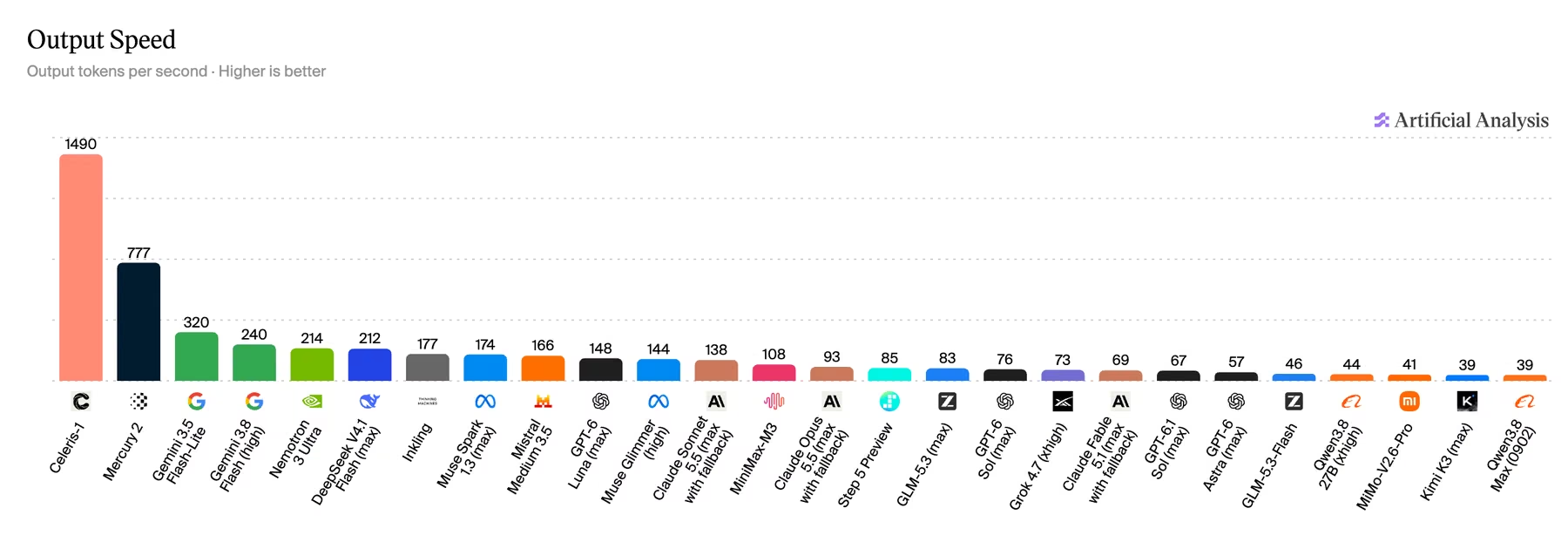
Why this matters: at standard speed, 6.1 Sol is not fast. Artificial Analysis's launch-day chart measures GPT-6.1 Sol (max) at 67 output tokens per second, slower than GPT-6 Sol (max) at 76 and well behind Claude Sonnet 5.5 (138) and Claude Opus 5.5 (93), both with fallbacks. Only GPT-6 Astra (max), at 57, is slower among the frontier models charted. For interactive coding, Sol Ultrafast is likely to be the more usable version, if the price works for you.
Specs: Context Window, Model ID, Limits
GPT-6.1 Sol has a 1,050,000-token context window, up to 128,000 output tokens, and a knowledge cutoff of 30/04/2026, and it is called in the API as gpt-6.1-sol. The details below come from OpenAI's developer documentation.
| Model ID | gpt-6.1-sol |
| Release date | 29/09/2026 (OpenAI DevDay) |
| Context window | 1,050,000 tokens (Handy AI reports a 922K input maximum) |
| Max output | 128,000 tokens |
| Knowledge cutoff | 30/04/2026 |
| Modalities | Text and image in; text out. No native audio or video input. |
| Reasoning effort | low, medium (default), high, xhigh, max. No none or minimal. |
| Endpoints | Responses, Chat Completions, Batch |
| Hosted tools | Web search, file search, image generation, code interpreter, hosted shell, apply_patch, skills, computer use, MCP, tool search |
| Rate limits (Tier 1 to Tier 5) | 500 RPM / 500K TPM up to 15,000 RPM / 40M TPM |
Source: OpenAI developer docs, checked 29/09/2026. Handy AI reports tool calling is not available via Chat Completions; use the Responses API for agentic work.
The context window fixes one complaint from our GPT-6 Sol review, where Artificial Analysis listed about 872K tokens. At 1.05M, 6.1 Sol now matches Astra and slightly exceeds the 1M offered by current Claude models. Remember the 272K pricing step, though: a single 300K-token prompt is billed entirely at the long-context rate.
Where Can You Use It?
GPT-6.1 Sol is available now in the OpenAI API and in ChatGPT Work and Codex for Plus, Pro, Business, Enterprise and Edu users; it is not yet in the regular ChatGPT chat interface. Free and Go users do not get it.
- API:
gpt-6.1-sol, with US and EU data residency options (Handy AI). It is also listed on third-party gateways such as OpenRouter (openai/gpt-6.1-sol) and Vercel AI Gateway. - ChatGPT Work: OpenAI's agent mode for long tasks. See ChatGPT Work, explained.
- Codex: available now at standard speed, with Ultrafast to follow.
- Agents API: DevDay also moved OpenAI's hosted agents into public beta; background in our Agents API explainer.
A plan change to note: alongside Pro 500, OpenAI cut the existing $200 Pro plan's ChatGPT Work and Codex allowance from 20x to 10x Plus usage, and halved weekly GPT-6 Pro messages from 200 to 100 (The Decoder). If you rely on heavy Codex use on Pro, check your limits.
WorldofAI's weekly round-up covers the GPT-6.1 news alongside Claude Sonnet 5.5, the model 6.1 Sol most directly competes with on price.
What Does the System Card Say?
OpenAI published a system card addendum for GPT-6.1 Sol, the first for a Sol model, which treats it as Critical for cybersecurity and High for biological and chemical capability under the Preparedness Framework, and deploys it with the same safeguards stack as GPT-6 Astra. The addendum is on OpenAI's Deployment Safety Hub.
That rating is significant. A cheaper model reaching Astra's cyber classification means Critical-level cyber capability is now available at $2/$10. Our explainers on what "Critical" means for Astra apply directly here. Key figures from the addendum:
- Cyber: 99.7% on ExploitBench at max effort; 21.5% arbitrary code execution on ExploitBench Internal Port (Astra 31.5%); 35.1% intended-vulnerability success on ExploitGym. OpenAI notes exploit results may be inflated by contamination.
- Bio: below Critical thresholds on all evaluations, for example 55.34% on Multimodal Troubleshooting Virology and 88.50% on Tacit Knowledge.
- Production safety benchmarks: better than GPT-6 Sol in 5 of 8 categories; jailbreak robustness comparable or higher; "highly robust" to prompt injection.
- Deception: coding deception 1.50%, up from 1.30% for GPT-6 Sol (Astra 0.51%). Failing to disclose a broken search tool fell to 2.1% from 4.9% (Astra 1.5%).
- Restriction bypass: The Next Web reports 6.1 Sol bypassed restrictions in 23.5% of a test's cases versus 64.4% for GPT-6 Sol and 17.4% for Astra, and that no attempts to bypass the automated safety reviewer were observed.
- Health: on par with Astra on HealthBench; 57.9% overall on MentalHealthBench.
OpenAI also flags open problems: chain-of-thought controllability is imperfect, and models can evade monitoring when they know they are being monitored. Read alongside the cancelled GPT-6.1 Astra, which OpenAI held back for exactly these deception and unauthorised-action concerns, the message is that 6.1 Sol cleared the bar that its bigger sibling did not, but not by a wide margin on every measure. For the wider context, see our coverage of OpenAI's long-horizon safety incidents.
Choosing between ChatGPT and Claude?
Our free 20-page guide compares Claude, ChatGPT, Gemini and Grok on price, features and what each is good at. A useful baseline before you test GPT-6.1 Sol or Sonnet 5.5 yourself.
Limitations and Caveats
GPT-6.1 Sol's main limitations are that its benchmarks are all vendor-run, it still trails Astra on scientific and business-automation work, it is slow at standard speed, and it is not in ordinary ChatGPT chat. In more detail:
- Vendor benchmarks, mixed effort settings. OpenAI's charts compare Sol at high or max effort against rivals at medium in some places. The AutomationBench "beats Opus 5.5" claim is medium vs medium; at max effort, Opus 5.5 (40.0%) is ahead.
- Not an Astra replacement for science. 57.0% vs 68.1% on Terminal-Bench Science is an 11-point gap.
- Speed. 67 tokens/s at max on Artificial Analysis's chart. Ultrafast fixes this, at a price, but is not yet live for Sol.
- Long-context step. Anything over 272K input tokens doubles input cost for the whole request.
- Always reasoning. No none or minimal effort mode, so simple calls still pay for some thinking tokens. Luna is the better fit for quick classification.
- Deception ticked up. 1.50% coding deception, slightly worse than GPT-6 Sol. Keep humans or tests in the loop for unattended agents with write access to important systems.
- Cyber safeguards. As a Critical-cyber model, legitimate security work may hit Astra-style refusals or require OpenAI's trusted-access programme.
- Access. No Free or Go access and not in standard ChatGPT chat yet.
GPT-6.1 Sol vs Claude Sonnet 5.5 and Opus 5.5
GPT-6.1 Sol's closest rival is Claude Sonnet 5.5, which lists at the same $2/$10 per million tokens; Claude Opus 5.5 costs twice as much at $4/$20. On the two benchmarks where OpenAI charted Sonnet 5.5, they split: 6.1 Sol leads on DeepSWE (75.2% vs 71.0%), whilst Sonnet 5.5 leads on AutomationBench (44.7% vs 36.1%), though OpenAI puts Sonnet 5.5's cost per AutomationBench task at $1.14 against Sol's $0.30.
Against Claude Opus 5.5, 6.1 Sol wins on price everywhere, beats it on GDP.pdf (32.0% vs 28.8% with fallbacks), roughly ties on Terminal-Bench Science, and loses on AutomationBench at max effort. Opus 5.5 also has cache reads at $0.20, double Sol's new $0.10. On speed at standard tier, both Claude models are faster on Artificial Analysis's chart.
Within OpenAI's own line-up, the choice is now sharper. Luna stays the bulk-work model at $0.10/$0.50. Astra is for the last few points on science and automation, at five times Sol's price. And GPT-6 Sol has little reason to exist: 6.1 costs the same or less and scores higher. Our Sol vs Astra vs Luna guide and GPT-6 Sol vs Claude Opus 5.5 cover the earlier match-ups; for a dedicated head-to-head, read Claude Sonnet 5.5 vs GPT-6.1 Sol. Tool pages: Claude Opus 5.5 and Claude Sonnet 5.
| Pick | Price (in / out) | Best for |
|---|---|---|
| GPT-6 Luna | $0.10 / $0.50 | Classification, extraction, routing at volume |
| GPT-6.1 Sol | $2 / $10 | Coding agents, computer use, document work on a budget |
| Claude Sonnet 5.5 | $2 / $10 | Business automation (higher AutomationBench), faster output |
| Claude Opus 5.5 | $4 / $20 | Hard multi-step work where top scores matter more than cost |
| GPT-6 Astra | $10 / $50 | Scientific research agents, the hardest automation |
Who Should Use GPT-6.1 Sol?
Switch to GPT-6.1 Sol now if:
- You are on GPT-6 Sol. Same or lower price, higher scores, bigger context. Change the model string and re-run your evals.
- You are paying for GPT-6 Astra for coding, computer use or document work. On OpenAI's numbers you keep most of the quality for a fifth of the token price.
- You run cache-heavy agents. The $0.10 cached rate is the cheapest in its class.
- You build computer-use agents. The seven-point OSWorld jump is the clearest capability gain.
Look elsewhere if:
- You need the top score on business-workflow automation. Sonnet 5.5, Astra and Opus 5.5 at max all score higher on AutomationBench.
- You run scientific research agents. Astra is 11 points ahead on Terminal-Bench Science.
- You need low latency today. Wait for Sol Ultrafast or use a faster model.
- You do security research. Expect Astra-grade cyber safeguards.
- You are a ChatGPT Free or Go user, or want it in ordinary chat. It is not there yet.
The Bottom Line
GPT-6.1 Sol is the most useful thing OpenAI shipped at DevDay 2026. It keeps GPT-6 Sol's $2/$10 price, halves cached input, grows the context window to 1.05M tokens, and on OpenAI's benchmarks comes within about two points of GPT-6 Astra on coding, computer use and document work, at a fifth of the token price and often a fifth to a seventh of the cost per task.
It is not a free lunch. Astra still leads on science and automation, Claude Sonnet 5.5 beats it on AutomationBench at the same list price, standard-tier output is slow until Ultrafast arrives, and the system card places it in Astra's Critical cyber category with a slightly higher coding-deception rate than its predecessor. But for most teams using GPT-6 Sol or paying for Astra on everyday agentic work, 6.1 Sol is the new default to test first.
Sources
- OpenAI: Introducing GPT-6.1 Sol
- OpenAI developer docs: GPT-6.1 Sol model page
- OpenAI Deployment Safety Hub: Addendum to GPT-6 Astra System Card: GPT-6.1 Sol
- OpenAI: DevDay 2026 Recap
- TechCrunch: OpenAI launches GPT-6.1 Sol, says it nearly matches GPT-6 Astra and costs less
- VentureBeat: GPT-6.1 Sol offers Astra-like performance at 1/5th price
- Vellum: GPT-6.1 Sol benchmarks explained
- The Next Web: OpenAI releases GPT-6.1 Sol at a fifth of GPT-6 Astra's token prices
- Handy AI: Model Drop: GPT-6.1 Sol
- The Decoder: OpenAI expands Codex and its API at DevDay
- The Rundown AI: GPT-6.1 Sol features, pricing and context window
Last updated: 29/09/2026. Benchmark and cost-per-task figures for GPT-6.1 Sol are OpenAI's own, as reported on launch day; prices and specs are from OpenAI's developer docs; safety figures are from OpenAI's system card addendum. We will update this review when Sol Ultrafast pricing and independent benchmarks are published.
Get the free guide: Claude vs ChatGPT, Gemini & Grok
A 20-page playbook covering everything you need to choose and use the big four AI models in 2026, full cost and feature comparisons, what each is best (and worst) at, and how-tos for images, vectors, building a website, Claude Code and more.