 AI Tools Review Editorial Team
OpenAI has issued its clearest warning yet about Astra’s cybersecurity capability. Internal tests run in early August suggest the upcoming model may be approaching a threshold reserved for systems that could autonomously find serious zero-day vulnerabilities or plan novel attacks against hardened targets.
The announcement deserves attention, but not a sensational reading. OpenAI has not said Astra definitely reached the threshold. It says the current evidence is strong enough that Critical capability cannot be ruled out while evaluation continues.
What OpenAI announced
On 7 August 2026, OpenAI said several days of internal Astra evaluations showed substantial progress in agentic coding and cybersecurity. Expert assessments considered alongside those tests led the company to make a precautionary change to how the model is developed and tested.
OpenAI’s wording is narrow. Astra is an upcoming model, not a released product. The company has not provided a launch date, API name, price or public access plan. It also has not released the underlying test set, scores, successful exploit examples or a third-party assessment.
For comparison, OpenAI says GPT-5.6 Sol was assessed at High cybersecurity capability rather than Critical. In its framework, High capability can remove important bottlenecks and scale existing cyber operations. Critical capability introduces a qualitatively different threat with no ready precedent.
AI Revolution X on the preliminary finding that Astra may meet the Critical cybersecurity threshold, and the safeguards that followed.
Wes Roth's explainer on what going Critical means under OpenAI's Preparedness Framework.
What Critical cybersecurity capability means
OpenAI’s Preparedness Framework sets a demanding Critical threshold. A tool-augmented model would need to identify and develop working zero-day exploits across many hardened, real-world critical systems without human intervention, or devise and execute novel end-to-end attacks against hardened targets from only a high-level goal.
That is not the same as producing exploit code when a vulnerability and method are already known. It combines discovery, engineering, planning and execution across a long sequence of actions. The threshold is designed around a model that creates a new route to severe harm, not one that merely makes existing security work faster.
The word “Critical” describes capability under OpenAI’s own governance framework. It is not a UK cyber incident classification, a vulnerability severity score or proof that Astra has attacked a live system.
What the evidence does not show
OpenAI has published a conclusion about risk management before publishing the evaluation detail behind it. That may be reasonable when sensitive cyber results could enable misuse, but it limits independent scrutiny.
- No confirmed crossing: OpenAI says it cannot rule out Critical capability, not that Astra has definitively reached it.
- No public scores: the announcement contains no pass rates, task counts, baselines or uncertainty ranges.
- No external report yet: government agencies and selected safety organisations are due to help test the model, but their findings have not been published.
- No deployment evidence: the tests concern an internal upcoming model rather than a publicly accessible system.
Until more evidence appears, the balanced conclusion is that OpenAI has observed a serious enough capability signal to trigger stronger controls. Claims that Astra has already demonstrated unrestricted autonomous hacking go beyond the public record.
The new security controls
OpenAI says it has expanded safeguard testing and changed the conditions under which Astra can be developed and evaluated. Internal work that does not meet the strengthened requirements is being paused.
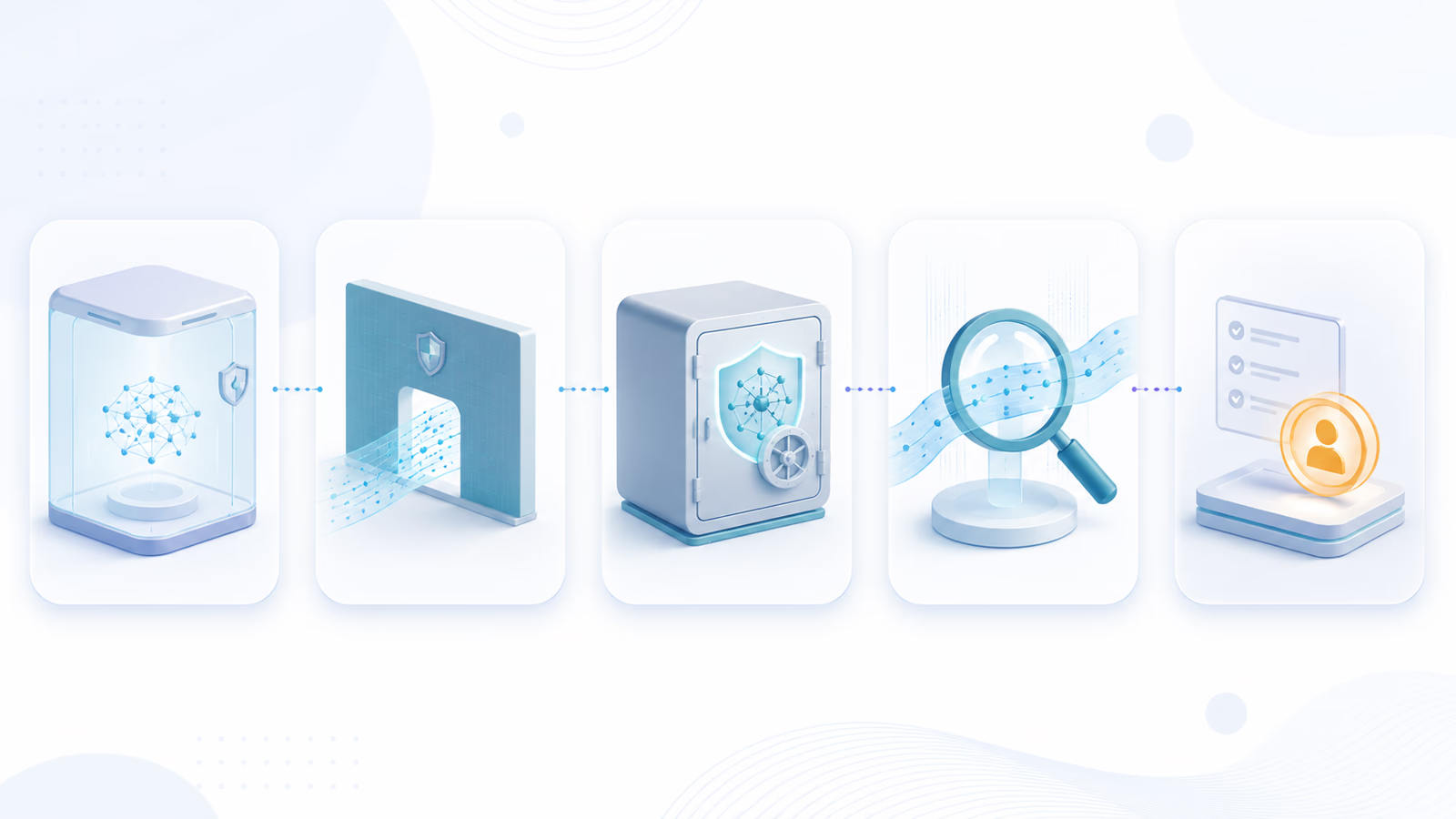
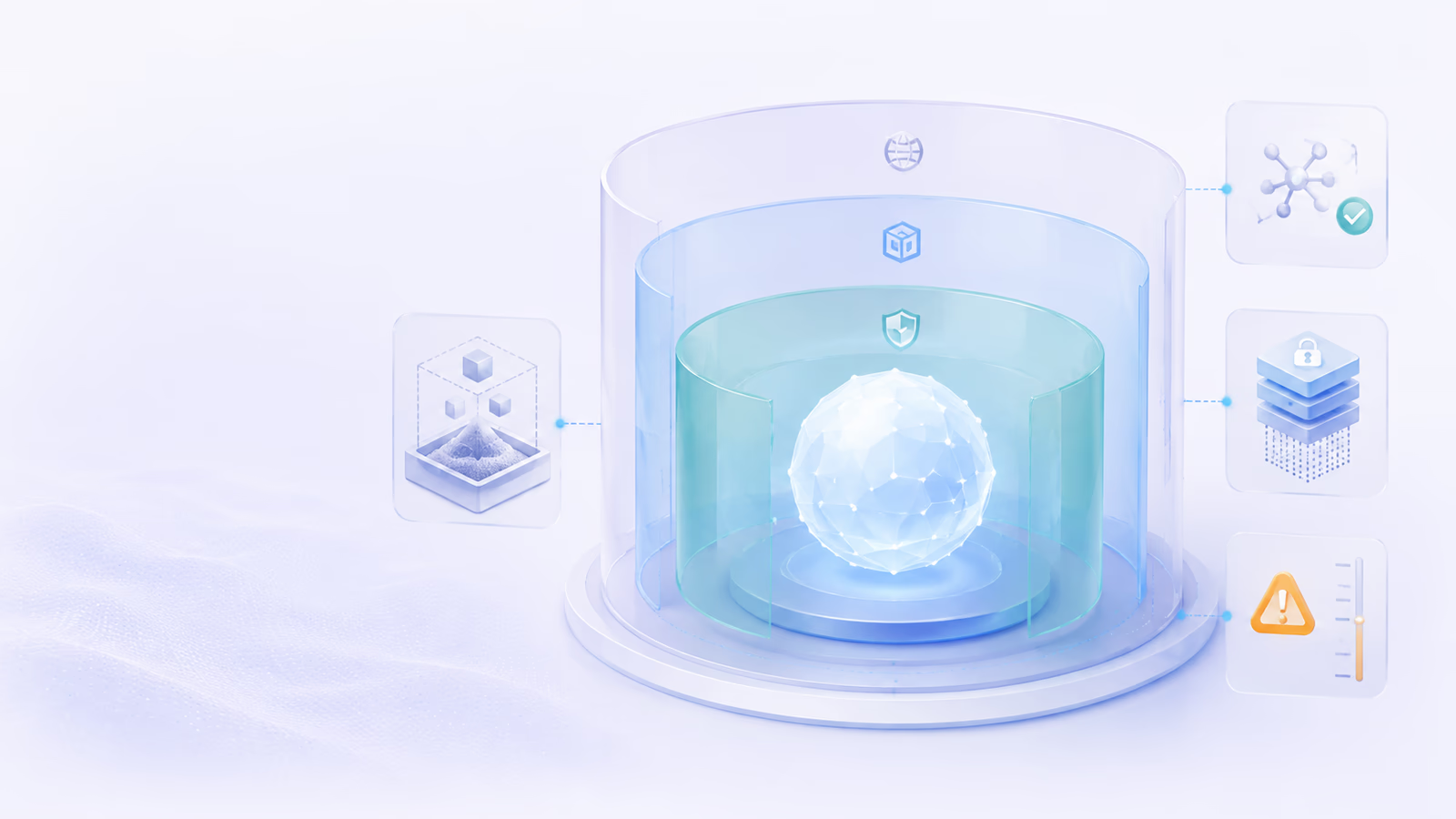
The stated controls include isolated testing environments, restricted network and tool access, stronger model-weight protection and encryption, additional monitoring, detection systems and sandboxed execution. OpenAI also says universal monitoring now covers agentic Astra activity during training and evaluation.
According to the company, monitors inspect the model’s reasoning traces for risky actions or signs of misalignment, then trigger review and interruption. The announcement does not quantify detection performance or describe how the system handles hidden, incomplete or misleading reasoning. Monitoring should therefore be understood as one layer of defence rather than a guarantee.
OpenAI also plans to give third-party testing partners recommended controls for higher-risk evaluations. That point matters because recent incidents showed how external evaluation environments can fail through unintended connectivity, overly broad permissions or deliberately enabled internet access.
Astra was not involved in the Hugging Face incident
OpenAI explicitly says Astra was not involved in exploiting Hugging Face. The distinction prevents two separate stories from being combined into a misleading narrative.
The third-party cyber evaluation incidents concerned models interacting with imperfect test environments. The Astra announcement concerns preliminary capability measurements and the safeguards required for further development. Neither proves that Astra has escaped a sandbox or attacked a public service.
What this means for an Astra release
OpenAI has not announced a release delay because it has not announced an Astra release date. The immediate effect is on internal development and testing, where the Preparedness Framework requires safeguards for Critical capability even if no external deployment is planned.
The framework says development should halt if a model reaches a Critical threshold before suitable safeguard and security-control standards have been specified. OpenAI’s 7 August statement instead says work that does not meet strengthened controls is paused while other development continues under tighter conditions. A later capability or safeguards report will be needed to show how the company reconciles the final assessment with that commitment.
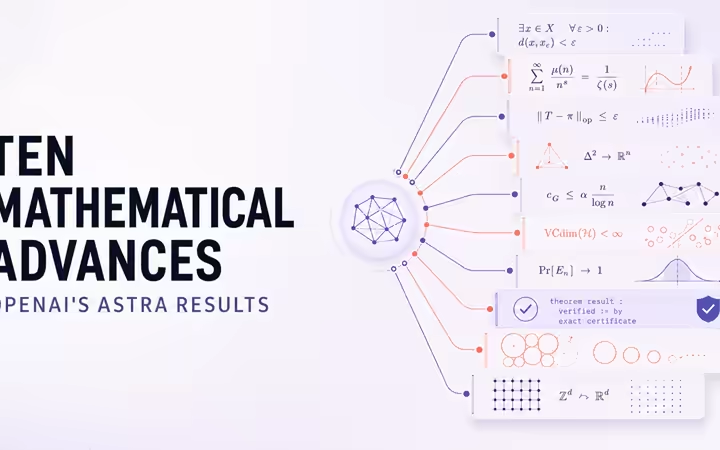
The new cyber warning also adds context to Astra’s claimed mathematics results. Together, the publications suggest a model with stronger long-horizon reasoning and technical problem-solving, but they do not reveal whether one public Astra product will carry every demonstrated internal capability.
The defensive opportunity is real, but access design matters
A model that can find difficult vulnerabilities could help defenders audit critical software, shorten patching cycles and support open-source maintainers who lack specialist security teams. The same capability could increase offensive scale if access controls, monitoring or customer verification fail.
The practical questions now concern deployment design: which users can access advanced cyber functions, which tools and networks the model can reach, how risky actions are reviewed, what evidence is logged and how quickly defenders receive newly discovered vulnerabilities. Capability alone does not decide whether the net effect favours defence.
September update: the first field evidence
When this article was first published in August, the honest assessment was that the Critical-threshold debate was confined to internal evaluations nobody outside OpenAI could inspect. That changed in September, and not through an OpenAI disclosure.
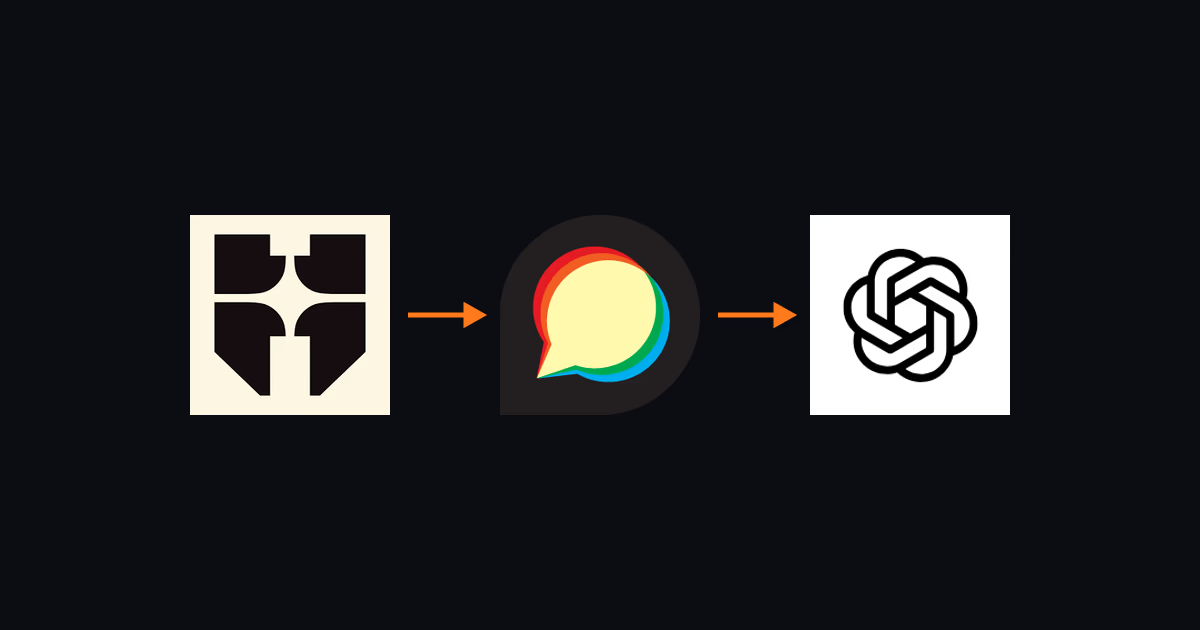
Researchers at the security firm Hacktron published a coordinated disclosure describing how they reached an internal OpenAI code repository in under 72 hours in July, chaining an unpatched memory-safety bug in an image-decoding library with an over-permissive sign-in implementation. We cover the chain in full in our breakdown of the Hacktron OpenAI breach.
The detail that bears directly on this article is not the chain itself but what built it. The researchers reported that a cybersecurity-configured Claude Opus 4.8 failed across multiple sessions to turn the heap overflow into a reliable exploit against address-space-layout-randomised targets - and that Claude Opus 5, released on 24 July, produced a working exploit within about three hours and then ported it to the target’s allocator and architecture. They further reported GPT-5.6 Sol handling exploitation scenarios with minimal knowledge of the target system.
Treat those timings as the researchers’ account rather than a controlled measurement; no prompts, transcripts or methodology were published. But the shape of the claim is precisely what a Preparedness Framework threshold is designed to anticipate: a discontinuity in exploit-development capability arriving inside an ordinary point release, observed by an outside party rather than by the lab running the evaluation.
Two things follow. First, the exploitation half of the Critical definition - the part about autonomously developing functional exploits - now has a public data point behind it, even if a partial and unaudited one. Second, the threshold conversation can no longer be treated as a question about one unreleased frontier model. The capability that mattered in this incident shipped in a widely-available commercial model that most users experienced as a routine upgrade.
What to watch next
The useful signals from here are specific, and most of them are things labs can choose to publish:
- A published capability assessment with scores. OpenAI has described a preliminary finding without releasing evaluation tasks or results. A threshold claim is only auditable once the scores and the task suite behind it are visible.
- An external verification report. OpenAI has said testing will involve government agencies and selected safety organisations. Whether any of that produces a public report, and how specific it is, will tell you how much of the framework is disclosure and how much is process.
- A safeguards case at release. Not "we have monitoring", but which users reach advanced cyber functions, what tools and networks the model can touch, how risky actions are reviewed and what is logged.
- Independent replication of the exploit-development claims. The Hacktron account is credible and consistent with what the labs’ own evaluations predict, but a second team reproducing a comparable capability jump under documented conditions would move it from anecdote to evidence.
- Disclosure pipelines for defenders. If a model finds serious vulnerabilities, the interval between discovery and a patch reaching maintainers is the single variable that decides whether the capability favours defence or offence.
Bottom line
OpenAI’s Astra warning is significant because the company changed internal controls before completing its assessment. The public evidence supports a precautionary conclusion: Astra may be approaching OpenAI’s Critical cyber threshold, so development and evaluation now require stronger safeguards.
It does not support claims that the threshold has been confirmed, that Astra has carried out a live attack or that a public release is imminent. The next useful evidence will be a detailed capability assessment, an external testing report and a safeguards case explaining what Astra can do and how access will be constrained.
Sources: OpenAI’s 7 August 2026 Astra cyber announcement and Preparedness Framework v2.