 AI Tools Review Editorial Team
Quick answer:
Qwen3.8-27B, released by Alibaba on 14 August 2026, is a free, Apache 2.0, dense 27-billion-parameter vision-language model you can download from Hugging Face and run on a single high-end GPU or an Apple Silicon Mac. It reads text, images and video, natively handles 262,144 tokens (extendable to 1 million via YaRN), and, on Alibaba's own benchmark table, beats the older Qwen3.7-Plus tier and even out-scores Claude Opus 4.6 Max on several vision and computer-use benchmarks. It does not, however, beat its own larger open sibling, the 2.4-trillion-parameter Qwen3.8-Max - and despite YouTube coverage calling it "Qwen3-VL-27B," that name belongs to a separate, older Qwen family. Here is what the model card actually says, the real numbers, and what it takes to run it yourself.
Most of the AI headlines this August went to the giant, hosted, 2.4-trillion-parameter Qwen3.8-Max. The quieter release - a 27-billion-parameter model you can actually download and run on hardware you already own - is arguably the more consequential one for anyone who isn't renting a datacenter.
Here is the corrected name, the real architecture, Alibaba's own benchmark numbers checked against its bigger sibling, what independent reviewers found when they actually ran it, and the licence and hardware details that decide whether it's worth your disk space.
Julian Goldie's walkthrough of the open-weights release: the Apache 2.0 licence, vision and video support, context window, and how to run it locally via Ollama, LM Studio or llama.cpp.
Summary
Alibaba's Qwen team shipped two related but distinct releases in August 2026: Qwen3.8-Max, a 2.4-trillion-parameter Mixture-of-Experts model available only through Alibaba's hosted API, and Qwen3.8-27B, a much smaller, dense, fully open-weight model released under Apache 2.0 on 14 August. They share a generation number but are aimed at completely different audiences - Max at enterprises willing to pay for frontier-class hosted inference, and the 27B at developers, researchers and hobbyists who want a genuinely capable model they can own and run themselves.
- Best for: local, self-hosted vision-language workloads - document and chart understanding, computer-use and browser automation, coding agents - on a single GPU or a well-specced Mac.
- Headline numbers: 84.3 on OSWorld-Verified computer-use, 90.3 on LiveCodeBench v6, 61.7 on SWE-bench Pro, all vendor-reported.
- Defining trait: a dense (not MoE) 27B vision-language model, Apache 2.0, that genuinely fits on consumer-class hardware.
- Main caveats: no official safety documentation, no independent benchmark verification yet, and a default reasoning setting that one independent reviewer found causes significant overthinking.
A Naming Correction: Not "Qwen3-VL"
Worth clearing up before anything else, because it's a genuinely easy mix-up: several videos and articles covering this release call it "Qwen3-VL-27B." That name belongs to a different, older Qwen family - Qwen3-VL - whose largest official releases topped out at 235B-A22B parameters back in September 2025. There is no 27B model in that lineage. This model's actual, official name, confirmed directly from its Hugging Face model card and GitHub repository, is Qwen3.8-27B, part of a distinct, newer Qwen3.8 series built on the architectural foundation of Qwen3.5. "Qwen 3.8 27B" (with a space) is a fine colloquial rendering, used by Ollama and much of the press - but "Qwen3-VL-27B" is simply the wrong model family. If you're searching for it yourself, search Qwen3.8, not Qwen3-VL.
Lineage: Where Qwen3.8-27B Fits
Qwen3.8-27B sits alongside two other releases in the same generation. Qwen3.8-Max is the flagship: a 2.4-trillion-parameter, 95-billion-active-parameter Mixture-of-Experts model, hosted-only through Alibaba's Qwen Cloud/DashScope API. Qwen3.8-2.4T-A95B is, confusingly, the open-weight checkpoint of that same Max model - released separately, under a custom licence rather than Apache 2.0. And Qwen3.8-27B, the subject of this article, is a much smaller, purpose-built-for-self-hosting dense model, released cleanly under Apache 2.0 with no revenue threshold or commercial-licence trigger attached.
That three-way split matters practically. If you want Alibaba's absolute best model and don't mind paying for hosted API access, that's Qwen3.8-Max. If you want to self-host the same underlying capability and have datacenter-class hardware (Alibaba's own guidance and independent infrastructure write-ups point to something like a single 8-accelerator node at minimum), that's the A95B open checkpoint - with a licence that requires a commercial agreement once your AI-assistant or model-as-a-service revenue crosses $50 million over any 12-month period. If you want something you can genuinely run on hardware you already own, with no strings attached, that's the 27B.
Architecture and Context Window
Qwen3.8-27B is a dense model - every parameter activates on every token, unlike the Mixture-of-Experts design used by its Max sibling. Per its Hugging Face model card, it uses a hybrid layer pattern (16 repetitions of three Gated DeltaNet-plus-FFN blocks followed by one Gated Attention-plus-FFN block), a hidden dimension of 5,120 across 64 layers, and roughly 27.78 billion total parameters including its vision encoder. It was trained with multi-token prediction (MTP), which - as covered below - meaningfully speeds up local inference on hardware that supports it.
The context window is genuinely large for a locally-runnable model: 262,144 tokens natively, extendable to 1,000,000 tokens using YaRN rotary-position-embedding scaling (Alibaba's model card shows the exact launch configuration for vLLM and SGLang). It accepts text, images and video as input, and outputs text - Alibaba markets it as reading "from STEM diagrams and documents to hour-scale videos."
Capabilities Deep Dive
Vision and real-world understanding
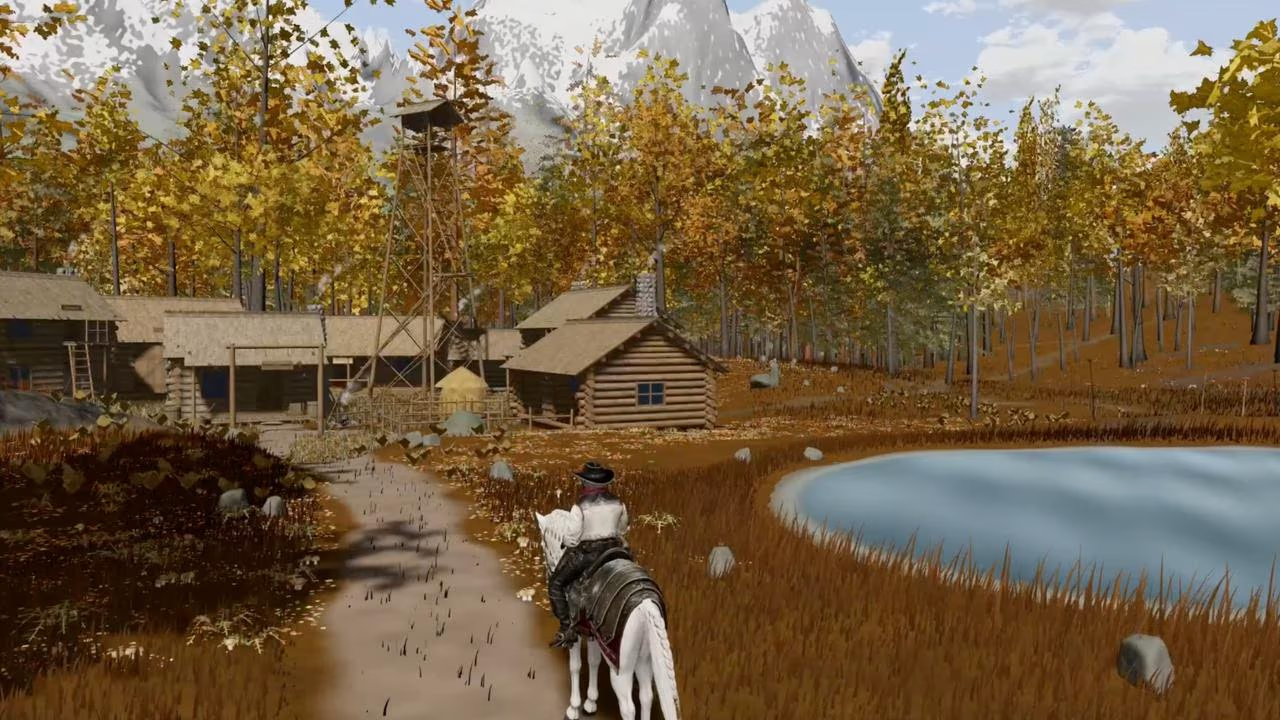
This is where the 27B looks strongest relative to its size. On OSWorld-Verified, a computer-use benchmark, it scores 84.3 - ahead of its own predecessor Qwen3.6-27B (63.9) and ahead of Claude Opus 4.6 Max (72.7). On AndroidWorld (mobile-use) it scores 81.9 versus Opus 4.6 Max's 62.0, and on WebArena-Verified (browser-use) it scores 64.8. The image below - one of Alibaba's own real-world demo assets for this model family - shows the kind of scene understanding this is measuring: identifying a specific real-world location, landmark and context from a single photo rather than a curated benchmark image.

Coding and agentic tasks
On LiveCodeBench v6, Qwen3.8-27B scores 90.3, ahead of both its predecessor (83.9) and Claude Opus 4.6 Max (88.8). On SWE-bench Pro, a realistic software-engineering benchmark, it scores 61.7, ahead of Opus 4.6 Max's 53.4. Agentic benchmarks show a similar pattern: CoWorkBench 70.7 (versus 68.2 for Opus 4.6 Max) and JobBench 33.4. These are Alibaba's own evaluation numbers, run on Alibaba's own harness - independent verification from a neutral aggregator such as Artificial Analysis or LMArena had not been published for this specific model at the time of writing.
Reasoning and general knowledge
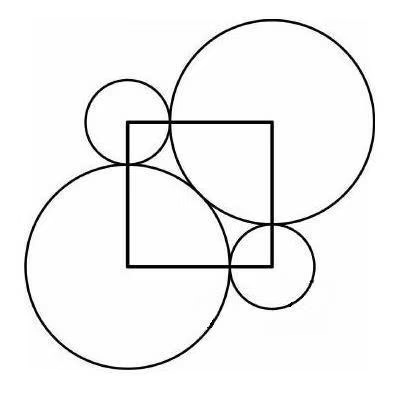
On GPQA Diamond, a graduate-level science reasoning benchmark, it scores 89.2 - strong, but behind Opus 4.6 Max's 91.3. On Humanity's Last Exam (HLE) it scores 30.8, well behind Opus 4.6 Max's 40.0 - the clearest gap in Alibaba's own comparison table, and a useful reminder that this is not a uniform win against a much larger closed frontier model, even on the categories where it does lead. On MathVision specifically - the visual mathematics benchmark shown below, which asks the model to reason about a diagram rather than solve a text-only equation - it scores 90.0 without a code interpreter, well ahead of Opus 4.6 Max's 65.5.
Benchmarks: The Real Numbers
The table below is pulled directly from Qwen3.8-27B's official Hugging Face model card, comparing it against its immediate predecessor (Qwen3.6-27B), a larger hosted Qwen tier (Qwen3.7-Plus), and Claude Opus 4.6 Max. All figures are Alibaba-reported; no independent lab had published its own Qwen3.8-27B scores at the time of writing, and a Japanese tech outlet (GIGAZINE) that covered the release simply repeated these same vendor numbers rather than re-testing them independently.
| Benchmark | Qwen3.8-27B | Qwen3.6-27B | Opus 4.6 Max |
|---|---|---|---|
| OSWorld-Verified (computer use) | 84.3 | 63.9 | 72.7 |
| AndroidWorld (mobile use) | 81.9 | 70.3 | 62.0 |
| LiveCodeBench v6 | 90.3 | 83.9 | 88.8 |
| SWE-bench Pro | 61.7 | 53.5 | 53.4 |
| Terminal-Bench 2.1 | 73.0 | 63.4 | 78.2 |
| GPQA Diamond | 89.2 | 87.8 | 91.3 |
| Humanity's Last Exam | 30.8 | 24.0 | 40.0 |
| MathVision (no code interpreter) | 90.0 | 85.1 | 65.5 |
The honest read: Qwen3.8-27B is a clear, substantial upgrade over its own predecessor across nearly every benchmark Alibaba tested, and it beats Claude Opus 4.6 Max - a far larger, closed, frontier model - on vision, computer-use and several coding benchmarks. It loses to Opus 4.6 Max on Terminal-Bench, GPQA Diamond and, most notably, Humanity's Last Exam. Neither result should be read as an unqualified win in either direction - it's a genuinely mixed, benchmark-by-benchmark picture, which is the most trustworthy kind vendor-reported numbers can offer.
Does It Really Beat Bigger Models?
Some coverage of this release, including one of the tracked-creator videos behind this article, frames Qwen3.8-27B as beating "larger Qwen models." That claim needs to be scoped carefully. Against Qwen3.7-Plus - an older, larger, hosted-only Qwen tier - it's true: the 27B beats it on nearly every benchmark in Alibaba's own table (Terminal-Bench 73.0 vs 64.0, SWE-bench Pro 61.7 vs 57.6, DeepSWE 42.2 vs 14.2, CoWorkBench 70.7 vs 65.1).
Against its own current-generation, larger open sibling - Qwen3.8-2.4T-A95B, the open-weight checkpoint of Qwen3.8-Max - it is not true. Checked head-to-head against that model's own published benchmark table: SWE-bench Pro 61.7 vs 67.7, Terminal-Bench 2.1 73.0 vs 86.6, DeepSWE 42.2 vs 56.6, CoWorkBench 70.7 vs 74.8, GPQA Diamond 89.2 vs 92.6. The larger sibling wins every one of these. There is also a real capability gap worth flagging: the open-weight A95B checkpoint is, per its own model card and independent technical write-ups, effectively text-only - vision input and the full 1-million-token default context are reserved for the hosted Qwen3.8-Max product, not included in the open release. That makes the 27B, somewhat counter-intuitively, the more capable open-weight vision model of the two, even though it's far smaller overall.
Safety and Limitations Disclosure
Neither Qwen3.8-27B's nor Qwen3.8-2.4T-A95B's official model card contains a dedicated safety, limitations, bias or responsible-use section - a direct full-text search of both official documents for those terms returns no relevant results. Alibaba does maintain a general-purpose content-moderation model, Qwen3Guard, for the wider Qwen family, but it isn't specific to this release. Independent tracking (AI Safety Facts) describes Alibaba's safety documentation as "less prominently featured than US frontier labs," with no evidence of participation in external evaluation programmes run by bodies like METR or the UK AI Security Institute, and no Seoul AI Safety Commitment signatory status. Earlier, unrelated Qwen models have had third-party red-teaming (by KELA Cyber and Adversa AI) surface prompt-injection and unsafe-content-generation vulnerabilities, and a January 2025 Qwen2.5-VL prompt-injection issue was separately disclosed - neither specific to this release, but relevant context for how much independent scrutiny this model family has historically received.
No CBRN-specific evaluation, independent red-team report, or formal system card (in the sense Anthropic or OpenAI now publish) exists for Qwen3.8-27B as of writing. That is a genuine, material gap rather than a clean bill of health - treat it the same way this site recommends treating any open-weight release without a published safety framework: apply your own sandboxing and review before giving it real-world tool access, rather than assuming the absence of a bad headline means the absence of risk.
Running It Locally: Hardware and Speed
Alibaba has not published an official VRAM or RAM specification for Qwen3.8-27B. Community quantisations from Unsloth give a concrete sense of the range: 54.7GB at full BF16 precision, down through 29GB (Q8_0), 22.9GB (Q6_K), 19.8GB (Q5_K_M), 17.1GB (Q4_K_M), 13.8GB (Q3_K_M) and 10.7GB at the smallest 2-bit quantisation.
Independent LLM commentator Simon Willison ran the ~17GB Q4_K_M quantisation on a 128GB Apple Silicon MacBook Pro via LM Studio and reported 15-30 tokens per second; a commenter on his review reported 59 tokens per second on an RTX 3090 using llama.cpp with the model's multi-token prediction feature enabled - roughly a 72% speedup over baseline. In practical terms: a single RTX 3090/4090-class GPU, or a Mac with 64GB or more of unified memory, is enough to run this model comfortably at 4-bit quantisation - a completely different proposition from the 2.4-trillion-parameter Max sibling, which independent infrastructure write-ups describe as needing a full multi-accelerator server node.
One practical catch worth knowing before you benchmark it yourself: Willison found the model defaults to an xhigh reasoning-effort setting that caused significant overthinking on some tasks - one SVG-drawing prompt took 21 minutes and over 22,000 reasoning tokens at the default setting, versus 137 seconds with reasoning disabled. Your effective speed and cost depend heavily on setting the reasoning-effort level deliberately rather than trusting the default.
A focused look at installing and running Qwen3.8-27B locally via Ollama, including its multimodal features and hardware requirements for local use.
Pricing and Access
Self-hosting Qwen3.8-27B is free - Apache 2.0 carries no usage fee, no revenue threshold, and no separate commercial-licence requirement. For anyone who would rather not manage their own inference server, third-party host OpenRouter lists it live at $0.40 per million input tokens and $3.00 per million output tokens, with cached input at $0.04 per million - across four listed providers. Alibaba's own official hosted endpoint for the 27B specifically was not yet live at the time of writing; the model card states a dedicated service "is coming soon," and a direct check of Qwen Cloud's dedicated URL for this model returned a 404.
The contrast with the larger Qwen3.8-Max is worth knowing if you're weighing which to build on. Max's open-weight checkpoint (the A95B) carries a custom licence: per South China Morning Post's reporting, companies whose AI-work-assistant or model-as-a-service business exceeds $50 million in revenue over any 12-month period must obtain a separate commercial licence before using it - internal, non-customer-facing use is exempt. The 27B has no such clause. If licence simplicity matters as much as capability, that alone is a reason to default to the 27B for anything commercial.
Limitations
- No independent benchmark verification yet: every number in this article is Alibaba-reported, run on Alibaba's own harness; no neutral aggregator score was available at time of writing.
- Does not beat its own larger open sibling (Qwen3.8-2.4T-A95B) on any directly comparable benchmark, despite framing in some coverage suggesting otherwise.
- No published safety documentation: no model card safety section, no CBRN evaluation, and no independent safety assessment specific to this release.
- Official hosted API not yet live for the 27B specifically - self-hosting or a third-party host like OpenRouter are the only current options.
- No official hardware specification - all VRAM/RAM guidance in this article comes from community quantisations and independent reviewers, not Alibaba.
- Overthinks by default: the default
xhighreasoning-effort setting produced dramatically slower results than necessary in at least one independent test. - No official benchmark chart or architecture diagram was published for this specific model at launch - a genuine gap in Alibaba's own release assets.
How It Compares
Against fellow open-weights releases from this same August 2026 wave - GLM 5.3, DeepSeek V4 Pro and Kimi K3 - Qwen3.8-27B occupies a genuinely different niche: all three of those are far larger Mixture-of-Experts models (743B to 2.8T total parameters) aimed at matching frontier closed models, while the 27B is deliberately sized to run on hardware an individual developer might already own. That makes it a poor apples-to-apples comparison on raw capability, but a strong one on accessibility - none of GLM 5.3, DeepSeek V4 Pro or Kimi K3 realistically self-hosts on a single consumer GPU the way this model does.
Against its own sibling, Qwen3.8-Max, the choice is straightforward: pay for hosted access to the larger, more capable, MoE model, or self-host the smaller, fully open, vision-capable 27B for free. There isn't a wrong answer, only a different set of trade-offs depending on whether your priority is raw capability or ownership and cost control.
Who Should Use It
Worth using now if you want a genuinely capable, vision-enabled model you can self-host on a single GPU or a well-specced Mac, with no licence complications, for coding, document/chart understanding, or computer-use automation.
Worth waiting for if you need independently verified benchmark numbers before committing - none exist for this model yet - or a published safety evaluation before deploying it with real-world tool access, since Alibaba has not provided one. And if raw capability matters more than self-hosting, Qwen3.8-Max outperforms this model on nearly every directly comparable benchmark, at the cost of paying for hosted access instead of owning the weights.
The Bottom Line
Qwen3.8-27B is a well-specced, genuinely self-hostable vision-language model that beats an older, larger Qwen tier and several benchmarks against Claude Opus 4.6 Max, all under a clean Apache 2.0 licence with no revenue-threshold catch. That combination - real capability plus real ownership - is the more interesting story than the headline-grabbing 2.4-trillion-parameter Max release it shares a generation number with.
The open-weights field has moved quickly since: IFM's K2 Horizon fleet shipped six Apache 2.0 models from 0.9B to 375B on a single day in September 2026, and publishes training code and data recipes alongside the weights, which is a meaningfully broader definition of open than weights alone.
Treat the "beats bigger models" framing with the same scepticism this site applies to any vendor-reported benchmark table: it's true against Qwen3.7-Plus and selectively true against Claude Opus 4.6 Max, but not true against its own larger open sibling, and none of it has been independently reproduced yet. Combined with the complete absence of published safety documentation, the sensible approach is the same one that applies to any capable open-weight model: download it, benchmark it against your own workload, and apply your own review before trusting it with anything that matters.
Last updated: 18 August 2026. Sourced from Alibaba Qwen's official Hugging Face model cards for Qwen3.8-27B and Qwen3.8-2.4T-A95B, the QwenLM GitHub repository, Ollama, LM Studio and OpenRouter listings, independent testing from Simon Willison, licensing reporting from South China Morning Post, safety-documentation tracking from AI Safety Facts, and the tracked-creator videos embedded above. Benchmark figures are vendor-reported and had not been independently reproduced by a neutral aggregator at time of writing; verify current pricing and availability before production use.
Get the free guide: Claude vs ChatGPT, Gemini & Grok
A 20-page playbook covering everything you need to choose and use the big four AI models in 2026, full cost and feature comparisons, what each is best (and worst) at, and how-tos for images, vectors, building a website, Claude Code and more.