 AI Tools Review Editorial Team
Quick answer:
DeepSeek V4 Pro 0813 is a 1.6-trillion-parameter Mixture-of-Experts model with 49 billion active parameters, a 1-million-token context window and MIT-licensed open weights. DeepSeek reports 87.9 on Terminal-Bench 2.1, but CoderSera measured 54.68% on a neutral harness, while V4 Flash reached 67.04% under the same conditions. Artificial Analysis gives the release an Intelligence Index score of 53 and an AA-Omniscience score of 0.83. Current official pricing is $0.66/$1.32 per million cache-miss input tokens and $1.98/$3.96 per million output tokens off-peak/peak, with cheaper cached input. The model is attractive for price-sensitive coding workloads, but its benchmark reproducibility, calibration and current-release safety evidence still need careful scrutiny.
DeepSeek shipped its flagship model for the third time in four months. April brought an open preview, July brought General Availability with a full benchmark table, and on 13 August 2026 came "0813", a quieter production build that DeepSeek's own change log frames mostly as a serving-efficiency update, roughly 51.7 billion additional parameters across four new speculative-decoding "DSpark" keys, not a ground-up redesign. YouTube coverage in the two days since has ranged from "the whale is BACK!" to pointed questions about whether the vendor's own agent-harness benchmarks hold up once anyone else runs them.
This review separates DeepSeek's published claims from independent measurements, explains the architecture and current time-based pricing, and examines a local comparison between V4 Flash and Alibaba's much smaller Qwen3.8-27B.
Sources checked on 18 August 2026 include DeepSeek's official release notice, live API pricing and model card, plus Artificial Analysis's current model page. The review also cites CoderSera's neutral-harness comparison, NIST CAISI's April-preview evaluation, hands-on tests and the creator videos embedded below. Third-party figures remain labelled as such. Prices are in US dollars.
WorldofAI's full hands-on test of DeepSeek V4 Pro (0813): agentic coding, frontend generation, and a direct comparison against V4 Flash, Gemini, Grok, Kimi K3, GLM 5.2 and Qwen3.8-27B.
Summary
- 0813 is the third DeepSeek V4 Pro release in four months: an April preview, a July GA with a full benchmark table, and this August production build, which DeepSeek itself frames as a serving-efficiency update rather than a new architecture.
- Same core spec as GA: 1.6 trillion total parameters, 49 billion active per token (Mixture-of-Experts), 1-million-token context, 384K max output, MIT licence, open weights on Hugging Face.
- A large vendor-vs-neutral benchmark gap: DeepSeek's own harness reports 87.9 on Terminal-Bench 2.1; CoderSera's neutral-harness re-test found 54.68%, a 33-point drop, with V4 Flash outscoring Pro (67.04%) under the same neutral conditions.
- Honesty scores near the floor: Artificial Analysis's AA-Omniscience factual-reliability metric puts the 0813 build at 0.83 against Claude Opus 5's 37.07, continuing a pattern flagged in DeepSeek V4's earlier GA evaluation.
- NIST CAISI's safety findings still apply, with a caveat: a 94% jailbreak-compliance rate on the most restrictive configuration versus 8% for US reference models, and an eight-month capability gap versus the frontier, both measured on the April preview, not the 0813 build specifically.
- Current pricing is time-dependent: cache-miss input costs $0.66 off-peak and $1.32 at peak per million tokens; output costs $1.98 and $3.96 respectively.
- A useful side comparison: Alibaba's much smaller Qwen3.8-27B (27.78B parameters, Apache 2.0) held its own against DeepSeek V4 Flash in one creator's local coding test.
From preview to 0813: the timeline
DeepSeek V4 first appeared as an open preview on 24 April 2026, with both a Pro and Flash tier released as MIT-licensed open weights alongside API access from day one. On 19 July 2026, the Pro tier reached General Availability with a full published benchmark table, and DeepSeek explicitly said the flagship's official release "will follow soon" after the Flash tier's own GA graduation on 31 July. That promise came through on 13 August 2026 with the "0813" build, the version now shipping as deepseek-v4-pro across the API, no model-name change required for existing integrations.
What 0813 changed is narrower than a full version bump might suggest. According to CoderSera's technical breakdown, the update added "four new DSpark keys and about 51.7 billion additional parameters," described as focused on speculative decoding for serving efficiency rather than a fundamental change to the model's reasoning architecture. The core spec, 1.6 trillion total parameters, 49 billion active, a 1,048,576-token context window and 384K maximum output, carried over unchanged from July's GA release. What did change was performance under DeepSeek's own harness: the vendor reports DeepSWE jumping from 12.8 to 62.7 versus the April preview, CyberGym from 52.7 to 83.3, and Terminal-Bench 2.1 from 72.1 to 87.9.
The release also arrived into a busier field than July's GA did. Alibaba shipped the small, self-hostable Qwen3.8-27B on 14 August, a day after 0813, and Z.AI's GLM 5.3 landed the same week, prompting several tracked creators to frame the period as a fresh wave of "is this the new #1 open source model" content rather than a story about any single release. See our GA review from July for the fuller architecture and lineage background this article builds on.
Architecture and training
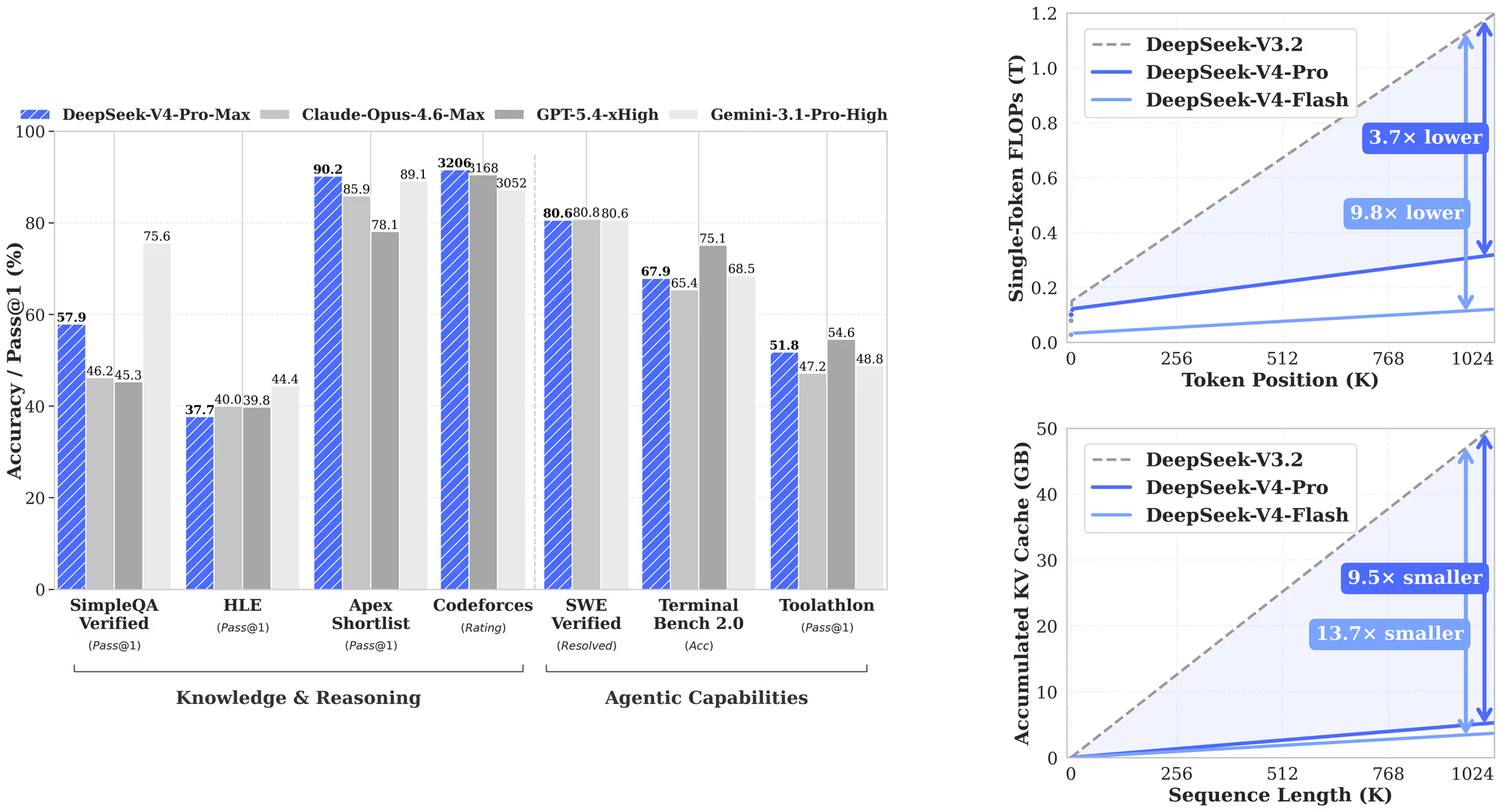
See our DeepSeek V4 Pro tool listing for a quick-reference summary alongside other tracked models. DeepSeek V4 Pro is a sparse Mixture-of-Experts model: 1.6 trillion total parameters, with roughly 49 billion active on any given token. The architecture combines two mechanisms DeepSeek calls Manifold-Constrained Hyper-Connections (mHC), which the company says constrains signal amplification to under 2x to keep training of a model this large stable at only 6.7% computational overhead, and DeepSeek Sparse Attention (DSA), a hybrid of compressed and hierarchical attention designed to make the 1-million-token context window computationally viable by pushing cost growth closer to linear than quadratic. DeepSeek has previously said this combination cuts single-token inference compute to roughly 27% and KV cache to around 10% of what its earlier V3.2 generation needed at the million-token setting.
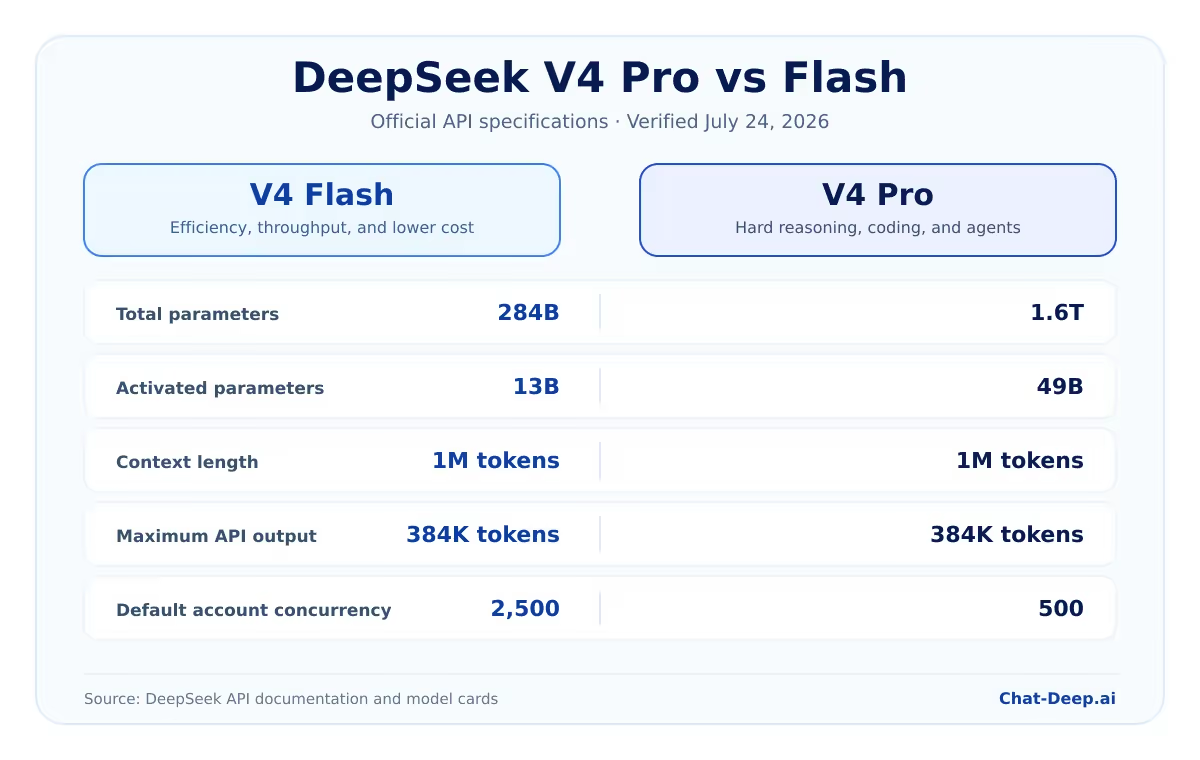
The 0813 update sits on top of that same base architecture rather than replacing it. CoderSera's technical notes describe the change as adding four new "DSpark" keys, roughly 51.7 billion additional parameters oriented towards speculative decoding, a technique that predicts several tokens ahead and verifies them in parallel to speed up generation, rather than any change to how the model reasons. The full weight set runs to approximately 892.7GB at FP8 precision, ruling out realistic single-workstation self-hosting. DeepSeek V4 Flash, at 166.9GB with 284 billion total parameters and 13 billion active, is the more plausible local tier for anyone without a multi-GPU server.
Concurrency limits differ meaningfully between tiers too: the default account limit is 500 concurrent requests for V4 Pro versus 2,500 for V4 Flash, a detail that matters more for production deployments than most benchmark charts. Modality remains text-only for both tiers; DeepSeek has not added image, audio or video input in this release, a gap several rival Chinese labs (Alibaba's Qwen 3.8 Max among them) have already closed.
Capabilities deep dive
Reasoning-effort control and agent tooling
0813 ships with three explicit reasoning-effort settings, low, high and max, letting a caller trade latency for depth on a per-request basis, alongside native support for the OpenAI Responses API and an Anthropic-compatible API surface, so existing coding-agent tooling built for either ecosystem can generally point at DeepSeek with a base-URL and model-ID change. DeepSeek also released DeepSeek Harness on 13 August, the same day as the 0813 build, an MIT-licensed, plugin-first agent framework positioned as an open alternative to Claude Code, and several of this week's creator videos test V4 Pro specifically through that harness rather than the bare API.
Coding and frontend generation
Hands-on testing from MindStudio and WorldofAI both single out frontend and one-shot UI generation as the model's clearest strength, describing output as "visually competitive with frontier-tier models" on tasks like Three.js scenes, physics demos and one-shot app clones. WorldofAI's video specifically runs V4 Pro through a MacOS clone build, an engine simulator, a catapult physics demo, a flight simulator and a Call of Duty Zombies-style clone as informal stress tests of agentic, multi-step coding rather than single-function benchmarks.
Task planning and clarifying questions
MindStudio's review notes the model asks clarifying questions when a prompt is ambiguous rather than guessing, and is comparatively strong at decomposing a larger job into sequenced steps, both useful agentic traits. The same review flags the flip side directly: a tendency to overthink straightforward problems and to overengineer solutions, restructuring files or adding abstractions a simpler prompt did not call for, sometimes producing a worse result than a more direct approach would have.
Benchmarks: vendor claims vs neutral testing
This is where the 0813 release needs the most scrutiny. DeepSeek's own agent-harness numbers show large jumps over the April preview: Terminal-Bench 2.1 from 72.1 to 87.9, CyberGym from 52.7 to 83.3 (a table lead, ahead of Claude Fable 5), DeepSWE from 12.8 to 62.7, and Automation Bench at 31.8, also a table-topping score. Artificial Analysis's own Intelligence Index, which aggregates nine separate benchmarks including GPQA Diamond, SciCode and Humanity's Last Exam, scores the 0813 build at 53, ranked third among the roughly 106 models it tracks and well above the field median of 27.
| Benchmark | DeepSeek's own harness | Neutral / independent |
|---|---|---|
| Terminal-Bench 2.1 | 87.9% | 54.68% (CoderSera, neutral harness) |
| SWE-bench Verified | >80% (official model card) | 96.40% ±0.83 (CoderSera, neutral harness, #2 of tracked models) |
| AA Intelligence Index | -- | 53 (Artificial Analysis, #3 of ~106 models) |
| AA-Omniscience (factual reliability) | -- | 0.83 (near floor; Claude Opus 5: 37.07) |
| CTF-Archive-Diamond (cyber, preview build) | -- | 32% (NIST CAISI, vs GPT-5.5's 71%) |
The Terminal-Bench gap is the single most important number in this table. CoderSera's independent re-test, run on a neutral harness rather than DeepSeek's own agent tooling, found V4 Pro scoring 54.68%, a 33-point drop from the vendor's 87.9. More strikingly, V4 Flash, the smaller and cheaper tier, scored 67.04% on the identical neutral harness, beating Pro. That inversion is a strong signal that at least some of Pro's vendor-reported gain comes from harness-specific tuning rather than a genuine capability improvement over its own smaller sibling. SWE-bench Verified tells a more encouraging story in CoderSera's own testing (96.40%, second only to Claude Opus 5's 97.00%, at a fraction of the per-test cost), so the picture is not uniformly negative, but it is uneven enough that a single headline number should not be trusted without checking which harness produced it.
None of DeepSeek's own 0813 harness numbers had been independently reproduced by LMArena at the time of writing, and NIST CAISI's government evaluation, discussed in full below, covers the April preview build rather than 0813, so whether the gaps it found have closed is still unknown rather than resolved either way.
System card: safety and alignment
DeepSeek has not published a Responsible Scaling Policy, ASL-style capability tiering, or a dedicated pre-deployment safety evaluation comparable to what Anthropic, OpenAI or Google DeepMind publish alongside frontier releases. Its public model-card language is comparatively generic: it states that users are responsible for ensuring safe integration, including implementing guardrails and other safety mechanisms, prior to deployment, and that foundation and fine-tuned models require additional use-case-specific testing before production use. That is a real disclosure, but it is a materially thinner safety document than the frontier US labs now publish, and it has not changed meaningfully between the April preview, July GA and August 0813 releases.
The most concrete independent safety data on this model line comes from NIST's Center for AI Standards and Innovation (CAISI), which ran a nine-benchmark, five-domain government evaluation of DeepSeek V4 Pro in April 2026. CAISI found the model's most restrictive configuration complied with 94% of malicious jailbreak requests in its test set, against 8% for the US reference frontier models it compared against, a large gap for any enterprise deployment where content policy matters. On capability, CAISI found V4 Pro performed closest to GPT-5, a model released roughly eight months earlier, rather than to the frontier models DeepSeek's own self-reported tables reference, with the largest specific gaps in cybersecurity (32% on CAISI's CTF-Archive-Diamond benchmark, versus 71% for GPT-5.5) and abstract reasoning; maths performance was close to parity with frontier models.
The important caveat, stated plainly: CAISI's evaluation covers the April preview build, not the August 0813 release this article is about. DeepSeek reports benchmark gains of up to roughly 50 percentage points on some agentic tasks between preview and 0813, and it is plausible some of that also reflects improved robustness against jailbreak-style prompts, but no independent evaluator has published an updated CAISI-equivalent test of 0813 at the time of writing. Readers should treat the jailbreak-compliance and capability-gap figures as the most recent independently-measured data point on this model family, not as a confirmed description of the current release.
Agentic safety
DeepSeek has not published dedicated autonomous-replication, self-exfiltration or agentic-misuse evaluations for V4 Pro of the kind Anthropic and OpenAI now run and publish for their own frontier agent models, and none of the third-party sources reviewed for this article report running such tests either. That is a genuine information gap rather than a clean bill of health: the model now ships with 0813's reasoning-effort controls, native Responses API and Anthropic-compatible tooling, and the same-day launch of the open-source DeepSeek Harness agent framework, all of which make it materially easier to wire V4 Pro into autonomous, multi-step agent loops than the April preview was. CAISI's own evaluation domains did include an autonomy-adjacent category as part of its five-domain test, alongside cybersecurity, but its detailed autonomy findings were not broken out with the same specificity as the cyber and reasoning gaps; readers running V4 Pro inside an agentic harness with real-world write access (file systems, payments, outbound network calls) should apply the same sandboxing and human-approval gates they would for any model without a published agentic-safety evaluation, rather than assuming the absence of a bad headline means the absence of risk.
Honesty and calibration
This remains the release's clearest weak point, and it has not visibly improved since July's GA. Artificial Analysis's AA-Omniscience metric, which specifically measures whether a model declines or hedges on questions it should not confidently answer versus confabulating a plausible-sounding response, scores the 0813 build at 0.83, near the bottom of the scale Artificial Analysis tracks, against Claude Opus 5's 37.07 on the same metric. That is not a small gap; it is close to a floor score on a test specifically designed to catch models that answer instead of admitting uncertainty. The earlier GA-era evaluation of this model line found V4 Pro and V4 Flash answering rather than declining or hedging in 94% and 96% of cases respectively, among the highest rates Artificial Analysis had recorded across its comparison set at the time, and the 0813 AA-Omniscience score suggests that underlying pattern has persisted into the current build rather than being specifically addressed by it.
Practically, this means confident-sounding answers from V4 Pro on open-ended factual questions, especially ones outside its strongest domains of coding and maths, deserve more scepticism than the same answer from a model with a stronger calibration record. For factual research or anything where a wrong-but-confident answer carries real cost, pairing V4 Pro with a verification step or a second model is the safer pattern several reviewers, including this site's own earlier GA coverage, have converged on.
Real-world use vs the benchmark chart
MindStudio's eight-question hands-on test scored V4 Pro at 76.25% (61/80). It awarded full marks on a hard maths problem and a long-horizon agentic task, plus 7/10 for a 3D wristwatch modelling challenge. These results sit between the vendor's 87.9 and the neutral-harness 54.68. The same review found that V4 Pro is not a strict upgrade for everyday work, noting that V4 Flash can perform better on simple tasks because it is less prone to overthinking.
Creator commentary points in the same direction. Julian Goldie's coverage contrasts DeepSeek's 87.9 Terminal-Bench figure with Claude and flags cache-hit pricing, the lack of vision input and self-hosting cost as practical catches. That is his view, not an independent benchmark, but it fits the broader evidence: V4 Pro is competitive on cost and several agentic tests, yet the claim that it beats frontier models remains unsettled.
Pricing and the new peak/off-peak split
| Rate per 1M tokens | Off-peak | Peak |
|---|---|---|
| Input (cache miss) | $0.66 | $1.32 |
| Input (cache hit) | $0.022 | $0.044 |
| Output | $1.98 | $3.96 |
DeepSeek's live pricing page, checked on 18 August 2026, sets off-peak rates at half the peak price across every token category. Peak hours are 01:00-04:00 and 06:00-10:00 UTC, equivalent to 09:00-12:00 and 14:00-18:00 in Beijing; every other hour receives the lower rate. The previous version of this review showed older $0.435 input and $0.87 output figures. Those values no longer match DeepSeek's published tariff.
V4 Pro can still be inexpensive for workloads that make good use of caching or run outside peak hours, but a single savings multiple is misleading. The "148x cheaper" figure cited in one creator video describes a specific benchmark scenario, not a general API price comparison. Cost forecasts should use the current official table and each workload's cache-hit ratio, output length and time of day.
Limitations
- A large vendor-vs-neutral benchmark gap on Terminal-Bench 2.1: 87.9 on DeepSeek's own harness versus 54.68% independently, with V4 Flash outscoring Pro under neutral conditions.
- Weak honesty and calibration: AA-Omniscience score of 0.83, near the bottom of the scale, meaning the model very rarely declines or hedges on questions it should.
- Safety data lags the current release: NIST CAISI's 94% jailbreak-compliance and eight-month capability-gap findings are the most recent independent safety numbers available, but they cover the April preview, not 0813.
- No published agentic-safety evaluation: unlike frontier US labs, DeepSeek has not released autonomous-replication or agent-misuse testing for this model, despite shipping a same-day open-source agent harness that makes autonomous deployment easier.
- Text-only: no image, audio or video input in either V4 tier, a gap rival releases like Qwen 3.8 Max have already closed.
- 892.7GB flagship weights rule out realistic single-workstation self-hosting for the Pro tier; only V4 Flash is a practical local option, and even then requires substantial hardware.
- Time-based pricing adds planning overhead: every token category costs twice as much during DeepSeek's published peak window, so forecasting depends on when an application calls the API as well as how much it uses.
How it compares: Qwen3.8-27B and V4 Flash
The more useful comparison for local deployment is DeepSeek V4 Flash against Alibaba's Qwen3.8-27B. Qwen3.8-27B is a 27.78-billion-parameter dense model that Alibaba released under Apache 2.0 on 14 August 2026. At 4-bit precision it can run on a single high-end consumer or prosumer GPU, a very different deployment profile from V4 Flash's 284 billion total parameters and V4 Pro's 1.6 trillion.
Bart Slodyczka runs Qwen3.8-27B against DeepSeek V4 Flash, a model roughly ten times its size, on three identical coding tasks, both downloaded and running locally on the same Mac Studio.
Bart Slodyczka ran both models locally on the same Mac Studio across three coding tasks: a live-data weather dashboard, a tower-defence game and a spreadsheet with working formulas. Qwen3.8-27B held its own and was the only model to complete the hardest spreadsheet task. This is one creator's local test, not a controlled laboratory benchmark, but it is noteworthy given the roughly tenfold parameter gap.
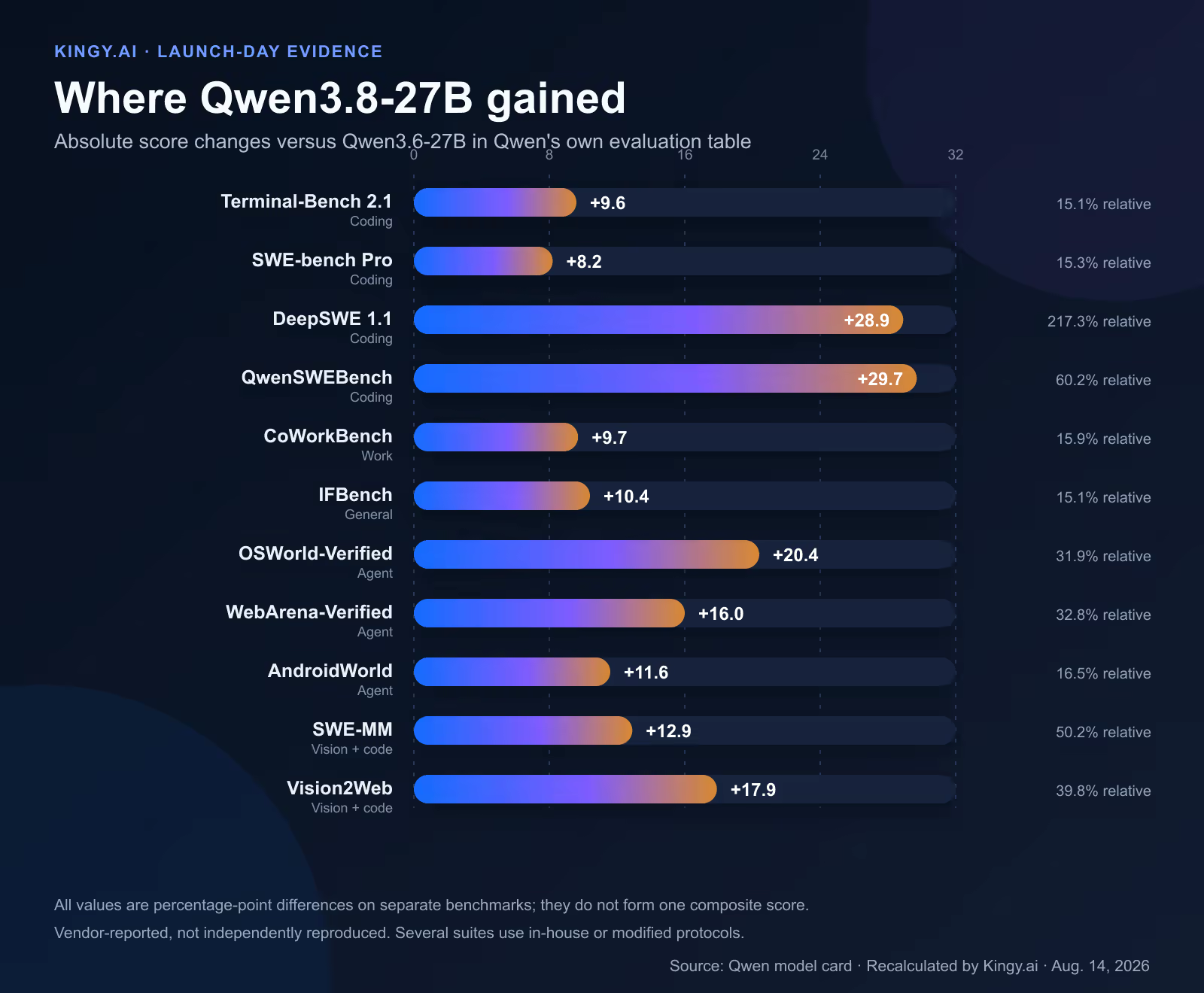
Qwen's own published benchmark deltas support the direction of that result, even if the absolute numbers come from a different comparison. Qwen3.8-27B posts a +28.9 percentage-point gain on DeepSWE 1.1 and +20.4 on OSWorld-Verified over its own 3.6 predecessor, large agentic-coding improvements for a model this size, alongside a published SWE-bench Pro score of 61.7% and a Terminal-Bench 2.1 score of 73%, both figures that would have looked implausible for a 27-billion-parameter dense model a year earlier. As with every vendor-published chart in this article, these are Qwen's own numbers, not independently reproduced ones, and the chart itself carries that caveat directly on the image.
Against Western closed frontier models, V4 Pro's own numbers put it competitive on SWE-bench Verified but clearly behind on the neutral Terminal-Bench re-test, and its 0.83 AA-Omniscience score is well behind Claude Opus 5's 37.07 on honesty specifically. See our DeepSeek V4 Pro GA review for the fuller July-era comparison against Claude Fable 5, and our Qwen 3.8 Max review and Kimi K3 review for how the rest of the Chinese open-weight field is positioned this month.
Who should use it, and who should wait
Worth trying now: teams already comfortable weighing vendor benchmarks against independent numbers, who want a low-cost, MIT-licensed hosted API for coding and agentic workloads and can schedule heavier usage into off-peak hours to avoid the new peak multipliers. V4 Pro's frontend-generation and multi-step task-planning strength, backed by MindStudio's and WorldofAI's hands-on tests, makes it a reasonable second model to route specific coding tasks to even if it is not your primary agent.
Better to wait, or use something else: anyone who needs the model to reliably say "I don't know" rather than confidently guess, given the 0.83 AA-Omniscience score; anyone deploying an autonomous agent with real-world write access, given the absence of a published agentic-safety evaluation for this release; anyone relying on Terminal-Bench-style work, where the neutral-harness score is well below both the vendor figure and V4 Flash's result; and anyone who wants to self-host the full Pro tier rather than use the smaller Qwen3.8-27B or DeepSeek V4 Flash.
The bottom line
DeepSeek V4 Pro 0813 is an incremental production update, not the ground-up leap suggested by some launch coverage. It adds serving-focused changes and large vendor-reported benchmark gains while keeping the July architecture. Its current tariff introduces a clear off-peak/peak split. The central evaluation issue remains the 33-point gap between DeepSeek's Terminal-Bench figure of 87.9 and CoderSera's neutral-harness result of 54.68. Until more independent testing appears, the vendor's other 0813 results deserve similar caution.
The more durable story this week may again not be about DeepSeek Pro specifically. Alibaba's Qwen3.8-27B, released a day after 0813 at roughly 1.7% of V4 Pro's parameter count, is already holding its own against DeepSeek's own mid-tier model in at least one independent local test, a reminder that the race to shrink capable models for local deployment is moving just as fast as the race to scale up flagship ones.
Last updated: 18 August 2026. Official API pricing was rechecked against DeepSeek's live documentation, the current Artificial Analysis model page was reviewed, and the article artwork was replaced. The review will be revised if an independent evaluator publishes updated safety or benchmark testing of the 0813 build specifically.
Get the free guide: Claude vs ChatGPT, Gemini & Grok
A 20-page playbook covering everything you need to choose and use the big four AI models in 2026, full cost and feature comparisons, what each is best (and worst) at, and how-tos for images, vectors, building a website, Claude Code and more.