 AI Tools Review Editorial Team
DeepSeek doesn't release new flagship architectures every month, but it re-trains the ones it has aggressively - and the 31 July update to V4-Flash is the clearest evidence yet of how much headroom sits in post-training alone. A model DeepSeek didn't resize or restructure just leapfrogged its own more expensive sibling on most of the tasks that matter for coding agents.
This review works through what actually changed on 31 July 2026, the real published numbers behind the "Fully Tested" YouTube headlines, official pricing, where independent verification of the DeepSeek V4 family stands, and how Flash-0731 sits against the rest of the July/August 2026 field.
WorldofAI's hands-on test of the 31 July DeepSeek V4 Flash update.
Summary
DeepSeek-V4-Flash-0731 is a re-post-trained release of the same V4-Flash architecture DeepSeek shipped as a preview earlier in 2026: 284 billion total parameters, 13 billion active per token, Mixture-of-Experts routing, a 1M-token context window as both default and maximum, and hybrid sparse attention for long-context efficiency. Nothing about the shape of the model changed on 31 July - what changed is what it was trained to do afterward, and the score gains are large enough that DeepSeek's own table shows Flash-0731 beating the larger V4-Pro-Preview on most agentic and coding evaluations.
The other half of the story is price. At $0.14 per million input tokens on a cache miss and $0.28 per million output tokens, V4-Flash-0731 costs roughly a third of V4-Pro and supports five times the concurrent request volume (2,500 vs 500). For teams running high-throughput agentic pipelines - code review bots, browser agents, batch document processing - that combination of "beats the pricier sibling" and "costs a third as much" is the entire pitch.
- Best for: high-throughput agentic coding, tool-calling pipelines, and cost-sensitive workloads where DeepSeek's ecosystem (Claude Code, OpenClaw, OpenCode integrations) already fits.
- Headline numbers: Terminal Bench 2.1 82.7, DeepSWE 54.4, AutomationBench Public 25.1 - all released 31 July 2026, all ahead of V4-Pro-Preview.
- Defining trait: identical architecture to the preview model; every gain is a post-training result, not a new model.
- Main caveat: still behind Claude Opus 4.8 on every row of DeepSeek's own comparison table, and independent NIST evaluation of the wider V4 family has previously found real-world capability lagging DeepSeek's self-reported figures.
Lineage: From V4-Flash-Preview to 0731
DeepSeek launched the V4 family on 24 April 2026 as two models: V4-Pro, a 1.6-trillion-parameter, 49-billion-active flagship pitched as comparable to leading closed-source systems, and V4-Flash, a 284-billion-parameter, 13-billion-active variant built for speed and cost. Both shipped with a 1M-token context window as the new default across DeepSeek's official services and dual thinking/non-thinking modes, and both integrated from day one with agent harnesses including Claude Code, OpenClaw and OpenCode.
On 31 July 2026, DeepSeek pushed what its own changelog calls simply an update: "DeepSeek-V4-Flash-0731 keeps the same model architecture and size as DeepSeek-V4-Flash-Preview, and was only re-post-trained." The model ID didn't change - calling deepseek-v4-flash now serves the 0731 version - but the scores did, substantially. For a wider view of how the V4 launch itself was received, including NIST's independent capability assessment, see our DeepSeek V4 GA review; this piece focuses specifically on what the 31 July Flash update changed and what it costs.
Architecture & Training
V4-Flash is a Mixture-of-Experts model: 284 billion parameters exist across its expert pool, but only 13 billion activate for any given token, which is what keeps inference fast and cheap relative to V4-Pro's 49-billion-active footprint. The V4 series combines this MoE routing with hybrid sparse attention - DeepSeek Sparse Attention (DSA) alongside token-wise compression - specifically to make the 1M-token context window computationally viable rather than a marketing number nobody can actually afford to fill.
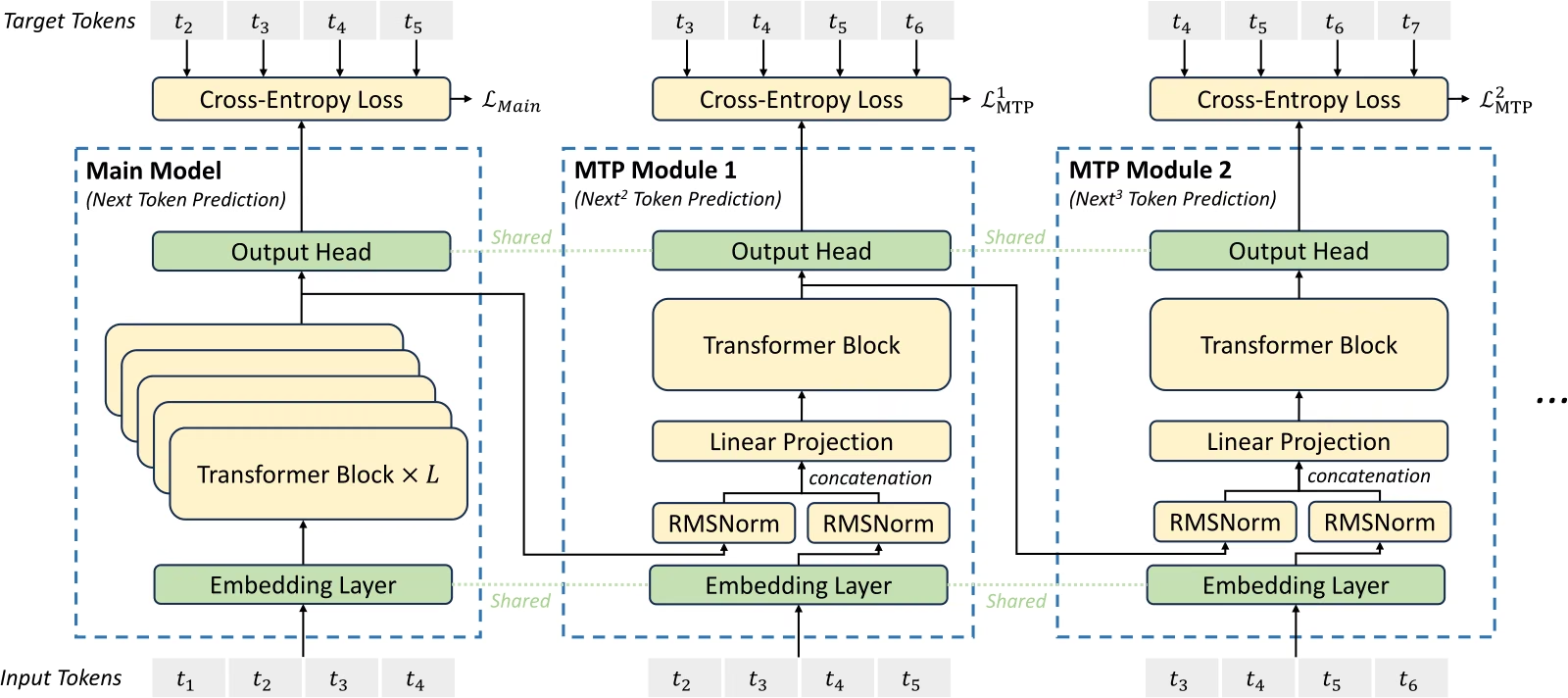
The 31 July update did not touch any of this. DeepSeek is explicit that Flash-0731 is "only re-post-trained" - the same base architecture, the same parameter count, put through a new round of post-training (the reinforcement-learning and fine-tuning stages that shape how a base model behaves on specific tasks, as opposed to pre-training, which teaches it language and world knowledge in the first place). That distinction matters for how to read the benchmark jump: it is not evidence of a bigger or smarter base model, it is evidence of how much capability was left on the table in the preview's post-training alone.
Practically, this also means anyone who had already built infrastructure around V4-Flash-Preview's behaviour - prompt templates, tool-calling formats, latency assumptions - carries that work forward largely unchanged; the API contract, context handling and pricing tier are the same, only the outputs improved.
Capabilities Deep Dive
Agentic terminal and coding work
This is where the update lands hardest. On Terminal Bench 2.1, an agentic terminal-use benchmark, Flash-0731 scores 82.7 - up from 61.8 on the preview, and ahead of V4-Pro-Preview's 72.1. On DeepSWE, a software-engineering agent benchmark, the jump is even sharper: 7.3 to 54.4, over a 7x improvement in a single post-training cycle, and well clear of V4-Pro-Preview's 12.8. DeepSeek's own framing is direct about the implication - a fast, cheap model outscoring its own larger sibling on the tasks that sibling was supposed to own.
Tool use and automation
On Toolathlon-Verified, which tests multi-step tool-calling reliability, Flash-0731 reaches 70.3, versus 49.7 for the preview and 55.9 for V4-Pro-Preview. On Zapier-style business automation (AutomationBench Public), it scores 25.1, more than double the preview's 10.8 and ahead of V4-Pro-Preview's 12.8. For anyone routing automated workflows - ticket triage, data-entry agents, scheduled report generation - through DeepSeek's API, this is the number that predicts how often a task finishes without human intervention.
Security research (Cybergym)
Cybergym measures vulnerability-analysis and security-research tasks. Flash-0731 scores 76.7, a large jump from the preview's 38.7 and ahead of V4-Pro-Preview's 52.7 - though still behind Opus 4.8's 83.1. DeepSeek does not publish a system-card-style breakdown of dual-use safeguards around this capability the way Anthropic does for Opus 5, which is worth flagging for anyone deploying it in a security context; see the safety section below.
Data science and full-stack tasks
On DSBench-FullStack, Flash-0731 scores 68.7 against the preview's 37.0 and V4-Pro-Preview's 41.8. On the harder DSBench-Hard split it reaches 59.6, versus 25.8 for the preview and 31.1 for V4-Pro-Preview - more than double the preview's score on the harder tier, which is typically where post-training gains are hardest to bank.
Reasoning under open-ended agent evaluation
Agents' Last Exam, a broader agentic reasoning suite, shows a smaller relative gain - 25.2 for Flash-0731 versus 15.8 for the preview and 16.5 for V4-Pro-Preview - suggesting the post-training focus leaned toward coding, tool use and terminal work rather than general open-ended reasoning, where gains are typically the hardest to move.
A hands-on look at running the 0731 update inside an agent-OS workflow.
The Benchmark Table: Real Numbers
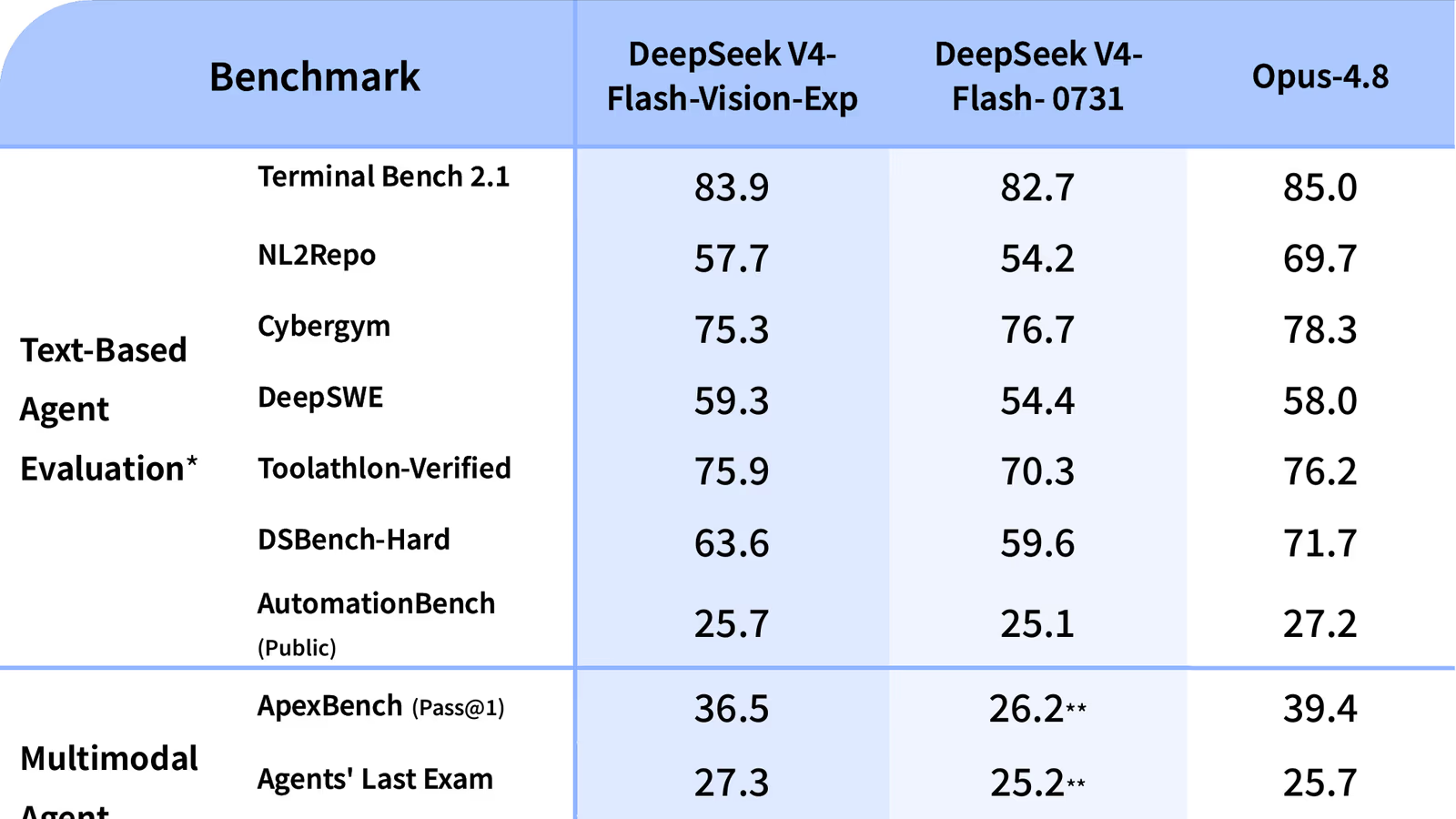
DeepSeek publishes its comparison table directly on the model card for DeepSeek-V4-Flash-0731 on Hugging Face, setting Flash-0731 against its own preview, V4-Pro-Preview, GLM-5.2 and Claude Opus 4.8 across nine evaluations. The table is worth reading in full because the pattern - Flash-0731 beating V4-Pro-Preview almost everywhere, both trailing Opus 4.8 everywhere - is the single most useful fact in the release.
| Benchmark | Flash-0731 | Flash-Preview | Pro-Preview | GLM-5.2 | Opus 4.8 |
|---|---|---|---|---|---|
| Terminal Bench 2.1 | 82.7 | 61.8 | 72.1 | 81.0 | 85.0 |
| NL2Repo | 54.2 | 39.4 | 38.5 | 48.9 | 69.7 |
| Cybergym | 76.7 | 38.7 | 52.7 | — | 83.1 |
| DeepSWE | 54.4 | 7.3 | 12.8 | 46.2 | 58.0 |
| Toolathlon-Verified | 70.3 | 49.7 | 55.9 | 59.9 | 76.2 |
| Agents' Last Exam | 25.2 | 15.8 | 16.5 | 23.8 | 25.7 |
| AutomationBench Public | 25.1 | 10.8 | 12.8 | 12.9 | 27.2 |
| DSBench-FullStack | 68.7 | 37.0 | 41.8 | 61.8 | 71.6 |
| DSBench-Hard | 59.6 | 25.8 | 31.1 | 54.5 | 71.7 |
Two honest caveats. First, every one of these numbers is DeepSeek's own internal run - there is no independent third-party replication of this specific Flash-0731 table at the time of writing. The closest semi-independent signal is Artificial Analysis's Intelligence Index, which scores V4-Flash at 50; that measures general intelligence rather than the agentic benchmarks DeepSeek emphasises here, so treat it as a different, narrower data point rather than a cross-check. Second, AutomationBench Public specifically is a public subset - Zapier's own full AutomationBench, used in Anthropic's Opus 5 comparisons at a different scale (26.0-27.2 range), is not the same test surface as smaller open leaderboards, so cross-vendor AutomationBench comparisons should be read as directional.
Safety, Moderation & Independent Verification
DeepSeek does not publish an Anthropic-style system card alongside V4-Flash-0731 - no automated behavioural audit score, no cyber-classifier intervention rate, no disclosed red-teaming methodology for this specific update. That is consistent with DeepSeek's general disclosure posture across the V4 series and is worth naming plainly rather than assuming parity with vendors that do publish this material.
What independent evaluation does exist points at the wider V4 family rather than this specific Flash update: NIST's Center for AI Standards and Innovation (CAISI) found the V4 series' real-world capability lagging roughly eight months behind DeepSeek's own reported figures when tested on CAISI's own benchmark suite - performing comparably to a GPT-5-era model rather than the more recent frontier tier DeepSeek's published numbers implied. Our DeepSeek V4 GA review covers that finding in full. It predates the 31 July Flash update specifically, so it should not be read as a direct rebuttal of Flash-0731's new scores - but it is the right context for how much weight to put on any DeepSeek self-reported benchmark table, including this one, until independent labs re-test.
Real-World Use vs Benchmarks
Early hands-on coverage of the 0731 update is consistent on one point that the benchmark table alone doesn't convey: the practical experience of running Flash-0731 inside an agent harness feels noticeably more reliable at completing multi-step terminal tasks than the preview did, which lines up with the Terminal Bench and DeepSWE jumps. Where reports diverge from the raw numbers is on cost predictability - DeepSeek has signalled upcoming peak/off-peak pricing that would double rates during Beijing business hours, and that change had not taken effect at the time of writing, so anyone budgeting against today's flat $0.14/$0.28 rate should watch DeepSeek's changelog for the rollout date rather than assume it's permanent.
The other practical gap between benchmark and deployment: Cybergym's 76.7 score signals genuinely useful security-research capability, but without a published safety framework around it, teams using Flash-0731 for vulnerability analysis are operating without the kind of documented guardrails Anthropic ships alongside Opus 5's comparable OSS-Fuzz results. That is a governance gap to plan around, not a reason to avoid the capability.
Pricing, Access & Deployment
V4-Flash-0731 is available today through the DeepSeek API by setting the model parameter to deepseek-v4-flash, and via both the OpenAI ChatCompletions-compatible interface and an Anthropic-compatible interface. Official pricing per million tokens: $0.14 (around £0.11) input on a cache miss, $0.0028 (around £0.002) input on a cache hit, and $0.28 (around £0.22) output. That compares to V4-Pro's $0.435/$0.003625/$0.87 - Flash runs at roughly a third of Pro's cost across the board.
Concurrency is a genuine differentiator: V4-Flash supports 2,500 concurrent requests against V4-Pro's 500, and DeepSeek does not publish separate requests-per-minute or tokens-per-minute caps - only these concurrency ceilings. The API supports a 1M-token context window with up to 384K tokens of output, and the newer Responses API format (adapted specifically for Codex-style agent harnesses) is currently available only on V4-Flash, not V4-Pro. Legacy model names deepseek-chat and deepseek-reasoner were discontinued on 24 July 2026, so any integration still calling those needs to migrate to the versioned deepseek-v4-flash / deepseek-v4-pro names.
For self-hosting, DeepSeek publishes open weights for the V4 series, and community GGUF quantisations of V4-Flash-0731 appeared on Hugging Face within hours of the API release - a materially lower hardware bar than V4-Pro's 1.6-trillion-parameter footprint, though still substantial for a 284-billion-parameter MoE model even quantised.
Limitations and Known Issues
- No independent replication yet: every Flash-0731 benchmark figure in this review is DeepSeek's own internal run; there is no third-party re-test of this specific table at the time of writing.
- Behind the frontier on every row: Claude Opus 4.8 leads Flash-0731 on all nine published benchmarks, most clearly on NL2Repo and DSBench-Hard.
- No published system card: unlike Anthropic's Opus 5 disclosures, DeepSeek does not detail safety classifiers, red-teaming methodology or misuse safeguards for this release.
- Pricing may change: DeepSeek has signalled peak/off-peak pricing (2x during Beijing business hours) without a confirmed rollout date; budget with that in mind.
- Prior CAISI findings apply to the family, not this update specifically: NIST's roughly-eight-months-behind finding predates 0731 and hasn't been re-run against it.
How It Compares
Against its own sibling, V4-Pro, the comparison is now genuinely awkward for DeepSeek's flagship: Flash-0731 outscores Pro-Preview on seven of nine published benchmarks while costing roughly a third as much and activating under a third of the parameters. Unless V4-Pro receives an equivalent post-training refresh, Flash is simply the better default for most agentic and coding workloads in DeepSeek's own line-up.
Against GLM-5.2, Flash-0731 leads on most rows - Terminal Bench, NL2Repo, DeepSWE, Toolathlon, AutomationBench, DSBench-FullStack - with GLM edging ahead only on DSBench-Hard (54.5 vs 59.6 actually favours Flash; the two are closely matched on this tier specifically). Against Claude Opus 4.8, there is no contest on capability - Opus 4.8 leads every row, sometimes by a wide margin on NL2Repo (69.7 vs 54.2) - but the price gap is enormous: Opus 4.8 costs $5/$25 per million tokens against Flash's $0.14/$0.28, an output-token difference of roughly 90x. For high-volume, cost-sensitive agentic work where Flash's scores clear your bar, that gap is difficult to ignore; for work that needs the highest achievable reliability, it doesn't change the ranking.
Who Should Use It
Switch to (or try) V4-Flash-0731 if you run high-volume agentic coding, tool-calling or automation pipelines where DeepSeek's pricing and concurrency make a material difference to unit economics, if you are already on V4-Flash-Preview (the upgrade is a drop-in model-ID swap with no downside), or if you want to self-host open weights at a more attainable parameter count than V4-Pro.
Stay on a frontier-tier model if your work needs the highest achievable coding or reasoning reliability regardless of cost, if you require a published safety framework around security-research or dual-use capability, or if you need benchmark figures independently verified rather than self-reported - in which case Opus 4.8, Opus 5 or a model with third-party evaluation coverage remains the safer choice until DeepSeek's 0731 table sees outside replication.
The Bottom Line
DeepSeek V4-Flash-0731 is a genuinely useful demonstration that post-training still has enormous room to run on a fixed architecture - a 13-billion-active model that now beats its own 49-billion-active sibling on most agentic benchmarks, without a single parameter added. At $0.14/$0.28 per million tokens and 2,500-concurrent-request support, it is a serious option for cost-sensitive, high-throughput agentic work.
Treat the benchmark table as DeepSeek's own claim rather than an independently verified fact until third-party labs re-test it - the gap NIST previously found between DeepSeek's self-reported and independently measured capability is the right caution to carry into this release too. For everyday high-volume agentic work where the price gap to frontier models genuinely matters, V4-Flash-0731 earns a serious look; for work where reliability has to be independently trustworthy, wait for outside verification or pay for a model that already has it.
Last updated: 1 August 2026. This review is based on DeepSeek's official API documentation, changelog and Hugging Face model card for DeepSeek-V4-Flash-0731; benchmark figures are DeepSeek's own internal runs and may be refined as independent evaluations land.
Get the free guide: Claude vs ChatGPT, Gemini & Grok
A 20-page playbook covering everything you need to choose and use the big four AI models in 2026, full cost and feature comparisons, what each is best (and worst) at, and how-tos for images, vectors, building a website, Claude Code and more.