 AI Tools Review Editorial Team
Quick Answer:
On 21 August 2026, DeepSeek launched DeepSeek-V4-Flash-Vision-Exp (deepseek-v4-flash-vision-exp), its first multimodal API model - an experimental vision variant of DeepSeek-V4-Flash-0731 that adds image understanding at no price premium over the text-only model. DeepSeek's own eleven-row benchmark table shows it beating Claude Opus 4.8 on three evaluations, running close on several more, and trailing by up to 12 points on NL2Repo. Images cost up to 384 tokens each regardless of resolution, billed at the same $0.22/$0.66 (about £0.17/£0.52) off-peak input/output rate as text-only V4-Flash. Every comparative figure here is DeepSeek's own internal run - no independent lab had reproduced it at the time of writing.
Three weeks after DeepSeek-V4-Flash-0731 reset expectations for what a "retrained, not resized" model update could do, DeepSeek shipped something genuinely new rather than another post-training refresh: its first model that can see. DeepSeek-V4-Flash-Vision-Exp went live on the DeepSeek API Platform on 21 August 2026, and the pitch is unusually specific for a lab that normally leads with a benchmark table alone - match the text model on everything it already does well, and bring multimodal agent performance "close to Opus-4.8" in the process.
This review works through what actually shipped on 21 August, DeepSeek's own benchmark numbers set against what independent tech coverage found when it checked the methodology, the real API mechanics of sending an image, official current pricing, and where Vision-Exp sits against Anthropic's own multimodal and agent tooling - including the computer use and browser use GA that landed on Anthropic's side just one day earlier.
Sources checked for this article include DeepSeek's official release announcement, its Vision API guide and live pricing page, plus independent coverage from Caixin Global, KuCoin/TechFlow, officechai, TheNextWeb and Intelligent Living. Every benchmark figure attributed to DeepSeek is clearly marked as DeepSeek's own internal result; independent commentary is cited separately. Prices are quoted in US dollars with approximate £ conversions.
WorldofAI covers the DeepSeek-V4-Flash-Vision-Exp launch (from 2:48), walking through its benchmarks, example outputs and a live multimodal demo, alongside the same week's other AI news.
Executive Summary
- DeepSeek's first multimodal API model: released 21 August 2026 as an experimental preview, callable as
deepseek-v4-flash-vision-exp, adding image input to the text-only V4-Flash-0731 architecture. - No architecture resize: still a 284-billion-parameter, 13-billion-active Mixture-of-Experts model with a 1M-token context window; DeepSeek's own framing is that it "matches DeepSeek-V4-Flash on text capabilities" while adding vision.
- Genuine, if mixed, multimodal agent gains: DeepSeek's own table shows Vision-Exp beating Claude Opus 4.8 on three of eleven listed benchmarks (DeepSWE, Agents' Last Exam, ZeroBench) and running within a point or two on several others.
- Independent coverage flags a methodology wrinkle: officechai and TheNextWeb both note that DeepSeek's multimodal comparison partly rests on a text-only V4-Flash baseline that simply ignores image content in mixed-modality tests, rather than genuinely failing to understand it.
- No price premium for vision: images are billed as ordinary input tokens (up to 384 per image) at the same rate as text-only V4-Flash - $0.22/$0.66 (about £0.17/£0.52) off-peak per million input/output tokens.
- Shipped with two companion pieces: DeepSeek Harness 0.1.1 (out-of-the-box support for the new model) and a new, free DeepSeek Files API for reusing uploaded images across requests, both launched the same day.
- No published safety framework for the vision variant specifically, and no independent lab had reproduced DeepSeek's benchmark table at the time of writing.
Lineage: From V4-Flash-0731 to Vision-Exp
To understand what actually changed on 21 August, it helps to place Vision-Exp in DeepSeek's own release cadence. DeepSeek V4 launched as a preview on 24 April 2026 in two tiers, Pro and Flash, both text-only. On 31 July, V4-Flash received a substantial post-training update, badged 0731, that our full 0731 review covers in depth - the same 284B/13B architecture, re-trained hard enough that it began beating DeepSeek's own larger V4-Pro on most agentic benchmarks. V4-Pro then received its own production refresh on 13 August, covered in our V4-Pro 0813 review, and a community harness claim about a further V4-Pro variant was fact-checked in our J-Space piece. Through all of that, every DeepSeek V4 release remained text-only.
Vision-Exp breaks that pattern. Rather than another round of post-training on the same text-only architecture, DeepSeek added a genuinely new capability, image understanding, while explicitly keeping text performance where 0731 left it. DeepSeek's own release notes are precise about the framing: "This experimental multimodal model matches DeepSeek-V4-Flash on text capabilities - including agents, reasoning, and world knowledge." That is a narrower, more testable claim than a typical launch headline, and it is worth taking at face value going into the benchmarks section below, because the actual numbers show DeepSeek slightly understating its own case on text performance specifically.
The release also did not arrive alone. DeepSeek shipped DeepSeek Harness 0.1.1 the same day with what the announcement calls "out-of-the-box support for the new model" - see our dedicated DeepSeek Harness review for what that open-source agent framework does more broadly - alongside a new, free DeepSeek Files API for uploading an image once and referencing it by ID across multiple requests, distinct from and unrelated to Anthropic's own Files API, which reached general availability on the Claude platform just one day earlier, on 20 August. That timing is a coincidence worth noting rather than reading into: two labs converging on the same "upload once, reuse by ID" pattern for multimodal and file-heavy agent workflows in the same week, discussed further in the comparison section below and in our Claude computer use, Skills API and Files API review.
Architecture & Training
Mechanically, Vision-Exp is not a new base model - it is V4-Flash-0731's existing Mixture-of-Experts architecture, 284 billion total parameters with 13 billion active per token, given a vision-processing path and, evidently, additional post-training on multimodal agent data. DeepSeek has not published a technical paper or architecture diagram specifically for the vision path at the time of writing, so the mechanism connecting image tokens to the existing text transformer (a vision encoder feeding projected embeddings into the same MoE backbone is the standard approach labs use for this kind of bolt-on multimodality, though DeepSeek has not confirmed this specific design) remains undocumented beyond what the API behaviour reveals.
What the API guide does document precisely is the tokenisation pipeline, and it is worth walking through because it explains both the pricing model and a real practical limitation. Every image submitted is automatically resized: images smaller than roughly 384×384 pixels are scaled up, and larger images are scaled down to approximately an 800×800-pixel equivalent, before being converted into a fixed budget of up to 384 tokens per image, regardless of the original file's resolution. A 2,000×2,000-pixel screenshot and a 5,000×5,000-pixel photograph cost identically in tokens. That is a deliberate design choice that keeps vision pricing predictable, but it also means fine visual detail beyond roughly 800 pixels of effective resolution is being thrown away before the model ever reasons over it - a real constraint for tasks like reading small text in a dense screenshot or comparing subtle differences in a high-resolution diagram.
Request-level limits, per DeepSeek's Vision API guide: images are capped at 32 MiB each when sent inline as base64 or an external URL (64 MiB via the Files API), a maximum image dimension of 8,192 pixels per side that drops to 4,096 pixels once a single request contains 15 or more images, and up to 600 images per request, with a total request body capped at 48 MiB for inline images or up to 200 MiB when referencing files by ID. Accepted formats are JPEG, PNG, GIF and WebP, detected from the file's actual content rather than its extension or declared MIME type - a small but sensible anti-spoofing detail.
Capabilities Deep Dive
Text capabilities: the parity claim
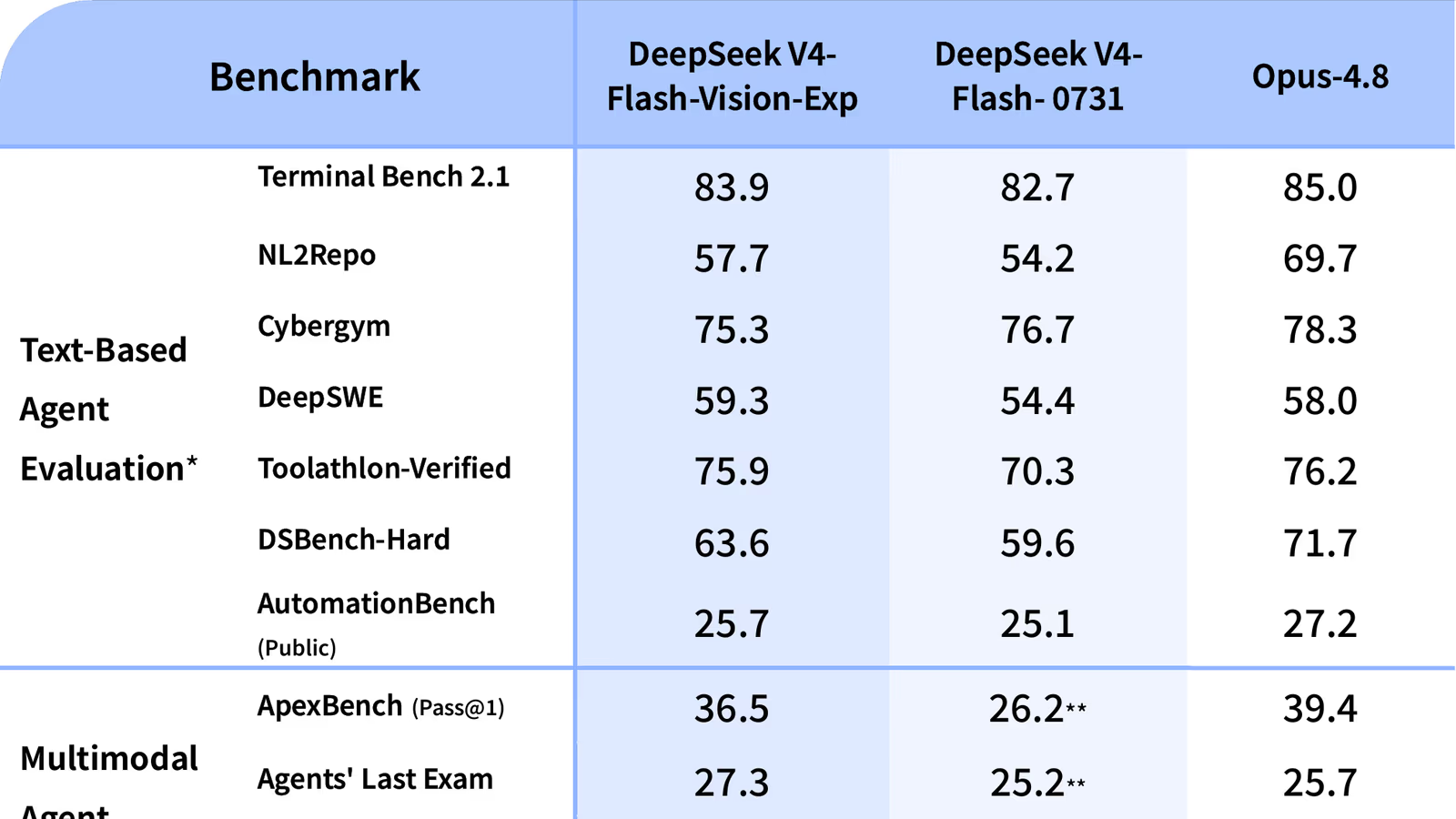
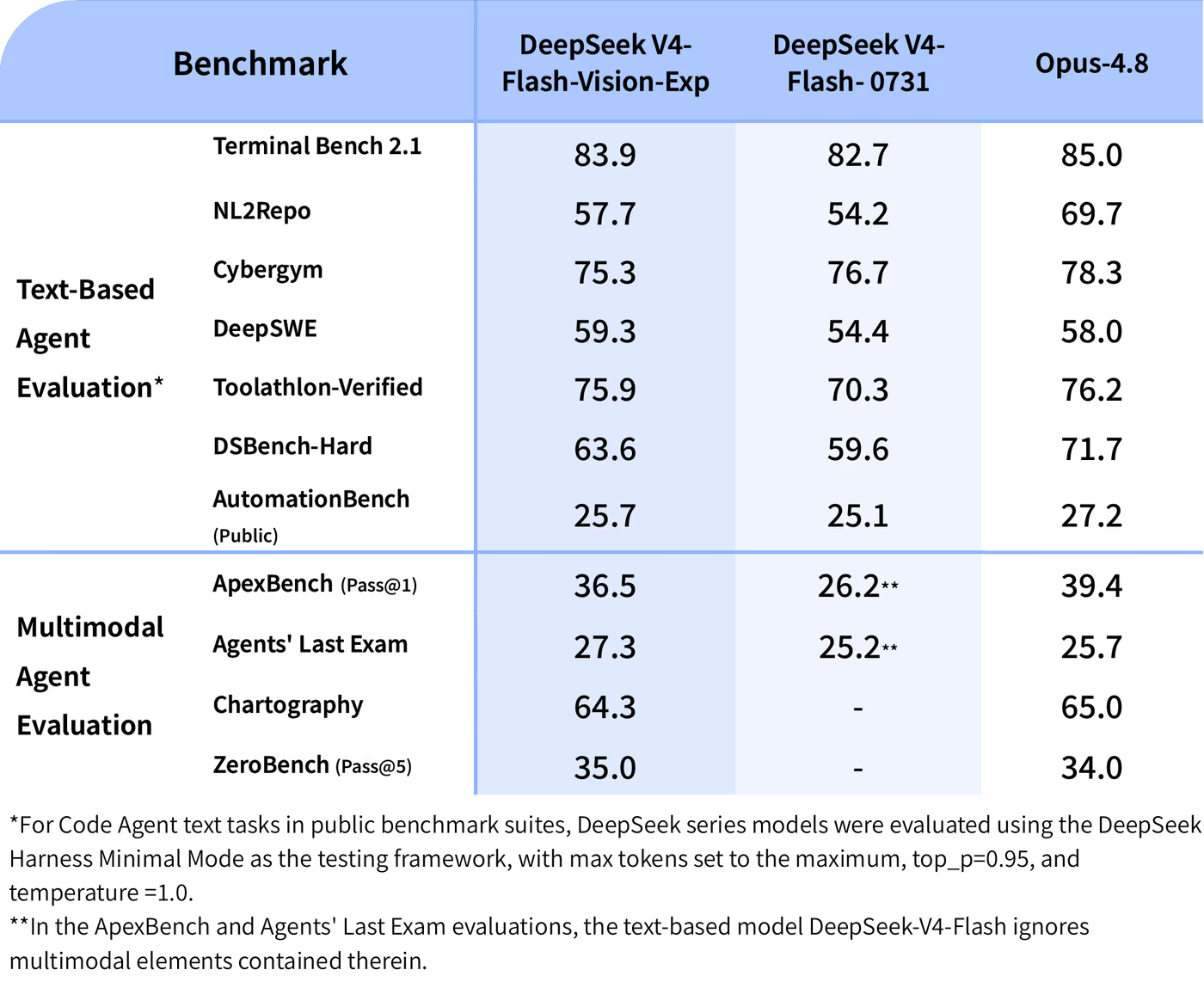
DeepSeek's stated goal was parity with V4-Flash-0731 on text - not an improvement, just no regression while vision was added. The actual numbers on DeepSeek's own table are more generous than that framing suggests. Comparing Vision-Exp against 0731 across the seven text-based agent benchmarks DeepSeek published: Terminal Bench 2.1 rises from 82.7 to 83.9, NL2Repo from 54.2 to 57.7, DeepSWE from 54.4 to 59.3, Toolathlon-Verified from 70.3 to 75.9, DSBench-Hard from 59.6 to 63.6, and AutomationBench (Public) from 25.1 to 25.7 - six of seven benchmarks improved, several by meaningful margins (Toolathlon +5.6 points, DeepSWE +4.9, DSBench-Hard +4.0). The single exception is Cybergym, DeepSeek's security-research benchmark, which dips slightly from 76.7 to 75.3. Independent coverage from TheNextWeb made the same observation independently, concluding that DeepSeek's own "matches on text" framing understates what its table actually shows.
Vision understanding: what it can actually see
Practically, Vision-Exp accepts images mixed with text in a single user message, submitted as base64-encoded data, an external HTTP(S) URL, or a file_id from the new Files API. DeepSeek's guide lists document and chart understanding, visual question answering and multimodal agent workflows that interleave text and images as the intended use cases - the kind of task where an agent needs to look at a screenshot, a rendered chart, or a piece of a user interface and reason about what it shows before deciding what to do next, rather than treating vision as a separate, standalone image-captioning feature. One meaningful constraint carries over from the tokenisation design above: images are accepted only in user messages, and DeepSeek's API returns a 400 error if an image appears in a system or assistant message, or if a request tries to reference a reserved image placeholder token directly in user text.
Multimodal agent use: closing the gap on Opus 4.8
This is the headline claim, and DeepSeek is specific about how it frames it: "On multimodal agent benchmarks, V4-Flash-Vision-Exp makes a major leap over V4-Flash, bringing multimodal agent performance close to Opus-4.8." The four multimodal-specific rows on DeepSeek's table back that up directionally - ApexBench (Pass@1) at 36.5 against Opus 4.8's 39.4, Agents' Last Exam at 27.3 against 25.7 (a win), Chartography at 64.3 against 65.0, and ZeroBench (Pass@5) at 35.0 against 34.0 (another win). DeepSeek Harness 0.1.1's day-one support for the model is the clearest signal of intent here: this is being positioned as infrastructure for agent loops that need to look at a screen, a document or a chart mid-task, not as a standalone vision-chat feature.
Benchmarks: DeepSeek's Table vs Independent Checks
DeepSeek published a single eleven-row table alongside the release, splitting seven text-based agent evaluations from four multimodal-specific ones, run through what it calls DeepSeek Harness Minimal Mode with max tokens set to the maximum, top_p=0.95 and temperature=1.0. Reproduced in full below, because the exact numbers matter more than a summary of them:
| Benchmark | Vision-Exp | Flash-0731 | Opus-4.8 |
|---|---|---|---|
| Text-Based Agent Evaluation | |||
| Terminal Bench 2.1 | 83.9 | 82.7 | 85.0 |
| NL2Repo | 57.7 | 54.2 | 69.7 |
| Cybergym | 75.3 | 76.7 | 78.3 |
| DeepSWE | 59.3 | 54.4 | 58.0 |
| Toolathlon-Verified | 75.9 | 70.3 | 76.2 |
| DSBench-Hard | 63.6 | 59.6 | 71.7 |
| AutomationBench (Public) | 25.7 | 25.1 | 27.2 |
| Multimodal Agent Evaluation | |||
| ApexBench (Pass@1) | 36.5 | 26.2** | 39.4 |
| Agents' Last Exam | 27.3 | 25.2** | 25.7 |
| Chartography | 64.3 | - | 65.0 |
| ZeroBench (Pass@5) | 35.0 | - | 34.0 |
The double-asterisk footnote on Flash-0731's ApexBench and Agents' Last Exam scores is DeepSeek's own disclosure, not an outside catch: "the text-based model DeepSeek-V4-Flash ignores multimodal elements contained therein." In plain terms, the text-only model was scored on those two multimodal benchmarks anyway, effectively answering blind to any image content in the test, which is why its scores there (26.2 and 25.2) sit so far below Vision-Exp's (36.5 and 27.3) - a comparison DeepSeek itself flags as not apples-to-apples, and one officechai's independent coverage picked up on directly, calling the resulting gap "somewhat artificial" as a demonstration of genuine vision capability specifically.
Set against Opus 4.8 specifically, the picture independent outlets converged on matches what the table shows on close inspection: Vision-Exp wins three of the eleven rows - DeepSWE (59.3 vs 58.0, +1.3), Agents' Last Exam (27.3 vs 25.7, +1.6) and ZeroBench (35.0 vs 34.0, +1.0) - runs within a point or two on several more (Terminal Bench, Toolathlon-Verified, Chartography, AutomationBench), and trails by a wide margin specifically on NL2Repo (57.7 vs 69.7, a 12-point gap) and DSBench-Hard (63.6 vs 71.7, 8.1 points). TheNextWeb summarised the overall pattern plainly: "An experimental Chinese multimodal model sits within a few points of a supported American model on most benchmarks, wins three of eleven, costs a fraction as much, and trails by twelve points on the hardest task."
The most important caveat applies to every number above: this is DeepSeek's own internal benchmark run, on its own DeepSeek Harness Minimal Mode test harness, with its own methodology disclosed but not independently audited. No third-party lab - Artificial Analysis, LMArena, or an equivalent neutral evaluator - had published a reproduction of this specific table at the time of writing. Given that previous DeepSeek releases have shown real gaps between vendor-reported and independently measured scores (documented at length in our V4-Pro 0813 review, where a neutral-harness Terminal Bench re-test came in 33 points below DeepSeek's own figure), the same caution applies here until an outside test exists.
Safety & Moderation
DeepSeek's release announcement and Vision API guide contain no dedicated safety section, red-teaming disclosure, or content-moderation framework specific to the vision variant - consistent with DeepSeek's general disclosure posture across the V4 series, which our V4-Pro review and V4 GA review have both flagged as materially thinner than what Western frontier labs publish alongside comparable releases. Adding image understanding to an agentic model introduces a genuinely new attack surface worth naming plainly: a screenshot or rendered webpage an agent is asked to read can itself contain adversarial instructions (text rendered inside an image, deceptive UI elements) designed to redirect the model's behaviour, the visual equivalent of the prompt-injection risk Anthropic's own safety documentation for its browser use tool addresses directly, as covered in our Claude computer use, Skills and Files GA review. DeepSeek has not published equivalent guidance for Vision-Exp at the time of writing.
None of the independent coverage reviewed for this article - Caixin Global, KuCoin/TechFlow, officechai, TheNextWeb or Intelligent Living - reports running or citing a dedicated safety evaluation of the vision variant either; all available commentary focuses on capability and pricing rather than red-teaming or misuse testing. That is a genuine information gap rather than a clean bill of health, and teams deploying Vision-Exp inside an agent that can act on what it sees (clicking, submitting, executing based on image content) should apply the same sandboxing and human-approval practices they would for any model without a published agentic-safety evaluation.
Real-World Use vs Benchmarks
Early independent coverage is notably more measured than DeepSeek's own "close to Opus-4.8" framing, without being dismissive of the release. Intelligent Living's hands-on technical write-up frames the practical case around marginal cost rather than raw capability: agent workflows like UI debugging, document extraction, browser automation, verifying a piece of generated code's output, and comparing several images side by side, where "the marginal cost of adding vision to an agent step is negligible" given the token-flat pricing. That framing lines up with DeepSeek Harness 0.1.1's day-one integration far more than a benchmark-chasing narrative would - this reads as infrastructure being added to an existing agent stack, not a standalone product launch.
The gap between DeepSeek's framing and the independent read is really a gap in how each side weighs the same numbers. DeepSeek's own text is technically accurate - Vision-Exp is genuinely close to Opus 4.8 on several rows - but officechai's and TheNextWeb's coverage both push back on treating "close on most rows, wins on three" as equivalent to parity, particularly given the flagged ApexBench/Agents' Last Exam methodology wrinkle and the clear 8-to-12-point gaps on NL2Repo and DSBench-Hard. Caixin Global's framing situates the release in a wider competitive context rather than a capability claim at all, describing it as "a step in the company's expansion beyond text-based models, as it competes with global rivals to develop more capable, general-purpose AI systems" - a fair description of the release's strategic weight independent of exactly where each benchmark row lands.
Pricing, Access & Rate Limits
Vision-Exp is available today via model='deepseek-v4-flash-vision-exp' across DeepSeek's Chat Completions, Messages (Anthropic-compatible) and Responses API surfaces. Per DeepSeek's live pricing page, checked 22 August 2026, it is billed at exactly the same rate as text-only V4-Flash - there is no vision surcharge:
| Rate per 1M tokens | Off-peak | Peak |
|---|---|---|
| Input (cache miss) | $0.22 (~£0.17) | $0.44 (~£0.35) |
| Input (cache hit) | $0.007 (~£0.006) | $0.014 (~£0.011) |
| Output | $0.66 (~£0.52) | $1.32 (~£1.04) |
Peak hours are 01:00-04:00 and 06:00-10:00 UTC; every other hour bills at the lower off-peak rate. Worth flagging directly: our 31 July review of V4-Flash-0731 quoted a flat $0.14 input / $0.28 output rate and noted that DeepSeek had "signalled upcoming peak/off-peak pricing" not yet in effect. That change has since landed - the off-peak rate itself now sits meaningfully above the old flat rate ($0.22 vs $0.14 input, $0.66 vs $0.28 output), not just the peak tier on top of it. Anyone with cost projections based on the July figures should re-check them against DeepSeek's live pricing page rather than assume the earlier numbers still hold. Third-party aggregator OpenRouter lists Vision-Exp at $0.22 input / $0.66 output per million tokens, matching DeepSeek's off-peak tier exactly.
Images add no separate line item: each is tokenised at up to 384 tokens and billed at the same input rate as text, meaning a single image costs roughly $0.000084 off-peak by DeepSeek's own tokenisation math - a fraction of a US cent, and by Intelligent Living's estimate, "1/10th to 1/170th" of what comparable vision calls cost on some competing platforms, though that comparison depends heavily on which specific model and image size is being compared. Context window and output limits carry over unchanged from V4-Flash: 1,048,576 tokens of context, up to 384,000 tokens of output, and a default account concurrency limit of 2,500 requests.
The new DeepSeek Files API, launched the same day, is free to use: upload an image once and reference it by file_id across multiple requests rather than re-sending the same base64 payload every time, which both saves request bandwidth and avoids repeatedly re-tokenising an unchanged image. It supports larger per-file limits (64 MiB) than inline submission (32 MiB) and, per Intelligent Living's reporting, roughly 25GiB of total storage. This is a distinct service from Anthropic's own Files API, which reached general availability one day earlier with a 500MB per-file, 1TB per-organisation ceiling - two labs, two separate products, similar concept, no interoperability between them.
Open weights are, at the time of writing, not part of this release. Both V4-Flash-0731 and V4-Pro 0813 shipped as open weights on Hugging Face; Vision-Exp has not, and DeepSeek has not committed to whether or when an open-weight version might follow. The "Exp" suffix in the model ID is a genuine signal, not just branding - DeepSeek's own documentation notes the model name itself may change in future iterations as the experimental model matures.
Limitations
- Every comparative benchmark figure is DeepSeek's own internal run. No independent lab had reproduced this specific table at the time of writing, and DeepSeek's V4 family has a documented history of gaps between vendor-reported and neutral-harness results.
- Wide gaps remain on two of eleven rows: NL2Repo trails Opus 4.8 by 12 points, DSBench-Hard by 8.1 points.
- The multimodal comparison methodology has a disclosed wrinkle: two of the four multimodal benchmark rows compare against a text-only baseline that ignores image content entirely, a gap DeepSeek itself footnotes and independent coverage has flagged as making the "major leap" framing partly artificial on those specific rows.
- Fixed 384-token image budget caps effective resolution at roughly 800×800 pixels regardless of the source image's actual size - fine text or fine visual detail beyond that may not survive the tokenisation step.
- No open weights, unlike the base V4-Flash-0731 and V4-Pro releases, and no committed timeline for one.
- No published safety or red-teaming framework specific to the vision variant, despite the genuinely new attack surface image-borne adversarial content introduces for agentic use.
- Experimental status: the model ID itself may change in future iterations, per DeepSeek's own documentation - not a stable, versioned release like V4-Flash-0731.
- No comparison against Claude Opus 5, Anthropic's more recent flagship (launched July 2026, ahead of Opus 4.8) - every comparison DeepSeek published, and every figure in this article, is against Opus 4.8 specifically.
How It Compares
Against Claude Opus 4.8, the honest summary is the one independent coverage converged on: close on most rows, ahead on three, clearly behind on two, at a fraction of the price. Neither Claude Opus 5 nor Anthropic's July 2026 flagship line appears anywhere in DeepSeek's comparison table, which is itself informative - the released numbers are being measured against Anthropic's previous-generation model, not its current one. Anthropic's own most recent multimodal-adjacent move, the 20 August 2026 GA of computer use, a new browser use tool, the Skills API and the Files API on the Claude platform (covered in full in our dedicated review), targets a related but distinct problem: acting on a live desktop or browser via screenshots and an accessibility tree, rather than DeepSeek's narrower focus on understanding a submitted image within an agent's reasoning step. The two are complementary capabilities more than direct competitors - one is about perceiving an image handed to the model, the other about operating a real interface the model is driving itself.
Within DeepSeek's own line-up, Vision-Exp is a genuinely new axis rather than a replacement for anything. V4-Flash-0731 remains the right choice for pure text and code workloads at a lower, more established price point; V4-Pro 0813 remains DeepSeek's larger flagship for workloads that don't need vision at all. Vision-Exp only makes sense once an agent pipeline actually needs to look at something - a screenshot, a chart, a document photo - as part of its reasoning, at which point it is currently DeepSeek's only option in the V4 family that can do so at all.
Who Should Use It
Worth trying now: teams already building agentic workflows on DeepSeek's API or DeepSeek Harness who have a genuine need to interpret images mid-task - UI debugging screenshots, document or chart extraction, verifying rendered output, comparing several images in one request - and who can tolerate an experimental, possibly-renamed model ID while treating every capability claim as DeepSeek's own until independently checked. The token-flat, no-premium pricing makes it cheap enough to trial against a real workload without much financial risk.
Better to wait, or use something else: anyone who needs open weights (not available for this variant), anyone whose workload depends heavily on NL2Repo-style or DSBench-Hard-style tasks specifically, where the gap to Opus 4.8 is widest by DeepSeek's own numbers, anyone who needs a documented safety and red-teaming framework before deploying a vision-capable agent with real-world write access, and anyone who wants a stable, versioned model ID rather than an experimental one that may change.
The Bottom Line
DeepSeek-V4-Flash-Vision-Exp is a real, useful expansion of DeepSeek's API line-up rather than a flagship-chasing headline release. It genuinely adds vision without regressing text performance - by DeepSeek's own numbers, it slightly improves on most text benchmarks rather than merely matching them - and it does so at no extra cost per image, which is the detail most likely to matter for anyone actually wiring it into a production agent. The multimodal agent gains over Opus 4.8 are real on three of eleven rows and competitive on several more, but the "close to Opus-4.8" framing deserves the same scrutiny this site has applied to every other DeepSeek self-reported table: unverified by an outside lab, and resting in part on a comparison methodology DeepSeek itself footnotes as imperfect.
Treat this as what it is: an experimental, API-only, no-open-weights preview that is genuinely worth testing against a real multimodal agent workload given the negligible marginal cost, but not yet a settled verdict on how DeepSeek's vision capability stacks up once independent evaluators get a look at it.
Last updated: 22 August 2026. Sourced from DeepSeek's official release announcement, Vision API guide and live pricing page, plus independent coverage from Caixin Global, KuCoin/TechFlow, officechai, TheNextWeb and Intelligent Living. This article will be revised if an independent evaluator publishes a reproduction of DeepSeek's benchmark table or a dedicated safety evaluation of the vision variant.
Get the free guide: Claude vs ChatGPT, Gemini & Grok
A 20-page playbook covering everything you need to choose and use the big four AI models in 2026, full cost and feature comparisons, what each is best (and worst) at, and how-tos for images, vectors, building a website, Claude Code and more.