 AI Tools Review Editorial Team
Quick Answer:
DeepSeek Harness entered developer preview on 13 August 2026: an MIT-licensed, provider-agnostic agent framework built around the idea that every layer - inference, tools, session state, the agent loop itself - is a replaceable plugin. It launched alongside the GA release of DeepSeek-V4-Pro, whose own published benchmarks show large jumps over the preview build (DeepSWE +49.9 points, Cybergym +30.6). It is a genuine open-source alternative to closed agent products like Claude Code, but it is early: version 0.1.0-rc.5 with explicit breaking-change warnings, and a new peak/off-peak pricing structure for V4-Pro that is, despite the framing, a real price increase over the old flat rate.
DeepSeek spent most of 2025 and early 2026 being covered as a model company - a lab that shocked the market on price-to-capability ratio with its base models. This release is different: it is DeepSeek explicitly building the scaffolding layer that sits on top of a model, the same territory Anthropic occupies with Claude Code. What follows is sourced to DeepSeek's own API documentation, the open-source repository, and independent day-one technical coverage - not launch-day marketing framing.
The most interesting design decision is also the most easily missed one: despite the DeepSeek branding, the harness is not locked to DeepSeek's own models at all.
Same-day coverage of the DeepSeek Harness developer preview launch.
Executive Summary
DeepSeek Harness is a new open-source agent framework, released as a developer preview on 13 August 2026 under the MIT licence, with source available on GitHub at deepseek-ai/deepseek-harness. Its organising idea, stated directly in the project's own README, is "everything is a plugin" - the inference layer, the tool registry, session state, the agent control loop, the execution sandbox, and even the web interface are all separately swappable components built on an internal dependency-injection system called Cordis, rather than a single fixed pipeline.
It shipped the same day as the general-availability release of DeepSeek-V4-Pro, an updated flagship model DeepSeek explicitly built around agentic workloads. DeepSeek's own comparison table shows large jumps over the earlier V4-Pro preview build across several agentic and coding benchmarks - though these are company-reported figures, not yet independently reproduced by a third-party evaluator at time of writing.
- Best for: developers who want a fully open, provider-agnostic agent runtime they can restructure rather than a closed, opinionated product.
- Licence: MIT, source on GitHub, currently at v0.1.0-rc.5 with explicit compatibility-breaking-change warnings.
- Not DeepSeek-locked: supports DeepSeek, Anthropic, OpenAI, Bedrock, Vertex, Azure and custom OpenAI-compatible endpoints as interchangeable inference providers.
- Companion release: DeepSeek-V4-Pro GA, with large self-reported gains on Terminal-Bench, DeepSWE, Cybergym, NL2Repo and Toolathlon-Verified versus the preview build.
- Main caveat: a new peak/off-peak pricing structure for V4-Pro that independent analysis found is a real price increase over the old flat rate, not the discount its framing suggests.
Why Now: DeepSeek's Pivot to Agents
The South China Morning Post framed this release as a strategic pivot: DeepSeek moving beyond raw model intelligence toward the agentic scaffolding that determines whether a model can actually operate real software, run code and complete multi-step tasks unsupervised. That is the same territory Anthropic has occupied with Claude Code, and the same competitive logic behind releases like Hermes Agent and Grok Bot earlier in August - 2026's AI competition has increasingly shifted from "whose base model scores higher" to "whose agent finishes more real tasks."
DeepSeek reportedly hired Cui Tianyu, a former Jane Street engineer, in March 2026 specifically to lead harness development - a hire that signals this was a deliberate, resourced bet rather than a rushed side project bolted onto a model release. Reporting also frames the open-sourcing itself as a deliberate strategic choice: rather than compete purely on a closed product, DeepSeek is trying to become the substrate other developers build agent products on top of, the same playbook that made its earlier base models widely adopted despite - or because of - being freely available.
That playbook has a track record worth noting. DeepSeek's earlier base models gained rapid third-party adoption specifically because they were freely licensed and inexpensive to run, which let smaller teams and independent developers build on top of them without a lab relationship or enterprise contract. Applying the same open, low-friction approach to the agent-scaffolding layer - rather than just the model weights - is a bet that the same dynamic repeats: that being the framework developers reach for by default matters more, over time, than winning any single benchmark cycle outright.
Architecture: Eight Replaceable Layers
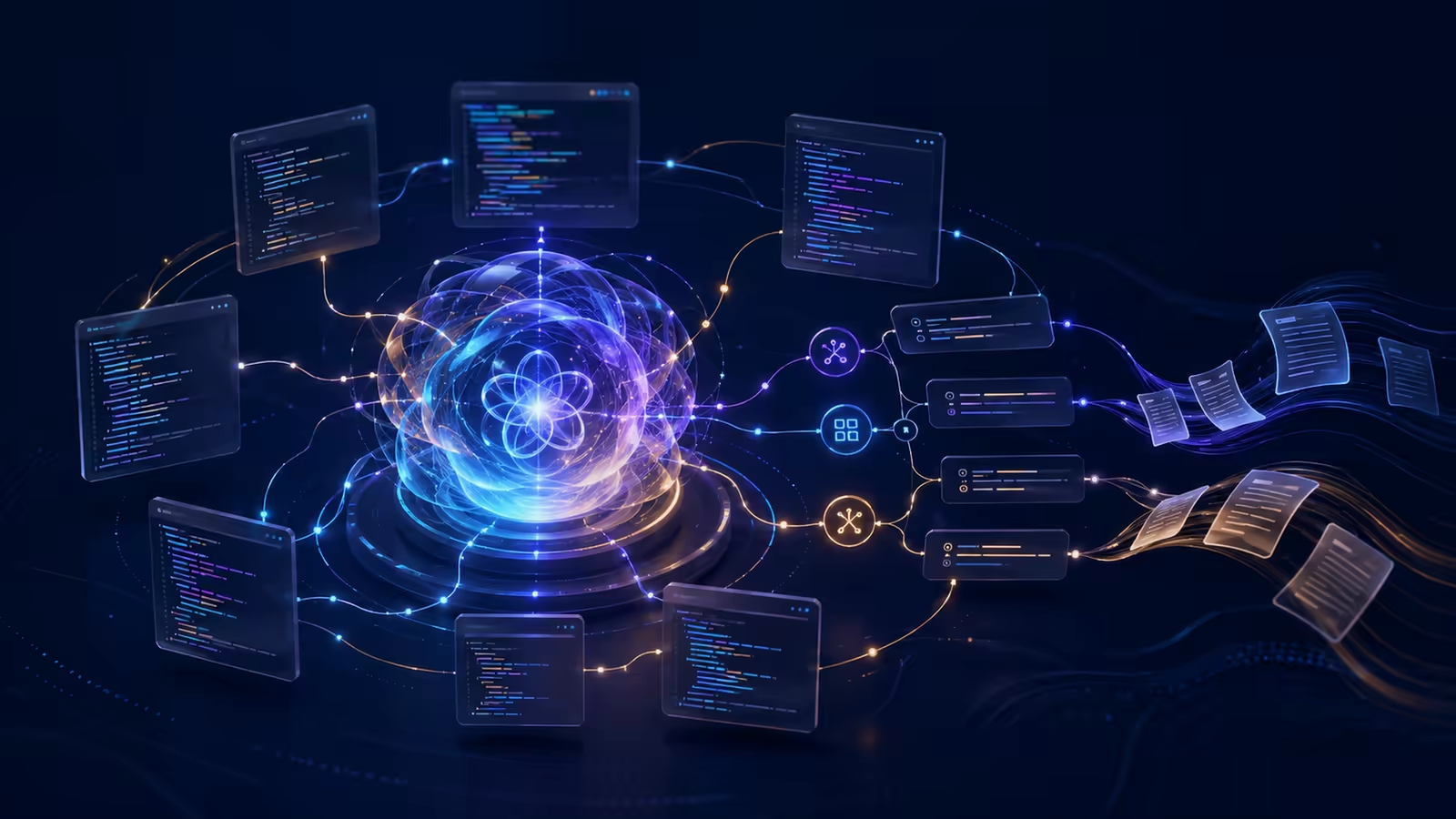
The project's own documentation describes the runtime as eight distinct, independently swappable layers, all wired together through an internal dependency-injection framework called Cordis that supports reversible plugin registration:
| Layer | What it covers |
|---|---|
| Inference | Model adapters and vocabulary handling via ctx.llm - the pluggable connection to whichever model provider is configured. |
| Tools | The tool registry, schemas, policy enforcement and result handling. |
| State | Append-only session event logs with persistence, replay and fork capabilities. |
| Control | The agent registry and loop driver - goals, turns, and step management. |
| Execution | Filesystem, shell, subprocess, terminal and sandbox providers. |
| Composition | Profiles, bundles, patches and runtime overlays for assembling a specific agent configuration. |
| Experience | The bundled web application, conversation nodes and settings UI. |
| Framework | Cordis itself - the service dependency-injection system underneath everything else, with reversible registrations. |
Independent technical coverage from explainx.ai singled this out as "the most radical about composition" among current open agent frameworks - more so than OpenCode, described as a more polished but less flexible open coding agent, or Pi, which takes the opposite approach of a deliberately minimal, non-modular core. Where DeepSeek Harness differs from a typical agent SDK is that this modularity extends all the way down to the dependency-injection layer itself, not just the tool-calling surface most frameworks expose to developers.
What You Can Actually Do With It
A single command, npx @deepseek-ai/dsh web, launches the bundled web UI locally at http://127.0.0.1:3080, giving developers a working agent interface without any custom scaffolding. Reporting describes four operational modes built on top of the same runtime: a standard mode for general tasks, a code-focused mode for multi-application automation, a creative mode for experimenting with custom tools, and a minimal mode for isolated testing - DeepSeek reportedly used minimal mode itself to test DeepSeek-V4-Flash ahead of this release.
Because the inference layer is a plugin, the same harness can drive DeepSeek's own models or point at Anthropic, OpenAI, Amazon Bedrock, Google Vertex, Azure, or any custom OpenAI-compatible endpoint. That is a meaningfully different pitch than a typical model-company agent tool: it positions Harness as infrastructure a team could standardise on regardless of which model wins a given benchmark this quarter, since swapping providers is a configuration change rather than a rewrite.
Beta testers quoted in coverage highlighted that Harness "departed from conventional software tool kits by giving programmers greater control over how their AI agent thinks and acts" - a reflection of the composition layer specifically, which lets developers assemble custom agent profiles from the underlying plugins rather than accepting a single fixed agent personality and tool set.
The MIT licence matters here beyond the usual open-source goodwill: it means a team can fork the project, strip out or replace any of the eight layers, and redistribute the result commercially without asking DeepSeek's permission or paying a licensing fee. For a framework whose entire pitch is architectural flexibility, a permissive licence is close to a prerequisite - a copyleft or source-available licence would have undercut the "compose it however you want" positioning DeepSeek is going for.
The Companion Release: DeepSeek-V4-Pro
DeepSeek-V4-Pro reached general availability the same day, adding native support for the OpenAI Responses API format - specifically adapted for Codex integration - and three selectable thinking-effort levels (low, high, max). DeepSeek's own change-log documentation reports the following gains versus the earlier V4-Pro preview build:
| Benchmark | V4-Pro (0813 GA) | Change vs preview |
|---|---|---|
| Terminal-Bench 2.1 | 87.9 | +15.8 |
| DeepSWE | 62.7 | +49.9 |
| Cybergym | 83.3 | +30.6 |
| Toolathlon-Verified | 74.1 | +18.2 |
| NL2Repo | 61.5 | +23.0 |
These are large, genuinely notable jumps - the DeepSWE gain in particular, +49.9 points, is a bigger single-release move than most frontier labs report on a comparable coding benchmark this year. The important caveat is that every figure above is DeepSeek's own reported number against its own preview build, not an independently reproduced result from a third-party evaluator like Artificial Analysis. Treat the direction (a real, large improvement) as credible given the consistency across five different benchmarks, but treat the exact magnitude as company-reported until independently confirmed.
Safety, Sandboxing & Maturity
DeepSeek Harness's Execution layer explicitly separates filesystem, shell, subprocess, terminal and sandbox providers into distinct, independently configurable plugins - a design that lets a developer run agent-generated code inside a restricted sandbox provider rather than directly on a host filesystem, if they choose that configuration. That is a meaningful safety-relevant design choice, but it is a capability the framework offers rather than a default it enforces; how safely a given deployment runs depends on which execution plugin an operator selects.
DeepSeek's own repository is explicit that this is a developer preview, currently versioned 0.1.0-rc.5, with a direct warning that there will be compatibility-breaking changes as the project iterates. That is not a criticism so much as a fact worth weighing heavily: this is pre-1.0 infrastructure, and production deployments should expect to track breaking changes actively rather than treat the current API surface as stable. Neither DeepSeek nor the independent coverage reviewed for this article references a published model card or Frontier-Safety-Framework-style evaluation specifically for the harness itself, as distinct from DeepSeek-V4-Pro the model - safety disclosure here is thinner than what labs like Google or Anthropic publish for comparable agentic tooling.
Pricing: The Peak/Off-Peak Catch
See our DeepSeek Harness tool listing for a quick-reference spec summary alongside other tracked models.
DeepSeek Harness itself is free and open source - MIT-licensed, self-hosted, with no separate framework fee. The cost is whichever inference provider you plug into it, and for DeepSeek's own models specifically, the pricing structure changed the same week as this release. From 16:00 UTC on 16 August 2026, DeepSeek-V4-Pro moves from a flat per-token rate to peak/off-peak pricing:
| Token type | Off-peak $/1M | Peak $/1M |
|---|---|---|
| Input, cache hit | $0.022 (~£0.02) | $0.044 (~£0.03) |
| Input, cache miss | $0.66 (~£0.52) | $1.32 (~£1.04) |
| Output | $1.98 (~£1.56) | $3.96 (~£3.12) |
Peak hours are 01:00-04:00 and 06:00-10:00 UTC - windows that, for UK and European users, land overnight and early morning respectively, meaning much production daytime usage from those regions falls in off-peak. Independent analysis from explainx.ai flagged the framing directly: off-peak is presented as a discount, but is actually roughly 2.28x the previous flat output rate, and peak pricing is roughly 4.55x that old rate. This is a genuine price increase dressed in discount language, not the cost-neutral restructuring the "off-peak savings" framing implies - worth budgeting for explicitly if you're already running V4-series workloads at volume.
Real-World Reception vs the Announcement
VentureBeat's coverage led with the framing that stuck across most outlets: DeepSeek Harness as "open source rival to Claude Code," launched "alongside V4-Pro on API with higher prices" - a headline that captures both halves of this release accurately, the ambitious open-source agent play and the less flattering pricing change, in one line. The South China Morning Post's framing emphasised the strategic pivot angle over the technical specifics, positioning this as DeepSeek repositioning itself in the agentic-AI market rather than simply shipping a new tool.
Developer-focused coverage from explainx.ai and Pandaily concentrated on the plugin architecture itself, and both were careful to flag the developer-preview status and breaking-change warnings rather than present this as a finished product - a more measured take than the pure "Claude Code rival" framing might suggest to a reader who only sees the headline.
Limitations
- Developer preview, not stable: version 0.1.0-rc.5 with explicit compatibility-breaking-change warnings from the project itself.
- V4-Pro benchmarks are company-reported: the large gains over the preview build have not yet been independently reproduced by a third-party evaluator at time of writing.
- Real price increase, not a cut: new peak/off-peak V4-Pro pricing runs roughly 2.28x to 4.55x the previous flat output rate, despite the off-peak framing.
- Thin safety disclosure for the harness itself: no published model-card-equivalent or safety evaluation specific to the agent framework, distinct from V4-Pro the model.
- Sandboxing is optional, not default: the Execution layer supports sandboxed providers, but safe configuration is a deployment choice rather than an enforced default.
- New project, unproven at scale: unlike Claude Code's multi-year production track record, Harness is days old at time of writing.
How It Compares
Against Claude Code, DeepSeek Harness trades a polished, closed, deeply-integrated product for a raw, MIT-licensed, provider-agnostic runtime - a genuinely different trade-off rather than a strict upgrade or downgrade. Teams that want to own their agent stack end-to-end, or that need to run multiple model providers behind one interface, gain real flexibility Claude Code doesn't offer by design. Teams that want a finished, supported product with a long production track record are better served staying with Claude Code for now.
Against other 2026 agent launches like Hermes Agent and Grok Bot, Harness is the most architecturally radical in how far its modularity extends - down to the dependency-injection layer, not just tool definitions - but it is also the newest and least battle-tested of the three. Model-for-model, DeepSeek-V4-Pro's self-reported coding gains sit alongside a similar week of releases from Gemini 3.7 Flash and GPT-5.6 Terra, all leaning hard into agentic and coding workloads specifically - the frontier's competitive centre of gravity has clearly shifted there for this cycle.
Who Should Use It
Choose DeepSeek Harness if you want an open-source, self-hostable agent runtime you can restructure at every layer, need to run multiple model providers behind a single interface, or are building infrastructure you want full control over rather than depending on a closed vendor product - and you can tolerate active breaking changes on a pre-1.0 project.
Look elsewhere if you need a stable, supported, production-proven agent product today, you specifically want DeepSeek-V4-Pro's independently-verified performance before committing (the current gains are company-reported only), or the new peak/off-peak pricing structure doesn't work for your usage pattern once actual costs are modelled rather than assumed from the "off-peak" label.
The Bottom Line
DeepSeek Harness is a genuinely ambitious, well-designed piece of open infrastructure - the eight-layer plugin architecture and provider-agnostic inference layer are real technical differentiators, not marketing dressing, and the strategic logic behind DeepSeek building it (hiring a dedicated lead months in advance, shipping it MIT-licensed) is sound. It arrives as exactly what it says it is: a developer preview, not a finished Claude Code replacement.
The companion V4-Pro release is the more mixed half of this story. The self-reported benchmark gains are large and consistent enough to take seriously, but they are still self-reported, and the new pricing structure is a real cost increase for existing users regardless of how it's framed. Judge the harness on its architecture and openness, judge V4-Pro cautiously until independent benchmarks land, and model the new pricing against your actual usage pattern before assuming "off-peak" means cheaper.
Last updated: 15 August 2026. Sourced from DeepSeek's official API documentation and change log (api-docs.deepseek.com), the deepseek-ai/deepseek-harness GitHub repository, and launch-day reporting from VentureBeat, the South China Morning Post, explainx.ai and Pandaily.
Get the free guide: Claude vs ChatGPT, Gemini & Grok
A 20-page playbook covering everything you need to choose and use the big four AI models in 2026, full cost and feature comparisons, what each is best (and worst) at, and how-tos for images, vectors, building a website, Claude Code and more.