 AI Tools Review Editorial Team
DeepSeek has a habit of shipping first and documenting later, and the V4.1 Flash beta is that habit taken to its logical extreme: no launch post, no model card, just a message in an official community group on the afternoon of 8 September 2026 telling API users to swap their model name and see what happens. Forty-eight hours later, on 9 September 2026, that is exactly where this review finds it - live, fast by every informal measure so far, and almost entirely undocumented by the company that built it.
This piece works through what DeepSeek has actually confirmed about V4.1 Flash, what independent testers and tech press have measured in the two days since, official pricing during the beta window, and how it lines up against the V4-Flash and V4-Pro tiers it is expected to reshape once it moves out of beta on or around 10 September 2026.
WorldofAI's hands-on test of the V4.1 Flash beta across coding, 3D simulations, games, agentic tasks and vision, published 9 September 2026.
Executive Summary
DeepSeek-V4.1-Flash is, at the time of writing, a limited-access API beta rather than a finished, documented release. It appeared without a launch post: DeepSeek posted a notice in its official user community groups at around 3pm Beijing time on 8 September 2026 announcing an "intermediate version" test build, accessible to any existing API account by pointing the model parameter at deepseek-v4.1-flash-expires-on-0910. That ID is designed to stop working automatically on 10 September 2026, and DeepSeek's own site has separately indicated a full public release is planned around that same date.
The headline claim, relayed via DeepSeek's community notice and reported by multiple outlets including PANews, CellCog and BigGo, is that V4.1 Flash uses an entirely new model structure with native multimodal support - text, image and audio processed by one unified architecture, rather than the separate vision-adapter approach DeepSeek used for August's V4-Flash-Vision-Exp. DeepSeek says the result is stronger capability, faster responses and lower operating cost, but has not published figures to quantify any of those three claims.
- Best for: early adopters and teams already on DeepSeek's API who want a preview of where the Flash tier is headed - not for anyone who needs a stable, documented model ID in production this week.
- What's confirmed: beta window (8-10 September 2026), 20-concurrent-request cap, billing matched to the existing V4-Flash rate, and a "new architecture, native multimodal" description from DeepSeek itself.
- What isn't confirmed: parameter count, context window, a benchmark table, a system card, or open weights - none of these have been published by DeepSeek as of 9 September 2026.
- Main caveat: every speed and quality figure in circulation right now, including in this review, comes from community testing or press relays of DeepSeek's internal community notice - not from an official DeepSeek benchmark release.
Lineage: From V4-Flash to a Beta Called V4.1
DeepSeek's V4 family launched on 24 April 2026 with two tiers: V4-Pro, a 1.6-trillion-parameter flagship, and V4-Flash, a 284-billion-parameter, 13-billion-active Mixture-of-Experts model built for cost and speed. Flash got a major post-training refresh on 31 July 2026 (badged V4-Flash-0731, covered in our V4 Flash 0731 review), Pro followed with its own 0813 update in mid-August, and DeepSeek added a bolted-on multimodal variant, V4-Flash-Vision-Exp, on 21 August 2026.
Eighteen days after that Vision-Exp release, on the afternoon of 8 September 2026, DeepSeek's team posted what several outlets describe as an internal test notice in its official community groups: an "intermediate version" of V4.1 Flash, live immediately, self-limiting to 20 concurrent requests, and set to expire on 10 September 2026. No blog post, no Hugging Face model card, no X thread from the official DeepSeek account - just a model ID developers could drop into existing code. DeepSeek's own website has reportedly signalled plans for an official V4.1 Flash release around 10 September 2026 Beijing time, which lines up with the beta's expiry, suggesting this two-day window functions as a public stress test ahead of a fuller launch rather than the launch itself.
One detail worth flagging for context: DeepSeek's feedback form for beta testers reportedly asks whether V4.1 Flash could "fully replace the online DeepSeek V4 Pro". Multiple outlets also report that once V4.1 Flash officially launches - but before any V4.1 Pro exists - requests that would previously have gone to V4-Pro will be automatically routed to V4.1 Flash instead. Read together, that is a fairly direct signal that DeepSeek sees this Flash-tier update as a genuine replacement for its current flagship's day-to-day traffic, not just an incremental Flash refresh.
Architecture & What DeepSeek Has Actually Said
This is the section where honesty matters most, because it is also where the least has been confirmed. DeepSeek's community notice - relayed in translation by outlets including IT之家, Phoenix Tech News and Machine Heart, and independently summarised by CellCog, PANews, BigGo and iGeekPhone - describes V4.1 Flash using four phrases: new model structure, native multimodal support, stronger capability, and faster and cheaper to run. None of those phrases come with a number attached.
"Native multimodal" is the specific, checkable claim in that list, and it does appear to distinguish V4.1 Flash from what came before it. V4-Flash-Vision-Exp, released three weeks earlier, added image understanding as what several developers on the NVIDIA developer forums characterised as a bolt-on adapter to the existing V4-Flash weights. Coverage of V4.1 Flash - including BigGo's reporting - describes it instead as processing text, image and audio inputs "in a unified manner" within one architecture, which if accurate would represent the more significant structural change DeepSeek is alluding to. One commenter on the NVIDIA developer forum thread following the beta offered a more sceptical read: that "new architecture" simply means this is the first model to fold Vision-Exp's capabilities into DeepSeek's next official GA release, rather than a ground-up redesign. Both readings are plausible; neither can be confirmed without DeepSeek publishing an actual architecture description.
What is absent is just as notable. DeepSeek did not disclose a parameter count for V4.1 Flash - unlike V4-Flash-0731 (284B total, 13B active) and V4-Pro-0813, both of which have documented figures. No context-window figure has been officially confirmed either, though third-party API aggregator listings for the beta - including Vercel's AI Gateway model page and a related Hacker News discussion thread - list a 1,000,000-token context window and 384,000-token maximum output, matching the existing V4-Flash tier exactly. That consistency is a reasonable signal, but it is inferred from how the beta is billed and routed, not from a DeepSeek specification sheet.
Capabilities Deep Dive
Coding and agentic tasks
WorldofAI's hands-on test - one of the first full video reviews of the beta, published the same day the test window opened - ran V4.1 Flash across coding tasks, 3D simulations, Three.js environments, browser-style games, agentic workflows and vision inputs. The video's framing ("Fully Tested", "Fast, Cheap, Powerful") is consistent with the broader pattern in early community reaction: testers are impressed with responsiveness and completion speed on multi-step tasks, which lines up with the throughput figures below, though this remains one creator's subjective assessment rather than a scored benchmark.
Response speed
This is where the most consistent, cross-sourced data exists - all of it community-measured, none of it from DeepSeek. Multiple independent testers reported sustained output throughput in the 300-355 tokens-per-second range, with individual peak readings as high as 500-507 tok/s reported separately on X by at least two different testers running unrelated prompts (one generating SVG animation code, another running a general benchmark pass). One test comparing V4.1 Flash directly against V4-Pro found 355 tok/s versus 63 tok/s sustained throughput - a roughly 5.7x gap - and a time-to-first-token of 178ms against V4-Pro's 766ms, a 77% reduction. Separately, a developer on the NVIDIA developer forums reported an average decoding speed around 350 tok/s while shadow-testing a vLLM build against the earlier Vision-Exp variant. These figures come from at least four independent sources measuring similar magnitudes, which is reassuring corroboration - but it is still not the same as DeepSeek publishing its own throughput numbers under disclosed test conditions.
Multimodal input handling
Community reports describe V4.1 Flash accepting text, image and, per some coverage, audio inputs within a single unified request, rather than routing to a separate vision-specific model as V4-Flash-Vision-Exp did. WorldofAI's test included a vision component alongside the coding and agentic tasks. Beyond that, no published evaluation set (equivalent to, say, an MMMU or vision-specific coding benchmark) has been run against V4.1 Flash publicly as of this review.
Benchmarks: What Exists and What Doesn't
There is no DeepSeek-published benchmark table for V4.1 Flash at the time of writing - no Terminal-Bench, DeepSWE, Cybergym or DSBench figures of the kind DeepSeek published alongside V4-Flash-0731 and V4-Pro-0813. That is a meaningful gap given the standard this site has applied to those earlier releases, and it is worth stating plainly rather than filling with estimated or extrapolated numbers.
What does exist is community-generated throughput and latency data, summarised in the table below. Treat every row as informal, unverified, and gathered from social posts and press relays of DeepSeek's internal test notice rather than a controlled benchmark run.
| Metric | Reported figure | Source type |
|---|---|---|
| Sustained output throughput | ~300-355 tok/s | Community X posts / press relay |
| Peak output throughput | Up to 500-507 tok/s | Individual X testers |
| Time to first token | ~178ms (short Q&A ~160ms) | Community benchmark, single test |
| vs V4-Pro throughput | ~5.7x faster (355 vs 63 tok/s) | Single comparative community test |
| DeepSeek official benchmark table | Not published | — |
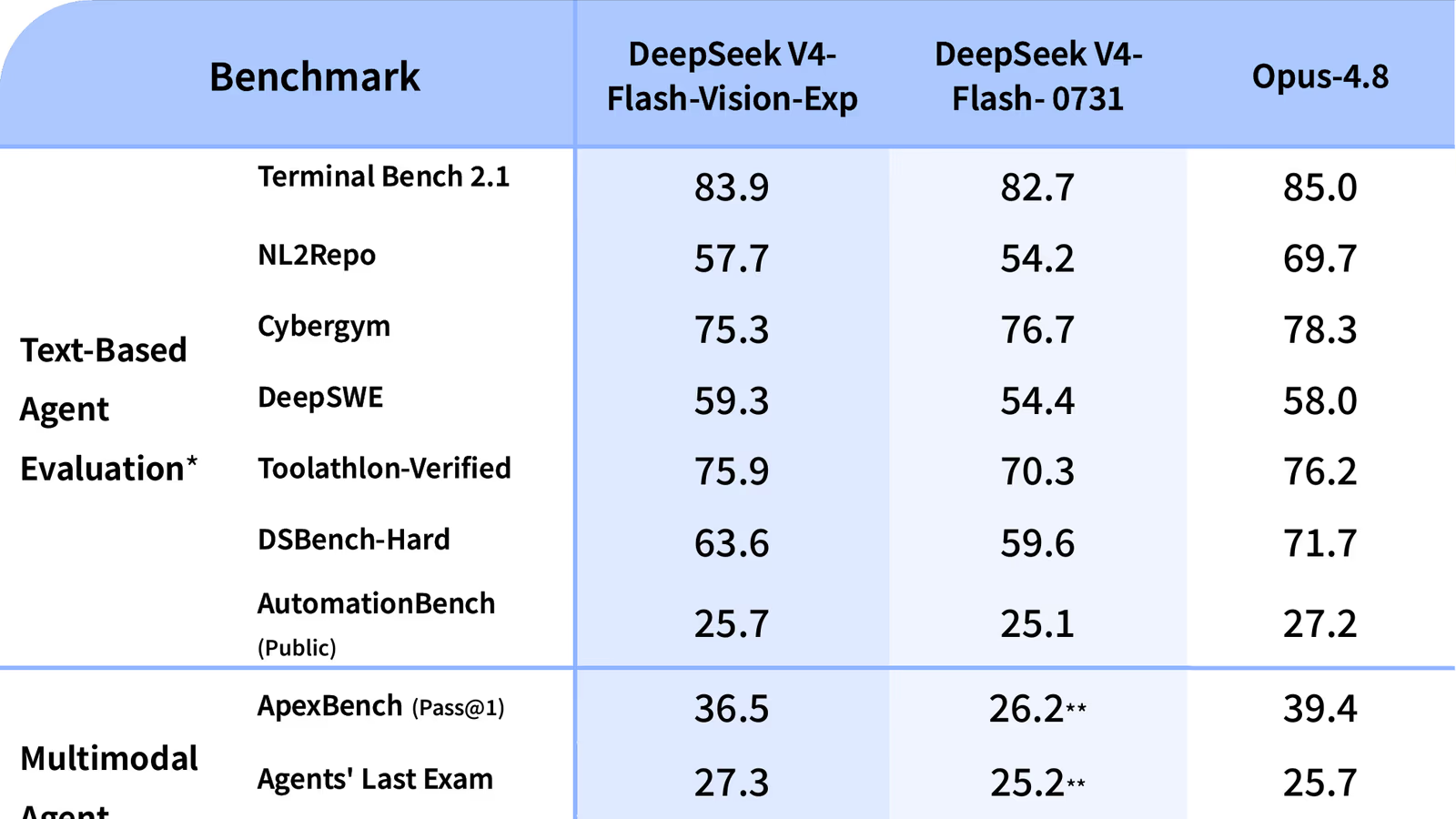
For scale, the confirmed, DeepSeek-published figures for the previous Flash generation give a sense of what a real benchmark table looks like when DeepSeek does release one: V4-Flash-0731 scored 82.7 on Terminal Bench 2.1 and 54.4 on DeepSWE, both ahead of V4-Pro-Preview at the time. Whether V4.1 Flash matches, exceeds or falls short of those figures is genuinely unknown until DeepSeek runs and publishes its own comparison, which the company has historically done on the Hugging Face model card at the point of a tier's full release.
System Card, Safety & Independent Verification
DeepSeek has not published a system card, safety framework, or red-teaming summary for V4.1 Flash, consistent with its general disclosure posture for the V4 series and its own earlier Flash and Pro releases. Given this is a 48-hour internal-style beta rather than a general-availability launch, that is arguably less surprising here than it would be for a full release - but it also means there is currently zero published information about how the model handles the classes of risk Western labs typically disclose: cyber-uplift, biological/chemical misuse potential, or agentic autonomy risk.
The most relevant independent context comes from outside this specific release: NIST's Center for AI Standards and Innovation (CAISI) previously found the wider DeepSeek V4 family's real-world capability lagging roughly eight months behind DeepSeek's own reported figures, and separately found DeepSeek's most permissive configuration complying with 94% of malicious jailbreak requests tested, against 8% for reference US frontier models - though that evaluation ran against the April 2026 preview build, not any later update, let alone this beta. Our DeepSeek V4 Pro 0813 review covers that finding in detail. None of it has been re-run against V4.1 Flash specifically, so it should be read as background on DeepSeek's general disclosure and safety-evaluation track record, not as a direct assessment of this release.
Real-World Testing vs the Claims
The gap between DeepSeek's four-word description ("new architecture, native multimodal, stronger, faster, cheaper") and what independent testers have actually been able to verify in two days is significant, but it isn't a contradiction - it is simply an early, fast-moving beta. Speed is the one dimension where multiple, independent testers converge on similar numbers using different prompts and tools, which is a reasonably strong signal that the throughput gains are real, even without DeepSeek's own confirmation.
Capability claims are harder to verify in a 48-hour window with a 20-concurrent-request cap. WorldofAI's test covering coding, 3D simulation, games, agentic tasks and vision is a genuinely broad hands-on pass and a useful early signal, but one creator's test - however thorough - is not the same as a scored benchmark suite run across dozens of tasks with a published methodology. Anyone deciding whether to build against V4.1 Flash this week should weight the speed data more heavily than the capability claims, simply because the speed data has more independent corroboration behind it.
Pricing, Access & the September 10 Cliff Edge
Access during the beta is simple: any existing DeepSeek API account can call V4.1 Flash by setting the model parameter to deepseek-v4.1-flash-expires-on-0910, using the same base URL and authentication as any other DeepSeek model call - no separate application or waitlist. The account-level concurrency cap is 20 simultaneous requests, a small fraction of V4-Flash's production limit of 2,500, which is the clearest practical evidence that this is a load-limited test rather than a production rollout.
DeepSeek is billing the beta at the existing, official V4-Flash rate: $0.007 (around £0.006) per million input tokens on a cache hit, $0.22 (around £0.17) per million input tokens on a cache miss, and $0.66 (around £0.52) per million output tokens, all at off-peak rates - peak hours (Monday-Friday, 01:00-04:00 and 06:00-10:00 UTC) double each figure. That matches DeepSeek's current published pricing page for deepseek-v4-flash exactly, which is consistent with reporting that beta billing is deliberately unchanged from the existing tier.
What is very likely to change is what happens after 10 September 2026. DeepSeek has separately indicated that new pricing for its Flash-series models takes effect from 12:00pm Beijing time on that date - the same day the beta model ID stops working. Anyone budgeting around today's beta rate should treat it as a temporary number, not a durable one, and check DeepSeek's official pricing page directly once the full V4.1 Flash release lands.
No open weights exist for V4.1 Flash as of this review. That is a departure from V4-Flash-0731, which had community GGUF quantisations on Hugging Face within hours of its API release - a difference worth noting for anyone planning to self-host rather than call the hosted API.
Limitations and Known Unknowns
- No official benchmark table: every performance figure in this review, aside from official V4-Flash-0731 figures used for scale, is community-measured or press-relayed, not DeepSeek's own published data.
- No parameter count or confirmed architecture: DeepSeek has described V4.1 Flash only in qualitative terms; no diagram, technical report or model card exists yet.
- No system card: no disclosed safety evaluation, red-teaming summary or misuse-risk assessment specific to this release.
- Time-limited and low-concurrency: the beta model ID is scheduled to expire on 10 September 2026 and is capped at 20 concurrent requests, unsuitable for production traffic.
- Pricing will likely change: DeepSeek has signalled new Flash-series pricing from 10 September 2026; today's rate is explicitly temporary.
- No open weights: unlike V4-Flash-0731, no GGUF or other community quantisation exists for V4.1 Flash at the time of writing.
How It Compares
| Spec | V4-Flash-0731 | V4-Pro-0813 | V4.1 Flash (beta) |
|---|---|---|---|
| Total / active parameters | 284B / 13B | 1.6T / 49B | Not disclosed |
| Context window | 1M tokens | 1M tokens | 1M tokens (third-party listing) |
| Native multimodal | No (separate Vision-Exp) | No | Claimed, unified |
| Output price / 1M tokens | $0.66 off-peak | $1.98 off-peak | $0.66 off-peak (beta rate) |
| Max concurrency | 2,500 | 500 | 20 (beta cap) |
| Open weights available | Yes (GGUF on HF) | Yes | Not yet |
Against its own predecessor, V4-Flash-0731, V4.1 Flash's pitch is speed and native multimodality rather than a documented capability jump - there simply isn't a benchmark table yet to compare against 0731's well-documented agentic and coding scores. Against V4-Pro-0813, the community throughput comparisons (355 vs 63 tok/s in one test) suggest V4.1 Flash could put real pressure on Pro's remaining reasons to exist for latency-sensitive workloads, which lines up with reports that V4-Pro traffic will auto-route to V4.1 Flash once it launches. Against Claude Opus 4.8 or other frontier-tier models with published system cards and third-party-verified benchmarks, there is currently no basis for comparison at all - and that absence of data is itself the most important fact about where V4.1 Flash stands today.
Who Should Try It (and Who Should Wait)
Try the beta if you already have a DeepSeek API key, want an early read on latency-sensitive agentic or coding workloads, and can tolerate a model ID that stops working on 10 September 2026 with no migration guarantee. Low-stakes experimentation, side-by-side speed testing against V4-Flash-0731, and multimodal-input prototyping are all reasonable uses of a 48-hour beta.
Wait for the full release if you need a stable model ID, a documented benchmark table to justify a technical decision, any published safety or system-card information, or open weights to self-host. For production workloads currently running on V4-Flash-0731 or V4-Pro-0813, there is no urgency to switch before DeepSeek publishes the permanent V4.1 Flash release - likely around 10 September 2026 - with real documentation attached.
The Bottom Line
DeepSeek V4.1 Flash is a genuinely interesting early signal wrapped in almost no official documentation. The consistent, cross-sourced speed data - multiple independent testers landing in a similar 300-500+ tok/s range - is the strongest evidence that something real has changed under the hood, and DeepSeek's own framing ("can it replace V4-Pro") suggests the company thinks so too. But a system with no published parameter count, no benchmark table and no system card is, by definition, not yet a release you can make a considered technical decision against - it is a preview of one.
The honest verdict for 9 September 2026: promising, fast by every informal measure available, and worth watching closely over the next 24-48 hours as DeepSeek's planned full release around 10 September approaches. Come back once the model card, benchmarks and permanent pricing exist before treating any specific number in this space - including the ones in this review - as settled.
Update (18/10/2026): DeepSeek has since shipped a new checkpoint. See our DeepSeek V4.1 Flash 1017 review for the new benchmark table, cost chart and Search and Fetch API.
Last updated: 9 September 2026. This review is based on DeepSeek's official API pricing documentation, its community-group beta notice as relayed by PANews, CellCog, BigGo, iGeekPhone and other outlets, third-party listings from Vercel's AI Gateway and Hacker News, and community speed testing shared on X and the NVIDIA developer forums. No official DeepSeek benchmark table, system card or architecture report for V4.1 Flash existed at the time of writing; figures here will be updated once DeepSeek publishes one.
Get the free guide: Claude vs ChatGPT, Gemini & Grok
A 20-page playbook covering everything you need to choose and use the big four AI models in 2026, full cost and feature comparisons, what each is best (and worst) at, and how-tos for images, vectors, building a website, Claude Code and more.