
 AI Tools Review Editorial Team
Quick Answer:
Grok Bot is xAI's 11 August 2026 beta launch of always-on AI agents: each "Bot" gets its own persistent cloud computer with a browser, filesystem and terminal, signs into your existing tools with your own credentials, and works through multi-step jobs end to end while you are away, only surfacing when something needs your approval. It is bundled into SuperGrok Heavy, Cursor Ultra ($200/month) and Cursor Teams Premium ($120/seat/month), available today on desktop and iOS, with a wider rollout tied to Grok 4.6 promised for later the same week. It is xAI's entry into the "digital labor" category already occupied by Hermes Agent and OpenClaw.
For most of 2026, xAI's product story has been about Grok the chatbot: bigger models, faster image generation, a build-anything creative mode. Grok Bot is a different kind of announcement. It is not a smarter reply in a chat window; it is a computer that keeps running after you stop talking to it.
Here is what actually shipped on 11 August 2026, how the persistent-agent architecture works, what it costs, and how it stacks up against the other always-on agents already fighting for the same territory.
AI Advantage's first-look coverage of Grok Bot the day it launched.
Summary
Grok Bot is xAI's answer to a question every frontier lab has been circling in 2026: what does an AI agent look like once it stops being a chat session you babysit and starts being a colleague you assign work to? xAI's own framing, in its launch post "Introducing Grok Bot," is direct - "AI teammates you can give real work to" - and the product design backs that framing up. A Bot is not a longer context window or a smarter prompt; it is a standing piece of infrastructure with its own computer, its own login sessions, and its own memory of how you like things done.
xAI says the feature began as an internal prototype that "took off across the company," with teams building Bots to handle sales outbound, marketing campaigns, office operations and bug fixes before it ever became a public product. That origin story matters for how to read the launch: this is being positioned as a proven internal tool being opened up, not a speculative bet shipped straight to market.
- Best for: individuals and small teams already inside the xAI/Cursor ecosystem who want a standing agent to run multi-step, multi-app jobs unsupervised.
- Headline mechanic: each Bot gets a persistent cloud VM with a browser, filesystem and terminal, and signs into your tools with your own credentials.
- Access: beta, bundled into SuperGrok Heavy, Cursor Ultra ($200/mo) and Cursor Teams Premium ($120/seat/mo); desktop and iOS today, Android "coming soon."
- Main caveat: this is a beta with no independent benchmark yet, closed-source, and priced through bundled subscriptions rather than a standalone plan.
What Grok Bot Is
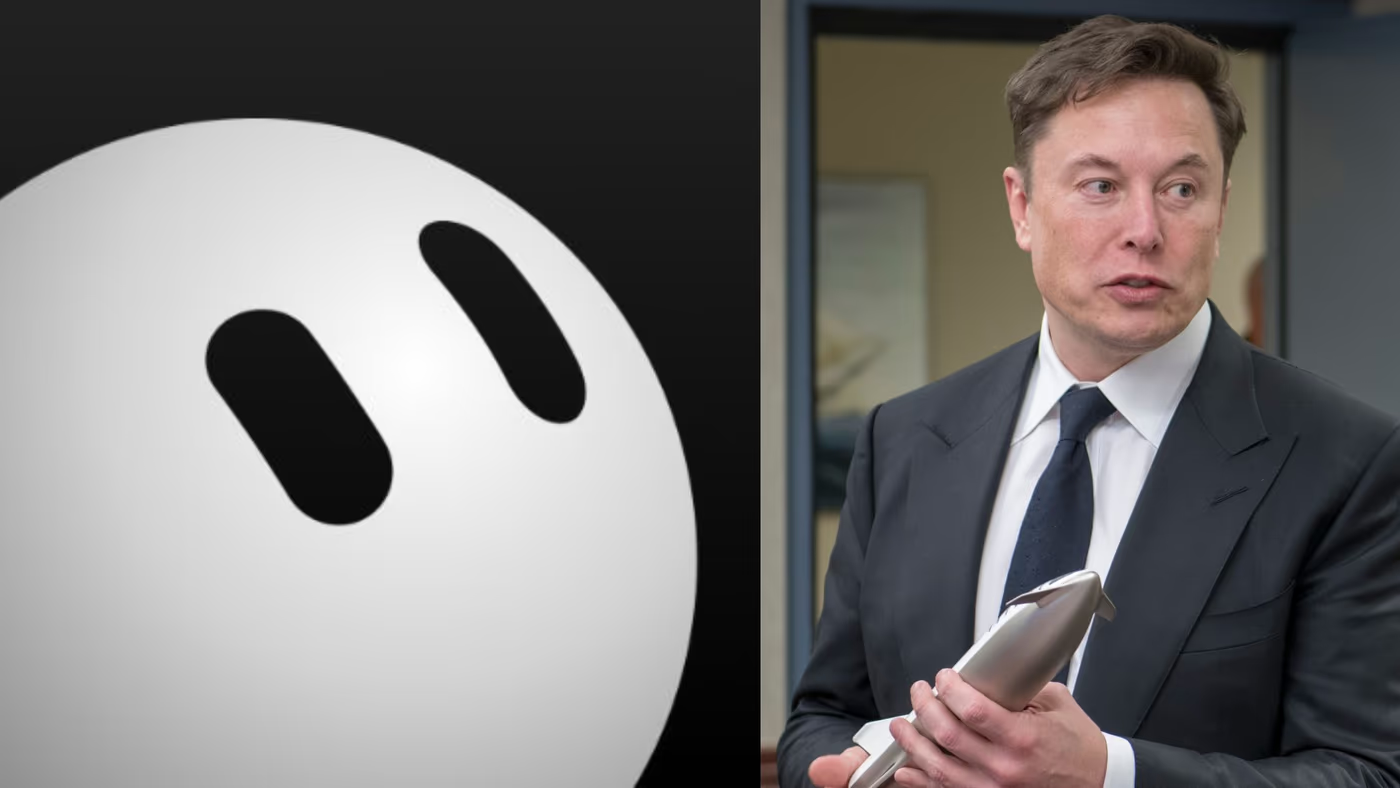
xAI's documentation calls a single Grok Bot "a persistent, named agent, one AI teammate," distinct from the shared chat interface most people know as Grok. Where a chatbot session ends the moment you close the tab, a named Bot keeps its state: files it has created, browser tabs and login sessions it has open, and preferences it has learned from watching you work. That persistence is the entire point. xAI is betting that the value of an agent compounds the longer it has been working with you, in the same way a new employee becomes more useful in their second month than their first day.
Bloomberg's coverage of the launch places it in a wider strategic context: Grok Bot is SpaceXAI's push to extend its product line beyond models and chat into what the industry has started calling digital labor, agents built to complete knowledge work rather than merely draft a response to it. That framing puts Grok Bot in direct competition not with other chatbots, but with agent-harness products like Hermes Agent and OpenClaw, both of which made the same "always-on teammate" pitch earlier in the year.
How It Works: The Persistent Cloud Computer
The technical core of Grok Bot is what xAI calls a persistent cloud VM: a virtual machine with a browser, a filesystem and a terminal that stays running independently of whether your own device is on. According to xAI's developer documentation, all of a user's Bots actually share one persistent cloud computer that is isolated to the account rather than to an individual Bot, which is what lets different Bots hand off files, browser sessions and app logins to each other without repeating setup work each time.
This is a meaningfully different architecture from a typical browser-automation agent that spins up a fresh, stateless session for every task. Because the VM persists, a Bot can be given a job, go idle for hours while an approval is pending, and pick the job back up exactly where it left off, including any half-open browser tab or partially filled form. xAI's stated design goal is to let Bots operate interfaces the way a person does rather than depending exclusively on formal software integrations, which means Grok Bot can, in principle, work inside tools that have no API and no Model Context Protocol connector at all.
Practically, that shows up in three capabilities xAI highlights: computer use (signing into and operating apps and websites, plus using MCP connectors where they do exist), multi-tool coordination (working across several systems in one job, with independent Bots able to collaborate with each other), and learning from demonstration (watching a user perform a workflow once and persisting it as a reusable routine for next time).
Key Features
- Own credentials, own logins: a Bot signs into the tools you already use with your own account, rather than requiring a separate integration to be built for each app.
- Runs while you're offline: because the VM is cloud-hosted and persistent, a job keeps progressing even with your laptop closed or powered off.
- End-to-end completion, human-in-the-loop only where needed: Bots are designed to finish a job fully and only return to the user when something specifically requires approval, rather than checking in at every step.
- State persistence across turns: memory, files, browser sessions and preferences carry over between interactions instead of resetting.
- Learns from demonstration: a user can show a Bot a workflow once, and it can persist that process as a reusable routine.
- Bot-to-bot collaboration: because all of a user's Bots share the same underlying cloud computer, they can hand work to one another without redundant setup.
Pricing and Subscription Tiers
Grok Bot is not sold as its own standalone product; access is bundled into three existing subscriptions. Cursor Ultra, at $200 a month, includes Grok Bot's own computer, tool sign-ins, scheduled routines, and desktop and mobile access with extended AI token limits. Cursor Teams Premium, at $120 per seat per month, adds centralised billing, a team marketplace, shared usage analytics and SAML/OIDC single sign-on on top of the same core Bot capability. SuperGrok Heavy subscribers also get Grok Bot included, though xAI has not published a separate price specifically for the Bot feature within that tier. Enterprise access beyond these tiers is currently gated behind a sales-led waitlist rather than a self-serve plan.
That pricing structure is itself a signal about who xAI expects to adopt Grok Bot first: it rides on top of Cursor, a developer-focused coding environment, more than it opens a low-cost consumer on-ramp. Treat the $200 and $120 figures as beta-era pricing; xAI has not committed to holding them steady once the promised Grok 4.6-tied rollout widens access.
Availability and Platforms
Grok Bot entered public beta on 11 August 2026 for subscribers on the three tiers above, with client apps for desktop, including a Linux build, and iOS. Android support is listed by xAI as "coming soon" without a firm date. Elon Musk said in connection with the launch that a broader rollout tied to Grok 4.6 is planned for later the same week, though as of this article's publication xAI had not confirmed exactly which restrictions that wider release would lift.
The beta label is worth taking literally rather than as a formality. A product this new, gated behind a Linux desktop build and an iOS app with no Android release yet, is still finding its stable feature surface, and early adopters should expect the rough edges that come with any first public version of an agent architecture this ambitious.
Security, Credentials and Approvals
Handing an autonomous agent your own login credentials to operate apps unsupervised is precisely the kind of capability that demands a real security model, and xAI's developer documentation directs users to dedicated pages on security, approvals and privacy rather than treating it as an afterthought bundled into the main product page. The core mechanism is the approval checkpoint: Bots are designed to complete a job end to end and only surface back to the user when something specifically needs sign-off, which implies a permissions layer distinguishing routine actions from ones significant enough to pause for a human.
What xAI has not yet published in detail, as of this article's research, is the specific technical mechanism for credential storage, whether individual Bots can be scoped to a subset of a user's logins rather than all of them, or an independent security audit of the shared persistent VM architecture. Given that all of a user's Bots share one cloud computer rather than each getting fully isolated infrastructure, the practical question for any team evaluating Grok Bot is how tightly that shared environment is sandboxed from other users' Bots, and xAI's own documentation defers those specifics to separate reference pages rather than the launch announcement itself.
Alex Finn's same-day reaction video, testing Grok Bot against the incumbent always-on agents.
Real-World Reception vs the Announcement
Coverage in the hours after launch focused heavily on the gap between "90% done" and "100% done" - a framing xAI itself used internally, with one product team member quoted by Unite.AI saying: "There is a huge difference between 90% done and 100% done. Most AI gets you almost there. Grok Bot can finish the swing." That is a specific, testable claim, and it is also the exact claim every agent product in this category has made about itself at launch, from Hermes Agent's release notes to OpenClaw's original pitch. None of the outlets that covered the 11 August launch reported independent, hands-on verification of task-completion rates; the early coverage is largely a restatement of xAI's own framing rather than adversarial testing.
AI YouTube creators who covered the launch the same day were split between framing Grok Bot as a genuine leap and treating it as a fast-follow on ideas Hermes Agent and OpenClaw had already shipped, in some cases within the same week as Hermes Agent's own major "Herald" release. That timing is unlikely to be coincidental: three well-funded always-on-agent products converging on nearly identical positioning in the same month is a strong signal the underlying idea, a persistent cloud agent with its own login sessions, has become the obvious next move for the whole category rather than one company's unique insight.
Limitations and Open Questions
- No independent benchmark yet: every performance and reliability claim currently traces back to xAI's own launch materials rather than third-party testing.
- Bundled, not standalone pricing: Grok Bot cannot currently be purchased on its own; access requires an existing $120-$200/month Cursor or SuperGrok Heavy subscription.
- Limited platform coverage: no Android app yet, and the desktop Linux build is new enough that broad compatibility is unproven.
- Security detail deferred: the launch materials point to separate documentation for credential handling and sandboxing rather than publishing the full technical model up front.
- Beta-stage stability: as with any first public version of an ambitious agent architecture, expect the feature surface and reliability to shift materially over the following months.
How It Compares
Grok Bot enters a category that already has real incumbents. Hermes Agent, from Nous Research, is free, open-source under the MIT licence, and model-agnostic, letting a user point the harness at whichever LLM they prefer; Grok Bot is closed-source, tied specifically to xAI's own models and infrastructure, and monetised through bundled subscriptions rather than a pay-for-hosting-only model. OpenClaw occupies a similar always-on niche with particularly deep messaging-platform integration. The meaningful differentiators between the three today are openness, which tools each already knows how to sign into out of the box, and pricing model, rather than any settled capability gap; no outlet has published a controlled head-to-head test across all three as of this article.
The comparison to Anthropic's own agent story is more indirect. Claude Code's cross-session messaging and Claude Cowork push in a related direction, giving Claude-based agents the ability to hand off work and operate more autonomously, but neither product frames itself around a single persistent, named "teammate" with its own standing cloud computer the way Grok Bot does. xAI's launch is a distinct product bet on that framing specifically, not simply a faster or cheaper version of what Anthropic or OpenAI already ship.
Who Should Use It
Try Grok Bot now if you already pay for Cursor Ultra, Cursor Teams Premium or SuperGrok Heavy, run repetitive multi-app workflows (sales outbound, marketing operations, routine bug triage) that would benefit from a standing agent with memory, and are comfortable being an early beta user of a security-sensitive product.
Wait if you need Android support today, want a fully published security and credential-handling model before granting an agent standing access to your accounts, or would rather see independent benchmarks and a few months of real-world reliability data before committing a workflow to a brand-new agent architecture.
The Bottom Line
Grok Bot is a serious, well-resourced entrant into the always-on AI agent category, not a minor chatbot feature update. The persistent cloud VM architecture, shared across a user's Bots and built to operate software the way a person would rather than depend solely on API integrations, is a genuine technical bet, and xAI's internal-adoption origin story gives it more credibility than a purely speculative launch would carry.
Whether it actually finishes the swing, xAI's own words, is not yet independently verified, and the bundled pricing, missing Android app, and deferred security documentation are real reasons for caution rather than nitpicks. For anyone already inside the Cursor or SuperGrok ecosystem, Grok Bot is worth testing on a genuinely low-stakes workflow first. For everyone else, the more prudent move is to watch how it performs against Hermes Agent and OpenClaw over the next few release cycles before handing it your own credentials.
Last updated: 12 August 2026. Sourced from xAI's official "Introducing Grok Bot" announcement and developer documentation (docs.x.ai), with pricing and platform detail corroborated by Bloomberg's and Unite.AI's launch-day reporting.
Get the free guide: Claude vs ChatGPT, Gemini & Grok
A 20-page playbook covering everything you need to choose and use the big four AI models in 2026, full cost and feature comparisons, what each is best (and worst) at, and how-tos for images, vectors, building a website, Claude Code and more.