
 AI Tools Review Editorial Team
Quick answer:
Grok Imagine Image 2.0 is xAI's next-generation image model, announced 7 August 2026 and live now as "Quality Mode" in Grok Imagine on the web and mobile apps. It adds region-level editing (a magic wand tool, segmentation, background removal with transparency), multi-reference generation from up to five input images, Smart Resize across nine aspect ratios, and sharper typography for dense, text-heavy compositions. On the Arena leaderboards it ranks second in the world in both text-to-image (1,320 points) and image editing (1,439 points), behind OpenAI's gpt-image-2 in both categories but a clear jump over Grok's own previous model. There is no public API yet, and access is bundled into Grok's paid subscription tiers rather than sold separately.
Julian Goldie SEO's hands-on look at Grok Imagine Image 2.0's editing tools and output quality shortly after the 7 August 2026 rollout.
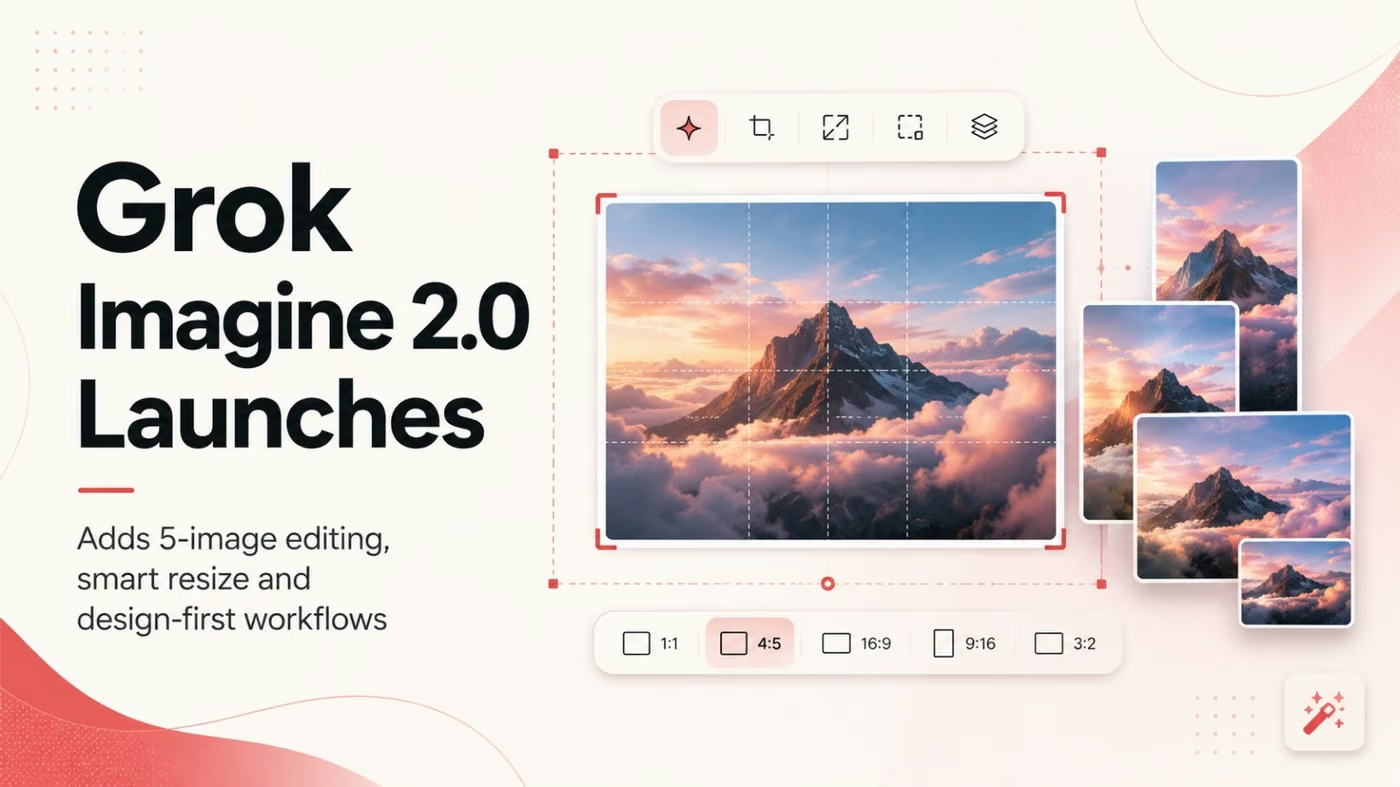
Grok Imagine Image 2.0 shifts xAI's image product towards practical creative work. The 7 August release combines prompt-based generation with precise region edits, multiple reference images and layout-aware typography, bringing the product closer to a usable design tool.
This review separates shipped features from marketing claims, examines the editing workflow and reports the dated Arena standings with their source and limitations.
Note: feature and availability details come from xAI's 7 August 2026 launch page. The Arena positions are a dated snapshot of the Image Edit and Text-to-Image leaderboards as of 7 August, reproduced by xAI on its launch page rather than a permanent measure of model quality. Subscription prices are billed in US dollars.
Summary
- Announced 7 August 2026 by xAI, live as "Quality Mode" in Grok Imagine on grok.com/imagine and the iOS/Android Grok apps.
- Region-level editing: a magic wand tool for targeted edits, segmentation for precise area selection, and background removal with transparent export.
- Multi-reference generation: up to five input images accepted in a single generation or edit.
- Smart Resize recomposes a single image across nine aspect ratios, from 1:2 to 2:1, rather than simply cropping.
- Ranks second in the world on both the text-to-image (1,320 points) and image-editing (1,439 points) Arena leaderboards, behind OpenAI's gpt-image-2 (1,380 and 1,463) in both.
- No public API yet. xAI says access is "coming" with no date; today it is consumer-app-only.
- No standalone price. Bundled into SuperGrok ($30/month) and higher consumer tiers; the free tier lost image generation entirely in March 2026.
What actually shipped on 7 August
xAI announced Grok Imagine Image 2.0 from the product's official account on X on 7 August 2026, with wider press coverage following the next day. It is generally available immediately as the Quality Mode inside Grok Imagine, both on the web at grok.com/imagine and inside xAI's iOS and Android apps, replacing the previous generation model (referred to in Arena listings as grok-imagine-image-quality) as the default high-fidelity option.
The framing throughout xAI's rollout is less "better prompt-to-picture generation" and more "a design tool built on a generative model". Alongside the editing primitives covered below, xAI shipped a set of pre-configured templates aimed at specific commercial use cases: product shots, headshots, e-commerce listings, game assets, icons, sprites, emojis and general marketing material. That template-first packaging is a departure from the single-text-box interface most image generators still ship with, and it signals xAI is chasing the same designer and small-business workflows that tools like Canva and Photoshop's generative features already serve, not just casual meme generation.
The editing toolset deep dive
Magic wand and segmentation
The headline editing feature is a magic wand tool that lets a user point at a specific region of an image and modify only that area, paired with a segmentation capability for selecting more precise, irregular regions before editing. This moves Grok Imagine away from the "regenerate the whole image and hope the rest stays similar" problem that has long frustrated users of prompt-only editing, where even a small requested change can visibly alter unrelated parts of a picture.
Background removal and multi-reference editing
Background removal exports any subject with a transparent background in a single step, a genuinely useful primitive for product photography and marketing assets that previously required a separate tool. Multi-reference editing accepts up to five input images in one generation, letting a user combine a product photo, a background reference and a style reference in a single prompt rather than iterating through several single-image edits.
Smart Resize and typography
Smart Resize recomposes a single generated or uploaded image across nine aspect ratios, reported as spanning from 1:2 to 2:1 and including square, portrait (9:16), landscape (16:9) and the standard 1:1, 4:5 and 3:2 formats, rather than performing a naive crop that can cut off a subject. The model was also specifically tuned for typography and layout planning, aimed at rendering dense, multi-part visuals, posters, infographics, UI mockups, where small text needs to stay sharp and legible, historically one of the weakest points of diffusion-based image generators.
Arena leaderboard rankings: the real numbers
| Model | Text-to-image (Arena) | Image editing (Arena) |
|---|---|---|
| OpenAI gpt-image-2 | 1,380 (#1) | 1,463 (#1) |
| grok-imagine-image-2 / grok-imagine-quality | 1,320 (#2) | 1,439 (#2) |
| grok-imagine-image-quality (previous gen) | 1,228 | 1,390 |
As reported at launch, xAI's new models rank second in the world in both categories: grok-imagine-image-2 scores 1,320 on text-to-image generation, and grok-imagine-quality scores 1,439 on image editing. Both trail OpenAI's gpt-image-2, which holds first place in both categories at 1,380 and 1,463 respectively, a gap of roughly 60 points on generation and 24 points on editing.
The more useful number for judging the release on its own terms is the jump over Grok's own previous model: the outgoing grok-imagine-image-quality scored 1,228 on text-to-image and 1,390 on editing, meaning Image 2.0 gained roughly 92 points on generation and 49 points on editing in a single release, a substantial single-version jump by Arena's usual pace. No independent third party beyond the Arena leaderboards themselves and the outlets citing them had published a separate benchmark of Image 2.0 at the time of writing, and xAI has not published its own numerical scores directly, so these figures should be read as leaderboard snapshots at a point in time rather than a permanent ranking.
Availability and rollout
Grok Imagine Image 2.0 is live today on the web at grok.com/imagine and inside the iOS and Android Grok apps, positioned as the Quality Mode option alongside a faster, lower-fidelity Speed Mode. There is currently no public API: xAI has said API access is coming, but has not published a release date, pricing structure, or documentation, so third-party developers cannot yet integrate the model directly into their own products.
Coverage of the release also noted a branding detail worth flagging for context rather than as a feature: some listings show the new image models under "SpaceXAI" branding, reflecting the corporate restructuring that followed SpaceX's Nasdaq listing in June 2026. This is a corporate-structure note rather than anything that changes what the model does or how it is accessed today.
Pricing and access
| Tier | Price | Grok Imagine access |
|---|---|---|
| Free | $0 | None – image/video generation removed 19 March 2026 |
| SuperGrok Lite | $10/month | Video generation only (480p, up to 6s); not full Imagine |
| SuperGrok | $30/month | Full Imagine access, incl. Image 2.0 and Spicy Mode (iOS/Android) |
| X Premium+ | $40/month | Grok access bundled through X |
| SuperGrok Heavy | $300/month | Full access plus Grok 4.5 flagship model tier |
xAI has not published a standalone per-image or per-token price for Image 2.0; access is bundled into Grok's consumer subscription tiers rather than metered separately. The free tier no longer includes any image or video generation at all, xAI removed that access on 19 March 2026, so a paid plan is required to use Grok Imagine at all today. SuperGrok at $30/month is the entry point for full Image 2.0 access, and also unlocks the R-rated "Spicy Mode" variant on iOS and Android. The cheaper SuperGrok Lite tier covers video generation but is not confirmed to include full Image 2.0 access.
Limitations
- Second place, not first. gpt-image-2 leads both Arena categories Image 2.0 competes in, by roughly 60 points on generation and 24 on editing.
- No API. Developers cannot build on Image 2.0 yet; it is a consumer-app-only release with an unspecified API timeline.
- No free access. Unlike some competitors that offer a limited free image-generation tier, Grok Imagine requires a minimum $30/month SuperGrok subscription for full access.
- No independent third-party benchmark yet. Every performance figure in circulation traces back to Arena leaderboard standings and press coverage of them, not a separate independent evaluation.
- Leaderboard scores are a snapshot. Arena rankings shift as new models are added and re-rated; a second-place finish today is not a permanent standing.
How it compares
Against OpenAI's gpt-image-2, the leaderboard verdict is straightforward: gpt-image-2 leads both text-to-image and editing, and xAI has not published a feature-for-feature comparison to argue Image 2.0 wins on capability instead. Where Grok Imagine 2.0 makes its case is workflow: the magic-wand region editing, five-image multi-reference input, and Smart Resize across nine ratios are a more complete design-tool feature set than a typical single-prompt image generator offers, closer in spirit to a lightweight version of Photoshop's generative fill than to a pure text-to-image model.
Within xAI's own broader model line, Image 2.0 arrives alongside the reasoning-focused Grok 4.5 and the upcoming Grok 4.6 and 4.7 releases, part of a broader August 2026 push across xAI's product line. For the wider assistant-level comparison across Grok, Claude, ChatGPT and Gemini, see our head-to-head comparison; for image generation specifically across the wider field, our AI image generation guide covers the category more broadly.
Who should use it
Worth trying now: existing SuperGrok subscribers who want a genuine editing toolset rather than a single-prompt image generator, particularly for product photography, marketing assets and multi-aspect-ratio social content where Smart Resize and background removal save real editing time; and anyone already inside the Grok ecosystem for chat or video who wants image generation without paying for a separate tool.
Better to wait or look elsewhere: developers who need programmatic API access, since none exists yet; anyone unwilling to pay a minimum $30/month subscription just for image generation, when several competitors offer usable free tiers; and users chasing the single highest-scoring model on Arena specifically, where gpt-image-2 currently leads both categories Image 2.0 competes in.
The bottom line
Grok Imagine Image 2.0 is a genuine step up from its predecessor, roughly 90 Arena points on text-to-image and 50 on editing, and a materially more complete toolset than a single text box: region editing, multi-image references, and resize-aware recomposition are all real, shipped features rather than roadmap promises. It is not, on the numbers xAI itself is implicitly competing against, the best image model available; OpenAI's gpt-image-2 holds first place in both categories it was measured against.
The more practical question for most users is not "which model wins on Arena" but whether the editing workflow is good enough to replace a separate tool, and whether a $30/month subscription that also includes chat and video access is worth it against paying for image generation on its own. For teams already inside the Grok ecosystem, Image 2.0 is a straightforward upgrade. For anyone choosing an image generator from scratch, it is a strong second-place option with a design-tool feature set worth testing directly rather than judging on leaderboard position alone.
Last updated: 10 August 2026, three days after launch, based on xAI's product rollout and independent press coverage. This article will be revised once xAI publishes API access details or independent third-party benchmarks land.
Get the free guide: Claude vs ChatGPT, Gemini & Grok
A 20-page playbook covering everything you need to choose and use the big four AI models in 2026, full cost and feature comparisons, what each is best (and worst) at, and how-tos for images, vectors, building a website, Claude Code and more.