
 AI Tools Review Editorial Team
This piece first ran in June 2026, when GPT-5.5 was the newest confirmed model and every "GPT-6" claim online was pure speculation. Three updates on, the picture has resolved twice over: GPT-5.6 shipped as the flagship family, and Astra, the model this page spent August tracking as named-but-unreleased with an open cyber-capability question, shipped as GPT-6 Astra on 3-4 September.
This is the full, sourced picture, updated for what has actually happened since: the complete GPT lineage through September 2026, the release cadence, the Astra cyber warning and how it resolved at launch, what is genuinely confirmed against the current GPT-7 speculation, and our updated prediction for what ships next.
Note: this analysis draws on OpenAI's own announcements, model release notes, pricing updates and its 7 August 2026 Preparedness Framework statement, alongside contemporaneous reporting on OpenAI's funding rounds and compute deals. Figures quoted from OpenAI's own evaluations are marked as such throughout; independent verification is noted where it exists.
The GPT Timeline So Far
To work out what comes next, you have to see the shape of what came before. The GPT lineage is the clearest cadence story in the industry: slow for years, then relentless through 2025 and 2026.
Here is the confirmed timeline, drawn from OpenAI's own announcements, release notes and contemporaneous reporting.
- June 2020: GPT-3 reaches the OpenAI API in beta, the model that first made large language models a mainstream story.
- March 2023: GPT-4 launches, OpenAI's first genuinely multimodal-capable flagship and the model ChatGPT ran on for over a year.
- May 2024: GPT-4o arrives, OpenAI's first natively multimodal, real-time voice and vision model.
- September 2024: o1-preview and o1-mini introduce dedicated reasoning models, a distinct product line that "thinks" before answering.
- December 2024: The full o1 model ships.
- January to April 2025: o3-mini (31 January), GPT-4.5 (27 February), GPT-4.1 (14 April) and o3 / o4-mini (16 April) land in quick succession, the reasoning and general-purpose lines converging.
- 7 August 2025: GPT-5 launches, unifying the reasoning and non-reasoning lines into a single model family for the first time.
- November to December 2025: GPT-5.1 and GPT-5.2 ship as fast, incremental point releases.
- 10 February 2026: GPT-5.3 Codex launches, within days of Anthropic's Claude Opus 4.6.
- 5 March 2026: GPT-5.4 Thinking and Pro ship, followed by GPT-5.4 mini and nano on 17 March.
- 23 April 2026: GPT-5.5, codenamed Spud, launches, with API access the following day.
- 27 June 2026: GPT-5.6 (Sol, Terra, Luna) enters limited preview.
- 9 July 2026: GPT-5.6 rolls out fully across ChatGPT, Codex and the API, following a US Department of Commerce regulatory clearance.
- 30 July 2026: OpenAI cuts Terra and Luna API prices, keeping Sol as the premium tier.
- Late July 2026: Sam Altman reportedly gives US lawmakers and regulators a private demo of an early Astra checkpoint in Washington.
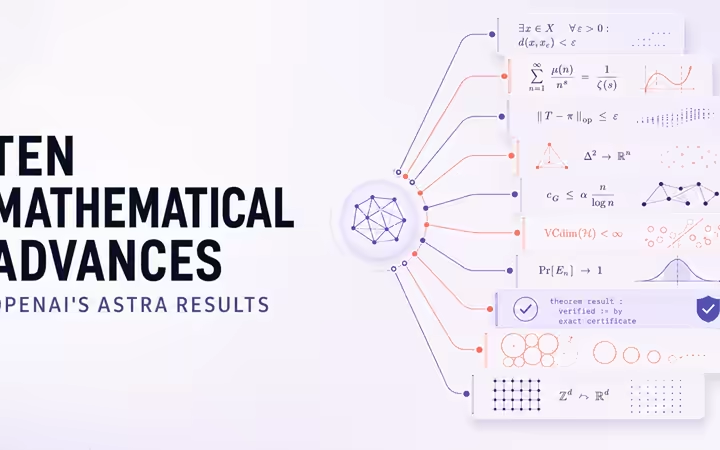
- 1 August 2026: OpenAI names Astra publicly for the first time, via a blog post detailing an internal version's claimed solutions to ten long-standing open problems in mathematics and theoretical computer science.
- 6 August 2026: OpenAI updates Sol's ChatGPT behaviour, reporting a 68% reduction in factual errors on financial, medical and legal prompts in its own internal evaluation.
- 7 August 2026: OpenAI says preliminary Astra evaluations are strong enough that it cannot rule out the model meeting its Preparedness Framework's "Critical" cybersecurity capability threshold, and tightens internal safeguards.
Stepping back, the lineage tells a story in three acts, closely mirroring the pattern on the Claude side. Act one, GPT-3 through GPT-4, was about proving frontier capability existed at all. Act two, GPT-4o through the o-series and GPT-5, was about reasoning and multimodality, culminating in GPT-5's unification of "thinks before answering" and general-purpose chat into one family. Act three, the 5.1 through 5.6 point-release run of 2026, is about speed: a model roughly every four to six weeks, each one narrower in scope than the last. Astra belongs to a fourth act that has only just begun, one defined less by benchmark leaps and more by the safety and regulatory apparatus now wrapped around anything OpenAI calls a frontier model.
One naming note worth fixing early, because it trips up a lot of coverage: GPT-5.6's three tiers, Sol, Terra and Luna, are not separate model generations. They are capability, cost and speed tiers within the same GPT-5.6 family, the same way Sonnet, Opus and Haiku are tiers within a single Claude generation rather than three different products.

Release Cadence & The Gaps
The single most useful signal for predicting the next GPT model is the gap between the last few. Through early 2026 that gap was startlingly short, then it stretched right as Astra entered the picture.
Look at the run from GPT-5.3 onward:
- GPT-5.3 Codex: 10 February 2026.
- GPT-5.4: 5 March 2026, roughly three weeks later.
- GPT-5.5: 23 April 2026, roughly seven weeks later.
- GPT-5.6: preview 27 June, full rollout 9 July 2026, roughly eleven to twelve weeks after 5.5.
That is a clear deceleration from a three-week gap to an eleven-week one, the opposite direction to Anthropic's Opus line over the same period, which compressed from roughly ten weeks to six. Two things plausibly explain it: GPT-5.6's rollout needed a US Department of Commerce regulatory clearance before shipping, the first time a GPT point release has been described as needing that kind of sign-off, and OpenAI's engineering attention through June and July was increasingly split toward Astra, whose maths results post and lawmaker demo both predate GPT-5.6's full rollout.
Since GPT-5.6 shipped, the pattern has been refinement rather than a new number: a price cut on 30 July, a ChatGPT behaviour update to Sol on 6 August. Both are the kind of thing you ship inside an existing release rather than as a new version, which suggests OpenAI's next actual model-number event is Astra, not a GPT-5.7.
There is a naming pattern hiding in the cadence, just as there is on the Claude side. OpenAI has used the decimal point consistently since GPT-5, reserving whole numbers for the rarer, larger jumps (GPT-4 to GPT-5 took two years; the decimal releases in between arrived every few weeks to months). That history matters directly for Astra: OpenAI's own leadership has previously signalled GPT-6 is in training and would arrive faster than the GPT-4-to-GPT-5 gap, but the company has since spent its "big number" announcement not on a GPT-6 launch, but on naming Astra without confirming what number, if any, it will carry.
The Cyber Warning That Changed the Calculus
You cannot answer "what's next?" without understanding what just happened. On 7 August 2026, one week after naming Astra, OpenAI said several days of internal evaluations showed the model making substantial progress in agentic coding and cybersecurity, strong enough that the company could not rule out Astra meeting its Preparedness Framework's "Critical" cybersecurity capability threshold, the level reserved for a tool-augmented model that can independently develop functional zero-day exploits across many hardened systems, or devise and execute novel end-to-end attacks from only a high-level goal.
This is a precautionary disclosure, not a confirmed result. OpenAI has not published the evaluation scores, the specific tasks used, or an external verification report, and it explicitly says Astra was not involved in the separate Hugging Face cybersecurity incident that made headlines the same month. What OpenAI has done is tighten controls: isolated testing environments, restricted network and tool access, stronger model-weight protection, additional monitoring and sandboxed execution, and it has paused internal Astra work that does not meet the strengthened requirements. We cover the announcement and what "Critical" actually means in full in OpenAI Astra Cyber Warning: What 'Critical' Means.
The warning reshapes the roadmap in three ways. First, it adds a governance gate that did not bind GPT-5.6 in the same way: any Astra release will need to clear OpenAI's own Preparedness Framework thresholds, not just product readiness. Second, it means the mathematics results that introduced Astra to the public on 1 August are no longer the headline story about the model, a cybersecurity capability warning is. Third, and most practically, it makes a near-term Astra launch date less likely, not more: a lab that has just said it cannot rule out its next model hitting its highest internal risk threshold has a strong incentive to complete testing before, not after, shipping.
There is a direct parallel worth naming plainly: this is the same shape of event that hit Anthropic's Fable 5 and Mythos 5 in June, a capability disclosure that triggers stricter internal controls right as a model is closest to public release. Anthropic's version came from an external government directive after launch; OpenAI's version is a pre-launch, self-disclosed warning. Which approach proves safer, or simply better at avoiding a post-launch recall, is one of the more interesting open questions in frontier AI governance this year.
Update, 22 September 2026: Resolved.
Every open question in the two sections below, Astra's name, its release date and its cyber-threshold status, has since resolved. OpenAI shipped the model as GPT-6 Astra, rolling it out to approved users on 3 September 2026 with general availability the next day, with tightened safeguards reflecting the August cyber warning. The sections below are kept as the original, dated record of the rumour and warning; see GPT-6 Astra Crosses OpenAI's Critical Cyber Threshold for the full launch review.
What's Confirmed vs Rumoured
This is where most "next GPT model" coverage falls apart, by blending fact and guesswork. Here is the clean separation, as it stood on 8 August 2026, before Astra shipped.
Confirmed (from OpenAI or its own announcements):
- GPT-5.6 (Sol, Terra, Luna) is the current flagship family, fully rolled out 9 July 2026 after a Commerce Department regulatory clearance.
- Astra exists as OpenAI's next major model, publicly named 1 August 2026, with internal versions used to produce claimed mathematics results and demonstrated privately to US lawmakers in late July.
- OpenAI cannot rule out Astra meeting its Preparedness Framework's Critical cybersecurity threshold, and has tightened internal testing controls as of 7 August.
- Astra has no confirmed release date, pricing, public API access or system card.
Rumoured or speculative at the time (since resolved):
- GPT-6 as Astra's name. Resolved: OpenAI shipped it as GPT-6 Astra on 3-4 September 2026.
- A specific Astra release date. Resolved: 3 September 2026 for approved users, 4 September for general availability, about four weeks after the cyber warning.
- A roughly 10-trillion-parameter figure. Still never confirmed by OpenAI for Astra or any other model in this generation.
- A GPT-5.7 point release. No evidence ever surfaced of a distinct GPT-5.7 separate from Astra.
The naming question that this section flagged as the most open item, GPT-6 versus a point release versus the Astra brand alone, resolved in favour of the most direct option: OpenAI used both, shipping GPT-6 Astra as a combined name. Our sister piece, GPT-5.7 and GPT-6 Rumours, tracks the pre-Astra rumour cycle in detail.
What Comes After Astra
With Astra shipped, the ranking this section previously carried (Astra under some name, a decoupled GPT-5.7, a GPT-6 rebrand, or a tiered rollout) has resolved: OpenAI shipped GPT-6 Astra directly, tiered access is confirmed via the safeguards attached at launch, and no separate GPT-5.7 ever materialised. Here is what is actually open now.
1. "GPT-7". As of 16 September 2026, unverified headlines claim OpenAI's next model already targets Gemini Omni 1.1 Flash and Claude Opus 5 on multimodal performance, but OpenAI has named, previewed or documented nothing. Treat this with the same scepticism the original Astra rumours deserved before OpenAI actually named it, real signal eventually arrived then, but only once OpenAI itself said something.
2. A GPT-6.1 or Astra point release. Given OpenAI's own recent cadence (GPT-5.5 to 5.6 in under three months), an incremental Astra refresh addressing any post-launch cyber-safeguard learnings is a reasonable medium-term candidate, mirroring how Anthropic followed Opus 5 with Fable 5.1.
For practical planning, the takeaway is the same shape as on the Claude side: design for the track, not the number. GPT-6 Astra is now your stable reference point for the frontier, with GPT-5.6 Sol as a cheaper, longer-evaluated fallback.
Funding, Valuation & Corporate Structure
Whatever ships next, money is not the bottleneck. OpenAI's capital position and corporate structure both shifted decisively in the past year.
On 28 October 2025, OpenAI completed a recapitalisation splitting the company into two entities: a nonprofit, the OpenAI Foundation, and a for-profit public benefit corporation, OpenAI Group PBC. The Foundation holds an equity stake reported at around $130bn, roughly 26% of the for-profit arm, and retains overall control; current and former employees and investors hold the remaining roughly 47% (with Microsoft a major shareholder following the restructure).
In October 2025, OpenAI completed a $6.6bn secondary share sale, letting more than 600 current and former employees sell stock, at a $500bn valuation, with participants including Thrive Capital, SoftBank, Dragoneer, Abu Dhabi's MGX and T. Rowe Price. By March 2026, OpenAI closed a $122bn primary funding round at an $852bn post-money valuation, nearly doubling the October figure in under six months.
Why does any of this matter for predicting the next model? Because, exactly as on the Anthropic side, the funding structure removes the usual excuse for delay. A company with this much committed capital and this much investor attention ships when it is ready, not when it can afford to. The corporate restructuring adds a subtler pressure of its own: a public benefit corporation with a nonprofit controlling stakeholder has an explicit mission mandate alongside its commercial one, which is part of the backdrop against which OpenAI chose to disclose Astra's cyber-capability uncertainty publicly rather than quietly fix it and say nothing.
Compute & Capacity
The other precondition for a new frontier model is raw compute, and OpenAI has locked in a position that is, by committed dollar value, the largest infrastructure buildout in the industry.
Stargate, the roughly $500bn, four-year initiative to deploy 10 gigawatts of AI compute in the US, is funded jointly by OpenAI, SoftBank, Oracle and Abu Dhabi's MGX. Its first data centre site went live in Texas in September 2025, with further sites since added in New Mexico and Ohio; the programme now spans nearly 7 gigawatts of planned capacity and over $400bn in committed investment.
Layered on top of Stargate are individual chip-supplier deals: Oracle committed 4.5 gigawatts of compute under a five-year, roughly $300bn deal; Nvidia agreed to build at least 10 gigawatts of AI data-centre capacity for OpenAI (requiring millions of GPUs) while separately committing to invest up to $100bn in OpenAI itself; AMD signed a 6-gigawatt deployment of its Instinct GPUs, with roughly 1 gigawatt due online in the second half of 2026; and Broadcom is partnering with OpenAI on custom AI chips.
The takeaway for the roadmap is simple, and it is the same conclusion the Claude side reaches from its own gigawatt-scale deals: if Astra slips, it will be because of safety evaluation, governance sign-off or product strategy, not because OpenAI ran out of chips. The multi-supplier shape of the buildout, Oracle, Nvidia, AMD, Broadcom and Stargate's own sites, also reduces single-point dependency, giving OpenAI parallel training and serving capacity of exactly the kind that supported the rapid 5.3-through-5.6 cadence.
Safety Trajectory: The Preparedness Framework
Safety policy is now a first-class input to OpenAI's release schedule, not an afterthought. The company's Preparedness Framework sets threshold-based categories, High and Critical among them, for specific dangerous capabilities including cybersecurity, biological and chemical weapons uplift, and long-horizon autonomous behaviour.
The Critical cyber threshold, the one Astra's preliminary testing cannot currently rule out, requires a tool-augmented model to independently develop functional zero-day exploits across many hardened, real-world systems without human intervention, or to devise and execute novel end-to-end attacks against hardened targets from only a high-level goal. For comparison, GPT-5.6 Sol was assessed at High cybersecurity capability, one tier below Critical, when it launched in July.
OpenAI's framework says development should halt if a model reaches a Critical threshold before adequate safeguards exist. Its actual 7 August statement is narrower than a halt: internal work that does not meet strengthened controls (isolated environments, restricted tool and network access, stronger weight protection, additional monitoring) is paused, while other Astra development continues under the tighter conditions. OpenAI also says government agencies and selected external safety organisations will be brought in to help test the model further, echoing the kind of external verification step Anthropic has used for its own Mythos-class evaluations.
The framework is itself a roadmap signal, in the same way Anthropic's Responsible Scaling Policy is. A commitment to specify adequate safeguards before crossing a threshold is, in effect, a self-imposed gate that can slow a generational leap regardless of how finished the underlying model is. That is one structural reason to expect Astra's eventual public release, whenever it comes, to arrive with more visible access controls and monitoring than GPT-5.6 needed: the company has publicly committed itself to exactly that standard before Astra can ship at its full demonstrated capability.
How It Compares to Anthropic's Roadmap
OpenAI does not set its cadence in a vacuum. Anthropic is on a parallel, equally fast track, and the two roadmaps have converged on a strikingly similar shape this summer: rapid point releases, a next-generation frontier model waiting in the wings, and a safety-driven disruption right as that model neared readiness.
Anthropic's Claude Opus 5 shipped 24 July 2026 after weeks of leaks (a research checkpoint codenamed "Honeycomb" surfacing in Cursor's model picker, a reported Vertex AI Model Garden sighting), while Anthropic's Mythos-class flagships, Fable 5 and Mythos 5, were suspended worldwide on 12 June under a US export-control directive over a cyber capability finding, then restored 1 July. OpenAI's Astra sits at an earlier stage of the same pattern: named, demonstrated, and now the subject of its own cyber-capability disclosure, but not yet shipped at all. For the full detail on Anthropic's side, see our companion piece, What's the Next Claude Model?.
The clearest asymmetry between the two labs is when the disruption hit. Anthropic's export-control suspension came after Fable 5 and Mythos 5 had already launched publicly. OpenAI's cyber warning came before Astra shipped at all, while the model was still in internal testing. That timing difference matters: OpenAI's approach, if it holds, means the public may never see an unrestricted "raw" Astra the way the world briefly saw an un-suspended Fable 5, because the safeguards are being built in ahead of any release rather than added after a recall.
There is also a naming-philosophy contrast worth noting. Anthropic has spent all of 2026 declining to badge anything "Claude 5," preferring product-line decimals (Sonnet 5, Opus 5, Fable 5.1 as a Mythos-class version number) over a whole-brand generational reset. OpenAI went the other way once it actually decided: it combined the generational number and the codename, shipping GPT-6 Astra rather than picking one or the other. Both approaches resolved cleanly once the labs actually committed, which is the real lesson for reading the next round of naming rumours on either side, from either lab, the uncertainty is genuinely open only until the company itself says something.
Our Prediction
Scoring our own August call: we predicted Astra's release was "further out than the pre-naming rumour cycle assumed" because of the cyber warning. That was wrong on timing, Astra shipped about four weeks after the warning, not materially delayed by it, though we were right that it would ship with visibly tightened safeguards rather than a single unrestricted release. We were also right that OpenAI would resolve the naming question rather than leave it open indefinitely; we leaned toward Astra shipping under its own brand, and OpenAI split the difference by using both.
For what comes next, we think a GPT-7 announcement is not close. As of 16 September, OpenAI has named, previewed or documented nothing, and the current headlines are the same shape of pre-naming speculation that circulated about Astra for months before OpenAI said anything, unnamed benchmarks against rival flagships, no parameter count from OpenAI itself, no blog post. Given Astra only just reached general availability on 4 September, we expect OpenAI's near-term public attention to go into Astra adoption, enterprise rollout and any post-launch safeguard tuning, rather than naming a successor within weeks.
A more likely near-term move is an incremental Astra point release addressing safeguard or performance learnings from the initial rollout, the same pattern Anthropic followed with Fable 5.1 five weeks after Opus 5.
Get the free guide: Claude vs ChatGPT, Gemini & Grok
A 20-page playbook covering everything you need to choose and use the big four AI models in 2026, full cost and feature comparisons, what each is best (and worst) at, and how-tos for images, vectors, building a website, Claude Code and more.
The Bottom Line
The next GPT model ended up being shaped exactly as the August cyber warning suggested it would: OpenAI shipped GPT-6 Astra with visibly tightened safeguards rather than a single unrestricted release, resolving the naming and capability questions this page spent August tracking as open.
What is confirmed is a fast-moving, extraordinarily well-funded, compute-rich lab that named a model, disclosed a serious capability warning about it, and then shipped it within five weeks, tightened safeguards and all. What is rumoured now is GPT-7, and as of this update OpenAI has said nothing about it at all. The roadmap keeps running through safety governance first, and Astra's clean resolution is the clearest evidence yet that doing so does not have to mean indefinite delay.
Last updated: 23 September 2026, adding GPT-6 Sol and Luna (22 September) and GPT-6 Astra's confirmed 3-4 September launch and the current unverified "GPT-7" chatter. Based on OpenAI's official announcements, release notes and Preparedness Framework statements plus contemporaneous reporting. Confirmed facts and speculation are separated throughout; predictions are our own and may change as OpenAI ships, tests or announces new models. Sources: OpenAI's GPT-5.6 announcement, its 7 August Astra cyber statement and OpenAI's model release notes.