 AI Tools Review Editorial Team
Quick answer:
Gemini 3.7 Flash launched on 13 August 2026 as Google's workhorse model for coding and agentic workloads. Google's table shows clear gains over Gemini 3.6 Flash, but the comparison with GPT-5.6 Terra and Claude Sonnet 5 varies by benchmark. Introductory pricing is $0.75 per million input tokens and $3.75 per million output tokens through 31 December 2026. Google says that is half 3.6 Flash's original cost and has extended the same promotional rate to 3.6 Flash. The Frontier Safety Framework evaluation found no tracked or critical capability level in the assessed CBRN, cybersecurity or self-proliferation domains.
Google released Gemini 3.7 Flash three weeks after Gemini 3.6 Flash. The short interval matters because the model card identifies 3.6 Flash as its base and refers readers to the earlier documentation for most architectural detail.
This review uses Google's announcement, the DeepMind model card, the Frontier Safety Framework report and Google's full benchmark table. It focuses on where the model leads, where it trails and how the corrected pricing changes the value case for coding-agent teams.
Same-day coverage of the Gemini 3.7 Flash launch and its coding/agent focus.
Summary
Gemini 3.7 Flash is Google's current workhorse model for coding and agentic workflows. Google says the update responds to developer feedback and uses algorithmic innovations in the model's reasoning foundation. The model card identifies Gemini 3.6 Flash as its base, but does not disclose enough detail to establish exactly which training stages changed.
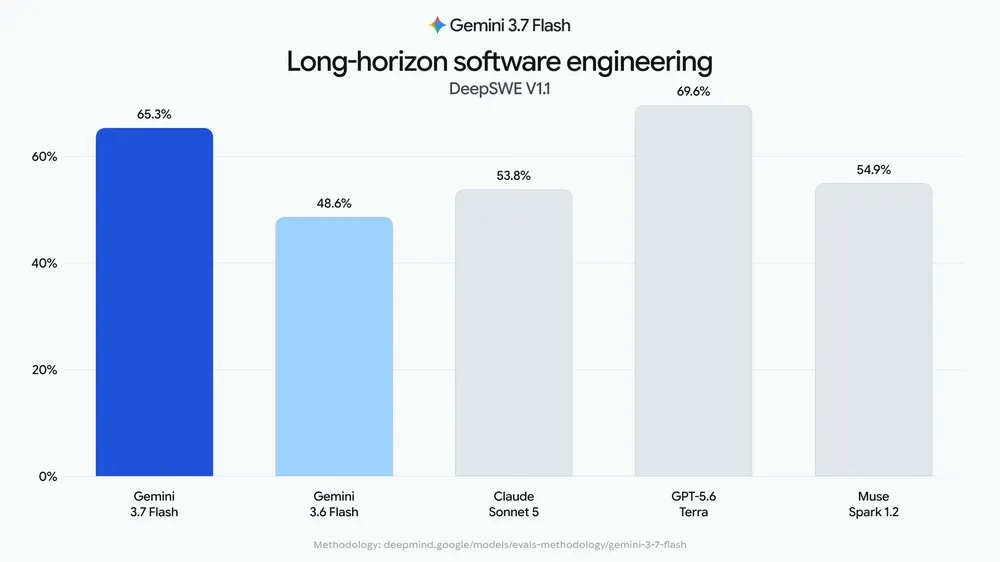
Google's evaluation table shows broad gains over Gemini 3.6 Flash. DeepSWE v1.1 rises from 48.6% to 65.3%, while AutomationBench increases from 17.0% to 30.4%. The external comparison is mixed: Gemini 3.7 Flash leads several coding, document and long-context tests, while GPT-5.6 Terra leads the composite Artificial Analysis Intelligence Index and several coding or computer-use benchmarks.
- Best fit: coding agents, terminal-based workflows and long-document tasks where its published strengths align with the workload.
- Introductory price: $0.75 input and $3.75 output per million tokens through 31 December 2026. Google says this is half 3.6 Flash's original cost and now applies the same promotional rate to 3.6 Flash.
- Largest cited coding gain: DeepSWE v1.1 rises from 48.6% to 65.3% against its predecessor, but remains below GPT-5.6 Terra's 69.6% on the same test.
- Main caveat: Google's nine-benchmark claim describes selected wins, not an overall victory across every measure in its table.
Lineage: A Three-Week Turnaround
Gemini 3.6 Flash launched three weeks before this update. Gemini 3.7 Flash now takes the workhorse position in Google's lineup, while the larger reasoning tiers remain separate products.
Google attributes the rapid iteration to developer feedback and algorithmic innovations in the model's reasoning foundation. The model card says 3.7 Flash is based on 3.6 Flash and carries the same stated knowledge cut-off. It does not provide enough evidence to conclude whether the update involved post-training alone or broader training changes.
What Shipped: Specs & Availability
Gemini 3.7 Flash supports a 1-million-token input context window and generates up to 64,000 tokens of output per response, in line with the rest of the Gemini 3 family. It ships with customisable "thinking" configuration, letting developers trade latency for reasoning depth per request rather than being locked into a single reasoning budget.
Availability at launch spans the Gemini API and Google AI Studio, Android Studio for mobile developers, Google Antigravity - Google's agent-first coding environment - the Gemini Enterprise Agent Platform, and Gemini Spark inside the consumer Gemini app for AI Pro and Ultra subscribers across more than 160 countries. That is a notably broad simultaneous rollout for a mid-cycle model refresh, and it reinforces the coding-and-agents positioning: developer surfaces (API, Antigravity, Android Studio) got it on day one alongside the consumer product.
Capabilities Deep Dive
Coding and agentic workflows
This is where Google concentrated the release. FrontierCode 1.1 Main - a production code-quality benchmark spanning around 100 programming tasks across multiple languages, scored on bug testing and style-guide compliance - improved from 34.4% to 43.6%, the single largest relative jump on Google's table and enough to lead every model listed, including GPT-5.6 Terra. Code Arena, a web-development-focused Elo ranking, moved from 1538 to 1588, again the top score on the table.
Enterprise document and knowledge work
On GDP.pdf, a benchmark testing expert-level comprehension of business PDF documents, Gemini 3.7 Flash scored 34.0% - roughly 6 points ahead of Claude Sonnet 5 and 9 points ahead of GPT-5.6 Terra on the same test. Harvey LAB-AA, which evaluates complex legal-workflow reasoning, put it at 90.7%, again the best result on the table and just ahead of Claude Sonnet 5's 90.1%. Long-context recall (GDM-MRCR v2, averaged at a 128K-token window) hit 97.0%, the strongest score of the five models compared.
Where it doesn't lead
Agentic computer-use (OSWorld-2.0) came in at 47.9%, behind GPT-5.6 Terra's 50.2%. On Agent's Last Exam - a pass-rate benchmark for multimodal desktop and OS agent tasks - Gemini 3.7 Flash scored 26.3%, behind both Claude Sonnet 5 (33.3%) and GPT-5.6 Terra (28.0%). And on GDPVal-AA v2, an Elo-style knowledge-work ranking, it placed behind Claude Sonnet 5, GPT-5.6 Terra and Muse Spark 1.2 alike, with Muse Spark 1.2 topping that particular table at 1628.
Benchmarks: The Full Scorecard
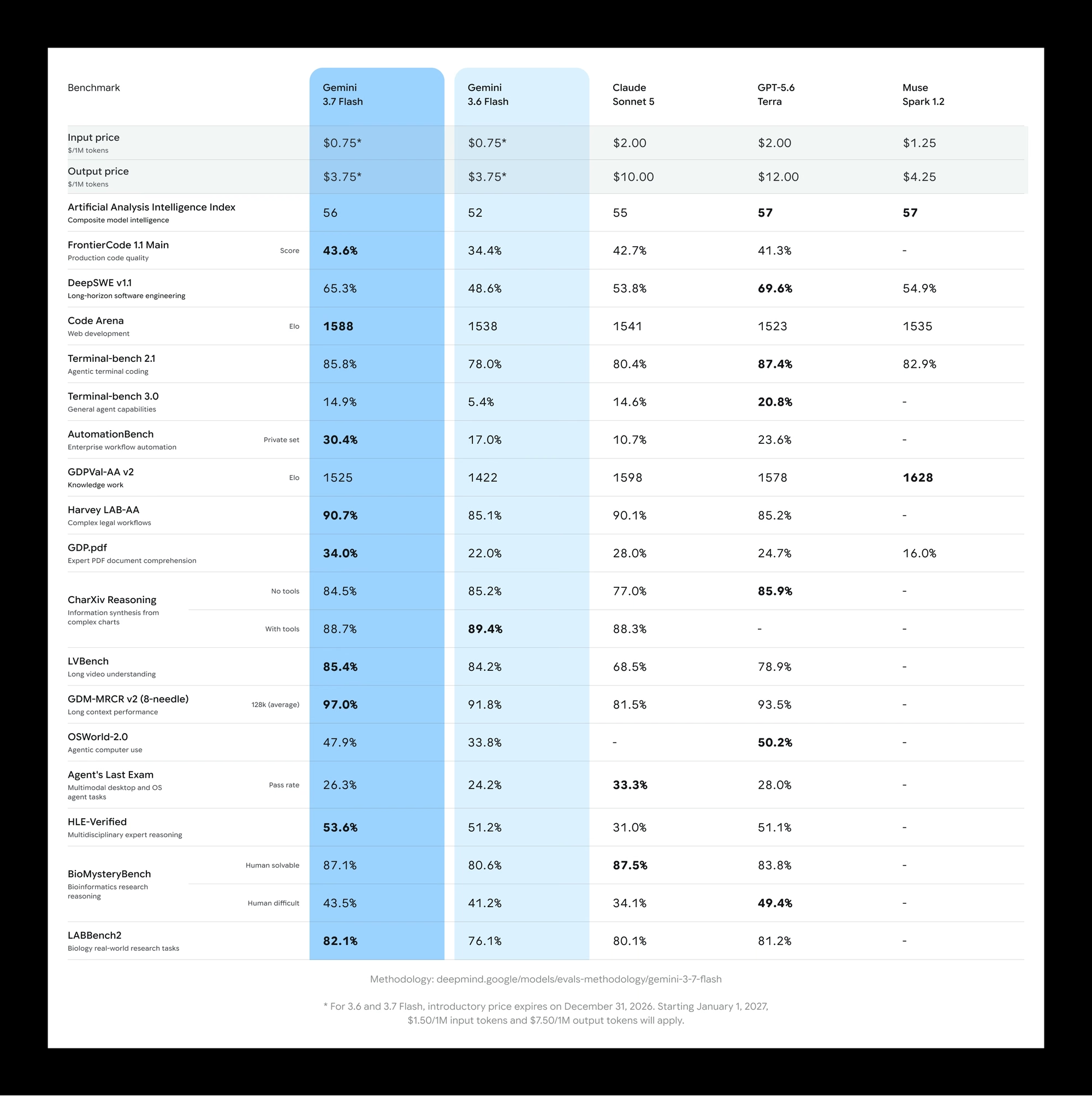
Rather than cherry-pick, here is the full table Google itself chose to publish, reproduced as prose. Bold in the source image marks the best score per row:
- Artificial Analysis Intelligence Index: 56 - behind GPT-5.6 Terra and Muse Spark 1.2 (both 57), ahead of Gemini 3.6 Flash (52) and just above Claude Sonnet 5 (55).
- FrontierCode 1.1 Main: 43.6% - best of the five, ahead of Claude Sonnet 5 (42.7%) and GPT-5.6 Terra (41.3%).
- DeepSWE v1.1: 65.3% - second-best; GPT-5.6 Terra leads at 69.6%.
- Code Arena Elo: 1588 - best of the five.
- Terminal-Bench 2.1: 85.8% and Terminal-Bench 3.0: 14.9% - both second-best behind GPT-5.6 Terra (87.4% and 20.8% respectively).
- AutomationBench (private set): 30.4% - best of the five, ahead of GPT-5.6 Terra (23.6%).
- GDPVal-AA v2 Elo: 1525 - lowest of the five; Muse Spark 1.2 leads at 1628.
- Harvey LAB-AA: 90.7% - best of the five, narrowly ahead of Claude Sonnet 5 (90.1%).
- GDP.pdf: 34.0% - best of the five.
- CharXiv Reasoning (no tools): 84.5% and (with tools): 88.7% - both trail GPT-5.6 Terra (85.9%, no-tools) and Gemini 3.6 Flash (89.4%, with-tools) respectively.
- LVBench (long video): 85.4% - best of the five.
- GDM-MRCR v2, 128K average: 97.0% - best of the five.
- OSWorld-2.0: 47.9% - behind GPT-5.6 Terra (50.2%); not tested for Claude Sonnet 5 or Muse Spark 1.2.
- Agent's Last Exam: 26.3% - lowest of the three models tested; Claude Sonnet 5 leads at 33.3%.
- HLE-Verified: 53.6% - best of the three models tested.
- BioMysteryBench (human-solvable): 87.1% - behind Claude Sonnet 5 (87.5%); (human-difficult): 43.5% - behind GPT-5.6 Terra (49.4%).
- LABBench2: 82.1% - best of the four models tested.
Read as a whole: Gemini 3.7 Flash is genuinely strong on production coding quality, web-dev Elo, long-context recall, and document/legal comprehension. GPT-5.6 Terra is genuinely stronger on the composite intelligence index, deep software-engineering (DeepSWE), terminal-agent tasks, and agentic computer use. Neither Google's launch framing nor a competitor's counter-framing captures that split accurately on its own - the table above is the more useful artefact than either headline.
System Card: Safety & Alignment
Google DeepMind evaluated Gemini 3.7 Flash against its Frontier Safety Framework (April 2026 version) ahead of launch. Per the published model card, the model did not reach a tracked or critical capability level (CCL) in any assessed domain:
- CBRN (chemical, biological, radiological, nuclear): DeepMind's own assessment states the model "lacks the nuanced expert knowledge and actionable depth necessary to complete priority harm journeys" - the CCL threshold was not reached.
- Cybersecurity: the model reached DeepMind's internal alert threshold - a lower bar than the critical capability threshold - which triggered updated cyber-offence mitigations being deployed at launch as a precaution, rather than because a hard capability limit was actually crossed.
- Harmful manipulation: performance fell beneath the CCL alert threshold.
- ML R&D / misalignment: DeepMind reports the model cannot bypass its own testing restrictions and lacks the independence needed for end-to-end autonomous research workflows.
Specialist red-teaming found safety performance similar to or improved versus Gemini 3.6 Flash, and child-safety evaluations met Google's launch thresholds. The alert-threshold cyber result is the one figure in this section worth flagging clearly: it is not evidence of a dangerous capability that shipped anyway, but it is the closest this model comes to any tracked threshold, and it is why updated cyber mitigations specifically - rather than a blanket capability restriction - accompanied the release.
Hallucinations and What Google Didn't Disclose
Unlike some competing labs, Google's Gemini 3.7 Flash materials do not include a dedicated hallucination-rate or calibration metric comparable to, say, Artificial Analysis's AA-Omniscience non-hallucination score used to evaluate other 2026 frontier models. The model card acknowledges, in general terms, that the model "exhibits hallucinations" and remains susceptible to jailbreak attempts, and notes occasional slowness or timeout issues in production use - but does not attach a quantified rate to any of that.
That is a real gap rather than a minor omission: HLE-Verified (53.6%) and Agent's Last Exam (26.3%) measure whether the model gets the right answer, not whether it knows when it doesn't know the answer. Buyers who need a specific honesty or calibration figure for risk-assessment purposes will not find one in Google's own launch materials for this release, and should treat that as an open question rather than assume parity with competitors that do publish the figure.
A creator's hands-on take on Gemini 3.7 Flash's price-to-capability ratio against pricier frontier models.
Real-World Reception vs the Announcement
Launch-day coverage was broadly positive but split on emphasis. SiliconANGLE's coverage led with the coding and agent-ensemble angle and reproduced Google's claim that the model "outperformed comparable models from Anthropic and OpenAI across nine benchmarks" largely at face value. 9to5Google's reporting focused on the unusually fast three-week release cadence and Google's own explanation - developer feedback and algorithmic innovation - for why a full model generation wasn't needed to justify the update. Coverage consistently noted that Gemini 3.7 Flash is rolling out to Spark inside the Gemini app ahead of any confirmed Gemini 3.5 Pro release, an unusual sequencing worth watching as the wider Gemini 3 generation continues to fill out.
The nine-benchmarks framing holds up under scrutiny for what it claims - Gemini 3.7 Flash does lead on nine of the eighteen listed metrics against at least one of GPT-5.6 Terra or Claude Sonnet 5 - but neither outlet's coverage foregrounded that GPT-5.6 Terra leads the composite Intelligence Index and several individual coding and agentic benchmarks on the very same table Google published. Readers relying solely on the announcement's headline claim would reasonably conclude Gemini 3.7 Flash is the strongest model in this comparison set outright, which the full table does not support.
Pricing
| Model and period | Input $/1M | Output $/1M |
|---|---|---|
| Gemini 3.7 Flash, introductory rate through 31 Dec 2026 | $0.75 | $3.75 |
| Gemini 3.7 Flash, standard rate from 1 Jan 2027 | $1.50 | $7.50 |
| Gemini 3.6 Flash, current promotional rate | $0.75 | $3.75 |
Google describes the Gemini 3.7 Flash introductory rate as half Gemini 3.6 Flash's original cost. It has also applied the same promotional rate to 3.6 Flash, so the two models currently cost the same. This is a price reduction against 3.6 Flash's original rate, but not a present-day price advantage over 3.6 Flash.
The promotional rate is scheduled to end on 31 December 2026. Teams estimating longer projects should model the standard $1.50 input and $7.50 output rates that begin on 1 January 2027. Prices are quoted in US dollars to avoid embedding a short-lived exchange-rate conversion.
Limitations
- Results vary by benchmark: GPT-5.6 Terra leads the Artificial Analysis Intelligence Index, DeepSWE v1.1, both Terminal-Bench versions and OSWorld-2.0 in Google's comparison table.
- No published hallucination or calibration metric: the model card acknowledges hallucinations in general terms but does not give a release-specific rate.
- The price is promotional: the $0.75 input and $3.75 output rates are scheduled to double on 1 January 2027.
- Cybersecurity alert threshold reached: this was not a critical capability breach, but it prompted updated mitigations at launch.
- Limited architectural disclosure: the model card refers readers to Gemini 3.6 Flash documentation for most technical detail.
How It Compares
Against GPT-5.6 Terra, Gemini 3.7 Flash trails on the composite Intelligence Index and on deep software-engineering and terminal-agent benchmarks, but leads on production code quality (FrontierCode), web-dev Elo, document comprehension and long-context recall - and costs meaningfully less at introductory pricing ($0.75/$3.75 vs $2/$12 per million tokens). Against Claude Sonnet 5, Gemini 3.7 Flash leads on most of the coding and document benchmarks but loses on Agent's Last Exam and GDPVal-AA v2, and again undercuts it substantially on price. Against its own predecessor, Gemini 3.6 Flash, the improvement is unambiguous and broad-based across nearly every listed benchmark, at unchanged introductory pricing.
The more useful framing than "which model wins" is task-fit: Gemini 3.7 Flash's specific strengths - production-quality code generation, long-document and legal-document comprehension, very long-context recall - line up well with coding-agent and enterprise-document workloads specifically, which is exactly how Google positioned it. For deep, multi-step software-engineering agentic work or terminal-heavy automation, GPT-5.6 Terra's lead on DeepSWE and Terminal-Bench is real and worth weighing against the price difference.
Who Should Use It
Choose Gemini 3.7 Flash if you're building coding agents, web-development tooling, long-document or legal-document processing pipelines, or any workload that benefits from a 1-million-token context window at a low per-token price - particularly if you're already inside Google's ecosystem via Antigravity, AI Studio or the Gemini Enterprise Agent Platform.
Look elsewhere if your workload is deep, multi-step software-engineering or terminal-agent work where GPT-5.6 Terra's benchmark lead is directly relevant, you need a disclosed hallucination or calibration figure for risk-assessment purposes, or you specifically need the strongest available composite reasoning score rather than task-specific strength. Note that Gemini 3.7 Flash is a text and code model - for AI video generation and editing, Google's separate Gemini Omni 1.1 Flash is the model to use instead.
The Bottom Line
Gemini 3.7 Flash improves substantially on Gemini 3.6 Flash across Google's published table. Its clearest case is for coding agents, long-context work and document-heavy enterprise tasks. The corrected pricing strengthens that case: Google has halved the cost relative to 3.6 Flash's original rate, while temporarily applying the same lower price to both models.
It is not the leader on every measure. GPT-5.6 Terra remains ahead on several deep coding and computer-use benchmarks in Google's own table. Choose 3.7 Flash when its specific strengths and lower token price match the workload, and test representative tasks before switching production traffic.
Last updated: 16 August 2026. Sources: Google's announcement, the DeepMind model card and Google's current model and pricing page.
Get the free guide: Claude vs ChatGPT, Gemini & Grok
A 20-page playbook covering everything you need to choose and use the big four AI models in 2026, full cost and feature comparisons, what each is best (and worst) at, and how-tos for images, vectors, building a website, Claude Code and more.