 AI Tools Review Editorial Team
Quick answer:
A community project called J-Space Cognition Suite claims that fixing two runtime bugs in how DeepSeek V4-Pro-0813 is normally run - no weight changes, no fine-tuning - lets it beat Claude Fable 5 on most of the benchmarks it tested. The project's starting ("before") numbers match DeepSeek's own official GA benchmark table exactly, which is a genuine point in its favour. Its ending ("after") numbers, however, are entirely self-reported: nobody outside the project that built J-Space has independently reproduced them as of 21 August 2026. Treat the "DeepSeek V4 Pro now beats Fable 5" headline as an interesting, methodologically plausible claim that is currently unverified, not as an established fact.
In the week after DeepSeek V4-Pro-0813 went GA, a small, independently-built harness project claimed to have found something odd: two bugs in how the model is normally run that were, in its telling, artificially capping benchmark scores the raw weights could already achieve. Fix the harness, the argument goes, and the same model - unchanged - scores meaningfully higher, on some benchmarks high enough to edge past Claude Fable 5.
That is a genuinely interesting claim, and it deserves to be taken seriously rather than dismissed out of hand. It is also, right now, a claim resting entirely on one project's own test runs. This article sets out exactly what J-Space says, what actually checks out against DeepSeek's own published numbers, and exactly what remains unconfirmed.
Julian Goldie's coverage of the J-Space harness claims, walking through what V4 Pro and Flash actually are, what J-Space changes, and why the results are self-reported and unreproduced.
Executive summary
- J-Space Cognition Suite is a third-party, inference-time harness for DeepSeek V4 models, built by an individual developer publishing under the handle Tiger3807861189. It changes how requests are routed and verified at runtime; it does not touch model weights.
- The claimed mechanism is two runtime bugs, described in plain terms as "representation drift" and "premature stopping," which J-Space's own documentation frames more cautiously as a "chain-of-thought diode" - sessions settling into either short, quick-to-stop responses or long, analytical ones that can lose track of state.
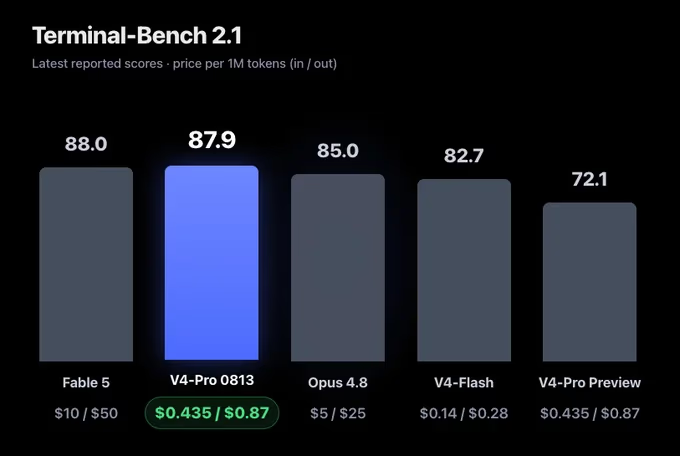
- The "before" numbers check out. J-Space's reported starting scores for DeepSeek V4-Pro-0813 - 87.9 on Terminal-Bench 2.1, 61.5 on NL2Repo, 74.1 on Toolathlon-Verified - are identical to DeepSeek's own officially published GA benchmark table.
- The "after" numbers do not check out with anyone else. J-Space's claimed post-fix scores (for example 90.1 on Terminal-Bench 2.1, 73.4 on NL2Repo) come only from the project's own test runs. No benchmark aggregator, academic group or independent tester had reproduced them at the time of writing.
- "Beats Claude Fable 5" is true on J-Space's own table for most, not all, of the benchmarks it reports - it still trails Fable 5 on HLE without tool access, for instance.
- J-Space's own README is unusually candid about its limits: it explicitly calls itself a black-box engineering diagnosis rather than a research finding, and states it cannot attribute score changes to a single mechanism.
What is DeepSeek V4 Pro?
DeepSeek V4-Pro-0813 is the current production build of DeepSeek's flagship model, a 1.6-trillion-parameter Mixture-of-Experts model with 49 billion active parameters per token, a 1-million-token context window and MIT-licensed open weights, which reached General Availability on 13 August 2026. We have already covered the model's architecture, official pricing and vendor-versus-independent benchmark gaps in full in our DeepSeek V4 Pro 0813 review, so this article will not re-cover that ground. What matters here is narrower and more specific: what happens when a third party changes the harness the model runs inside, not the model itself.
It is worth being precise about one more name collision before going further. DeepSeek also publishes its own official, MIT-licensed agent framework called DeepSeek Harness, launched by DeepSeek itself a few days before V4 Pro's GA release. J-Space Cognition Suite is not that. J-Space is a separate, third-party project that runs on top of a harness like DeepSeek Harness (or an equivalent tool-calling setup); DeepSeek has not built, endorsed or commented on it. The two names are easy to confuse and refer to entirely different codebases from entirely different organisations.
What is J-Space, and who built it?
J-Space Cognition Suite, currently at version 3.6, is described by its own documentation as "a model-agnostic control system that runs at inference time and does not modify model weights." It is built and published by an individual developer using the handle Tiger3807861189, who maintains two related GitHub repositories: the suite itself (J-Space-Cognition-Suite-V3.6) and a separate benchmark write-up (DeepSeek-V4-J-Space-Capability-Realization-Report) that documents the test results this article covers. Both are individual, community-maintained projects, not products of DeepSeek, Anthropic or any other named AI lab.
The benchmark report repository has attracted real attention on GitHub - roughly 1,000 stars and 67 forks at the time of writing - and is licensed CC BY-ND 4.0 (attribution required, no derivative works), with a Zenodo DOI issued for citation. That level of engagement does not, on its own, tell you whether the numbers are correct; it tells you the claim is being taken seriously enough by enough developers to warrant close scrutiny, which is exactly what this article is doing.
Two things about the project's own framing are worth noting up front, because they cut against the more breathless "DeepSeek V4 Pro now beats Fable 5" framing that circulated on social media after the report was published. First, the report explicitly states it is not a research paper: "it does not provide internal mechanism proofs, formal verification methods, ablation designs, or causal-contribution decomposition." Second, it cites two related, independently-run community projects - dsh-anchored-standard and dsh-routing-suite - that investigate adjacent harness-level effects on DeepSeek models. Notably, the second of those projects later issued a public correction, walking back an earlier, stronger claim that DeepSeek had "deliberately designed dual attractors" into the model, while keeping its underlying observed data. That is a useful data point for how seriously to weigh strong causal claims from this specific corner of the DeepSeek harness-tinkering community: even within it, at least one adjacent project has already had to publicly retract an overreaching interpretation of its own results.
The claims: two bugs, before and after
J-Space's central technical claim is that a DeepSeek model's reasoning, within a given session, tends to settle into one of two stable modes rather than flexibly moving between them. J-Space's own documentation calls this a "chain-of-thought diode": sessions either commit early to short, intuitive answers, or to long, analytical reasoning, and rarely switch sides once the first few tokens set the pattern. Each mode has its own characteristic failure:
- Short-mode failure ("premature stopping," in the plain-English gloss used by secondary coverage): the model accepts the first fluent-sounding answer too early, skips necessary verification steps, or declares a task complete after a local test passes without checking the fuller requirement.
- Long-mode failure ("representation drift"): the model over-analyses, repeatedly second-guesses itself, delays acting on tool calls, and - on genuinely long-horizon tasks - loses track of earlier state as the session runs on, a pattern J-Space's own table of structural problems literally labels "long-horizon state drift."
J-Space's proposed fix is not a single patch but a small set of harness-layer interventions applied depending on which failure mode a session appears to be in: forcing short-mode sessions to bridge to evidence and verification before declaring success, and forcing long-mode sessions toward concrete next actions, checkpoints and limited candidate sets rather than open-ended re-planning. A shared task ledger and tool-state tracking layer runs underneath both, intended to preserve context across files and tool calls on long tasks.
The headline numbers, drawn from J-Space's own benchmark report, are these. For DeepSeek V4-Pro-0813, official-baseline-to-claimed-J-Space-result: Terminal-Bench 2.1 rises from 87.9 to a claimed 90.1; NL2Repo from 61.5 to a claimed 73.4; CyberGym from 83.3 to a claimed 86.8; DeepSWE from 62.7 to a claimed 72.0; Toolathlon-Verified from 74.1 to a claimed 79.5; Agents' Last Exam from 25.7 to a claimed 30.3; and Humanity's Last Exam with tool access from 60.0 to a claimed 67.7. The smaller DeepSeek V4-Flash-0731 shows a similar pattern in the same report, for example Terminal-Bench 2.1 rising from 82.7 to a claimed 87.1.
Every single one of those "after" figures is J-Space's own number, produced on its own testing setup. That is the load-bearing caveat for everything that follows.
Why the before numbers line up but the after numbers don't
This is the part of the story that separates J-Space from a purely fabricated claim, and it is worth stating plainly: the "before" column in J-Space's benchmark table is not made up. Terminal-Bench 2.1 at 87.9, NL2Repo at 61.5, Toolathlon-Verified at 74.1 - these match DeepSeek's own officially published GA benchmark table for V4-Pro-0813 to one decimal place, figures we have independently confirmed from DeepSeek's own release material for our separate DeepSeek V4 Pro review. Whoever ran this evaluation was genuinely starting from the real, verifiable baseline, not inventing a lower starting point to make the "after" numbers look more dramatic than they are. That is a meaningful piece of methodological credibility, and it is the reason this story is worth a careful article rather than a one-line dismissal.
But matching the baseline only tells you the test harness was pointed at the correct starting line. It says nothing about what happened after the gun went off. The "after" numbers were produced by the same party making the claim, on a testing setup nobody outside that project controls, using an evaluation environment its own documentation admits involves hardware conditions, process isolation, tool availability and information-access boundaries that "may affect observed results" - the report's own words. There is no control group, no blinded evaluation, and no third party who ran the same prompts through the same harness independently. In benchmarking, a correct starting point and an unverifiable endpoint are not partial credit toward a verified result; they are two entirely different epistemic categories, and conflating them is exactly the mistake the "DeepSeek V4-Pro now outperforms Fable 5" social-media framing makes.
There is also a structural reason to expect a harness-layer change to move agentic benchmark scores at all, which is worth taking seriously rather than assuming the entire premise is nonsense. Terminal-Bench, Toolathlon and similar agentic evaluations score whether a multi-step task gets completed correctly, not just whether the model "knows" the right answer - and completion depends heavily on scaffolding: when the agent decides to stop, how it recovers from a failed tool call, whether it verifies its own work before declaring success. Our own testing of DeepSeek V4 Pro elsewhere on this site found a 33-point gap between DeepSeek's own harness score and an independent neutral-harness re-test on the same benchmark, with the smaller V4 Flash actually outscoring Pro under neutral conditions - direct, independently confirmed evidence that harness choice alone can swing this specific model's agentic scores by a wide margin. That does not prove J-Space's specific claimed gains are real. It does mean the underlying premise, that harness design measurably affects DeepSeek V4's benchmark scores, is not speculative; it is already independently demonstrated, just not at the specific magnitude or in the specific direction J-Space claims.
How this fits the pattern of self-reported benchmark claims
Self-reported benchmark inflation is not a new problem in AI, but it is worth being honest that this specific pattern - a third-party harness or wrapper claiming to unlock hidden capability in someone else's already-released model, purely through inference-time changes - is a comparatively unusual variant. Most benchmark disputes in this space involve a model's own vendor publishing favourable numbers on its own tooling, which independent testers then attempt to reproduce on neutral harnesses; DeepSeek V4 Pro's own 87.9-versus-54.68 Terminal-Bench gap, which we cover in detail in our main V4 Pro review, is exactly that pattern. J-Space is a step removed from that: it is not the vendor claiming its own model is better, it is an outside party claiming the vendor's own official numbers are themselves an undercount, caused by a scaffolding bug the vendor has not acknowledged.
The closest genuine parallel available at the time of writing sits within the same small community rather than a different model entirely: the dsh-routing-suite project referenced in J-Space's own documentation made an early, stronger causal claim about DeepSeek's routing behaviour and later issued a public statement walking that specific claim back while keeping its underlying observational data intact. We have not found a directly comparable episode involving a different foundation model family, and we are not going to force one; readers should treat the absence of a wider precedent as itself informative; this is either a genuinely novel finding about DeepSeek's specific harness ecosystem, or an early instance of a pattern that has not yet had time to play out elsewhere.
What is a broader, well-established pattern is self-reported benchmark numbers from a party with an incentive to publish an impressive result going unreproduced for weeks or months before independent testing catches up, if it ever does. Our coverage of Ornith 1.5, an unrelated open-weights model from DeepReinforce, found the same shape of problem: a vendor-published table showing the model matching Claude Opus 4.8 on some benchmarks while trailing well behind it on others, with no independent lab having reproduced the flagship model's scores at the time of writing. The lesson generalises: whenever a single party controls both the claim and the evaluation that produced it, and there is a genuine incentive - reputational, commercial or attention-driven - to report a favourable number, that number needs independent reproduction before it should change anyone's decisions, regardless of whether the party making the claim is a well-funded lab or a solo GitHub maintainer.
An independent, hands-on test of DeepSeek V4-Pro-0813 on real coding and agentic tasks, run on the creator's own benchmark tooling rather than DeepSeek's or J-Space's - useful context for how much a testing setup can move this specific model's scores.
Official DeepSeek vs J-Space: side by side
The table below separates what is officially confirmed from what is claimed. The "DeepSeek official" column is DeepSeek's own published GA figure for V4-Pro-0813. The "J-Space claimed" column is entirely self-reported by the J-Space project and unverified by anyone outside it. The "Fable 5" column is included for scale and is itself drawn from J-Space's own compiled comparison table, sourced there to Anthropic's published Claude Fable 5 & Claude Mythos 5 System Card - so treat that specific figure as filtered through J-Space's own compilation, even though it originates with Anthropic.
| Benchmark | DeepSeek official (V4-Pro-0813) | J-Space claimed (unverified) | Claude Fable 5 |
|---|---|---|---|
| Terminal-Bench 2.1 | 87.9 | 90.1 | 88.0 |
| NL2Repo | 61.5 | 73.4 | not reported |
| CyberGym | 83.3 | 86.8 | 83.1 |
| DeepSWE | 62.7 | 72.0 | 70.0 |
| Toolathlon-Verified | 74.1 | 79.5 | 77.9 |
| Agents' Last Exam | 25.7 | 30.3 | 23.8 |
| AutomationBench (Public) | 31.8 | 38.2 | 29.1 |
| HLE (with tools) | 60.0 | 67.7 | 63.0 |
| HLE (no tools) | 42.7 | 48.0 | 53.3 |
Read this table carefully rather than skimming to the "wins" column. On J-Space's own claimed numbers, DeepSeek V4-Pro-0813 plus J-Space edges past Claude Fable 5 on six of the eight comparable rows above (Terminal-Bench 2.1, CyberGym, DeepSWE, Toolathlon-Verified, Agents' Last Exam and HLE-with-tools), stays behind on HLE without tool access (48.0 vs 53.3), and NL2Repo has no published Fable 5 score to compare against at all. "Beats Fable 5" is therefore an accurate description of J-Space's own table on most, but not all, of what it measured - and every single figure in the "J-Space claimed" column remains unverified by anyone outside the project.
What would actually confirm this
A claim like this moves from "interesting and self-reported" to "confirmed" through a fairly specific set of steps, none of which have happened yet as of 21 August 2026:
- Independent replication on the same tasks. A party with no stake in J-Space's success running the identical benchmark suites, on the identical prompts, through J-Space's published harness code, and getting comparable scores.
- A neutral benchmark aggregator picking it up. Services such as Artificial Analysis or LMArena, which already track DeepSeek V4 Pro's official scores, adding a J-Space-harness configuration and reporting the delta themselves rather than relying on the project's self-reported figures.
- Ablation studies isolating the actual mechanism. J-Space's own documentation admits it cannot currently attribute score changes to "representation drift" fixes specifically versus "premature stopping" fixes specifically versus general prompt or tool-schema changes; a genuine mechanistic claim needs to show which intervention did what.
- DeepSeek's own acknowledgement or silence. DeepSeek has not, at the time of writing, commented publicly on J-Space or on the specific bugs it describes. Either an official response confirming or disputing the diagnosis, or a future DeepSeek Harness release that independently addresses the same failure modes, would be informative in either direction.
- Consistency across a wider task set. A harness fix that produces genuine capability gains should generalise beyond the specific benchmark suite the project chose to test on; results on an unrelated, held-out evaluation set would meaningfully strengthen the case.
None of this is a criticism unique to J-Space - it is simply what independent verification of any benchmark claim requires, whether the claim comes from a solo developer or a well-funded lab. Until some of it happens, the honest description of this story is "an unverified but methodologically plausible claim from a project whose starting numbers check out," not "DeepSeek V4 Pro now beats Claude Fable 5."
Limitations: what we don't know
- No independent reproduction exists. Every "after" figure in this article comes from J-Space's own testing, run on its own hardware and evaluation setup, which its own documentation says may affect results.
- DeepSeek has not commented. There is no official DeepSeek statement confirming, disputing or even acknowledging the existence of "representation drift" or "premature stopping" as bugs in its own tooling.
- The project itself declines to make a strong causal claim. J-Space's own README states it cannot attribute score changes to a single mechanism and explicitly labels its terminology ("chain-of-thought diode," "minimal interface overfitting hypothesis") as operational engineering language rather than proven internal model behaviour.
- We could not independently verify every figure against a primary DeepSeek source. The Terminal-Bench 2.1, NL2Repo and Toolathlon-Verified baseline figures are independently confirmed against DeepSeek's own published GA benchmark table; some of the other baseline rows in the comparison table above are drawn from J-Space's own compilation and secondary reporting rather than a primary DeepSeek source we accessed directly.
- Social-media amplification does not equal verification. Posts describing this as DeepSeek V4 Pro definitively "outperforming Fable 5" were widely shared in the days after the report's publication; that reach reflects interest in the claim, not confirmation of it.
- This is a fast-moving, low-institutional-scrutiny story. Unlike a frontier lab's system card, there is no external safety institute, academic partner or regulator currently reviewing J-Space's methodology, so the normal external-verification channels that eventually catch vendor overclaiming may take longer to engage here, if they engage at all.
How it compares
Our DeepSeek V4 Pro 0813 review covers the model's architecture, official pricing and the separate, already-confirmed vendor-versus-neutral-harness benchmark gap that makes this story plausible in the first place. Our DeepSeek Harness review covers DeepSeek's own official, unrelated agent framework, which J-Space is often confused with because of the similar naming but which is a completely separate product from a completely separate organisation.
For a same-shape story involving a different model family, our Ornith 1.5 review covers another open-weights release, from DeepReinforce, where vendor-published benchmark tables show the flagship model matching Claude Opus 4.8 on some metrics while trailing on others, again with no independent lab reproduction at the time of writing. If you want the broader pattern of how this site treats viral, unverified AI claims generally, our OpenAI Astra pacing coverage and Claude for Finance skills fact-check apply the same standard - separate what a vendor or project has actually published from what has been independently confirmed - to two entirely different stories.
The bottom line
J-Space Cognition Suite makes a claim worth taking seriously: that a harness-layer fix, with no weight changes, can measurably move DeepSeek V4-Pro-0813's benchmark scores, and that the model's official numbers might undercount what the weights can actually do under better scaffolding. The fact that its starting numbers match DeepSeek's own official baseline exactly, and the fact that we already have independent, confirmed evidence elsewhere on this site that harness choice swings this specific model's scores by tens of points, both make the claim more plausible than a typical unverified benchmark story. None of that, however, makes the specific "after" numbers confirmed. They are J-Space's own numbers, produced on J-Space's own testing setup, and as of 21 August 2026 no independent party has reproduced them. "DeepSeek V4 Pro now beats Claude Fable 5" is what J-Space's own table shows on most of the benchmarks it ran - not yet what anyone outside J-Space has confirmed.
This account is built from J-Space's own published benchmark report and README on GitHub, explainx.ai's independent analysis of the same claims, DeepSeek's own officially published GA benchmark table (cross-checked against our separate DeepSeek V4 Pro coverage), and Julian Goldie's video coverage embedded above.
Last updated: 21 August 2026. This article will be revised if J-Space publishes ablation data, if an independent lab or benchmark aggregator reproduces its claimed scores, or if DeepSeek comments publicly on the underlying claims.
Get the free guide: Claude vs ChatGPT, Gemini & Grok
A 20-page playbook covering everything you need to choose and use the big four AI models in 2026, full cost and feature comparisons, what each is best (and worst) at, and how-tos for images, vectors, building a website, Claude Code and more.