
DeepSeek V4 Pro
By DeepSeek
Released: 2026-04-24
DeepSeek V4 Pro is the value outlier of 2026: a 1.6-trillion-parameter open-weights model (MIT licence) with a 1M-token context, measured at $0.04 per Intelligence Index task - the cheapest serious model recorded. Intelligence Index 44 puts it level with Kimi K2.6 and MiniMax-M3; API pricing is $0.435/$0.87 per million tokens.
Visit DeepSeek V4 ProCheapest serious model measured
At $0.04 per Intelligence Index task on Artificial Analysis, V4-Pro is tied with OpenAI's gpt-oss-120b as the cheapest serious model measured. API pricing sits at $0.435 per million input tokens and $0.87 per million output.
1M-token context under an MIT licence
The Hybrid Attention Architecture supports a 1M-token window, enough for entire codebases in one prompt, and the weights ship under MIT, the most permissive mainstream licence available.
Respectable rather than frontier
An Intelligence Index of 44 puts it level with Kimi K2.6 and MiniMax-M3, but behind GLM-5.2's 51. On coding, Z.ai's model card reports beating it comfortably on SWE-bench Pro and FrontierSWE.
DeepSeek V4 Pro is the clearest value outlier of 2026 so far. Released as a preview on 24 April 2026, it is a 1.6-trillion-parameter open-weights model with a 1M-token context window, an MIT licence, and a measured cost of $0.04 per Intelligence Index task, the cheapest serious model Artificial Analysis has recorded. It is not the smartest open model available, and its coding results trail the frontier. But nothing else delivers this much capability for this little money.
What DeepSeek V4 Pro is: the value outlier of 2026
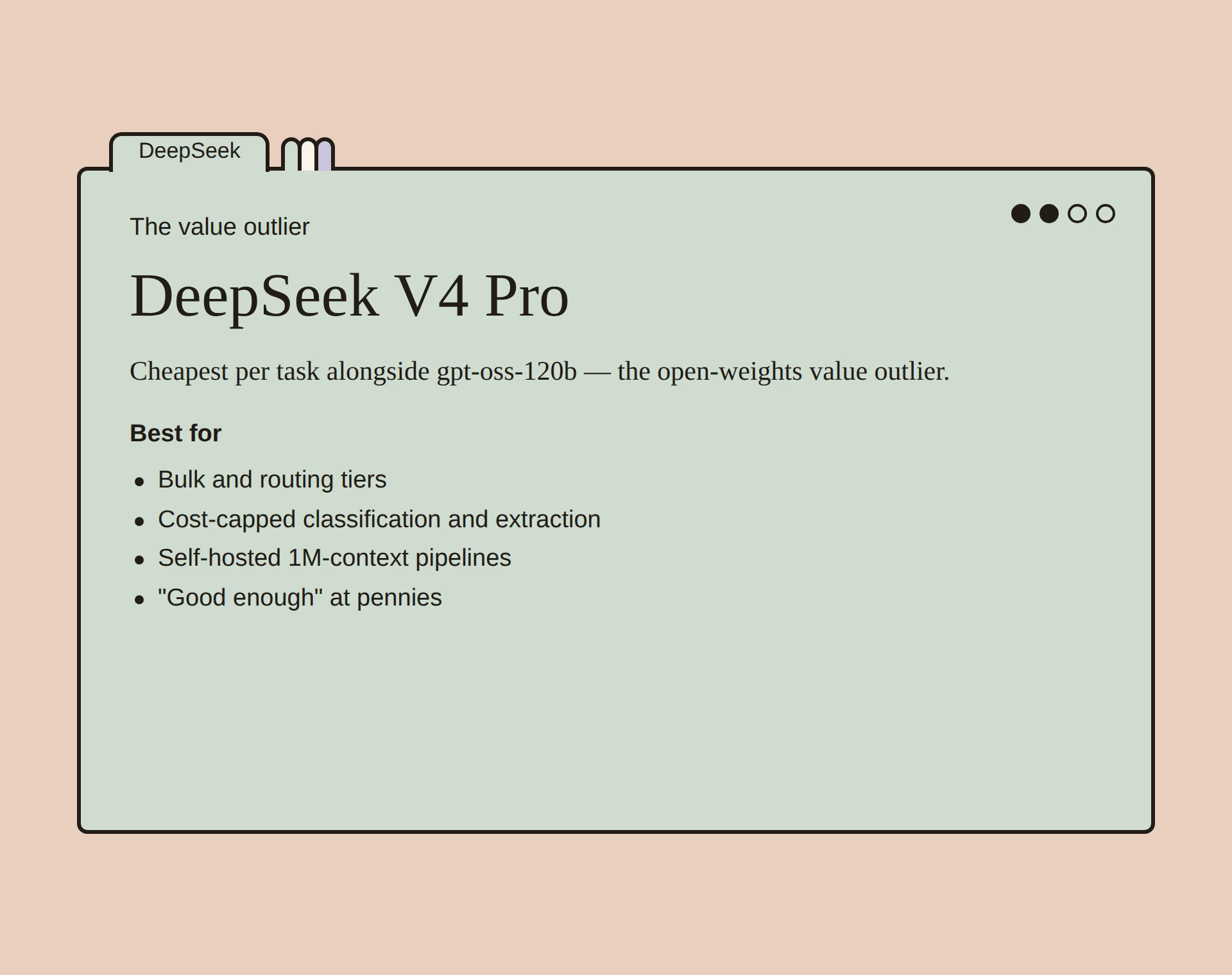
DeepSeek-V4-Pro arrived on 24 April 2026 as part of the V4 preview, alongside a smaller sibling, DeepSeek-V4-Flash. The Pro model carries 1.6 trillion parameters; Flash carries 284 billion. Both offer a 1M-token context window and ship under an MIT licence. The release came with a deadline attached: DeepSeek's older deepseek-chat and deepseek-reasoner endpoints were scheduled for deprecation on 24 July 2026, which makes V4 the company's entire forward-looking product line rather than an optional upgrade.
The pitch at launch was ambitious. DeepSeek positioned V4-Pro as competitive with the leading closed models of the moment (Claude Opus 4.6, GPT-5.4 and Gemini 3.1-era rivals) on major benchmarks. Three months of independent measurement have refined that picture. The model is genuinely capable, but its defining characteristic turns out not to be peak intelligence. It is economics: what you get per pound spent is, by our own metric, second best in the industry.
On Artificial Analysis's methodology, running V4-Pro costs $0.04 per Intelligence Index task, tied with OpenAI's gpt-oss-120b as the cheapest serious model measured. Our AITR Value For Money Index, which divides measured intelligence by cost per task, scores it at 1,100, second only to Xiaomi's MiMo-V2.5-Pro at 1,400. That is the lens this review applies throughout: not whether V4-Pro is the best model you can use, but whether it is the best deal you can get.
Architecture and the V4 preview
The technical centrepiece of the V4 preview is what DeepSeek calls its Hybrid Attention Architecture. The company's stated aim is better memory across long conversations, the tendency of models to lose track of earlier instructions or context as a session grows is a persistent complaint, and hybrid attention is DeepSeek's answer to it. The same architecture underpins the 1M-token context window, which applies to both the 1.6-trillion-parameter Pro model and the 284-billion-parameter Flash.
A 1M-token window changes how you can work. DeepSeek's own framing is that entire codebases fit in one prompt, and that is the practical shift: instead of building retrieval pipelines to feed a model fragments of a large repository or document set, you can often hand it the whole thing. For long-running agent sessions and multi-document analysis, the window removes a category of engineering work that smaller-context models force on you.
The MIT licence matters as much as the architecture. It is about as permissive as software licensing gets: you can run the weights anywhere, fine-tune them, embed them in commercial products, and owe nothing back. In practice most users will consume V4-Pro through hosted APIs, our 10 July 2026 snapshot found 15 live serving endpoints on OpenRouter, with roughly the full 1M context observed, but the licence keeps the self-hosting and fine-tuning doors permanently open.
One housekeeping note for existing DeepSeek users: the deprecation of deepseek-chat and deepseek-reasoner on 24 July 2026 means anything built on those endpoints needs migrating. This is a preview generation replacing a stable one on a three-month clock, and teams with DeepSeek in production should treat that date as a hard deadline rather than a suggestion.
- DeepSeek-V4-Pro: 1.6 trillion parameters, 1M-token context, MIT licence
- DeepSeek-V4-Flash: 284 billion parameters, same context window and licence
- Hybrid Attention Architecture targets long-conversation memory
- 15 live serving endpoints on OpenRouter as of 10 July 2026
- deepseek-chat and deepseek-reasoner deprecated 24 July 2026
Benchmarks in context
On Artificial Analysis's Intelligence Index v4.1, measured on 9 July 2026, V4-Pro scores 44 at maximum settings. That places it level with Kimi K2.6 and MiniMax-M3, solid company in the open-weights field, but below GLM-5.2, whose 51 makes it the current open-weights leader. The honest reading is that V4-Pro sits in the strong middle of the open-weights pack rather than at its head.
Coding tells a similar story with sharper edges. In the Coding Agent Index, run in the Claude Code harness, V4-Pro scores 47, respectable, but not frontier. Z.ai's GLM-5.2 model card goes further, reporting direct comparisons in which its model beats V4-Pro on SWE-bench Pro (62.1 versus 55.4) and, far more dramatically, on FrontierSWE (74.4 versus 29.0). Those are vendor-reported figures from a competitor's marketing material and deserve appropriate scepticism, but a gap that large on FrontierSWE is difficult to explain away entirely.
It is worth remembering how the launch was framed. In April, DeepSeek presented V4-Pro as matching Claude Opus 4.6, GPT-5.4 and Gemini 3.1-era rivals on major benchmarks, and at preview time that claim held up on the headline suites. Benchmarks move quickly, though, and by July the independent picture is more modest: competitive on general intelligence, clearly behind the best open and closed models on the hardest agentic coding evaluations.
None of which settles the question that actually matters, because raw scores ignore price. A score of 44 delivered at $0.04 per task is a different proposition from the same score at ten times the cost. The benchmark table below should be read alongside the economics section that follows it, not instead of it.
Where it sits on the Intelligence Index
Artificial Analysis Intelligence Index v4.1 across every scored frontier model: this model highlighted.
The $0.04-per-task economics
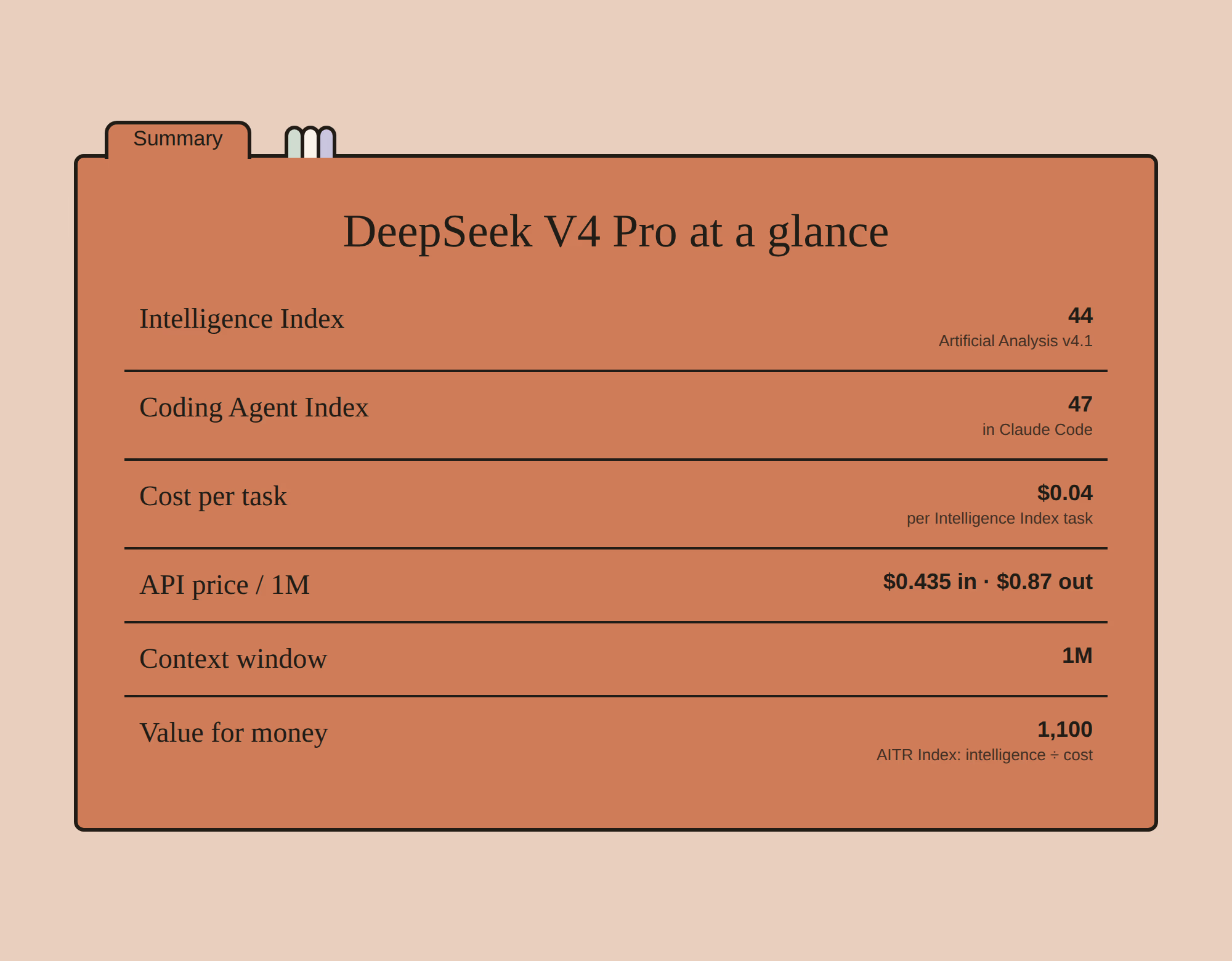
Artificial Analysis measures cost per Intelligence Index task: what it actually costs to run a model through the full evaluation, divided per task. This is a more honest measure than per-token list prices, because it captures verbosity, a model that thinks in long, rambling chains of reasoning burns tokens that a headline rate never shows. On this measure V4-Pro comes in at $0.04, the cheapest serious model measured, tied with OpenAI's gpt-oss-120b.
The list prices are equally aggressive: $0.435 per million input tokens and $0.87 per million output tokens. At those rates, workloads that would be budget conversations with a frontier closed model become rounding errors. Processing a million tokens of input, roughly the model's entire context window, costs less than half a dollar. For teams running classification, extraction or summarisation across large corpora, that pricing changes what is economically feasible to attempt at all.
Our own AITR Value For Money Index divides measured intelligence by cost per task, and V4-Pro scores 1,100: second in the field, behind only Xiaomi's MiMo-V2.5-Pro at 1,400. The metric deliberately rewards models that deliver competent results cheaply rather than brilliant results expensively, and V4-Pro is close to the purest expression of that trade-off currently on the market.
The reason cost per task deserves this much attention is agentic workloads. Agents do not send one prompt; they loop, retry, re-read context and accumulate token spend across dozens of calls per user request. When each underlying task costs $0.04, aggressive agent designs (more retries, more verification passes, more parallel attempts) become affordable in ways they simply are not at frontier pricing.
Cost per Intelligence Index task, in context
What a unit of benchmarked work actually costs across the field. Lower is better.
Where it fits in real workflows
The natural home for V4-Pro is the bulk and routing tier of a multi-model stack. Most production AI systems now route requests by difficulty: a cheap, competent model handles the high-volume default traffic, and a frontier model handles the escalations. V4-Pro's combination of a 44 Intelligence Index and $0.04-per-task cost makes it one of the strongest candidates yet for that default slot, smart enough that escalations stay rare, cheap enough that volume stops being a budget line you worry about.
The 1M-token window opens a second role: long-context comprehension. Feeding an entire codebase or a large document set into one prompt for navigation, question-answering and analysis plays to the model's strengths without touching its weaknesses. The coding benchmarks warn against relying on V4-Pro to autonomously fix hard bugs; they say nothing against using it to read, explain and cross-reference a repository it can hold in context whole.
The MIT licence adds a third role for organisations with data-residency or confidentiality constraints. Because the weights are open and permissively licensed, V4-Pro can run inside your own perimeter, and for everyone else the 15 serving endpoints live on OpenRouter as of our July snapshot mean hosted capacity is plural and competitive rather than a single-vendor dependency.
- Default tier in a router, with frontier models reserved for escalations
- High-volume summarisation, extraction and classification over large corpora
- Whole-codebase and multi-document comprehension using the 1M window
- Self-hosted deployment where data cannot leave the organisation
- Long-running conversational sessions that benefit from hybrid attention
Limitations
The clearest weakness is frontier coding. A Coding Agent Index of 47 is workable for routine tasks, but the comparative figures in Z.ai's GLM-5.2 model card (SWE-bench Pro at 55.4 against 62.1, and FrontierSWE at 29.0 against 74.4) suggest V4-Pro falls off steeply as coding tasks approach the frontier of difficulty. Even discounting for the vendor source, we would not recommend V4-Pro as the sole model behind an autonomous coding agent working on hard, real-world engineering tasks.
It is also not the open-weights intelligence leader. GLM-5.2's Intelligence Index of 51 sits seven points clear of V4-Pro's 44, and Kimi K2.6 and MiniMax-M3 match it exactly. If your selection criterion is the smartest open model regardless of cost, V4-Pro is not the answer. Its case rests entirely on the intelligence-per-dollar ratio, and buyers should be clear-eyed that this is a value purchase, not a capability purchase.
Open weights carry an operational burden that marketing rarely mentions. Self-hosting a 1.6-trillion-parameter model is a serious infrastructure undertaking: the GPU fleet, serving stack, monitoring and update cadence are all yours to own. Most teams will sensibly use hosted endpoints instead, but with 15 providers serving the model it is worth verifying context length, throughput and pricing against your requirements per endpoint rather than assuming uniformity.
Finally, this is a preview generation in visible motion. The old endpoints die on 24 July 2026, the benchmark landscape has already shifted since April, and figures quoted here carry snapshot dates for good reason. Anyone standardising on V4-Pro should plan to re-evaluate as the preview matures rather than treating today's numbers as settled.
Verdict
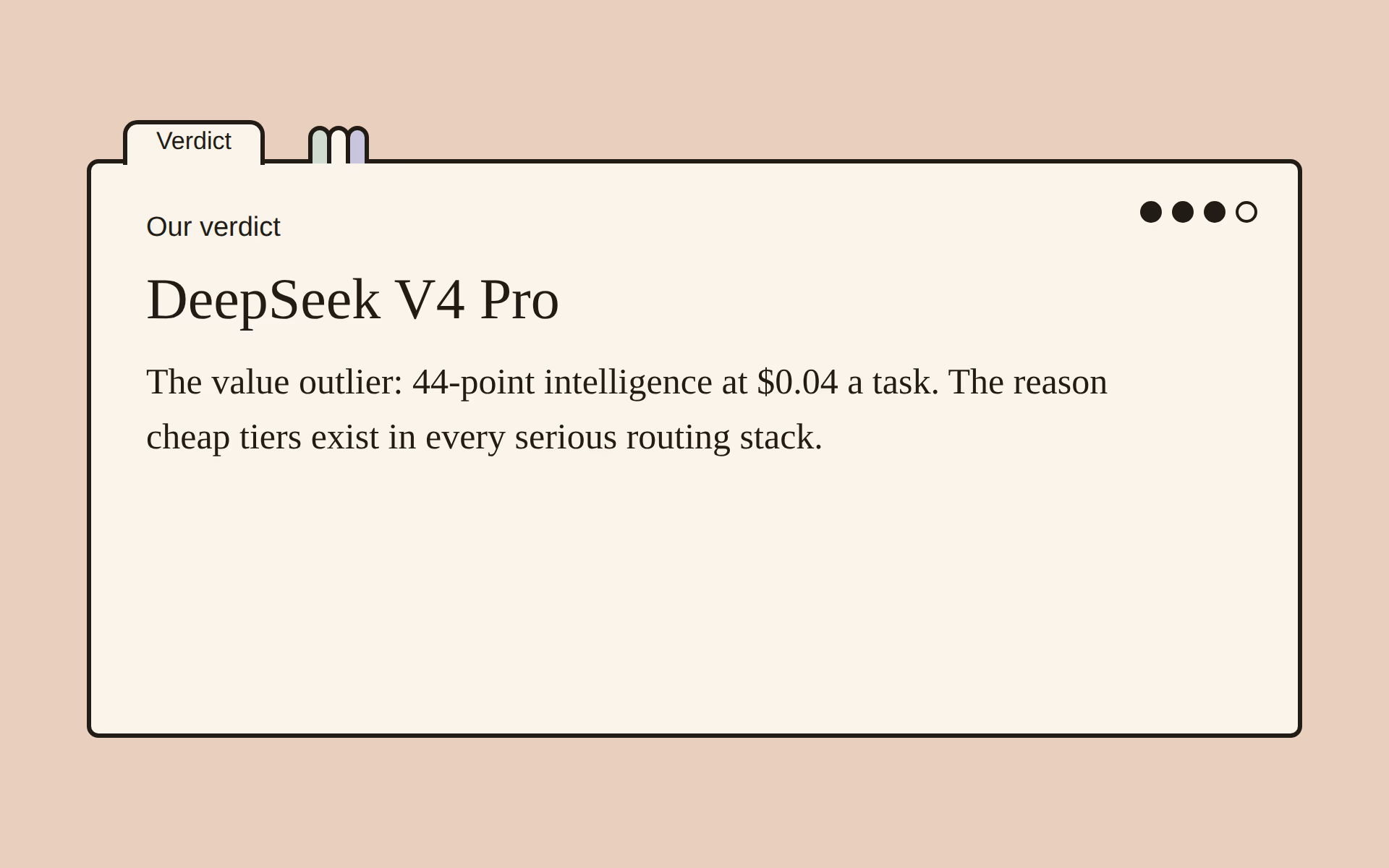
If your primary workload is hard agentic coding, DeepSeek V4 Pro is the wrong choice as a sole model: the FrontierSWE gap reported against GLM-5.2 is too wide to ignore, even allowing for its vendor source. And if you simply want the most capable open-weights model available, GLM-5.2's 51 on the Intelligence Index outranks V4-Pro's 44. On pure capability, V4-Pro finishes in the pack, not on the podium.
Judged on value, the verdict inverts. At $0.04 per Intelligence Index task, $0.435 per million input tokens and $0.87 per million output, V4-Pro delivers genuinely competent intelligence, level with Kimi K2.6 and MiniMax-M3, at a price no comparable model beats. Add the 1M-token context, the MIT licence and 15 live serving endpoints, and it earns its billing as the value outlier of 2026, with an AITR Value For Money score bettered only by MiMo-V2.5-Pro.
Our recommendation is to deploy it where it wins: as the bulk and routing tier of a multi-model stack, for long-context comprehension work, and for self-hosted deployments that need a permissive licence. Pair it with a stronger coding model for escalations, watch the 24 July deprecation date if you run legacy DeepSeek endpoints, and revisit the benchmarks as the preview matures. As a default workhorse, it is very hard to argue with at this price.
DeepSeek V4 Pro benchmark results
as reported in Z.ai's comparative model card
lower is better; cheapest serious model measured
site's own derivation
Artificial Analysis + vendor model cards, April–July 2026.
Where DeepSeek V4 Pro fits
Bulk document processing
Summarisation, extraction and classification across large corpora, where $0.04-per-task economics and $0.435-per-million input pricing make previously unaffordable volumes routine.
Whole-codebase comprehension
Loading an entire repository into the 1M-token window for navigation, explanation and cross-referencing, playing to the model's long-context strength rather than its weaker frontier coding.
Router default tier
Serving as the cheap, competent default in a multi-model stack, handling high-volume traffic while frontier models take only the escalations that genuinely need them.
Self-hosted private deployments
Running the MIT-licensed weights inside your own perimeter for data-residency or confidentiality requirements, with fine-tuning and commercial embedding permitted without restriction.
Long-running conversational agents
Extended assistant and support sessions where the Hybrid Attention Architecture's improved long-conversation memory and the 1M window keep context intact across hours of interaction.
Sources & further reading
DeepSeek Model Timeline
1M tokens context
Frequently Asked Questions
How much does DeepSeek V4 Pro cost to use?
API pricing is $0.435 per million input tokens and $0.87 per million output tokens. On Artificial Analysis's methodology that works out at $0.04 per Intelligence Index task, the cheapest serious model measured, tied with OpenAI's gpt-oss-120b.
Is DeepSeek V4 Pro good at coding?
It is competent rather than leading. It scores 47 on the Coding Agent Index in the Claude Code harness, and Z.ai's GLM-5.2 model card reports beating it on SWE-bench Pro (62.1 versus 55.4) and by a wide margin on FrontierSWE (74.4 versus 29.0). For hard agentic coding, pair it with a stronger model.
What is the difference between V4-Pro and V4-Flash?
Size. V4-Pro carries 1.6 trillion parameters while V4-Flash carries 284 billion. Both were released in the 24 April 2026 preview, both offer a 1M-token context window, and both ship under the same MIT licence.
Can I self-host DeepSeek V4 Pro?
Legally, yes, the MIT licence permits running, fine-tuning and commercial use without restriction. Practically, serving a 1.6-trillion-parameter model is a major infrastructure commitment, and most teams will prefer hosted access; 15 serving endpoints were live on OpenRouter in our 10 July 2026 snapshot.
What happens to deepseek-chat and deepseek-reasoner?
Both older endpoints were scheduled for deprecation on 24 July 2026, three months after the V4 preview launched. Anything built on them needs migrating to the V4 family, and teams with DeepSeek in production should treat that date as a hard deadline.
Specifications
AI Evaluation
Not the smartest open model - GLM-5.2 holds that - but nothing delivers this much capability for this little money. The natural default tier of any routed stack, and second on our Value For Money Index at 1,100.
Pros
- Cheapest serious model measured ($0.04/task)
- 1M context + MIT licence
- 15 live OpenRouter endpoints
Cons
- Well behind frontier on hard coding (FrontierSWE 29.0)
- Old endpoints deprecated 24 July 2026
- Preview generation still in motion
Related Tools
FLUX
FLUX, from Black Forest Labs, is a family of high-quality open and commercial image generation models prized for photorealism and prompt adherence. Widely integrated across third-party tools and APIs, it has become a default backbone for image generation.
Claude Opus 5.5
Claude Opus 5.5, launched 22 September 2026, is Anthropic's current Opus-line flagship, replacing Opus 5. It performs at roughly the level of Claude Fable 5.1 on most work while costing 40% less to run than Opus 5, at $4 input / $20 output per million tokens (both 20% down, cache reads cut 60% to $0.20). It leads on Terminal-Bench 4.0, GDPval-AA v2.1 and Humanity's Last Exam, and is the first Opus model to ship with Fable-5.1-class cybersecurity, biology and distillation safeguards.
Claude Sonnet 5.5
Claude Sonnet 5.5, released 28 September 2026, is the second model in Anthropic's Claude 5.5 family and the faster, lower-cost complement to Claude Opus 5.5. It keeps Sonnet 5's $2 input / $10 output per million tokens ($0.20 cache reads) while generating output over 30% faster, and scores 70.6% on Terminal-Bench 4.0, above Opus 5.5's 66.4%. It has a 1M-token context window, 128K max output, adaptive thinking, and is the first Sonnet with cyber and anti-distillation classifiers.