
Claude Fable 5
By Anthropic
Released: 2026-06-01
Claude Fable 5 is Anthropic's most intelligent generally available model and the first of its Mythos-class tier, positioned above Opus. It tops the Artificial Analysis Intelligence Index at 60, leads SWE-bench Pro at 80.3%, and dominates knowledge-work benchmarks on substance - at $2.75 per measured task, the highest in the field. It returned to sale on 1 July 2026 after a fortnight-long US export-control suspension.
Visit Claude Fable 5Highest measured intelligence
Fable 5 scores 60 on the Artificial Analysis Intelligence Index v4.1, the highest figure ever recorded, a single point ahead of GPT-5.6 Sol and four clear of Anthropic's own Opus 4.8.
Substance over style
On AA-Briefcase, the knowledge-work benchmark, Fable 5 leads outright: a 56% rubric score against GPT-5.6 Sol's 42%, and an Analytical Quality Elo of 1,764 versus 1,592. Sol produces prettier documents; Fable produces better ones.
A genuinely premium price
At $2.75 per Intelligence Index task (roughly 2.6 times GPT-5.6 Sol's $1.04), Fable 5 is the most expensive model in the field, and it sits at the bottom of our Value For Money Index with a score of 22.
Claude Fable 5 is Anthropic's most intelligent generally available model and the first occupant of its new Mythos-class tier, positioned above Opus. It tops the Artificial Analysis Intelligence Index, leads SWE-bench Pro, and dominates knowledge-work benchmarks on substance, while costing roughly 2.6 times as much per task as its nearest rival. Add a mid-June export-control suspension that removed it from sale entirely, and you have the most capable, most complicated, and most expensive model of 2026. This review weighs all three.
What Fable 5 is, and where it sits
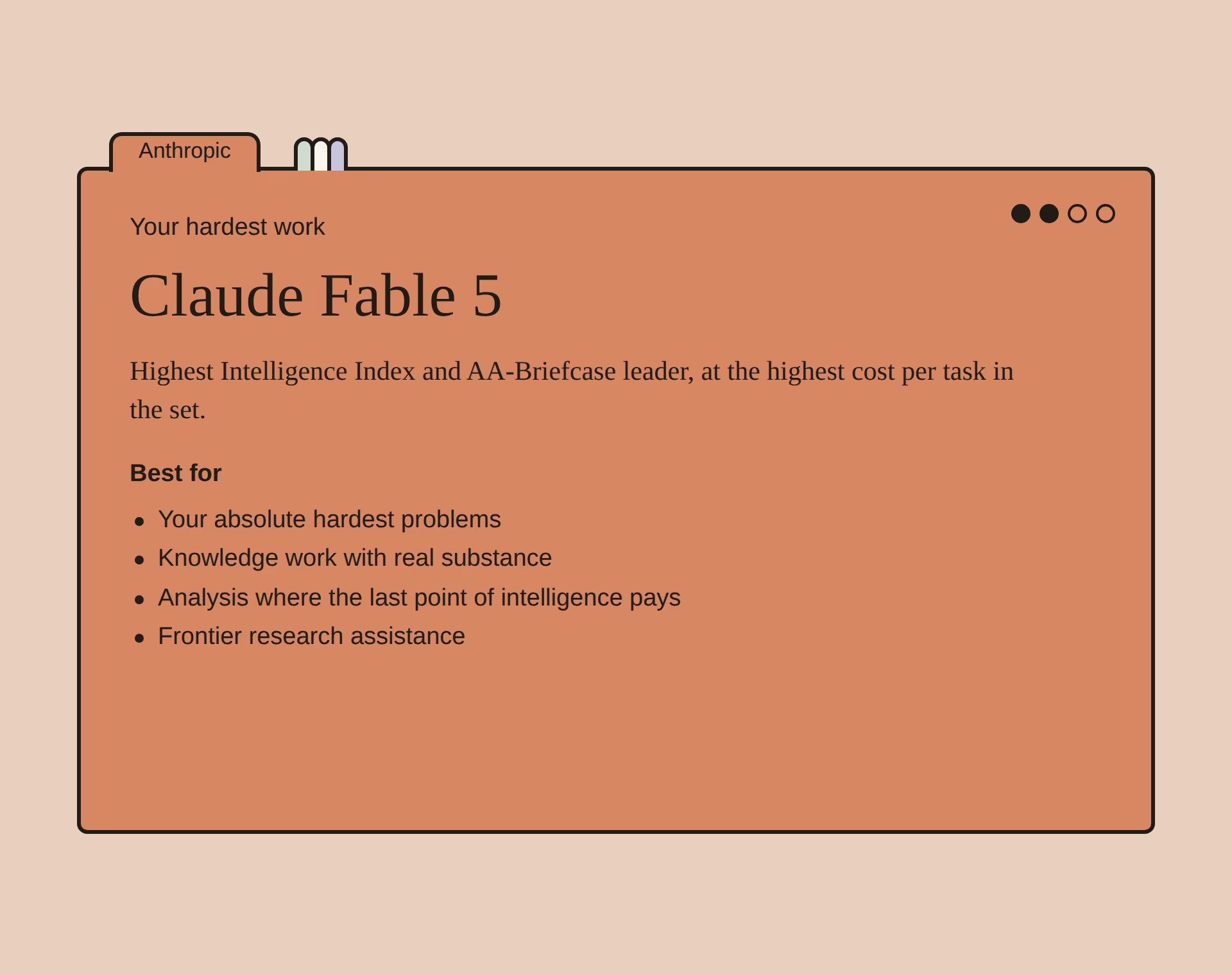
Claude Fable 5 arrived as Anthropic's most intelligent generally available model, and with it a structural change to the Claude range. For years, Opus marked the top of the line. Fable 5 sits above it, in what Anthropic calls the Mythos-class tier, a designation that signals this is not an incremental Opus successor but a separate class of model, positioned for work where the last point of capability is worth paying for. Opus 4.8 remains Anthropic's workhorse flagship; Fable 5 is the model you reach for when the workhorse is not enough.
The tier's internal structure matters more than the branding suggests. Fable 5 shares its underlying model with Claude Mythos 5, which is available only to approved organisations and ships without Fable's dual-use safety measures. If you have seen both names and wondered whether they are different models, they are not: the difference is who can access them and what safeguards sit around them. Fable 5 is the publicly purchasable version: the same intelligence, wrapped in protections designed to limit misuse in sensitive domains. Anthropic's own explainer sets out the split, and it is worth reading before choosing between them if your organisation qualifies for both.
On raw specification, Fable 5 offers a 1M-token context window and runs what Anthropic describes as adaptive reasoning, the model calibrates how hard it thinks to the task in front of it, and in its flagship configuration can fall back to Opus 4.8. That fallback arrangement is unusual enough to deserve its own discussion, and we give it one below.
One caveat on 'generally available': it carries a recent asterisk. Fable 5 was suspended from sale in mid-June 2026 under a US export-control order and only returned on 1 July. It was the highest-profile model outage of the year, and it colours any assessment of the model as a dependency. We cover the saga in full further down.
Capabilities: built for the long haul
Fable 5's design centre is long-horizon agentic work: tasks that unfold over many steps, many tools, and many minutes rather than a single prompt and reply. Where mid-tier models excel at quick turnaround, Fable 5 is tuned for the opposite shape of problem: planning a piece of work, executing it across an extended run, checking its own output, and course-correcting without a human steering every step. The benchmark results bear this out, with its strongest showings on exactly the agentic and knowledge-work evaluations that reward sustained, structured execution.
The most distinctive architectural feature is how it reasons. Fable 5 runs adaptive reasoning: rather than applying a fixed amount of deliberation to every request, it scales its thinking to the difficulty of the task. In the configuration Artificial Analysis measured for its Intelligence Index (maximum effort, with fallback) the model can also fall back to Opus 4.8. In practice this means the Fable 5 experience is really a two-model arrangement, with Anthropic's Opus-tier flagship standing behind the Mythos-class one. The headline Intelligence Index score of 60 was recorded in precisely this configuration, so buyers should understand that the number describes the system, fallback included, rather than a single model in isolation.
The 1M-token context window rounds out the picture. That is enough headroom to hold substantial codebases, long document sets, or the accumulated state of an extended agentic session without aggressive summarisation. For the long-horizon work Fable 5 is aimed at, context capacity is not a vanity figure: it is the difference between an agent that remembers what it did an hour ago and one that has to be reminded.
Taken together, the capability story is coherent: adaptive reasoning to spend compute where it matters, a fallback to keep work flowing, and a context window large enough to sustain genuinely long tasks. This is a model built for depth rather than throughput, and its pricing (as we shall see) reflects that.
The benchmark picture
Start with the headline. On the Artificial Analysis Intelligence Index v4.1, published on 9 July 2026, Fable 5 in its max configuration with Opus 4.8 fallback scores 60: the highest figure the index has ever measured. GPT-5.6 Sol sits at 59, Anthropic's own Opus 4.8 at 56, and Sonnet 5 at 53. A single point over Sol is a narrow margin, and honest readers should treat it as a statement that the two frontier labs are effectively level at the top, but the crown, for now, is Anthropic's.
Coding tells a more contested story. On the Coding Agent Index, measured in the Claude Code harness, Fable 5 scores 77, tying GPT-5.6 Terra and finishing one point behind Sol's 80, which was recorded in Codex. On SWE-bench Pro it posts 80.3%, the highest score of any usable model. Terminal-Bench 2.1 is the clear miss: Fable 5's 83.4% is strong in absolute terms, but GPT-5.6 Sol leads that benchmark at 88.8%, a gap too large to wave away.
Where Fable 5 is unambiguous is knowledge work. On AA-Briefcase, Artificial Analysis's benchmark for real-world professional deliverables, it leads the field outright: a rubric score of 56% against GPT-5.6 Sol's 42%, and an Analytical Quality Elo of 1,764 versus Sol's 1,592. Those are not benchmark-noise margins; they are the difference between a model that gets the analysis right and one that merely gets it plausible. The one dimension Sol wins is presentation: it holds the highest Presentation Elo, meaning its documents look better. Fable wins on substance.
The overall shape, then: the most intelligent model measured, the best knowledge worker by a distance, the strongest score on the hardest software-engineering benchmark, and a model that trades wins with OpenAI's best on agentic coding while conceding terminal-driven work. That is a genuine frontier profile: dominant in places, merely competitive in others, behind in one.
Where it sits on the Intelligence Index
Artificial Analysis Intelligence Index v4.1 across every scored frontier model: this model highlighted.
The fortnight it disappeared
In mid-June 2026, Fable 5 was suspended from sale under a US export-control order. For roughly two weeks, the most intelligent generally available model on the market was not, in fact, generally available. It was the highest-profile model outage of the year, not a technical failure, not a capacity crunch, but a regulatory removal of a frontier product from the shelf.
The suspension ended on 1 July 2026, when the order lifted and Fable 5 returned to sale. Anthropic's benchmark position was re-established almost immediately: the Artificial Analysis Intelligence Index figures that put it at the top of the field were published on 9 July, barely a week after its return. Whatever the interruption cost Anthropic commercially, it does not appear to have cost the model its standing.
For buyers, though, the episode is more than a curiosity. It established that a frontier model can be withdrawn from the market by regulatory action at short notice, and that even the vendor's flagship is not immune. Teams that had built Fable 5 into production workflows spent a fortnight discovering how good their fallback plans were. Some will have found the adaptive-reasoning architecture's Opus 4.8 fallback a useful precedent for their own contingency thinking; others will have learnt the lesson the hard way.
Our editorial view is that the saga should inform architecture, not vendor choice. The order lifted, the model returned, and there is no public indication of an ongoing restriction. But any organisation adopting a Mythos-class model, a tier that exists precisely because its capabilities are at the regulatory frontier, should assume that availability risk is now part of the deal, and design accordingly. A workflow that degrades gracefully to Opus 4.8 or another model is worth more than one that assumes Fable 5 will always be there.
Pricing, and the cost-per-task reality
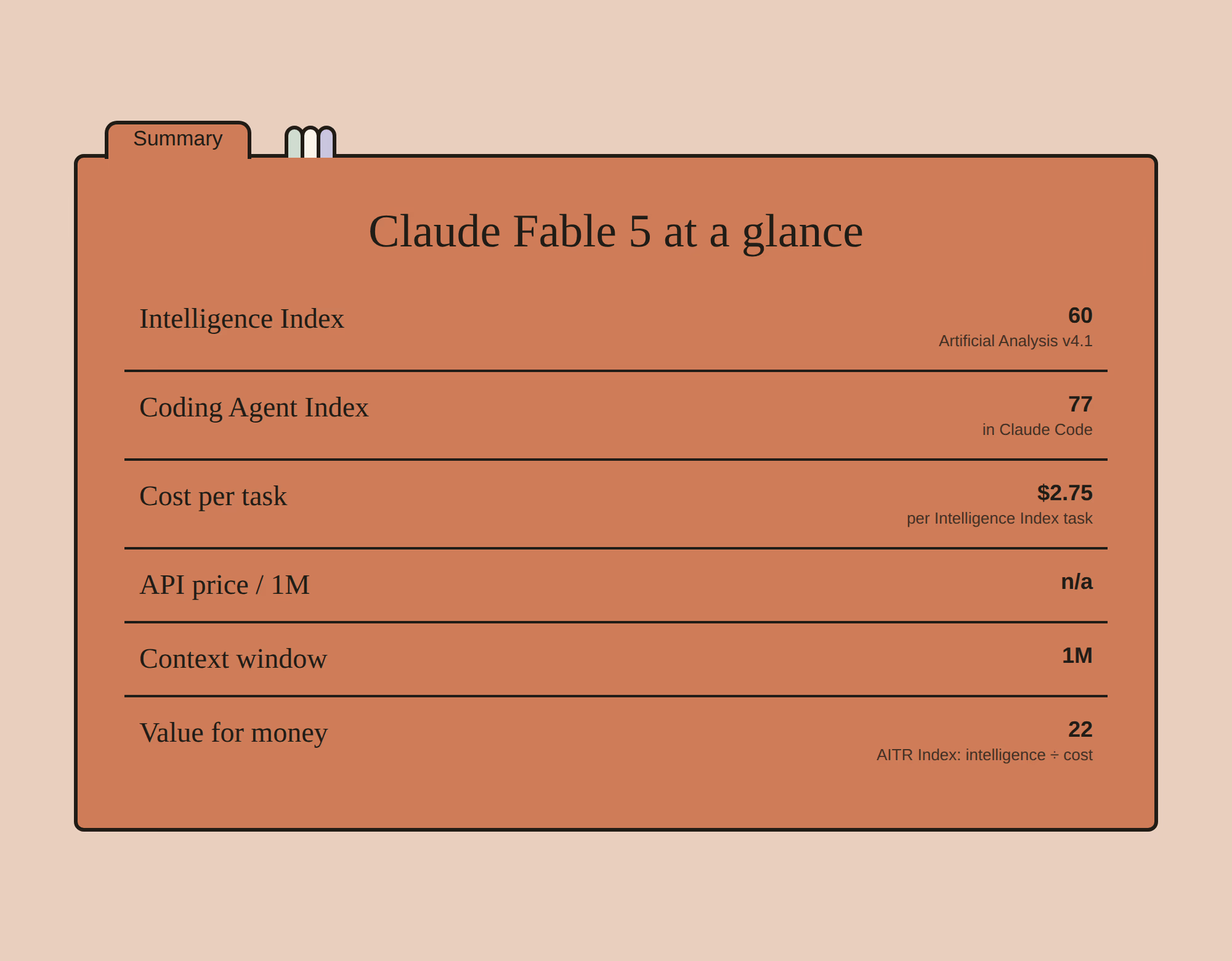
Fable 5's pricing is unusual in two respects. First, per-token API pricing is not published, which makes the traditional pounds-per-million-tokens comparison impossible and forces buyers towards a different lens. Second, on the lens that is available, it is expensive by any standard: Artificial Analysis measures its cost per Intelligence Index task at $2.75, the highest in the field and roughly 2.6 times GPT-5.6 Sol's $1.04.
Cost per task is, in fairness, the more honest way to price a reasoning model. A model that thinks longer burns more tokens per answer, so a low per-token rate can conceal a high per-answer bill. Fable 5's adaptive reasoning means its spend scales with task difficulty, and on the hard tasks that justify choosing it in the first place, that spend is substantial. The $2.75 figure captures what a unit of frontier-grade work actually costs, which is precisely what a per-token sticker price would obscure.
Our own AITR Value For Money Index, the site's metric dividing measured intelligence by cost per task, puts the trade-off starkly. Fable 5 scores 22, bottom of the field. For comparison, the index leader, MiMo-V2.5-Pro, scores 1,400. That is not a rounding difference; it is a statement that on a pure intelligence-per-dollar basis, Fable 5 is the worst buy we track. Nobody should adopt it for routine workloads on economic grounds.
The counter-argument is equally simple: value-for-money indices assume tasks are interchangeable, and at the frontier they are not. If the work is a complex analysis where Fable 5's 56% rubric score versus Sol's 42% is the difference between a usable deliverable and a rewrite, the extra $1.71 per task is trivially justified. The economics of Fable 5 only make sense for work where quality compounds, and make no sense anywhere else.
Cost per Intelligence Index task, in context
What a unit of benchmarked work actually costs across the field. Lower is better.
Limitations and honest caveats
Fable 5 is not uniformly the best model available, and the gaps are worth naming. On Terminal-Bench 2.1 it trails GPT-5.6 Sol by more than five points, 83.4% against 88.8%, and on the Coding Agent Index it finishes one point behind Sol's 80. Teams whose workloads are dominated by terminal-driven agentic coding have a legitimate case for looking elsewhere, or at least for benchmarking both models on their own tasks before committing.
Presentation is a second, subtler weakness. AA-Briefcase shows Sol holding the highest Presentation Elo: its documents simply look better out of the box. Fable 5 wins decisively on analytical substance, but if your deliverables go straight to clients without an editing pass, expect to spend some effort on polish that a Sol-based pipeline might not need.
The economics deserve restating as a caveat, not just a pricing note. With no published per-token pricing, budgeting is harder than with conventionally priced models, and the $2.75 cost per Intelligence Index task means high-volume use gets expensive quickly. A Value For Money Index score of 22, at the bottom of our table, is the quantified version of that warning.
Finally, two structural caveats. The export-control suspension of June 2026 demonstrated that availability is not guaranteed, and prudent adopters should architect for a repeat even if none comes. And the headline benchmark figures describe a specific configuration (max effort, with Opus 4.8 fallback) measured at a specific moment, 9 July 2026. Run the model differently and your results may differ; the frontier also moves quickly enough that a one-point lead over Sol should be read as parity, not supremacy.
Verdict: who should use it
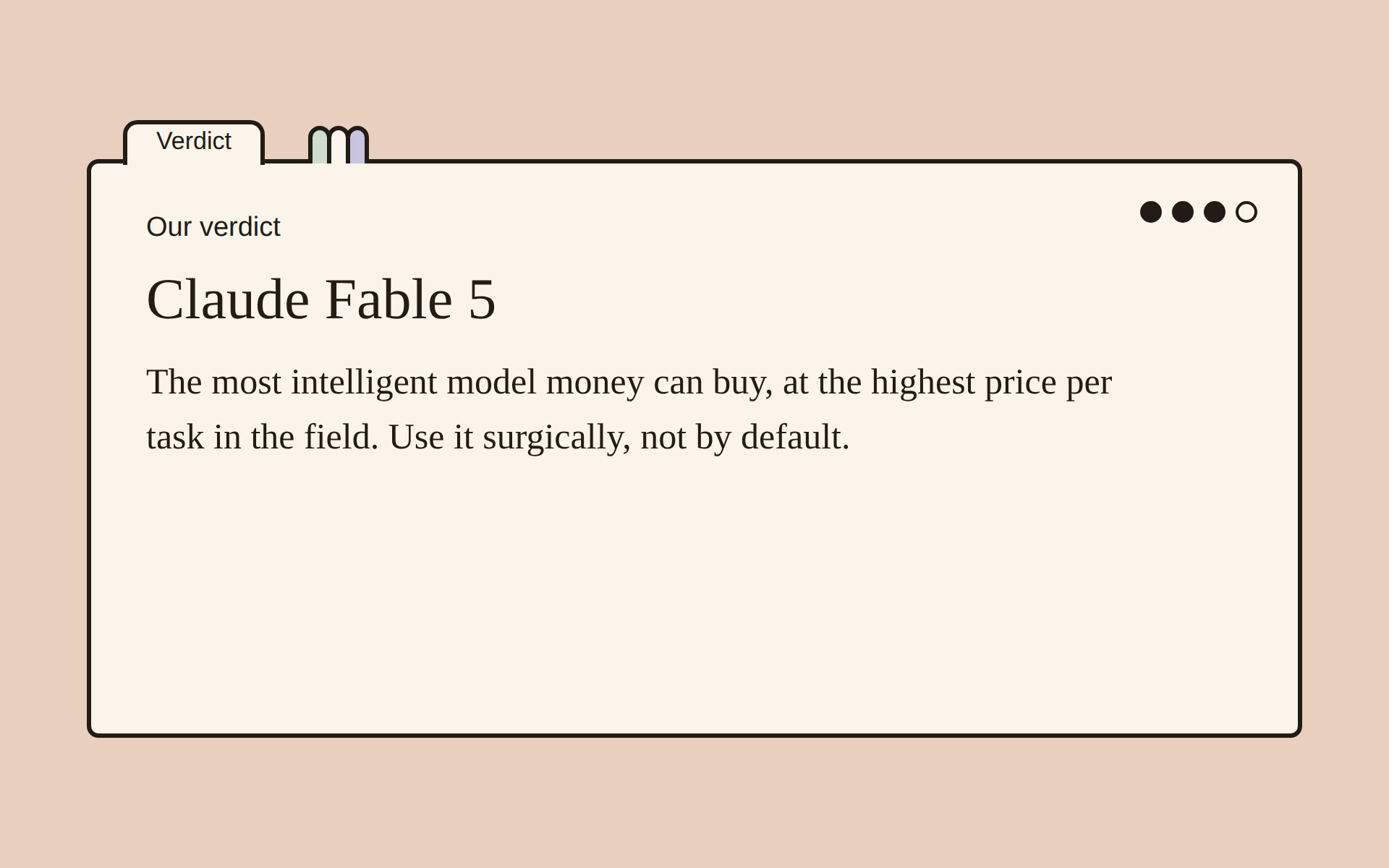
Claude Fable 5 is the most intelligent generally available model you can buy, by the numbers that exist to measure such things: an Intelligence Index of 60, the field's best SWE-bench Pro score at 80.3%, and a commanding lead on knowledge work. It is also the most expensive per task, the worst value-for-money proposition in our index, and a model that spent a fortnight of 2026 unavailable by government order. Both halves of that sentence are true, and any verdict has to hold them together.
It is the right choice for organisations whose hardest problems are worth $2.75 a task and considerably more: long-horizon agentic engineering, complex analysis, and professional deliverables where the gap between 56% and 42% on a quality rubric translates directly into money or risk. For that buyer, Fable 5 is not just defensible but obvious: nothing else measured produces work of this analytical quality, and the Opus 4.8 fallback gives the arrangement a resilience single-model deployments lack.
It is the wrong choice for high-volume, routine, or cost-sensitive workloads, where Sonnet 5, Opus 4.8, or a value leader like MiMo-V2.5-Pro will do the job at a fraction of the spend. It is also a questionable sole dependency: the export-control episode ended well, but it happened, and workflows built on Fable 5 should degrade gracefully without it.
Our recommendation is to use Fable 5 the way its own architecture suggests: as the top of a tiered system, reserved for the work that genuinely needs it, with cheaper models handling everything else. Deployed that way, it is the best model of 2026. Deployed indiscriminately, it is merely the most expensive.
- Choose it for: frontier reasoning, long-horizon agents, analysis-heavy knowledge work
- Avoid it for: high-volume pipelines, cost-sensitive workloads, terminal-heavy coding agents
- Architect for it: route routine work to cheaper models and keep a fallback path
Claude Fable 5: the scores that matter
Artificial Analysis Intelligence Index v4.1: highest ever measured; GPT-5.6 Sol 59, Opus 4.8 56, Sonnet 5 53
Measured in the Claude Code harness; ties GPT-5.6 Terra, one point behind Sol's 80 (in Codex)
Highest score of any usable model
GPT-5.6 Sol leads this benchmark at 88.8%
Figures are drawn from Artificial Analysis and lab-reported results, July 2026. Intelligence Index measured on v4.1 (9 July 2026) in the max configuration with Opus 4.8 fallback.
Where Claude Fable 5 fits
Long-horizon agentic engineering
Extended autonomous runs (multi-step refactors, migrations, and build-out work) are Fable 5's design centre, backed by adaptive reasoning, an Opus 4.8 fallback, and a 1M-token context window that sustains state across long sessions.
Hard software-engineering tasks
With the highest SWE-bench Pro score of any usable model at 80.3% and a Coding Agent Index of 77 in the Claude Code harness, Fable 5 is a top-tier choice for the most difficult real-repository engineering work.
Analysis-heavy knowledge work
Fable 5 leads AA-Briefcase outright (a 56% rubric score and 1,764 Analytical Quality Elo), making it the strongest measured model for reports, financial analysis, and professional deliverables where substance matters more than polish.
Whole-codebase and long-document reasoning
The 1M-token context window lets Fable 5 hold large codebases or extensive document sets in a single session, avoiding the lossy summarisation that undermines long-context work on smaller windows.
Tiered frontier deployments
Used as the top layer of a routed system (with Sonnet 5 or Opus 4.8 handling routine traffic), Fable 5 delivers frontier quality where it counts while containing its $2.75 per-task cost.
Sources & further reading
Anthropic Model Timeline
1M tokens context
1M tokens context
1M tokens context
1M tokens context
Long-context context
200k tokens context
200k tokens context
200k tokens context
1,000k tokens context
200k tokens context
200k tokens context
1,000k tokens context
200k tokens context
200k tokens context
200k tokens context
200k tokens context
200k tokens context
Frequently Asked Questions
What is the difference between Claude Fable 5 and Claude Mythos 5?
They share the same underlying model. Claude Mythos 5 is available only to approved organisations and ships without Fable 5's dual-use safety measures; Fable 5 is the generally available version with those safeguards in place. Capability is the same, access and safety wrapping differ.
Why was Claude Fable 5 suspended in June 2026?
It was suspended from sale in mid-June 2026 under a US export-control order, the highest-profile model outage of the year. The order lifted and the model returned to sale on 1 July 2026. There is no public indication of an ongoing restriction, but the episode is a reminder to build fallback paths into production workflows.
How much does Claude Fable 5 cost?
Anthropic has not published per-token API pricing. The most useful figure is Artificial Analysis's measured cost per Intelligence Index task: $2.75, the highest in the field and roughly 2.6 times GPT-5.6 Sol's $1.04. On our Value For Money Index it scores 22, bottom of the table, so it only makes economic sense for work where quality genuinely compounds.
Is Fable 5 the best coding model?
It depends on the workload. Fable 5 posts the highest SWE-bench Pro score of any usable model at 80.3%, and its Coding Agent Index of 77 ties GPT-5.6 Terra, but Sol scores 80 on that index and leads Terminal-Bench 2.1 at 88.8% against Fable's 83.4%. For terminal-heavy agentic coding, Sol has the edge; for hard repository-level engineering, Fable 5 does.
What is the Opus 4.8 fallback?
Fable 5 runs adaptive reasoning that can fall back to Claude Opus 4.8, Anthropic's Opus-tier flagship. The headline Intelligence Index score of 60 was measured in this configuration, max effort, with fallback, so the benchmark figure describes the two-model arrangement rather than Fable 5 in isolation.
Specifications
AI Evaluation
The most intelligent model money can buy, priced accordingly. Use it surgically at the top of a routed stack - the analysis quality is unmatched, but the economics only work where quality compounds.
Pros
- Highest measured intelligence (Index 60)
- Leads SWE-bench Pro and AA-Briefcase
- Opus 4.8 fallback for resilience
Cons
- $2.75 per task - the field's most expensive
- No published per-token pricing
- June export-control suspension showed availability risk
Related Tools
GitHub Copilot
GitHub Copilot is Microsoft's AI pair programmer, built into VS Code, JetBrains IDEs and GitHub.com. It offers inline code completion, a chat interface, an autonomous coding agent and support for multiple underlying models including GPT and Claude, making it one of the most widely deployed AI coding assistants.
Zapier
Zapier is the most widely used no-code automation platform, connecting thousands of apps through triggers and actions. Its AI features include Zapier Agents, which build and run autonomous multi-step workflows from a natural-language description, and AI-powered steps inside existing Zaps for summarisation, extraction and classification.
Perplexity Comet
Comet is Perplexity's AI-native web browser, built around an agentic assistant that can research, summarise, compare and take actions across tabs on a user's behalf, alongside Perplexity's own answer-engine search built in. It positions Perplexity as a full alternative to Chrome rather than just a search product.